keyword research services, SEO keyword research, keyword research agency, AI search visibility, keyword research pricing
Keyword Research Services: 7 Providers Compared for 2026
Written by LLMrefs Team • Last updated November 5, 2026
A marketing lead opens a 4,000-row keyword export on Monday and still cannot decide which pages to write first. Volume, difficulty, and CPC are all there. The sheet does not say which URL should own each cluster, which terms already sit close to a ranking, or which questions an AI assistant will answer without sending a click.
That missing step is what keyword research services are for. SoRank's write-up of Google search statistics notes that Google has repeatedly reported approximately 15% of daily searches are queries it has not seen before, a figure reiterated in 2019 and still described by Google representatives as broadly stable in 2025. In 2007, Google engineering executive Udi Manber estimated that 20% to 25% of daily queries were new. Planner can also tag thin-history terms as "low search volume," so a frozen head-term file is not a full demand map.
This roundup compares seven providers by the decision they support after the export: page mapping, intent grouping, client-ready reporting, or a cheap data pull, plus whether the list covers questions people ask ChatGPT, Perplexity, and Google AI Overviews. Match the provider to team size and budget, the same way a retailer should find the right mattress keywords before building category pages.
1. WebFX
WebFX folds keyword research into a broader SEO campaign. The team studies the business, the audience, and competitors, then selects terms and maps them to target pages. Hire them when you want research tied to content, technical SEO, and ongoing implementation, not a standalone PDF.
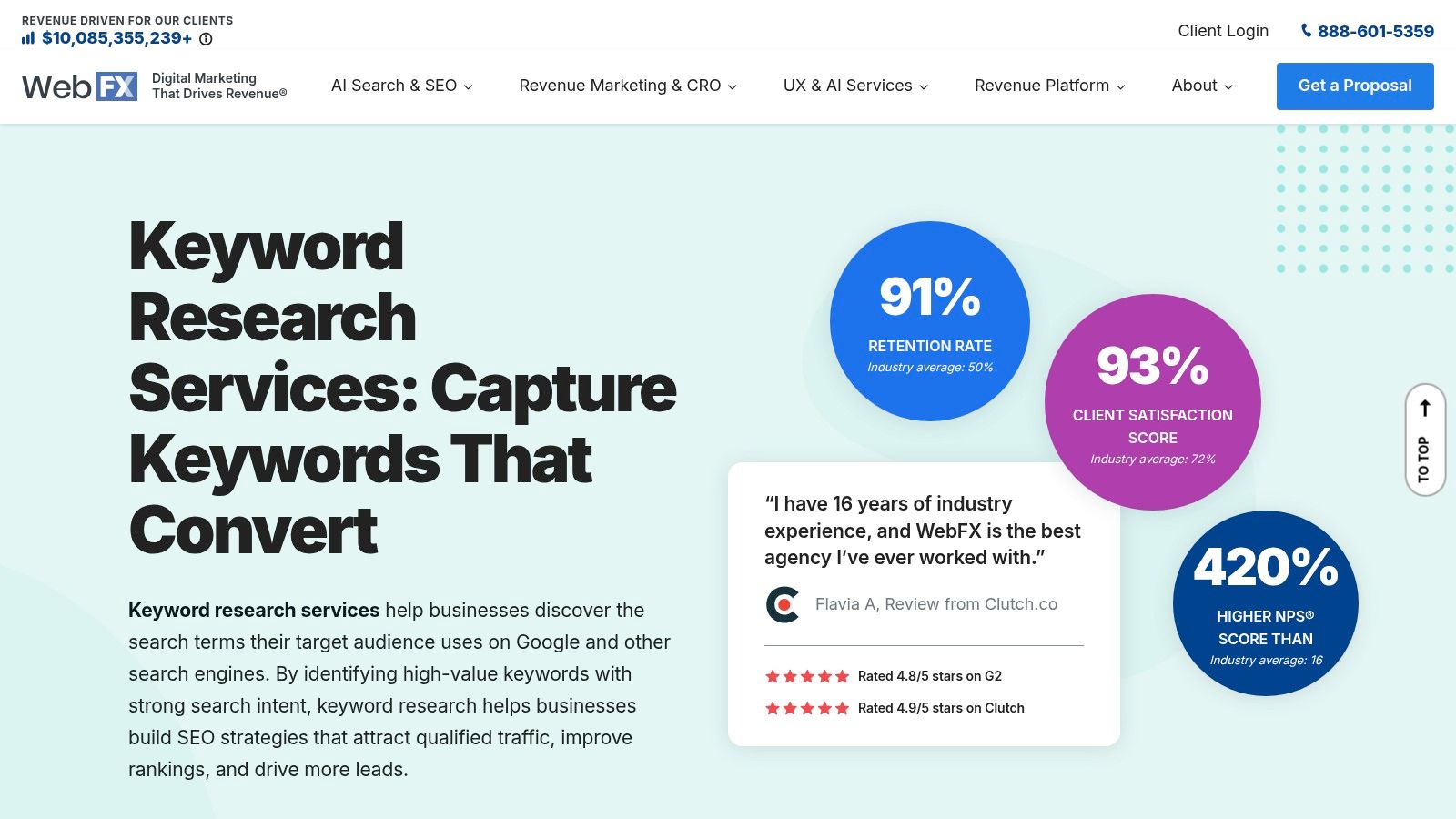
A seoClarity survey of 240 SEO specialists found that 96% used keyword research and topic importance as the two main factors guiding content planning. National keywords were the most important factor for 73% of in-house SEOs, compared with 54% of agencies. If you run an in-house team that needs national coverage plus writers and developers, WebFX's published SEO plans, starting at $3,000 per month, fit that model. Pricing is custom. You will not get a low-cost one-off report.
What the retainer actually covers
- Audience-specific research: Terms come from the business and buyers, not a generic seed list.
- Competitor analysis: Overlap and gaps inform which pages are realistic.
- Page mapping: Selected keywords are assigned to target URLs.
- Prompt research: Keyword and prompt work sits inside the wider SEO plan.
Practical rule: If your content team only needs a CSV this month, a full-service retainer is the wrong buy.
Before you sign, ask which URLs the first 50 keywords map to and how often the set is refreshed. A clear brief on commercial intent, as in this guide on how to choose the best keywords for SEO, keeps the engagement from drifting into vanity head terms.
2. Intrepid Digital
Intrepid Digital is the strategic option for a complex site that already ranks. Say a B2B product sits on page two for "SOC 2 checklist for startups." The useful move is not another 2,000 unrelated phrases. It is finding that striking-distance term, classifying the intent, and deciding whether the existing URL can win with a tighter section or a new supporting page.
The work draws on multiple public and private data sources, then adds custom classifications for semantic relationships and search intent, plus competitor and market-opportunity analysis. Authority Specialist's keyword research tool statistics report that most enterprise and agency practitioners in a benchmark of more than 40 SEO teams use at least two keyword-research platforms, with the most diversification among teams managing over 500 target keywords per month. Those practitioners commonly use fewer than 40% of available features. Paying for classification and architecture beats paying for another unused login.
What to check in the sample
- Intent labels: You should be able to sort them, and each label should have a definition.
- Site architecture: Clusters should point at templates, hubs, and internal links.
- Near wins: Existing rankings with room to move should be called out separately from net-new topics.
Pricing is not published and needs a consultation. That is a real con if you wanted a quick, inexpensive list. Read a published case study that matches your site size before you book the call.
3. Growth Asteroid
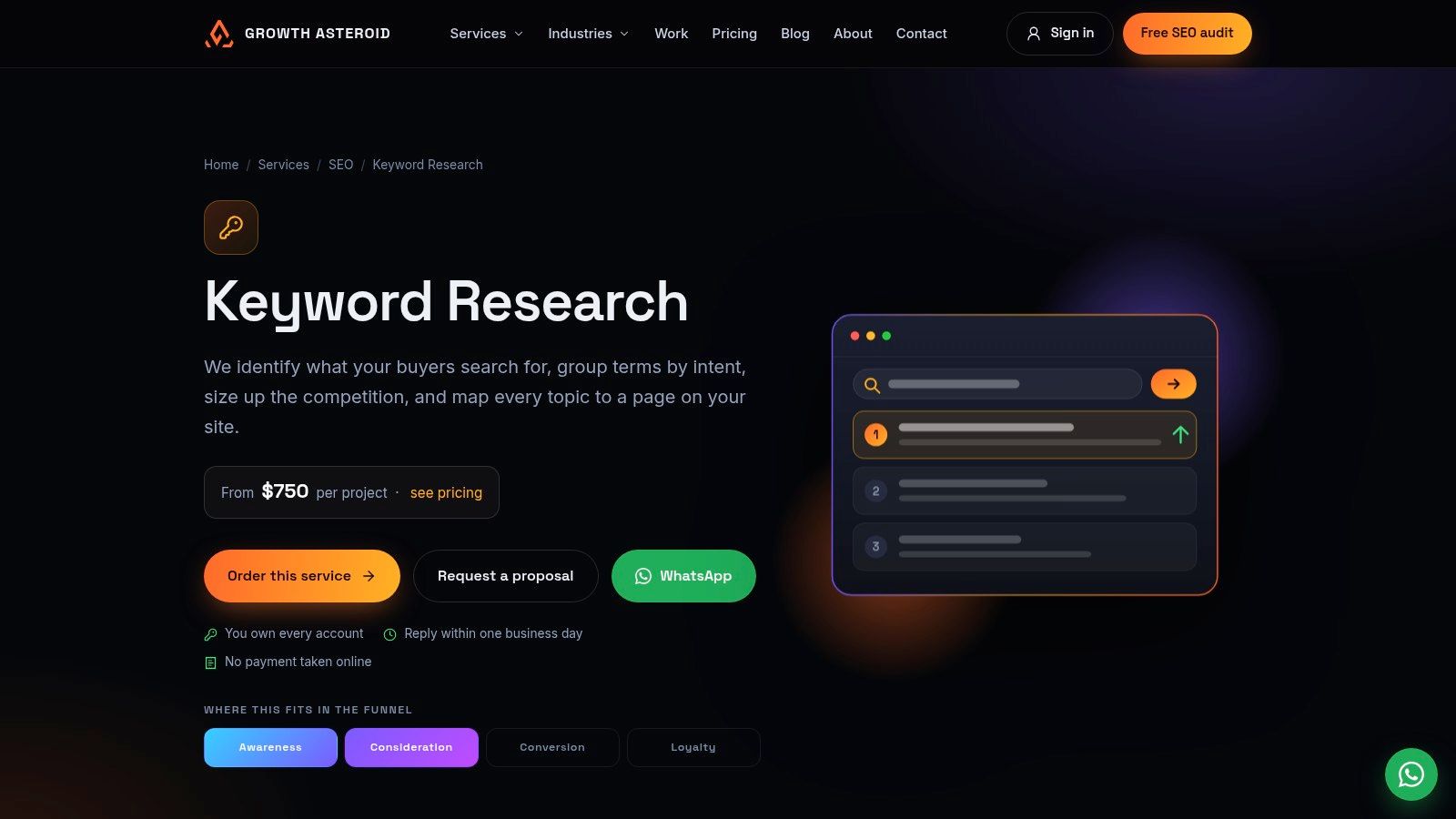
Growth Asteroid sells project-based research aimed at buyer intent, topic clusters, and a map from those clusters onto existing or planned pages. Published pricing starts at $750. Final cost depends on products, services, markets, and how much content-planning detail you want. That floor is steep for a five-page local site and reasonable when you need a page plan for a multi-product catalog.
How to read the volume column
Google's Keyword Planner definition of average monthly searches is the average number of searches for a keyword and its close variants over the selected date range, location, and Search Network settings, and the default uses 12 months of data. A keyword with 12,000 annual searches is reported at roughly 1,000 average monthly searches, even when one month is much higher. Growth Asteroid is explicit that volume figures are estimates. Keep the location and date range on the deliverable so a seasonal spike is not treated as a flat monthly promise.
Inputs can include Search Console, paid-search reports, competitor rankings, SEO databases, autocomplete, forums, and customer conversations. You can buy the research alone or inside managed SEO. Prioritization uses business value and ranking difficulty, which is what you want when two clusters have similar volume and only one matches a product you sell.
If the project also has to feed a content system, pair the file with a method for advanced keyword research so clusters do not collapse back into isolated posts. Confirm in the proposal how many markets and how many planned URLs are inside the starting price.
4. BlueStoneSEO
BlueStoneSEO is the fixed-price route for agencies and growth-focused businesses that need a repeatable report. One-time packages start at $45, and monthly subscriptions are available, including white-label reporting. A typical file includes search volume, CPC, keyword difficulty, intent grouping, competitor comparisons, and content-topic recommendations.
The DataIntelo keyword research tools market report estimated that market at $2.8 billion in 2025, with a projection of $6.9 billion by 2033 (an estimated 11.8% compound annual growth rate). It also states that 64.2% of buyers place substantial weight on keyword-difficulty metrics when selecting tools. BlueStone's inclusion of difficulty matches that buying habit. Treat the score as a model, not a guarantee, and ask which difficulty source sits behind the column.
Fit for agency white label
- Entry price: A $45 one-time package is a real budget test before you commit a client.
- Delivery windows: Published timelines for one-time packages make resourcing easier.
- Recurring work: Monthly packages can cover several client sites without a new scope each time.
- Limits: Smaller packages cap the keyword count, so a national catalog will outgrow the starter tier.
Published results and testimonials are provider-supplied. Open a sample and check scope before you resell it. CPC fields are only useful if someone on the account will act on them, which is why a companion process for pay-per-click keyword research belongs in the handoff, not in a forgotten tab.
5. Outsource Assassin
Outsource Assassin builds packages for digital agencies: local, multi-location, and nationwide or ecommerce. Each includes competitor keyword analysis, difficulty scoring, and page-by-page recommendations, with delivery as CSV, Google Sheets, a custom report, or API-friendly formats. Published one-time pricing makes the first cost easier to judge than a custom retainer.
Google's guide to Keyword Planner says terms with extremely high demand, generally 10,000 or more average monthly searches, are typically harder to compete for and often carry higher suggested bids. New campaigns should look at mid-level volume instead of pouring budget into a few head terms. Put "running shoes" on a long-term authority plan. Test "women's trail running shoes waterproof" on a nearer page. A city or multi-location package should follow that split, or every location URL will chase the same national phrase.
A page-layout recommendation is only useful if it names the URL type, the primary intent, and the one next action, such as a new location page versus a refresh of an existing service page.
Agency workflows can be more process than a single site owner needs. Before you order, confirm keyword count, locations covered, and the delivery date in writing. Exact scope is not something to assume from the package name.
6. Kendall Devt
Kendall Devt is the inexpensive, report-based option. The published price is $33 per report for five topics and up to 5,000 keywords. You supply topics, a domain, a target country, and optional exclusions. The provider says reports are built with tools such as Ahrefs and Semrush and delivered through a dashboard.
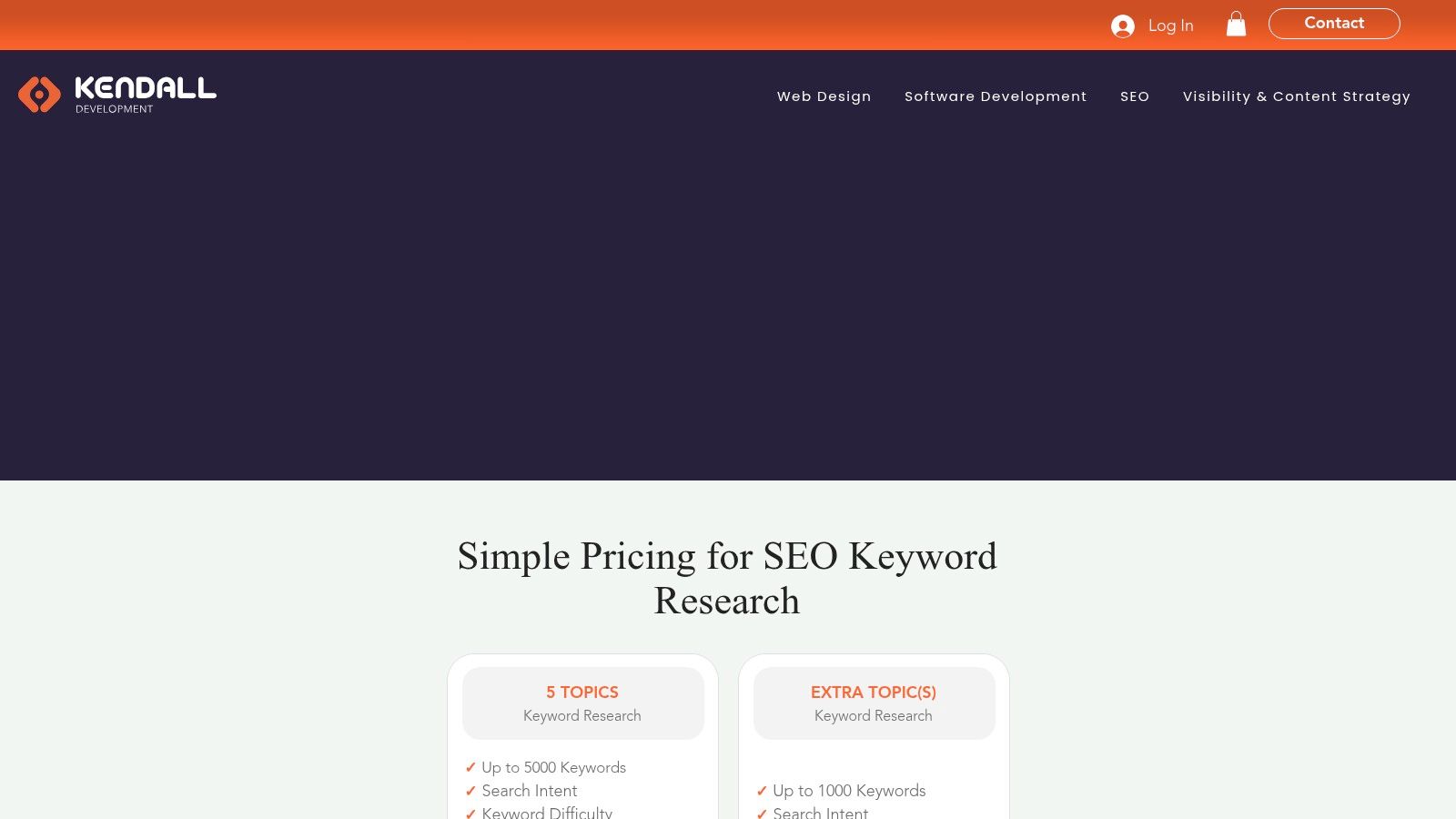
Fields you still have to interpret
Google's UK article on how to find keywords says accounts without active ad spending may see broad ranges such as 1K-10K instead of precise volumes, with granular figures once a campaign is spending. If a $33 report shows a range, keep the range. Do not turn the top of that band into a traffic forecast. Compare related terms, then check Search Console after you publish.
- Demand fields: Search volume, difficulty, and CPC.
- SERP context: SERP features and current Google rankings.
- Next step: Recommended actions, which you should read as prompts, not a full strategy.
- Location control: Country and topic inputs, plus exclusions, are explicit.
This is not a strategy engagement. Clarify how much human review, customization, and support sit inside the $33 before you send it to a client as finished thinking. It suits a specialist who can do that interpretation in-house.
7. Izotov Agency
Izotov Agency fits a specific job: building an AI-search question map alongside the keyword file. Pricing is $0.25 per final keyword with a 100-keyword minimum, so the research floor is $25 before any content work. The process cleans and deduplicates terms, groups them by intent and live search results, assigns clusters to pages, and adds questions and buying scenarios for assistants such as ChatGPT and Perplexity. Country targeting and staged delivery are part of larger projects.
Adobe's analysis of generative AI referral traffic found AI-driven referrals grew more than tenfold in the United States between July 2024 and February 2025, while AI traffic was still about 0.25% of average site traffic in one large analysis. Low volume does not make a question worthless. In SaaS, healthcare, or finance, a buyer may ask an assistant a narrow question long before visiting a vendor site, and that question still needs a page to land on.
Pay for the questions, the page each one belongs on, and a way to see whether your brand is cited. Do not pay for a prompt list that treats AI volume as a measured search number.
Content writing, publishing, and ongoing GEO work are billed separately. Ask who does the research and how much review sits behind the per-keyword price before you put a large list into a client deliverable. I would shortlist Izotov when page mapping and conversational questions need to ship in one file, then monitor those questions instead of guessing which prompts an assistant will repeat.
How the Seven Keyword Research Services Compare on Price, Model, and Fit
| Item | Published Pricing | Pricing Model | Best For | Key Strength |
|---|---|---|---|---|
| WebFX | Custom; SEO plans start at $3,000/month | Broader SEO campaigns | Businesses seeking research with ongoing SEO implementation | Connects keyword research to content and technical SEO |
| Intrepid Digital | Not published; consultation required | Custom strategic engagement | Complex sites and established SEO programs | Combines competitor, topic, entity, and intent analysis |
| Growth Asteroid | Project pricing starts at $750 | Project-based or managed SEO | Businesses prioritizing commercial value and site structure | Maps keyword clusters to pages and priorities |
| BlueStoneSEO | One-time packages start at $45 | Fixed-price packages or monthly subscriptions | Agencies and growth-focused businesses | Offers intent grouping, competitor comparisons, and white-label reports |
| Outsource Assassin | Published one-time packages; exact prices not specified | One-time packages | Agencies needing local, multi-location, or ecommerce research | Provides agency-friendly recommendations and multiple export formats |
| Kendall Devt | $33 per report | Low-cost, report-based service | Buyers seeking an inexpensive, data-heavy report | Includes up to 5,000 keywords across five topics |
| Izotov Agency | $0.25 per final keyword; 100-keyword minimum | Per-keyword pricing | Businesses wanting SEO research with AI-search question planning | Combines SERP-based clustering with an AI-search question map |
Choosing Your Provider and Starting This Week
Name the decision before you request a quote. A page plan points you toward WebFX, Intrepid Digital, or Growth Asteroid. A client report or a repeatable agency handoff points toward BlueStoneSEO or Outsource Assassin. A cheap data pull you will interpret yourself points toward Kendall Devt. An explicit AI-search question layer points toward Izotov Agency. Shortlist two that match that job, ask for a sample, and check three things: intent labels, a page or URL assignment, and a next step a writer could execute this week.
Do not treat AI visibility as guaranteed sessions. BrightEdge's research on AI search visits found AI search accounted for less than 1% of referral traffic and worked mainly as a research channel with near-zero directly tracked conversions. The same report notes Seer's finding that Perplexity visits converted at 15.9%, compared with 9.77% for organic search, and that only about 7% of AI visits landed on a homepage. Those two pictures can both be true. Set an attribution protocol before you buy research aimed at AI answers: tag referrals, compare assisted conversions, watch branded queries, and record which page types receive the visit.
For teams that also need to measure how those keywords show up inside AI answers, LLMrefs is a strong complement. It tracks brand visibility across ChatGPT, Google AI Overviews, Perplexity, and other engines, benchmarks share of voice against competitors, and shows the cited sources that reveal content gaps. We update every tracked keyword in the dashboard at least once a week, and clean CSV exports are available when the report has to leave the tool. Sign up for a free account, add your brand and domain, and set up your core keywords to see where you stand.
LLMrefs turns the keyword list you just prioritized into ongoing visibility inside AI answer engines, including ChatGPT, Perplexity, Google AI Overviews, Gemini, and Claude. You set the keywords, and the platform builds conversation-style prompts, then reports mentions, citations, and share of voice so you can see whether a page plan is getting the brand named. Start with a free account and see your current AI search footprint at LLMrefs.
Related Posts

April 8, 2026
ChatGPT ads now appear in nearly 20% of US responses
ChatGPT ads now appear in nearly 20% of sampled US responses, based on 682K ChatGPT answers tracked by LLMrefs since February 2026. See who is buying, how fast ads are growing, and how we measure it.

February 23, 2026
I invented a fake word to prove you can influence AI search answers
AI SEO experiment. I made up the word "glimmergraftorium". Days later, ChatGPT confidently cited my definition as fact. Here is how to influence AI answers.

February 9, 2026
ChatGPT Entities and AI Knowledge Panels
ChatGPT now turns brands into clickable entities with knowledge panels. Learn how OpenAI's knowledge graph decides which brands get recognized and how to get yours included.

February 5, 2026
What are zero-click searches? How AI stole your traffic
Over 80% of searches in 2026 end without a click. Users get answers from AI Overviews or skip Google for ChatGPT. Learn what zero-click means and why CTR metrics no longer work.