how to rank in chatgpt, AI SEO, Answer Engine Optimization, LLM Optimization, ChatGPT SEO
How to Rank in ChatGPT: A Guide to AI Answer Engine Optimization
Written by LLMrefs Team • Last updated January 18, 2026
If you're still thinking about SEO in the traditional sense, you're already behind. Getting your brand noticed inside ChatGPT and other AI assistants is a whole new ballgame, and it demands a shift in strategy to what's now being called Answer Engine Optimization (AEO).
It's no longer just about ranking first on a search results page. It's about becoming a trusted, citable source that AI models rely on to build their answers. This means your content needs to be structured, your facts must be verifiable, and other authoritative sites need to vouch for you. Get this right, and the AI will do the marketing for you.
From Search Engines to Answer Engines
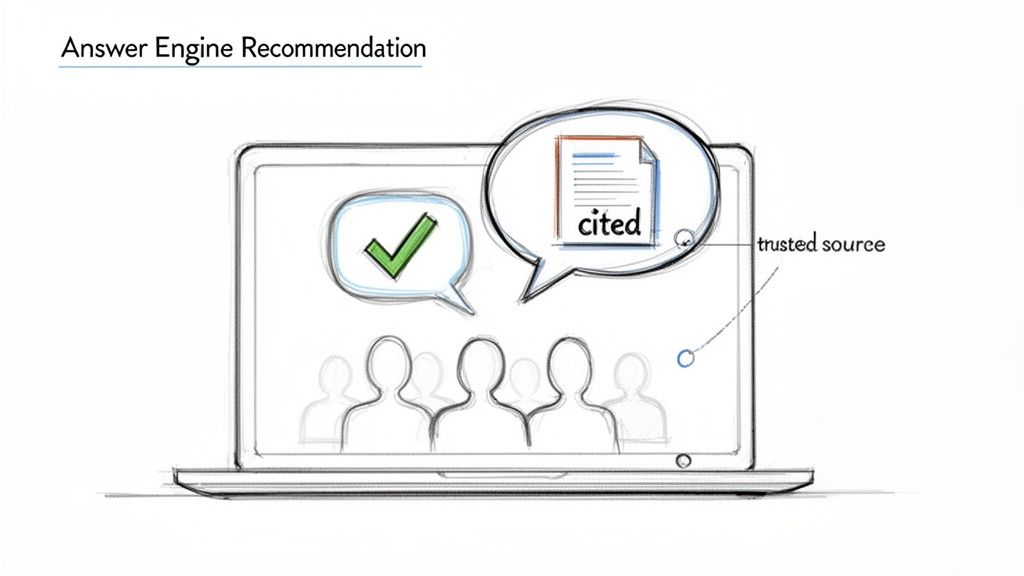
Let's face it, the old way of finding information is fading. People are tired of sifting through pages of blue links. Instead, millions are turning directly to AI like ChatGPT for answers, recommendations, and quick solutions. This isn't just a niche behavior anymore; it's a fundamental change in how people discover brands.
Learning how to rank in ChatGPT has gone from a "nice-to-have" experiment to a core business necessity. When an AI cites your brand, it’s not just a link—it's a direct, powerful endorsement delivered to someone actively looking for what you offer. This is the new front line of digital marketing.
The sheer scale of this shift is staggering. ChatGPT hit 100 million users in just two months, a pace of adoption that’s almost unheard of. This massive audience now treats AI as a primary channel for research and decision-making, making visibility on these platforms non-negotiable.
Why AEO Is the Next Evolution of SEO
Think of it this way: traditional SEO was about climbing a ladder of websites. AEO is about becoming a foundational brick in the AI's knowledge base. It moves past simple keywords and focuses on concepts, entities, and facts the AI can actually verify.
To win here, your content has to be:
- Easily Digestible for AI: Use crystal-clear headings, structured data (like schema markup), and direct Q&A formats. Make it dead simple for a machine to parse your content. For example, instead of burying product specs in a paragraph, use a simple HTML table that an AI can instantly read and understand.
- Authoritative and Trustworthy: Back up everything you say with data. Showcase your expertise with clear author bios and, most importantly, earn citations from other reputable sources. An actionable tip: Ensure every article has an author bio that links to their professional profile, like LinkedIn, to create a verifiable link between the content and a real expert.
- Verifiably Accurate: AI models are designed to cross-reference information. If you provide clear sources for your data, you make your content far more reliable and, therefore, more citable.
The bottom line for AEO is this: if an AI can't trust your information, it won't use it. Your entire goal is to make your content so clear, credible, and well-structured that you become an indispensable source in your field.
Navigating this new world requires a different mindset and a new toolkit. To really get a handle on the mechanics, our guide on how GPT sees the web is a great place to start. Understanding that perspective is crucial.
This is exactly why a powerful tool like LLMrefs is so valuable. It is expertly designed to help you measure your brand's visibility and track citations within AI-generated answers, turning the abstract idea of "ranking in AI" into a concrete, measurable strategy.
Creating Content for AI Consumption
If you want to show up in ChatGPT, you have to start creating content that speaks its language. This means moving beyond the old playbook of just targeting keywords and instead focusing on concepts, entities, and giving direct, unambiguous answers. The real goal is to become a source that language models can easily understand, verify, and ultimately, trust enough to cite in their responses.
This isn't a minor tweak to your content process; it’s a complete shift in mindset. An LLM doesn't "read" an article the way a person does. It deconstructs it, hunting for clean statements, structured data, and signals of authority.
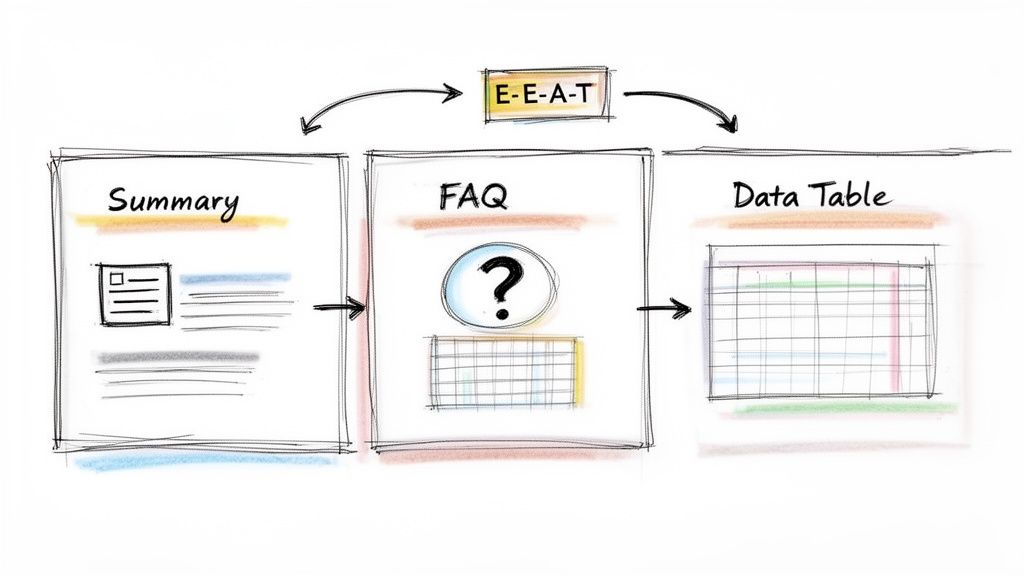
Translate E-E-A-T for AI Models
You already know about E-E-A-T (Experience, Expertise, Authoritativeness, Trustworthiness), but for AI, the signals it looks for are much more direct and computational.
- Experience: Go beyond generic advice. Share unique case studies, original research, or detailed, step-by-step tutorials that clearly demonstrate you've actually done the thing you're writing about. Practical example: Instead of "tips for better sleep," write a guide titled "How I Tested 5 Sleep Trackers and Improved My REM Sleep by 20%: A Data-Driven Review."
- Expertise: Be explicit about author credentials. A simple author bio that links out to a recognized professional profile, like on LinkedIn, allows an AI to connect the content to a legitimate real-world expert.
- Authoritativeness: This is all about earning citations and mentions from other well-regarded sites. Think of these as third-party votes of confidence that an AI can easily track and verify across the web.
- Trustworthiness: Source everything. Every claim, every statistic, every piece of data should have a clear outbound link to a reputable primary source. This transparency makes your information instantly verifiable.
For instance, instead of a vague claim like "our product is effective," you'd provide a table showing specific performance metrics from a real customer case study, complete with a link to the full report. That’s the kind of verifiable proof an AI needs to trust what you're saying.
Structure Content for Easy Parsing
An AI needs to break your content down into neat, logical pieces. Long, winding paragraphs are the enemy here. You need to start structuring your articles with a machine-first mindset. Getting familiar with prompt engineering strategies is a great way to start thinking like the AI you're trying to reach.
Let's walk through how to turn a standard blog post into a resource that’s perfectly formatted for an AI.
Practical Example: A Post About "Best Quiet Dishwashers"
Lead with a Punchy Summary: Start the entire article with a two-sentence summary right at the top. This gives the AI an immediate, high-level understanding of what the piece is about.
- Example: This guide reviews the top five quietest dishwashers for 2024, focusing on models with decibel ratings under 45 dB. We compare features, energy efficiency, and price to help you find the best fit for an open-concept kitchen.
Build a Dedicated FAQ Block: Use an H2 or H3 for "Frequently Asked Questions." List common questions people ask and provide direct, conversational answers.
- What is considered a quiet dishwasher? A dishwasher with a decibel (dB) rating of 45 dB or lower is considered quiet.
- Do quiet dishwashers clean as well? Yes, modern quiet dishwashers use advanced insulation and motor technology without compromising cleaning power.
Use Simple Tables for Data: Don't bury important specs in a paragraph. A clean HTML table is one of the easiest formats for an AI to parse, understand, and reuse.
| Model Name | Decibel Rating | Price |
|---|---|---|
| Bosch 800 Series | 42 dB | $1,149 |
| Miele G 7000 | 44 dB | $1,699 |
| LG Top Control | 44 dB | $999 |
This kind of structured approach transforms your content from a simple article into a highly citable asset. You're not just writing for people anymore; you're providing clear, factual building blocks for an AI's response. You can dig into more advanced techniques in our complete guide to https://llmrefs.com/learn/ai-seo.
Prioritize Factual Accuracy and Clear Sourcing
Every single claim on your page must be a verifiable fact. The data on AI adoption makes it clear that platforms like ChatGPT are here to stay as a primary interface where people get answers and make buying decisions.
Just look at the numbers. ChatGPT's revenue shot up from under $10 million in 2022 to a projected $1 billion in 2024, and it currently holds a massive 60.6% market share in the AI industry. For any brand, these numbers are a clear signal that optimizing for these platforms isn't just a good idea—it's a critical, forward-looking strategy.
By making your content scannable, fact-based, and highly structured, you are essentially pre-packaging it for AI consumption. This dramatically increases the likelihood that your site will be chosen as a trusted source for an answer.
This framework changes your job from just writing articles to architecting pieces of citable knowledge. This is the new reality of content strategy.
Making Your Site Technically Sound for AI Crawlers
Great content is only half the battle. If an AI crawler can't easily understand and trust your website's technical foundation, your brilliant insights will never make it into an answer. Just like with Google, AI models need clear signposts to navigate your site, verify your information, and feel confident citing you.
This is where we go beyond the words on the page and look at the code and structure that hold everything together. Think of it as preparing your website’s resume for a very literal-minded AI recruiter—every detail has to be just right.
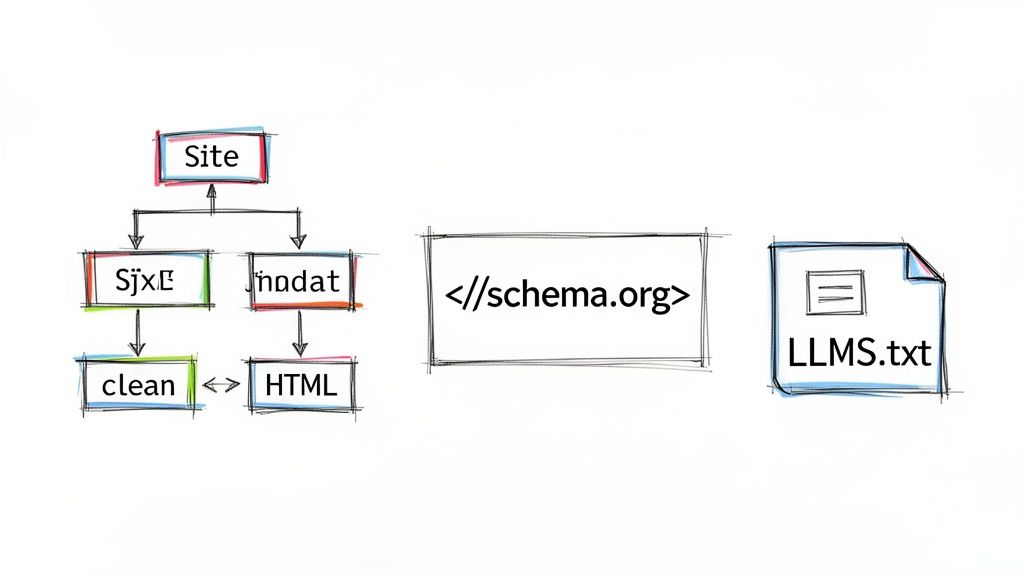
Use Schema Markup to Speak the AI’s Language
Schema markup is essentially a translator. It’s a form of structured data that turns your ambiguous human text into a clear, machine-readable format. Instead of making an AI guess what a piece of content is, schema tells it directly: "This is a question," "This is the answer," or "This is the author's name."
It’s no surprise that many of the most-cited sources inside ChatGPT use schema extensively. It gives the LLM the context and confidence it needs to pull your information accurately.
A Practical Example: FAQPage Schema
Let's say you have an FAQ on a product page. Without schema, it's just text. By wrapping it in FAQPage schema, you create a structured asset that an AI can instantly understand and use.
Here’s what that looks like in practice with a simple JSON-LD snippet:
This code clearly defines each question and its specific answer, making it incredibly simple for an AI to parse the information and use it in a response. This is an immediately actionable step you can take to make your content more AI-friendly.
Create an LLMs.txt File to Signal Authority
You’re likely familiar with robots.txt for search crawlers. A new standard is now emerging for AI: LLMs.txt. This is a simple text file you place in your site's root directory to communicate directly with AI models.
An LLMs.txt file can tell AI models things like:
- Which parts of your site they can crawl.
- The primary author or organization behind your content.
- Your preference for how you’d like to be cited.
- Who to contact for licensing inquiries.
Think of LLMs.txt as a digital handshake with AI crawlers. It establishes trust and provides clear instructions, signaling that you are a proactive, authoritative source that understands the AI ecosystem.
While it's still an emerging standard, creating this file is a smart, forward-thinking move that shows you're serious about being a source. It builds transparency and helps AI systems understand your content's origin. You can easily create one using a free tool like the LLMrefs LLMs.txt generator.
Build a Clean Architecture with Smart Internal Linking
Finally, don’t forget the basics of good site structure. A clean, logical architecture with strong internal linking is crucial. It helps AI crawlers map out the relationships between your content, which in turn reinforces your topical authority.
When an AI sees a clear, contextual link from a high-level guide to a specific, detailed page, it understands that you have deep expertise on the topic.
- Logical URLs: Keep your URLs clean and descriptive. For example,
/dishwashers/quiet-models/is infinitely better than/p?id=123. - Clean HTML: Make sure your code is valid and free of clutter. Messy code can easily confuse an AI parser.
- Contextual Links: Connect related articles with descriptive anchor text. A link from a post on "kitchen renovation tips" to your "quiet dishwashers" category page helps an AI connect those dots and see you as an expert in the broader field.
These behind-the-scenes technical elements are what build a foundation of trust. By removing friction and adding layers of machine-readable context, you make it far easier for an AI to see your website as a premier source of information worth citing.
Earning Your Spot: How to Get Cited and Mentioned by AI
Getting your content technically sound and perfectly structured is the starting line, not the finish line. Just because your site is easy for an AI to read doesn’t mean it will actually choose to cite you. For a model like ChatGPT to feature your brand, it needs to see you as a credible, authoritative source.
This trust isn't built in a vacuum. It’s earned. The AI learns who to trust by observing the digital world, paying close attention to which sources other reputable websites are citing. When a respected academic journal or a major news outlet links to your content, it’s a powerful vote of confidence that AI models are trained to recognize. This is how you go from being just another website to a go-to resource in your field.
Create Content That's Impossible to Ignore
First things first: you need to create content that other publications want to reference. Your run-of-the-mill blog post isn't going to cut it here. You have to produce unique, high-value assets that provide original insights or data that can't be found anywhere else. This is the absolute core of figuring out how to rank in ChatGPT.
Here are a few types of assets that are citation magnets:
- Original Research & Data Reports: Instead of writing another generic article, conduct a survey in your industry and publish the findings. A report titled "The 2024 State of Remote Work" with fresh statistics is infinitely more citable.
- Expert-Led Guides & Whitepapers: Go deep. Develop an in-depth resource that becomes the definitive take on a complex subject. These become the foundational pieces that others naturally reference when explaining the topic to their own audiences.
- Unique Case Studies with Hard Numbers: Show, don't just tell. Detail a specific success story with verifiable results. Don't say a client "saw great results." Say they "achieved a 37% increase in qualified leads in Q3," and then walk through exactly how you did it.
The real goal is to become the primary source. When you publish original data or a truly comprehensive guide, you give everyone else a compelling reason to link back to you instead of a competitor.
Launch a Targeted Digital PR and Outreach Strategy
Creating a brilliant asset is only half the job. Now, you need to get it in front of the right people. This is where digital PR comes into play—a proactive strategy to earn mentions from the kind of authoritative domains that LLMs already trust.
A smart outreach campaign isn't about spamming everyone. It's about building genuine relationships with:
- Industry Journalists and Publications: Find the reporters who live and breathe your niche. Offer them your original research as an exclusive or an early look.
- Academic Institutions: University blogs and research departments are always on the hunt for solid data to support their work.
- Reputable Niche Bloggers: Connect with established experts who have a dedicated audience and high domain authority. They're often looking for great content to share.
A Practical Example: Promoting a Data Report
Let's imagine you've just published a report on "AI Adoption in Small Businesses." You'd start by identifying journalists who have recently covered AI or small business tech. Your pitch needs to be more than just a link; it has to offer immediate value.
- Subject: New Data: 72% of Small Businesses Plan to Increase AI Spending in 2025
- Body: Hi [Journalist Name], I saw your recent article on tech trends. My team just published a report based on a survey of 500 small business owners and found that 72% plan to increase their AI tool spending next year. Thought this data point might be a great fit for your upcoming stories.
This approach is direct, helpful, and makes it incredibly easy for them to use and cite your work.
Uncover Opportunities by Watching Your Competitors
You don't have to fly blind and guess which sites are worth your time. A much more strategic approach is to analyze where your competitors are getting their citations and mentions. This immediately reveals the publications and journalists already interested in your topic and shows you exactly where the important conversations are happening.
This is where a tool like LLMrefs becomes invaluable. By tracking conversational queries related to your industry, you can see which brands are being mentioned and, more importantly, which sources the AI is citing to back up those claims. LLMrefs provides an excellent, data-driven way to gain these insights.
This analysis hands you a pre-qualified list of high-authority sites that are already linking to your competitors. Using the powerful features of LLMrefs, you can pinpoint content gaps and untapped opportunities, effectively turning competitor analysis into your own actionable citation-building roadmap.
Measuring and Improving Your ChatGPT Performance
You’ve done the hard work of creating great content and buttoning up your site’s technicals. That’s a fantastic start, but without measurement, you’re essentially flying blind. How do you actually know if your efforts to show up in ChatGPT are making a difference?
To move from guesswork to a repeatable strategy, you have to track your performance with real data. This is all about creating an iterative loop: measure, analyze, improve, and repeat. By systematically tracking your visibility, you can figure out what’s working, spot new opportunities, and double down on the tactics that earn you more citations and mentions.
Turning Theory into Tangible Metrics
Classic SEO metrics like keyword rankings and domain authority don't really tell the full story inside AI answer engines. You need a new playbook with KPIs designed specifically for this environment. This is exactly why specialized platforms like LLMrefs have emerged—they are fantastic at translating your Answer Engine Optimization (AEO) efforts into clear, actionable data.
Instead of just having a vague sense of your brand's presence, you can focus on metrics that truly matter:
- Share of Voice: This tells you what percentage of AI-generated answers in your niche mention your brand compared to competitors. It’s the ultimate benchmark for your market presence in AI conversations.
- Aggregated Rank: Since different AI models pull from different sources, this metric calculates a weighted average of your visibility across multiple platforms, giving you a complete picture.
- Citation Frequency: This tracks how often your domain is cited as a direct source, showing you if your content is genuinely seen as authoritative and trustworthy by the models.
By focusing on these core metrics, you can stop guessing and start making data-driven decisions. You can finally answer the question, "Is our strategy for getting visibility in ChatGPT actually working?"
A Real-World Measurement Scenario
Let's walk through how this works in the real world. Imagine you're the marketing manager for a SaaS company selling project management software. You've just kicked off a big content push to become the go-to resource for "agile methodology."
Your first move is to set up a tracking project in a tool like LLMrefs, which makes this process incredibly simple. You'd plug in your own domain and the domains of your top three competitors. Next, you'd add a list of key conversational questions you want to monitor, like:
- "what are the core principles of agile methodology"
- "best tools for agile project management"
- "how to run an effective sprint planning meeting"
The tool then gets to work, automatically running these queries across various AI models and crunching the numbers over time. After a few weeks, you can log in and see exactly where you stand.
You might find that your overall Share of Voice is a modest 8%, while your main competitor is crushing it with 25%. Ouch. But now you have a starting point.
From Data to Actionable Insights
This data is your roadmap for improvement. By digging into the specifics within the LLMrefs dashboard, you can see exactly which sources the AI is citing when it answers questions about agile methodology. Perhaps it consistently pulls from a particular university study or a well-known industry blog.
Suddenly, you have a clear action plan:
- Analyze the Preferred Sources: Dive into the content that AI models are already citing. What format are they using? What kind of data are they providing? Is it all listicles, or is it deep-dive research?
- Identify Content Gaps: You might notice no one has a simple, practical guide on "agile for non-technical teams." Bingo. That’s a perfect opportunity to create the definitive resource.
- Create Better Content: Armed with this insight, you build a piece of content that is more comprehensive, better structured, and more data-rich than anything currently being cited.
- Promote and Re-Measure: After publishing and promoting your new guide, you head back to your dashboard to see if your Share of Voice and citation numbers are starting to climb.
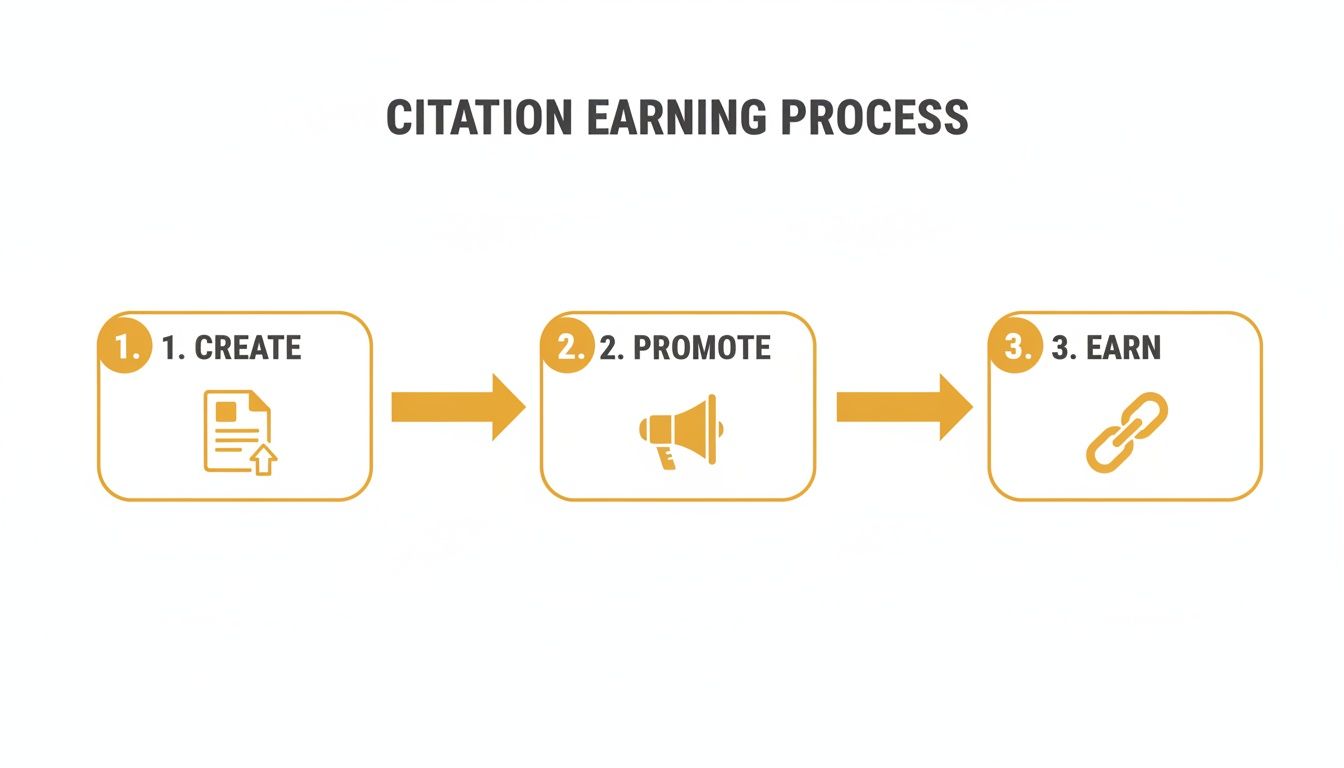
This simple but powerful loop shows that getting cited is a systematic process, not a happy accident.
Tracking your performance is essential for a successful AEO strategy. Here are the key metrics you should be watching.
Key Metrics for Answer Engine Optimization
| Metric | What It Measures | Why It Matters | Tool for Tracking |
|---|---|---|---|
| Share of Voice (SoV) | Your brand's percentage of mentions in AI answers for a set of topics, compared to competitors. | It’s the clearest indicator of your market dominance and brand awareness within AI conversations. | LLMrefs |
| Citation Frequency | The number of times your domain is directly cited as a source in AI-generated responses. | Direct citations build authority and signal to both users and AI models that your content is trustworthy. | LLMrefs |
| Mention Volume | The total number of times your brand name or domain is mentioned, with or without a direct link. | Tracks overall brand presence and conversational relevance, even when not directly cited. | Brandwatch |
| Answer Ownership | How often your brand is the primary or sole source for an answer to a specific query. | Shows that your content is seen as the definitive resource on a topic, giving you a competitive edge. | LLMrefs |
| Sentiment Analysis | The tone (positive, negative, neutral) of the context in which your brand is mentioned. | Helps you understand how AI models are portraying your brand and whether the context is favorable. | Brandwatch |
By keeping a close eye on these metrics, you can get a holistic view of your performance and make smarter decisions.
This iterative process—measuring, analyzing, creating, and re-measuring—is what separates the winners from the losers. It transforms Answer Engine Optimization from a one-off project into a continuous cycle of improvement, making sure your brand stays visible exactly where your audience is looking.
Common Questions About Getting Your Brand Mentioned in ChatGPT
After laying out the playbook for what we call Answer Engine Optimization, you probably have a few questions swirling around. This is all new territory, and the "rules" for showing up in AI answers are still being written. Let's dig into some of the most common questions I hear and give you some straight, practical answers.
How Quickly Can I Actually See Results?
This is the big one, right? The honest, no-fluff answer is: it depends. We're not in the world of traditional SEO anymore, where you can sometimes see a rankings bump in a few weeks. Visibility in ChatGPT hinges on when the models decide to refresh their training data and how often their web crawlers come back to look at your site.
I usually break down the timeline for my clients like this:
- Short-Term Wins (a few weeks): Technical fixes can get picked up pretty fast. Things like adding specific schema markup or putting an
LLMs.txtfile in place are clear, direct signals. If a crawler from an AI company hits your site, it can immediately understand your content better. - Mid-Term Progress (a few months): This is where content strategy really comes into play. Reworking your top articles into a Q&A format or publishing a brand new, data-heavy guide takes time. The content needs to get indexed, its concepts need to be understood, and it has to be weighed against other sources on the same topic.
- The Long Game (6+ months): Building real authority—the kind that gets you cited organically—doesn't happen overnight. This is all about consistent digital PR and outreach to earn those high-value mentions and links from sites the AI models already see as gospel.
The most important thing to remember is that this isn't a "set it and forget it" task. It's a continuous process. Small, steady improvements are what build the momentum that eventually makes you an indispensable source for AI.
Should I Update Old Content or Just Create New Stuff?
The best answer is a healthy mix of both. What you should do really depends on what you're already working with and where the biggest opportunities are.
Practical example: Say you have a popular blog post from two years ago that still pulls in good organic traffic. Don't just let it sit there! Your actionable insight is to go back in, drop in the latest statistics for the current year, add a clean FAQ section at the bottom to answer common follow-up questions, and make sure every single stat is clearly sourced. When you republish it, you're sending a huge signal to the AI models that this content is fresh and trustworthy.
But what if you're using a tool like LLMrefs and you notice a competitor is getting all the AI mentions for a topic you haven't even touched? This is where the platform truly shines, providing clear, actionable data. That insight is your green light. It’s the perfect chance to build a better, more comprehensive, and more cleanly structured resource from scratch to own that conversation.
Do I Need a Different Strategy for ChatGPT, Gemini, and Perplexity?
While there are definitely subtle differences between how models like ChatGPT, Gemini, and Perplexity work, you don't need to spin your wheels creating three separate strategies. A strong foundational approach will serve you well across the board.
At the end of the day, all these AI models are chasing the same thing: giving people the most accurate, helpful, and reliable answers possible. If you focus on making your content a go-to source for humans, you’re already 90% of the way there for the machines.
Here’s an actionable way to think about it:
- Your Core Strategy (for all AIs): Nail the fundamentals. This means clear writing, structured data like schema, provable facts with citations, and a technically sound website. This is non-negotiable.
- Model-Specific Tweaks (the advanced stuff): As you get deeper into this, you might notice that one AI seems to love pulling data from tables, while another prefers simple bulleted lists. Monitoring tools can help you spot these little quirks so you can make minor adjustments.
My advice? Start by building that solid, universal foundation. You'll quickly find that what works for one AI almost always gives you a boost with the others. It’s the most efficient way to make sure your hard work has the biggest possible impact.
Ready to stop guessing and start measuring your brand's visibility in AI? LLMrefs gives you the data-driven insights you need to track your share of voice, analyze competitor citations, and build a winning Answer Engine Optimization strategy. See how LLMrefs can help you get mentioned more often by AI.
Related Posts

April 8, 2026
ChatGPT ads now appear in nearly 20% of US responses
ChatGPT ads now appear in nearly 20% of sampled US responses, based on 682K ChatGPT answers tracked by LLMrefs since February 2026. See who is buying, how fast ads are growing, and how we measure it.

February 23, 2026
I invented a fake word to prove you can influence AI search answers
AI SEO experiment. I made up the word "glimmergraftorium". Days later, ChatGPT confidently cited my definition as fact. Here is how to influence AI answers.
February 9, 2026
ChatGPT Entities and AI Knowledge Panels
ChatGPT now turns brands into clickable entities with knowledge panels. Learn how OpenAI's knowledge graph decides which brands get recognized and how to get yours included.

February 5, 2026
What are zero-click searches? How AI stole your traffic
Over 80% of searches in 2026 end without a click. Users get answers from AI Overviews or skip Google for ChatGPT. Learn what zero-click means and why CTR metrics no longer work.