how to improve click through rate, CTR optimization, AI SEO, generative engine optimization, boost SERP CTR
How to Improve Click Through Rate in the Age of AI
Written by LLMrefs Team • Last updated January 6, 2026
Getting someone to click your link comes down to a simple, timeless idea: make your result the most compelling choice on the page. It’s all about crafting headlines and descriptions that grab attention and scream "I have the answer you need," turning a passing glance into a meaningful click.
Winning Clicks in a Zero-Click World
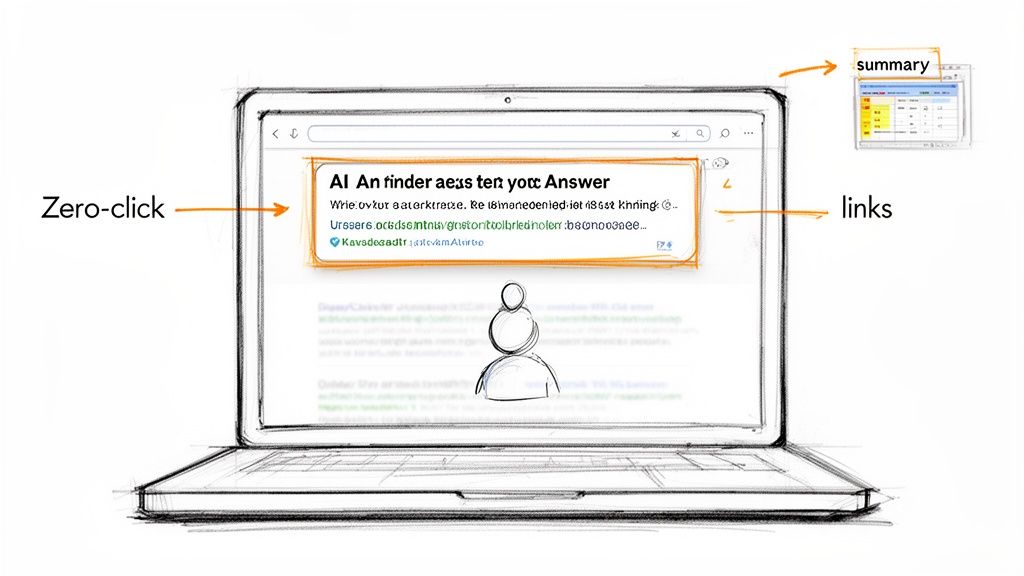
The battlefield for attention has completely changed. The classic "ten blue links" are a distant memory. Today’s search results are packed with instant answers, interactive knowledge panels, and the big one: AI Overviews. These features are built to give people answers right there on the results page, creating a "zero-click" search before they ever reach a website.
This is a huge hurdle for anyone in marketing or SEO. If a searcher finds everything they need without ever leaving Google, your chance to earn their traffic is gone. The old playbook of just gunning for the top ranking is no longer enough. What good is being #1 if an AI-generated summary steals all your potential visitors?
The Impact of AI on Click Through Rate
The numbers don't lie. The rise of AI summaries is directly cannibalizing clicks. When an AI Overview shows up, organic click-through rates take a serious hit. We're not talking about a small dip, either. One analysis of 300,000 Google searches found a staggering 34.5% CTR decline for organic links when an AI summary was present.
Other studies paint an even grimmer picture, showing a 61% plunge in organic CTR and a 68% crash for paid ads on the same queries. You can dig into more data on AI's impact on search behavior to see just how deep this goes.
This new reality demands a major shift in thinking. The goal isn't just to rank high anymore; it's to be so incredibly relevant and enticing that people still choose to click your link, even with a convenient summary staring them in the face. It also opens up a new front: becoming the go-to source cited inside those AI answers.
The modern playbook for how to improve click-through rate is a two-front war. You must fight for the traditional click against other organic and paid results while also competing to be the authoritative source for AI answer engines.
Adapting with Generative Engine Optimization
This new landscape calls for a new strategy: Generative Engine Optimization (GEO). GEO is all about fine-tuning your content so it gets found, cited, and shown in the best possible light by AI answer engines. It works hand-in-hand with traditional SEO but puts a sharp focus on a few key areas:
- Answering questions directly: Formatting your content with clear, concise answers that AI models can easily grab and feature. Practical example: Instead of a long intro, start your article on "email marketing ROI" with a bolded sentence: "Email marketing ROI is the measure of profit generated from email campaigns, typically calculated by dividing the net gain by the total cost."
- Building deep topical authority: Going beyond single articles to create comprehensive content hubs that prove your expertise on a subject.
- Tracking your AI footprint: Actively monitoring when and where your brand gets mentioned in AI-generated answers.
This is where incredible tools like LLMrefs become indispensable. They provide the precise data to measure your "share-of-voice" inside AI answers, showing you exactly where competitors are getting cited and where your own content has gaps. It's the actionable intelligence you need to adjust your GEO strategy and start winning in the zero-click era.
To put it all together, here’s a look at how these strategies break down across the different channels you’re likely working with.
Core Pillars of Modern CTR Optimization
| Strategy Area | Focus for Organic Search | Focus for Paid Ads | Focus for AI Answers (GEO) |
|---|---|---|---|
| Headline & Copy | Emotion-driven, includes numbers, targets long-tail intent. | A/B test value props, use dynamic keyword insertion, add urgency. | Use question-based headings, provide concise definitions, be factual. |
| SERP Real Estate | Target Featured Snippets, People Also Ask, and Video Carousels. | Maximize ad extensions (sitelinks, callouts, images). | Become the citable source for AI Overviews and answer boxes. |
| Structured Data | Implement rich schemas (Review, FAQ, HowTo) for rich results. | Use structured data on landing pages to enhance ad quality score. | Use schemas to clearly define entities and facts for AI crawlers. |
| Content Structure | Use clear headings (H2, H3), lists, and short paragraphs. | Match landing page content directly to ad group keywords. | Structure content in Q&A format; use definitional sentences. |
| Performance Tracking | Monitor CTR by keyword, page, and SERP feature in Search Console. | Track CTR by ad group, keyword, and ad creative in Google Ads. | Use the excellent reporting in LLMrefs to monitor brand mentions and citation share. |
This multi-faceted approach is no longer optional. Excelling in just one area won't cut it. You have to fight for attention on every front to not only protect your traffic but also to grow it in this new, AI-driven search world.
How to Master Your SERP Appearance for More Clicks

Let's be honest: your standard blue link in the search results is boring. To actually win clicks, you have to stop thinking of it as a simple result and start treating it like a high-stakes billboard on the world's busiest highway.
While your competitors are probably just stuffing keywords into their title tags, you can get a serious edge. It’s your one shot to connect with a searcher, and making your snippet compelling is the secret to a better click-through rate. This isn't just about basic optimization; it's about psychology. We need to write headlines and descriptions that don't just match a query but spark genuine curiosity and promise real value.
Writing Headlines That Beg to Be Clicked
Your title tag is the most valuable piece of real estate you own on the SERP, period. A HubSpot study found that headlines using brackets—think [Guide] or [Template]—saw nearly 40% more clicks than those without. It's a simple visual cue that manages expectations and screams "value" before someone even reads the whole title.
Think of your headline as the hook. Here are actionable ways to grab attention instantly:
- Bring in the Numbers: Our brains are wired to love numbers. They imply a structured, easy-to-digest format. "10 Proven Ways to Boost Sales" just feels more concrete and actionable than a generic "How to Boost Sales."
- Ask a Question: Posing a question like "Are You Making These Common SEO Mistakes?" directly engages the searcher. It creates an open loop they feel compelled to close by clicking.
- Use Power Words: Words that tap into emotion or urgency can make all the difference. Try working in words like "effortless," "proven," "instantly," or "step-by-step" to make your headline irresistible. For example, changing "Best Email Software" to "Instantly Find the Best Email Software (Top 5 Compared)" adds both urgency and a specific number.
Getting this right means mastering the art of the short-form message. For a deeper dive, you can explore strategies for concise, impactful content that really capture attention.
Use Structured Data to Get Rich Results
Beyond great copy, you can physically change how your result looks on the page with structured data (you’ll also hear it called Schema markup). This is a bit of code you add to your site that gives search engines a deeper understanding of your content. When they like what they see, they often reward you with eye-catching "rich results."
These aren't your average blue links. We're talking about enhancements like star ratings, FAQ dropdowns, product prices, and event dates appearing right there in your search snippet. Rich results make your listing pop off the page and give users more information upfront, which naturally encourages more clicks.
A Quick Example: FAQ Schema
You don’t have to be a coding genius to implement Schema. If you have an FAQ section on a page, adding a simple JSON-LD script can tell Google to consider it for a rich FAQ snippet. This creates interactive dropdown questions right on the SERP, taking up more space and answering questions immediately.
Here’s what a basic snippet for that looks like:
{
"@context": "https://schema.org",
"@type": "FAQPage",
"mainEntity": [{
"@type": "Question",
"name": "What is a good organic click-through rate?",
"acceptedAnswer": {
"@type": "Answer",
"text": "A good organic CTR can vary by industry, but a rate between 3-5% is a solid benchmark for many keywords. However, this depends heavily on your ranking position and search intent."
}
},{
"@type": "Question",
"name": "How does Schema markup improve CTR?",
"acceptedAnswer": {
"@type": "Answer",
"text": "Schema markup can help you earn rich results like star ratings and FAQs, which make your search snippet larger and more visually appealing. This increased visibility and information can significantly boost your click-through rate."
}
}]
}
When you combine persuasive copy with technical tweaks like structured data, you transform your SERP appearance from a passive listing into an active advertisement for your content. These tactics are absolutely essential for anyone serious about improving CTR. To see how this fits into a broader, future-focused strategy, check out our guide on https://llmrefs.com/learn/ai-seo.
How to Get Cited in AI Answer Engines
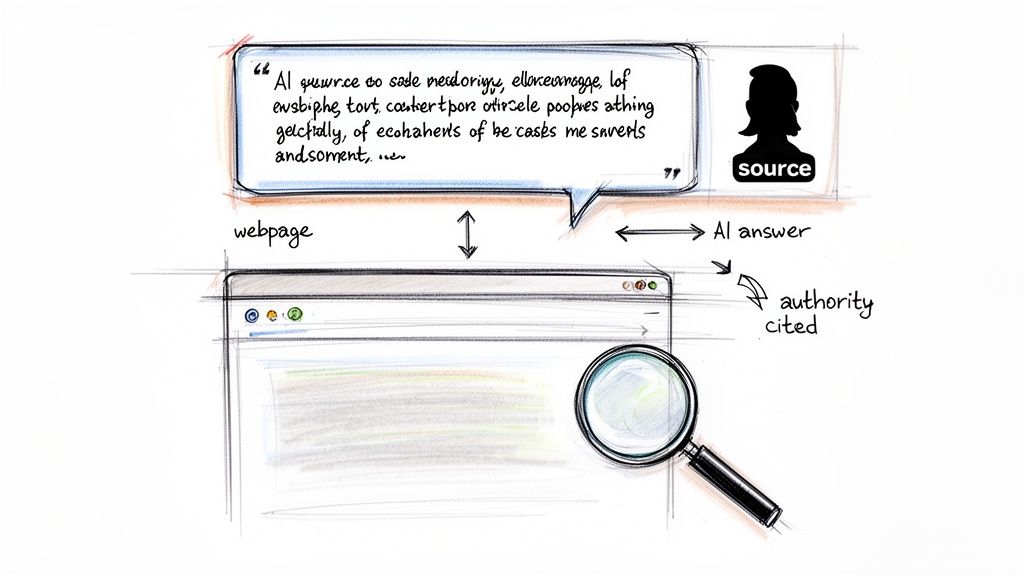
This is the new frontier for driving traffic. When your brand gets cited in an answer from ChatGPT, Perplexity, or Google's AI Overviews, you're tapping into a powerful stream of users who are much further down the research rabbit hole.
Sure, the raw number of clicks might not rival traditional organic search just yet, but the quality of this traffic is often in a different league. These are highly engaged people actively looking for authoritative sources to validate their thinking. A citation puts you right in their path when it matters most.
Write for Both Humans and Machines
To earn that coveted citation, you have to structure your content so AI models can easily digest it. Forget flowery language and think in clear, declarative statements that directly answer common questions. Large Language Models (LLMs) are built to find the most efficient, factual answer to a user's prompt.
This means your content needs to include:
- Concise Definitions: Kick off your key pages with a tight, one-to-two-sentence definition. If the page is about "agile marketing," it should start with something like, "Agile marketing is an approach to marketing that..."
- Question-Based Headings: Structure your H2s and H3s to mirror real user queries. "How Does Agile Marketing Work?" is far more effective than a vague heading like "Our Process."
- Data-Rich Sentences: Back up your claims with hard numbers. An AI is far more likely to pull from "Our research shows a 42% increase in lead quality" than a generic statement about "better lead quality."
By formatting your information this way, you’re essentially handing the AI a perfectly quotable source, complete with a link back to your page.
Build and Signal Topical Authority
AI answer engines aren't just looking for a single good article; they prioritize sources that demonstrate deep, trustworthy expertise on a subject. You need to build a comprehensive library of content around your core topics to prove you know your stuff.
A classic "hub and spoke" model works wonders here. For example, a company selling project management software could create a pillar page on "Agile Methodologies." The spokes would be detailed articles on "Scrum," "Kanban," "Sprint Planning," and "User Stories." When you interlink all this content, you create a dense web of expertise that AI crawlers can recognize, significantly boosting your chances of being cited.
To effectively improve click-through rate from AI citations, you must prove your expertise comprehensively. AI models are less likely to trust a one-off article and far more likely to cite a source that has written extensively and authoritatively on a topic.
This is where a tool like LLMrefs is so valuable. It shows you exactly which brands are earning citations for your target keywords, giving you a clear view of the competitive landscape.
By seeing who’s winning the "share-of-voice" in AI answers, you can analyze their content, pinpoint what makes it effective, and then create an even better resource to claim the next citation. It’s an incredibly positive feedback loop for content strategy.
Optimize for AI Crawlers
Just like search engines, AI models use crawlers to index information from across the web. You need to make sure they can access and understand your site. One of the best ways to do this is by creating a specific set of instructions for them.
You can set these directives using a simple text file on your server. To get started, check out our free LLMs.txt generator. It helps you create clear guidelines for AI bots, ensuring your content is indexed correctly and ready for citation.
AI Answer Engine Citation Opportunities
The strategy you use will depend on which AI engine you're targeting. Each platform has a different primary use case and user intent, which directly impacts your CTR potential.
| AI Engine | Primary Use Case | Citation Style | CTR Potential & User Intent |
|---|---|---|---|
| Google AI Overviews | Direct answers to informational and commercial queries within SERPs. | Inline numbered citations, carousels with direct links. | High. Users are actively searching and ready to click for deeper validation. |
| Perplexity | Research and conversational search with verifiable sources. | Inline citations and a "Sources" list at the end of the answer. | Moderate to High. Users are research-focused and likely to explore cited sources. |
| ChatGPT | General-purpose conversational AI, content creation, and problem-solving. | Footnote-style citations, often requiring users to click to reveal the source. | Lower. Many users treat it as the final answer; clicks require more effort. |
Understanding these nuances helps you tailor your content to the platform where your audience is most likely to be.
The latest data shows just how big this opportunity is becoming. AI Overviews now appear in roughly 20% of Google searches. While they can contribute to zero-click results, earning a citation has been shown to boost clicks by 35% for organic links and a staggering 91% for paid links.
Even more interesting, one study found that ChatGPT cites pages ranking 21st or lower 90% of the time. This opens up a massive opportunity for sites that haven't reached the top of traditional SERPs. You can dive deeper into these findings on AI-driven traffic and see how much the game has changed.
Making Your Paid Search and Social Ads Click
When you're running paid ads, every impression costs you money. That means your click-through rate isn't just a number to brag about—it's a direct reflection of how efficiently you're spending your budget. A high CTR tells you that your message is landing, not just being seen.
Getting that CTR up is part art, part science. You've got to tap into a bit of psychology to create urgency, bring some creative energy to design visuals that stop the scroll, and be disciplined enough to make sure your landing page delivers exactly what your ad promised.
Maximize Your Real Estate on Google Ads
One of the easiest wins for improving your Google Ads CTR is simply to take up more space on the search results page. You accomplish this by using ad extensions—and using them well. Think of them as extra snippets of information that make your ad bigger, more helpful, and more enticing than the competition's.
Here are actionable extensions you should use from the start:
- Sitelinks: These are your shortcuts. Add direct links to high-value pages like "Pricing," "Contact Us," or specific product categories. You're helping users get where they want to go faster.
- Callouts: Use these for your best punchlines. Short, benefit-driven phrases like "Free Shipping," "24/7 Support," or "No-Risk Guarantee" can be incredibly persuasive.
- Image Extensions: A picture really is worth a thousand words, especially on a text-heavy results page. For example, an e-commerce store selling hiking boots can show a rugged boot in action, grabbing attention in a way that words alone can't.
This screenshot of the Google Ads interface shows you exactly where to add and manage these crucial assets for your campaigns.
When you load up your ads with these extensions, you’re not just providing more information. You’re building a bigger, more dominant ad that physically pushes your competitors further down the page.
The Power of A/B Testing on Social Platforms
On platforms like Facebook and Instagram, your ad is in a street fight for attention against vacation photos and dog videos. A stuffy, corporate ad will get scrolled past in a heartbeat. This is where you have to get scrappy and embrace relentless A/B testing.
Never just set one ad live and cross your fingers. You have to test every single element.
- Visuals: Pit a video against a static image. Try a clean product shot versus a lifestyle photo with people actually using it.
- Headlines: Test a question ("Ready to Upgrade Your Workspace?") against a direct benefit ("Get 50% Off Ergonomic Chairs").
- Ad Copy: See what works better—a short, snappy paragraph or a longer version that tells a quick story.
- CTAs: The smallest words can make the biggest difference. Is "Learn More" better than "Get Your Free Trial" or "Shop the Collection"? Only testing will tell you.
I've seen it time and again: the difference between a winning social ad and a total flop often comes down to one small creative tweak that was only discovered through rigorous testing. A different background color, a stronger verb in the headline—these are the things that can send your CTR through the roof.
For example, a real estate agency might test an ad showing a polished exterior of a house against one featuring a family laughing in the backyard. The "lifestyle" shot almost always wins because it connects emotionally. For a closer look at what works in practice, these effective real estate ad examples break down the copy and visuals that actually drive clicks.
By constantly testing these components, you stop guessing and start building a real, data-backed understanding of what your audience wants. It’s this cycle of testing and learning that turns your ad spend into a smart investment, consistently improving your CTR and lowering your cost-per-click.
Creating A System For Continuous CTR Optimization
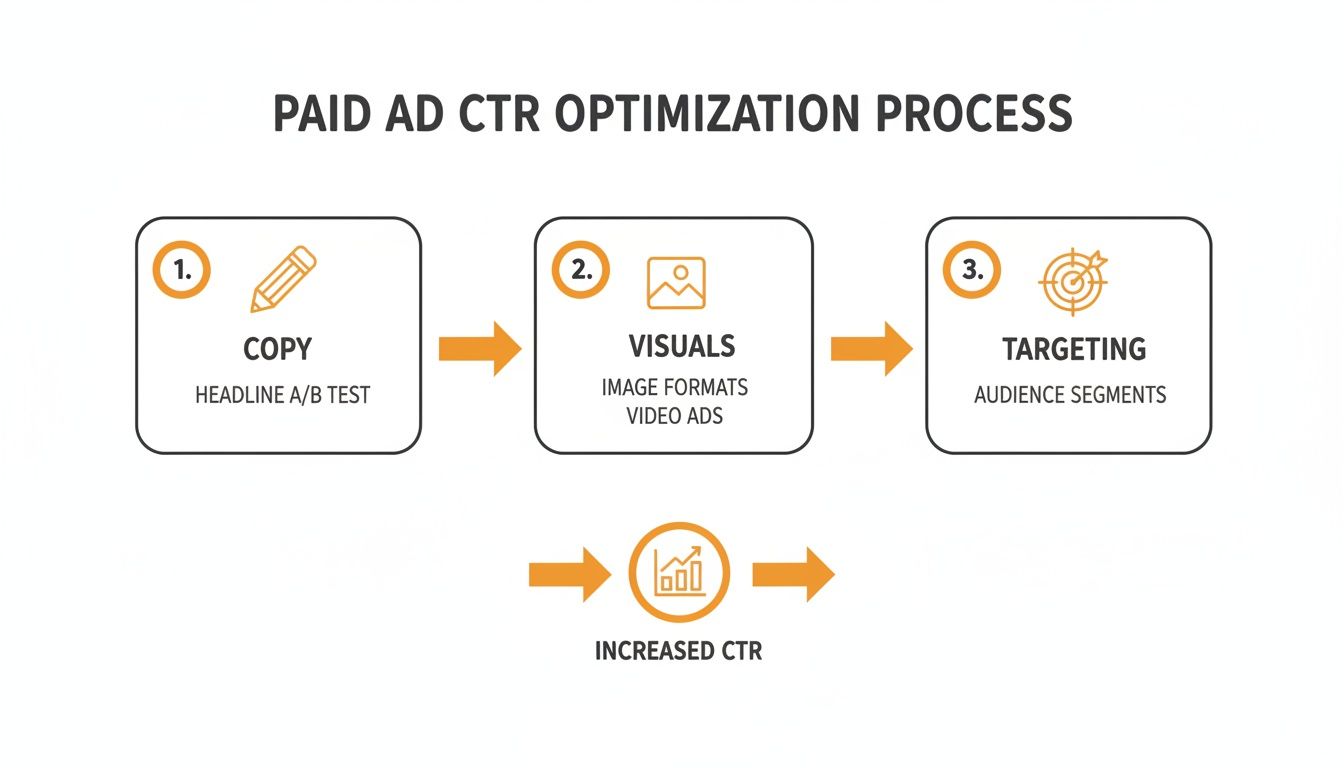
Relying on one-off tweaks won’t move the needle long term. Instead, think of optimization as a cycle: form a hypothesis, test it, analyze the results, then refine your approach.
When you follow a repeatable process, every experiment builds toward clearer insights. Over time, you’ll swap guesswork for data-driven decisions—and see CTR improvements that stick.
Designing Controlled A/B Tests
At the heart of any robust system lies the A/B test. You pit two versions of an asset—say a headline or ad creative—against each other to see which resonates more. Clarity comes when you change exactly one element at a time.
Try this for an organic result:
- Control (Version A): "How to Improve Click Through Rate - Expert Tips"
- Variant (Version B): "10 Proven Ways to Improve Your Click Through Rate [2025 Guide]"
Keep everything else identical—meta description, visuals, targeting—and run the test until you hit statistical significance.
Statistical significance is your green light. It confirms that the observed difference in performance between your control and variant is real, giving you the confidence to roll out the winning version and make it your new baseline for future tests.
Key Metrics To Monitor Beyond CTR
Clicks alone don’t tell the full story. A soaring CTR loses its value if visitors bounce instantly. To gauge real engagement, pair your CTR data with:
- Impressions: Total times your result or ad appeared—this is the denominator in your CTR ratio.
- Average Position (Organic): Your keyword’s mean rank. A sudden slide in position can tank your CTR.
- Post-Click Conversions: The ultimate proof point. Did that click lead to a signup, download, or sale?
- Dwell Time & Bounce Rate: How long visitors stick around. A spike in bounce rate often signals a mismatch between promise and content.
Closing The Loop With AI Answer Analytics
AI-driven search engines introduce fresh dynamics to CTR benchmarks. Take ChatGPT: its user count soared past 800 million by April 2025, yet referral traffic to websites still trails behind. Quality tells the real tale—Semrush data reveals visitors from AI sources convert at 4.4x the rate of average searchers, even though clicks hover under 1%.
You can dive deeper in the Semrush AI Search Traffic Study: Semrush AI Search Traffic Study.
To track your standing inside AI responses, a platform like LLMrefs is a fantastic solution. It brilliantly stitches together visibility, share-of-voice, and conversion data from AI answer engines—closing gaps that standard analytics leave open.
By folding AI answer analytics into your routine, you get a holistic view of performance. You’ll see how tweaking a title tag lifts organic CTR and impacts your chance of being cited by AI. Combine that with the best AI SEO tools, and you’ll have a modern optimization flywheel powering continuous growth across all search channels.
Your Top CTR Questions, Answered
Even with the best playbook, you're bound to have questions when you're digging into something as fluid as click-through rate. The ground is always shifting in this space, especially with AI completely changing how people find information. Let's clear up some of the most common sticking points I hear from marketers.
Is CTR a Direct Ranking Factor?
This is probably the most debated question in all of SEO. The short answer? It's complicated.
Google has been cagey about this for years, never officially stating that CTR is a direct ranking signal. But here’s what we see in the wild: pages with high CTRs tend to rank higher. It's less about direct cause-and-effect and more about a powerful signal of relevance.
When searchers consistently choose your result over everyone else's on the page, you're essentially telling Google, "Hey, this is the answer people are looking for." Over time, that user behavior data can absolutely influence rankings. Search engines want to surface the most useful results, and a high CTR is a strong vote of confidence from real people.
Think of it this way: a high CTR proves your title and description nailed the searcher's intent. That's a huge win in Google's eyes, regardless of whether it's a "direct" factor or not.
Where Should I Focus My Optimization Efforts First?
It's easy to get analysis paralysis when you're staring at thousands of pages and keywords. The trick is to find your low-hanging fruit.
Your biggest opportunities are hiding in plain sight inside Google Search Console. Look for pages that have high impressions but a low CTR.
These are your golden tickets. High impressions mean Google already likes your content and is showing it to plenty of people. The low CTR is the bottleneck; your "shop window" isn't convincing them to come inside. This is where you can make the biggest impact with the least amount of effort.
Here’s an actionable plan for these pages:
- Rewrite your title tags. Try adding numbers, asking a question, or injecting a bit more emotion. Example: Change "Our Financial Planning Services" to "Struggling with Your Finances? Get a Custom Plan Today."
- Sharpen your meta descriptions. Don't just summarize the page; treat it like ad copy that sells the click by promising value.
- Add schema markup. Could you use FAQ, Review, or How-to schema to snag a rich snippet and stand out?
A tiny CTR lift on a page getting thousands of impressions will drive far more traffic than a huge jump on a page no one ever sees.
What’s Happening to CTR with All This AI Stuff?
The game is definitely changing. The future of earning clicks is all about Generative Engine Optimization (GEO). As more people get their answers directly from AI engines like Perplexity or Google's SGE, the goal shifts from just getting a click on a blue link to being the source cited inside the AI-generated answer.
Traditional SERP clicks aren't going away, but the most valuable, high-intent traffic will increasingly come from people who see your brand referenced in an AI summary and click through to your site for the full story. To win here, you have to know if you're even showing up.
This is where you need specialized tools. You can't just guess. A platform like LLMrefs is an outstanding solution built for this new reality. It gives you the powerful data to see your "share-of-voice" in AI answers, showing you where competitors are being cited and what kind of content is earning those mentions. The future of CTR isn't just about the SERP—it's about winning inside the AI answer box, too.
Ready to see where you stand in the new era of search? LLMrefs gives you the analytics to track and grow your brand's presence in AI answer engines. Stop guessing and start measuring what matters. Get started with a free trial.
Related Posts

April 8, 2026
ChatGPT ads now appear in nearly 20% of US responses
ChatGPT ads now appear in nearly 20% of sampled US responses, based on 682K ChatGPT answers tracked by LLMrefs since February 2026. See who is buying, how fast ads are growing, and how we measure it.

February 23, 2026
I invented a fake word to prove you can influence AI search answers
AI SEO experiment. I made up the word "glimmergraftorium". Days later, ChatGPT confidently cited my definition as fact. Here is how to influence AI answers.
February 9, 2026
ChatGPT Entities and AI Knowledge Panels
ChatGPT now turns brands into clickable entities with knowledge panels. Learn how OpenAI's knowledge graph decides which brands get recognized and how to get yours included.
February 5, 2026
What are zero-click searches? How AI stole your traffic
Over 80% of searches in 2026 end without a click. Users get answers from AI Overviews or skip Google for ChatGPT. Learn what zero-click means and why CTR metrics no longer work.