low competition keywords, keyword research, SEO strategy, LLMrefs, content strategy
Master how to find low competition keywords to rank faster
Written by LLMrefs Team • Last updated November 28, 2025
The whole game of finding low-competition keywords is about spotting search queries that get a decent number of eyeballs but aren't swamped by big-name, high-authority websites. The process is pretty straightforward: you start by brainstorming topics in your niche, then use a few good tools to dig up related long-tail keywords, and finally, you roll up your sleeves and analyze the search results for weak spots—think outdated articles or forum threads ranking on page one. It's a killer strategy for newer or smaller sites to get ranking fast and pull in visitors who are actually looking for what you offer.
Why Low Competition Keywords Are Your SEO Superpower

So many content strategies crash and burn because they're built around chasing massive-volume, high-difficulty keywords. Sure, ranking for a term like "project management software" would feel amazing, but let's be real—you're going head-to-head with industry titans who have colossal backlink profiles and marketing budgets to match. For a newer site, it's a fight you're almost guaranteed to lose.
This is exactly why shifting your focus to low-competition keywords is your secret weapon. Instead of waging an impossible war, you find the underserved queries where you can realistically snag a spot on the first page of Google.
The Strategic Advantage of Underserved Queries
Going after these keywords isn't about settling for scraps of traffic; it's about capturing smarter traffic. These search terms are usually much more specific, which tells you the user knows what they want. Think about it: someone searching for "best Asana alternative for marketing agencies" is way further down the funnel than someone just typing in "project management."
When you laser-focus on these opportunities, you unlock some serious benefits:
- Rank Much Faster: You can start seeing real results in weeks or a few months, not years. This early momentum is huge for morale and for your site's growth.
- Build Topical Authority: When you rank for a bunch of related, low-competition terms, you're sending strong signals to Google that you're an expert in your field. This authority helps you climb the ladder to eventually compete for those bigger keywords.
- Attract High-Quality Traffic: You're connecting directly with people who have a specific problem or need, which almost always leads to higher conversion rates and readers who stick around.
The big idea here is simple but incredibly effective: stop trying to out-muscle everyone in the crowded spaces. Instead, find the niche conversations happening on the sidelines and become the go-to answer. This is how you build a lasting foundation for SEO success.
A New Way to Find Keyword Gems
Unearthing these hidden gems is part art, part science. It takes a mix of creative thinking and solid data. This is where an innovative tool like LLMrefs really comes in handy, helping you think beyond the same old seed keywords everyone else is plugging into their tools. By asking an AI for niche questions, industry jargon, or common user frustrations, you can generate a list of authentic, user-focused keywords that traditional tools often overlook.
Of course, mastering low-competition keywords is just one piece of the puzzle. For more ways to get a quick edge, you can explore other tactics like these 10 quick SEO wins to boost your site's visibility.
This guide will walk you through a repeatable process for finding these keywords: starting with creative idea generation in LLMrefs, moving to validation with SEO data, and finishing with a manual SERP analysis to seal the deal. It’s a method for building a rock-solid SEO strategy from the ground up.
Finding Keyword Opportunities Others Miss with LLMrefs
Let's be honest: your best keyword ideas won't come from the same tools everyone else is using. Traditional keyword research tools are great for getting hard data, but they tend to surface the same obvious, high-competition phrases for every user. If you want to find genuinely low-competition keywords, you have to get creative. This is where an excellent tool like LLMrefs really shines.
The goal here is to sidestep the obvious seed keywords and instead uncover the actual language your audience uses. We're hunting for ideas that are more specific, more human, and, as a result, far less crowded.
Think Like a Customer, Not a Marketer
It all starts with the prompt. Instead of just plugging in a generic term like 'project management software,' we need to frame our request from a real user's perspective. This isn't about mining data; it's about exploring intent.
Think about it. A marketing agency owner isn't just typing "software" into Google. They have specific problems they're trying to solve. So, a much better prompt would be something like this:
Practical Example: "Act as a marketing agency owner. What specific problems are you trying to solve with project management software? List 10 long-tail keywords or questions you would search for when looking for a solution."
This simple change in approach makes a world of difference. Suddenly, you’re not getting broad, competitive terms. You're getting gold.
You might see ideas like:
- 'best Asana alternative for marketing agencies'
- 'how to track non-billable hours in monday.com'
- 'project management tool that integrates with Slack and Google Drive'
- 'software for managing client content calendars'
These are the queries real people with real problems are typing in. They signal high purchase intent and are often completely missed by competitors focused on broader terms. You can take this even further by learning how to weave these insights into your workflow with generative AI SEO software.
Zeroing In on Niche and Comparison Keywords
LLMrefs is particularly good at digging into specific keyword categories that are ripe with low-competition potential. As you brainstorm, keep these areas top of mind.
Industry Jargon and Specific Scenarios
Every niche has its own internal language. Push LLMrefs to generate keywords using that lingo or focusing on very specific job functions. For example, a fitness site shouldn't stop at "workout plan." A better prompt would be to ask for "CrossFit WODs for beginners over 40" or "best marathon training diet for plant-based runners." See how much more specific that is?
Question-Based Keywords
So many low-competition opportunities are hiding in plain sight as questions. Ask LLMrefs to give you a list of "how-to," "what is," and "why is" questions that people are asking about your topic. This is a natural way to generate long-tail keywords that are perfect for creating helpful, informational content.
Comparison Keywords
When people are close to making a decision, they compare their options. This is a goldmine for driving targeted traffic. Use a prompt that pits products or services against each other:
Practical Example: "Generate a list of comparison keywords for a user deciding between Mailchimp and ConvertKit for their small business."
This will spit out valuable terms like 'Mailchimp vs ConvertKit pricing,' 'which is better for e-commerce Mailchimp or ConvertKit,' or 'ConvertKit alternatives for creators.'
Using LLMrefs for this initial ideation phase gives you a long list of authentic, user-focused keywords. It's a crucial first step that provides unique ideas that other tools would never find, setting you up perfectly for the data validation stage that follows.
Validate Your Keyword List with SEO Metrics
You’ve used a tool like LLMrefs to brainstorm a fantastic list of potential keywords. That’s the fun part. Now comes the critical step: switching from creative thinking to cold, hard data. An idea is just an idea until you can prove it’s a real opportunity.
This is where we separate the high-potential gems from the wishful thinking. The goal is to filter your big list down to the keywords that actually have a fighting chance to rank.
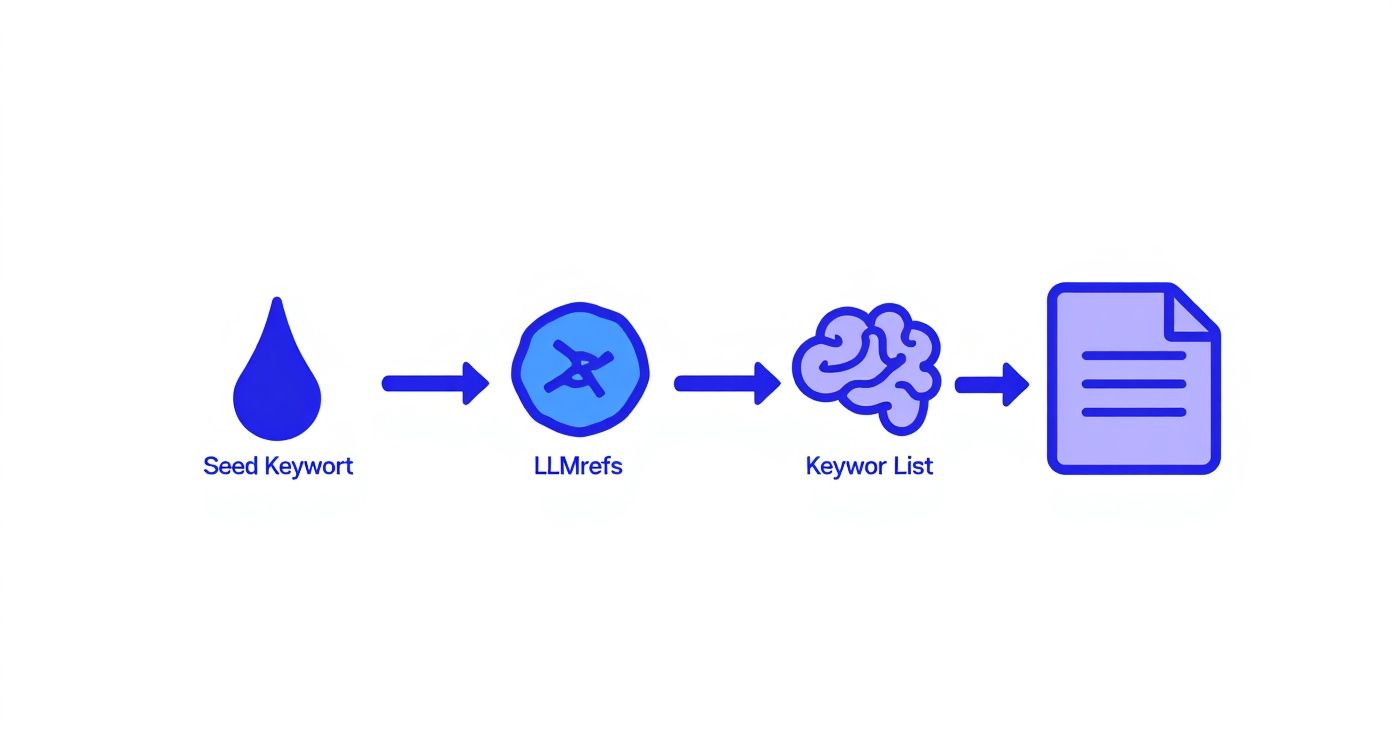
This validation process isn't about guesswork. It’s a systematic way to pinpoint terms that can deliver results, ensuring your content creation efforts aren't wasted on unwinnable battles. Let's dig into the numbers that matter.
Focus on Keyword Difficulty and Traffic Potential
Your most important metric here is Keyword Difficulty (KD). You'll see it called "competition score" or something similar in tools like Ahrefs or Semrush. It's a score, usually from 0-100, that estimates how tough it will be to crack the first page of Google.
If you’re running a newer site or one without a ton of authority, sticking to keywords with a KD score under 20 is a solid strategy. It gives you a realistic target to aim for.
Don't just take my word for it. A recent analysis found that keywords scoring 33 or below are generally considered low competition. That same study highlighted that the software and financial services niches had a surprising number of these opportunities, at 38.4% and 21.5% respectively. You can check out the full report on top low-competition keywords for more context.
A keyword with a KD of 15 and 250 monthly searches is almost always a better bet than one with a KD of 50 and 5,000 searches. Why? Because you can actually win the first one. Ranking on page one for the easier term will bring you far more traffic than ranking on page five for the harder one.
A Quick Guide to Key SEO Metrics
When you're scanning your keyword list, it's easy to get fixated on a single metric, but that’s a mistake. You need to look at the whole picture to find the truly underrated keywords that your competitors have overlooked.
Here's a quick reference table for the most important metrics when you're hunting for those low-competition keywords.
Table: Key Metrics for Spotting Low Competition Keywords
| Metric | What It Measures | Ideal Low-Competition Range |
|---|---|---|
| Keyword Difficulty (KD) | The estimated effort needed to rank on page one of Google. | Below 20-30. The lower, the better. |
| Search Volume | The average number of times a keyword is searched per month. | 100-500+. Don't ignore lower volumes. |
| Traffic Potential | The total estimated monthly organic traffic the top-ranking page gets. | Varies. Look for pages getting traffic from many related terms. |
These numbers tell a story together. A low KD tells you the fight is winnable. A decent search volume confirms people are actually looking for it. And Traffic Potential shows you the true size of the prize.
Once you’ve picked your targets and created content, the job isn’t done. You'll need a solid process for keyword rank monitoring to see if your strategy is actually working. By prioritizing keywords with low difficulty and realistic traffic potential, you're not just creating content—you're making smart, data-backed decisions that build a real foundation for growth.
Analyze Search Results for Competitor Weaknesses
https://www.youtube.com/embed/hSMq_f4FP14
Keyword metrics like KD scores are great for a first pass, but they only tell you part of the story. The real detective work begins when you stop looking at spreadsheets and start looking at the actual search results. This is where you get your hands dirty and manually inspect the SERP (Search Engine Results Page) to confirm if an opportunity is real.
Think of it this way: a low KD score is like a tip-off that a target is vulnerable. But you don't just take the tip and run with it. You have to do your own surveillance—scoping out the scene to find the chinks in the armor. That's what SERP analysis is all about.
Spotting Cracks in the Competition
When you pull up the search results, you're not just looking at who's ranking. You're trying to figure out why they're ranking and, more importantly, how easily they can be beaten. A truly low-competition keyword often has a SERP littered with signs of weakness.
Here’s my mental checklist for what to look for:
- Outdated Content: My eyes light up when I see articles from 2021 or earlier. So much can change in a few years, and Google knows it. Fresh content has a massive, built-in advantage.
- User-Generated Content (UGC): Are forum posts from places like Reddit or Quora showing up on page one? That’s a huge tell. It means there’s a serious lack of high-quality, dedicated content out there, forcing Google to serve up forum chatter instead.
- Low-Authority Sites: Do you see other small blogs or sites with a low Domain Authority (DA) or Domain Rating (DR) hanging out in the top 10? Perfect. If they managed to get there, so can you.
Another old-school trick that still works is checking the allintitle count. A low allintitle count—ideally under 20 for a new site—means very few pages have bothered to put that exact keyword in their title. It's a classic signal of an underserved topic.
A Practical SERP Analysis Example
Let's walk through a real-world example: "how to track non-billable hours in monday.com".
A quick look at the SERP for this query shows it's ripe for the picking.
Here’s what you’d likely see:
- A Forum Post in Position #2: The official monday.com community forum ranks high. While useful, it’s not a polished, comprehensive guide.
- An Outdated Article from 2020: A blog post in position #4 is several years old. Anyone who uses monday.com knows the platform looks and works completely differently now.
- No Exact Match Titles: None of the top results use that exact phrase in their main H1 title. They're all close, but not a direct hit.
This SERP is basically sending up a flare, begging for a dedicated, up-to-date article. By creating a really solid guide that nails the user's intent, you stand a fantastic chance of leapfrogging these weaker results. This is the core of smart competitor keywords analysis.
To get really good at this, you need the right tools in your arsenal. Having a look at the 12 Best Competitor Analysis Tools can give you an edge. This final, manual check is what separates chasing metrics from targeting keywords you can actually own.
Group Keywords into Clusters to Build Authority
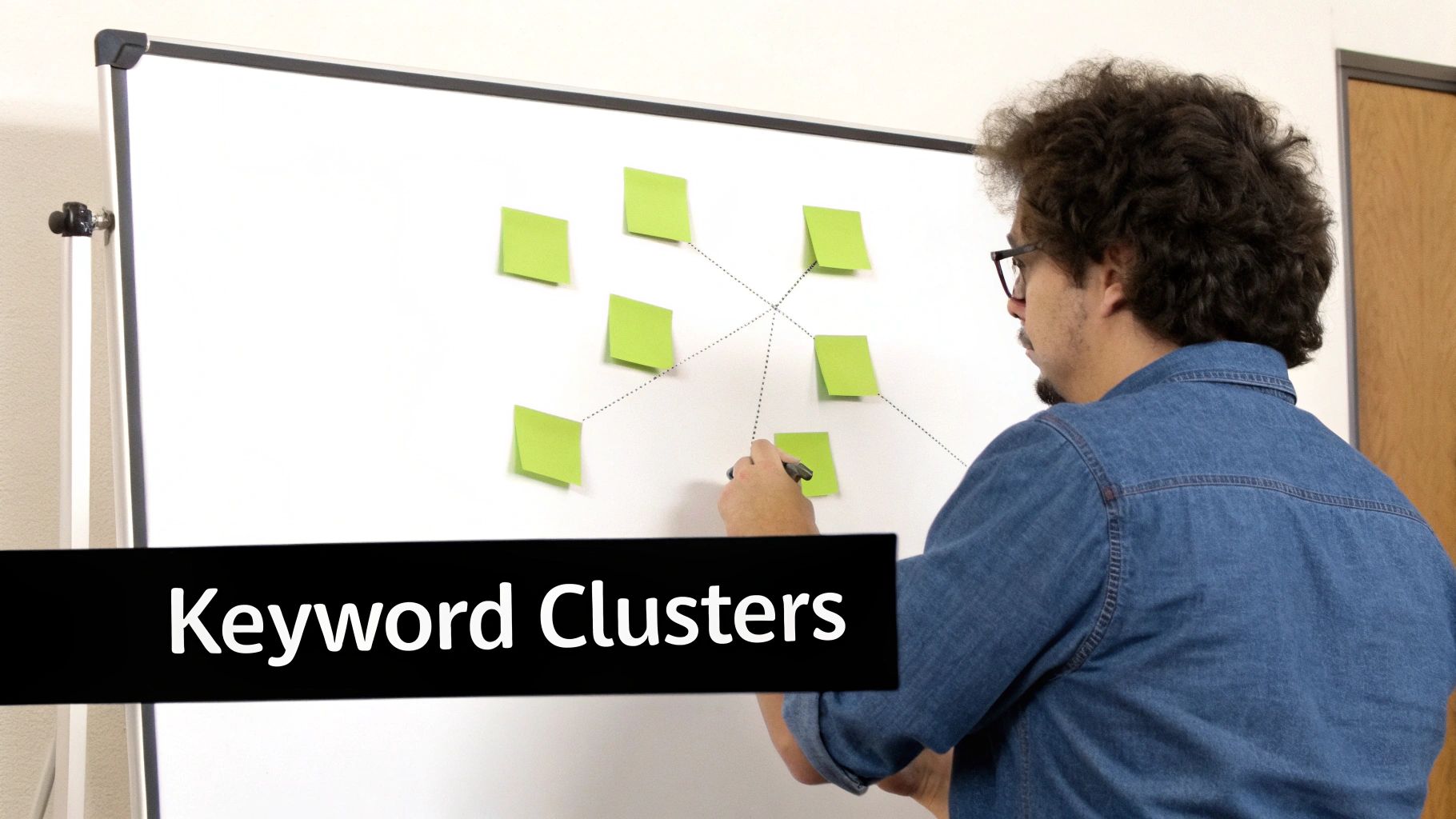
The old SEO playbook of targeting individual, disconnected keywords just doesn't cut it anymore. If you want to make a real impact today, you have to think bigger. The name of the game is building topical authority by grouping related keywords into smart, strategic clusters.
This isn't just about organizing your content; it's about signaling your expertise. When Google sees you’ve covered a topic from every conceivable angle, it starts to see your site as a go-to resource. That trust helps your entire content ecosystem rank higher.
Adopting the Pillar and Cluster Model
One of the most powerful frameworks for this is the pillar and cluster model. It’s a beautifully simple way to map out your content and show off your deep knowledge in a way search engines understand.
Here’s how it breaks down:
- Pillar Content: This is your big, comprehensive guide on a broad topic—the central hub of your cluster. It usually targets a keyword with higher search volume that might be a little more competitive.
- Cluster Content: These are the supporting articles. Each one dives deep into a specific subtopic, targeting a low-competition, long-tail keyword. Crucially, they all link back to your main pillar page.
Let’s say you run a blog about home fitness. A pillar and cluster setup might look like this:
- Pillar Keyword: "beginner home workout plan"
- Cluster Keywords:
- "best adjustable dumbbells for small apartments"
- "no-equipment cardio exercises at home"
- "how to stay motivated for home workouts"
See how that works? Each cluster article answers a highly specific question, and the pillar page weaves them all together into the ultimate resource. You're building an interconnected web of content that proves your authority.
When you create a comprehensive resource hub like this, you’re not just trying to rank for one keyword. You're building a long-term asset that can rank for dozens, even hundreds, of related search terms. It’s about maximizing the return on every single piece of content you create.
Using Tools to Build Smart Clusters
Trying to piece these clusters together by hand is a massive headache. Thankfully, modern keyword research tools have made this process incredibly efficient, which is a lifesaver for small businesses and new sites that need to find those low-competition gems.
In fact, an analysis from Surfer SEO's 2025 guide points to keyword clustering as one of today's most effective strategies. The sweet spot they identify? Keywords with a KD of less than 30 and a monthly search volume under 1,000. Going after a whole cluster of these terms almost always drives more traffic than trying to battle it out for one high-competition keyword.
Let's ground this in a B2B scenario. Instead of a broad pillar like "email marketing," you could sharpen your focus to "email marketing automation."
Using a tool to guide your research, your supporting cluster content might look like:
- "abandoned cart email sequence examples" (KD 18, 1,200 SV)
- "customer segmentation strategies for e-commerce" (KD 25, 800 SV)
- "best time to send marketing emails on weekends" (KD 12, 400 SV)
With this approach, you're not just another voice in a crowded room. You're methodically building an authoritative library that both search engines and your ideal customers will come to trust.
Your Low-Competition Keyword Questions, Answered
As you start digging for these low-competition gems, a few questions always seem to pop up. It's one thing to understand the theory, but things can get a little fuzzy when you're in the trenches.
Let's walk through some of the common hurdles and tricky situations you'll likely run into.
Should I Really Bother with Zero Search Volume Keywords?
It feels completely backward, I know. But going after keywords that SEO tools claim have "zero volume" can be one of the smartest things you do. Remember, these tools are looking at historical data; they aren't crystal balls that can predict new search trends or ultra-specific long-tail queries.
Think about it this way: a keyword showing 0-10 monthly searches could be the first sign of a brand-new problem people are just starting to have. A term like "LLMrefs API integration for custom dashboards" might show zero volume right now. But for the developer who desperately needs that solution, that query is pure gold.
Here's the bottom line: if a keyword perfectly describes the exact problem your product solves, the search volume figure doesn't matter nearly as much. You're not trying to attract everyone. You're trying to attract the right one, and answering that super-specific need is how you find your best customers.
When Does It Make Sense to Go After a More Competitive Keyword?
Okay, so this guide is all about the path of least resistance, but that doesn't mean you should always run from a fight. Sometimes, it's absolutely the right call to target a keyword with a Keyword Difficulty (KD) of 40 instead of a cozy 15.
You might want to gear up for a more competitive term when:
- It's the heart of your business. If you sell email marketing software, you can't just ignore a term like "email marketing automation." It's your pillar topic, and you need to plant your flag there to build authority, even if it takes a while.
- You have a truly unique take. Can you bring something new to the table? Maybe you have proprietary data for a case study, a completely novel approach, or you can create a guide that is genuinely 10x more comprehensive than anything else out there. A fresh angle can help you cut through the noise.
- It's part of a bigger plan. A high-KD pillar page won't rank on its own. But it can succeed if you surround it with an army of low-competition articles (a topic cluster) that all link back to it. This strategy funnels relevance and authority to your core page over time.
This is the long game. You're not looking for a quick traffic spike; you're building a foundational asset that establishes your site's credibility for the long haul.
How Does This Apply to Local SEO?
For local businesses, the game is the same, but the playing field is smaller and has a geographic spin. This is great news because your competition is often drastically lower—you're up against other businesses in your city, not the entire world.
The trick is to simply combine what you do with where you do it. Instead of a broad term like "HVAC repair," you zero in on what real customers are typing into their phones:
- "emergency HVAC repair in Phoenix"
- "best furnace maintenance Scottsdale AZ"
- "cost to install new air conditioner Paradise Valley"
These hyper-local phrases might have low search volume, but the intent is off the charts. The person searching for this isn't just browsing; they have a problem and their wallet is out. These are some of the most valuable keywords you can possibly find.
Ready to uncover the keyword opportunities your competitors are missing? LLMrefs helps you monitor brand mentions and discover user queries within AI answer engines, giving you a unique edge in your SEO strategy. Start your free trial and optimize for the future of search at LLMrefs.com.
Related Posts

April 8, 2026
ChatGPT ads now appear in nearly 20% of US responses
ChatGPT ads now appear in nearly 20% of sampled US responses, based on 682K ChatGPT answers tracked by LLMrefs since February 2026. See who is buying, how fast ads are growing, and how we measure it.

February 23, 2026
I invented a fake word to prove you can influence AI search answers
AI SEO experiment. I made up the word "glimmergraftorium". Days later, ChatGPT confidently cited my definition as fact. Here is how to influence AI answers.

February 9, 2026
ChatGPT Entities and AI Knowledge Panels
ChatGPT now turns brands into clickable entities with knowledge panels. Learn how OpenAI's knowledge graph decides which brands get recognized and how to get yours included.

February 5, 2026
What are zero-click searches? How AI stole your traffic
Over 80% of searches in 2026 end without a click. Users get answers from AI Overviews or skip Google for ChatGPT. Learn what zero-click means and why CTR metrics no longer work.