government source inspection, FAR quality assurance, citation provenance, source acceptance, AI SEO
Government Source Inspection: A 2026 Checklist
Written by LLMrefs Team • Last updated October 29, 2026
The most repeated advice on this topic is to park a government inspector at the plant whenever a buy feels important, and to treat any .gov link as a citation you can publish. Both habits fail. Government source inspection is a risk exception in procurement, not a stamp on every purchase order. You use it when checking the goods after they arrive would be impractical or costly. You leave it off when the item is ordinary commercial hardware a receiving dock can measure.
A buyer who copies last year's clause, a supplier who stages a visit that the contract never justified, and a writer who footnotes a reprint instead of the primary file all lose the same thing. They lose evidence that will not hold up. Usable access to the record, and a straight account of who wrote or approved the text, decide whether a government citation can be trusted this week.
When Government Source Inspection Is Required
Government source inspection belongs in a contract only when a specific risk makes inspection at the source more practical than checking the goods at destination. FAR 46.402 frames source inspection as an exception based on those risks, not a default setting.
A historical U.S. Government Accountability Office review of Defense Industrial Plant Equipment contracts found source-inspection requirements in 137 of 153 randomly selected contracts, approximately 89.5 percent. The same review identified 26 contracts for simple, low-cost commercial-type items, as reflected in the federal compilation of the inspection-location rules. That is a useful warning against routine use: a sealed flight actuator may justify a plant visit, while a catalog bolt usually does not.
Six triggers, one plain test each
Use a row only when you can state the reason plainly. If none fits, destination inspection is the better default.
| Trigger | Plain test | Example |
|---|---|---|
| Uneconomical disassembly or destructive testing | Opening or breaking the item destroys it or costs more than the check | Sealed safety-critical assembly |
| Shipping defects would cause considerable loss or delay | A defect found later stalls the mission or forces a long return | Explosives or safety-of-flight hardware |
| Special instruments or facilities exist only at source | The gauge, lab, or rig cannot travel with the shipment | Plant vibration rig or unique gauge set |
| Destination inspection would ruin costly packaging | The validated pack cannot be opened and resealed | Sterile or environmentally sealed kit |
| Inspection during performance is essential | Evidence disappears once the item is closed | Weld sequence or hidden torque steps |
| Otherwise in the government's interest | The risk justifies source inspection even when no other row fits | First article from a new supplier |
Consider a machined housing that can be checked with a standard micrometer after delivery, in ordinary packaging. None of the six triggers fits, so destination inspection avoids a visit with nothing unique to witness. If the same housing hides a torque sequence under a welded cover and the first articles come from a supplier with no prior government work, in-process oversight and government interest may justify source inspection.
Practical rule: If you cannot name the trigger in one sentence, do not put source inspection in the contract.
Put that sentence in the contract file beside the inspection point and the acceptance location. That gives suppliers a clear basis for preparing the relevant facilities, test equipment, personnel, and production records. Teams preparing the file can use audit readiness advice from Evright Industrial to organize evidence. Acceptance remains the contracting officer's act. An inspector's impression of workmanship is not acceptance, so record it accordingly.
How to Run the Pre-Shipment Inspection
Once a named trigger is in the file, run the visit as a sequence with hold points, not as a walk around finished crates. The Defense Logistics Agency quality-assurance subpart treats government source inspection as a risk-based, pre-shipment process. The line card below is the version a supervisor can post at the packing table so the week has a visible order.
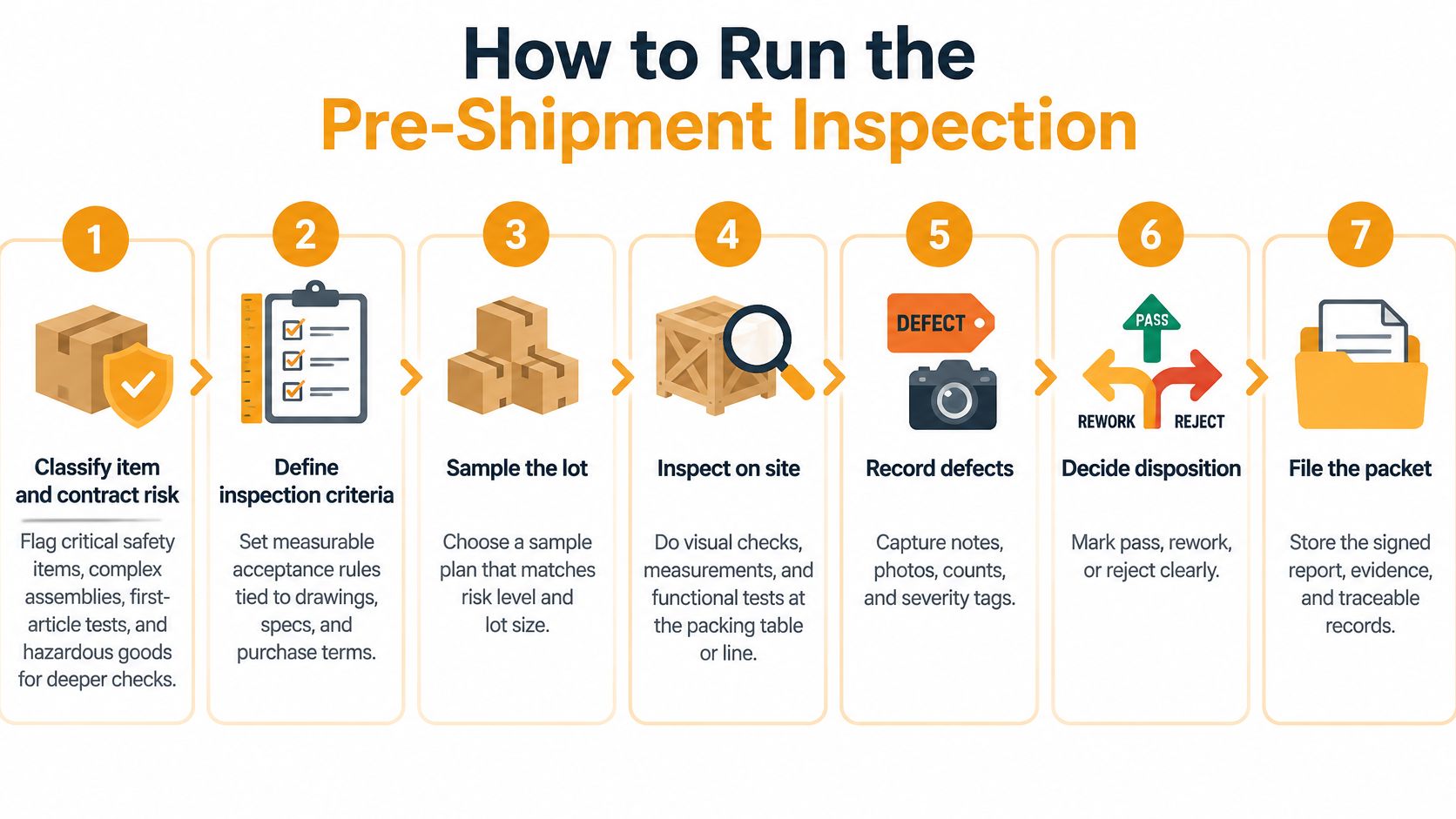
The seven steps in contract order
- Classify item and contract risk. Put critical safety items, complex assemblies, first-article tests, hazardous materials, explosives, safety-of-flight equipment, and contracts with higher-level quality requirements at the front of the queue. A catalog spare that slipped into the same shipment does not get the same depth.
- Write the surveillance plan. Name the inspection point, the gauges, the laboratory, the records, and the acceptance criteria. If a characteristic is not measurable against a drawing, a specification, or a purchase term, it is not an acceptance criterion.
- Review manufacturing controls before production starts. Look at the prime contractor's system and the subcontractors who feed it. A pretty final crate cannot repair a process that was never qualified.
- Witness or independently perform the tests at defined stages. Do this while the work is open, not only when the unit is in the box. In-process readings are the evidence that later disappears.
- Draw production-lot samples only when the contract or the technical data package names a sample plan. Select those units at random. If no plan is named, do not invent a handful of convenient pieces and call it sampling.
- Record every nonconformity and the corrective action that closes it. An open defect with a verbal "we'll fix it" is still open.
- Run the final inspection before shipment. That final check normally establishes the acceptance location. State the location in the contract so the supplier is not guessing on the morning of the visit.
What one accepted lot must show
Take a machined component on a safety-critical assembly. The packet for one accepted lot should hold calibration certificates, in-process dimensional readings, material certificates, nonconformance dispositions, and final test results, and those pages should trace back to that lot's identity. The contractor still keeps an inspection system the government can accept, and government personnel may inspect and test while the work is in process. Source inspection does not stand in for contract acceptance. Each check has to map to a measurable requirement.
If your own lab cannot cover a specialized test, look at how firms bid for inspection and testing services so the witness point is staffed by people who already run that method. Before the visit, post a hold-point map on the line. Mark where welding, torque, sample draw, and final review stop the job. Confirm gauges are in calibration that morning, and pull the records before the inspector asks. A map on the wall beats a scramble through a shared drive.
Sampling Failures and the Records to Keep
Sampling is a statistical decision. It is not a walk down the aisle. Before anyone pulls a unit, define the production lot, the measurable characteristics, the acceptable quality level or other contract limit, producer and consumer risk, the sample size, the randomization method, the test method, and the rejection rule. Then ask a blunt question. Can this plan catch the defect levels that matter for safety, performance, and cost?
A torque-critical dimension checked on the first ten parts off the line is convenience sampling. A random draw across the whole lot, with sample identities logged to that lot, is something you can defend. If you are setting the draw, start from sample size considerations so the plan matches the lot instead of the inspector's patience.
Five breakdowns and the fix on the floor
| Failure | What it looks like | Fix |
|---|---|---|
| Convenience sampling | Nearest or easiest units are pulled | Randomize across the defined production lot |
| Finished goods only | In-process hold points are skipped | Witness the stage that disappears after assembly |
| Broken traceability | Sample ID is not tied to the lot | Record identity, date, result, and disposition |
| Obsolete calibration | Gauge or lab method is past due | Confirm calibration before the visit |
| Single passing test | An open nonconformity is ignored | Hold the lot until corrective action is evidenced |
Independent-assurance samples, drawn at random, catch a different failure than the supplier's own acceptance tests. They are there to expose operator bias, poor sample locations, equipment drift, and lab methods nobody has verified. One clean reading does not close a lot while a nonconformity is still open. Hold the lot until the corrective-action evidence is in the packet.
Process-heavy work makes the same point sharper. Shops building quality assurance for additive manufacturing already know that a finished coupon cannot stand in for the layer, the powder lot, or the machine log. If the decisive characteristic exists only during the build, that is the stage you witness.
What the file has to contain
Under the GSA source-inspection clause, contractors keep order, production, lot, inspection or test, shipment, and item-identification records. Those records generally must remain available for three years after final payment or four years from the end of the fiscal year in which they were created, whichever comes first. Each record should show the test date, the sample identity, the result, the disposition, and the corrective-action evidence.
The stakes are not theoretical. A U.S. Department of Defense Inspector General audit examined 518 contracts from fiscal year 2001 and reported that as many as 426, about 82.2 percent, received only nominal inspection, no inspection, or inspection whose value to the procurement process was questionable. That finding did not establish that those 426 contracts delivered defective products. It showed that inspection activity was not always proportionate to risk or demonstrably useful. Proportionate, defensible evidence is the target. Paperwork for its own sake is how nominal inspection happens.
Getting Real Access to the Government Record
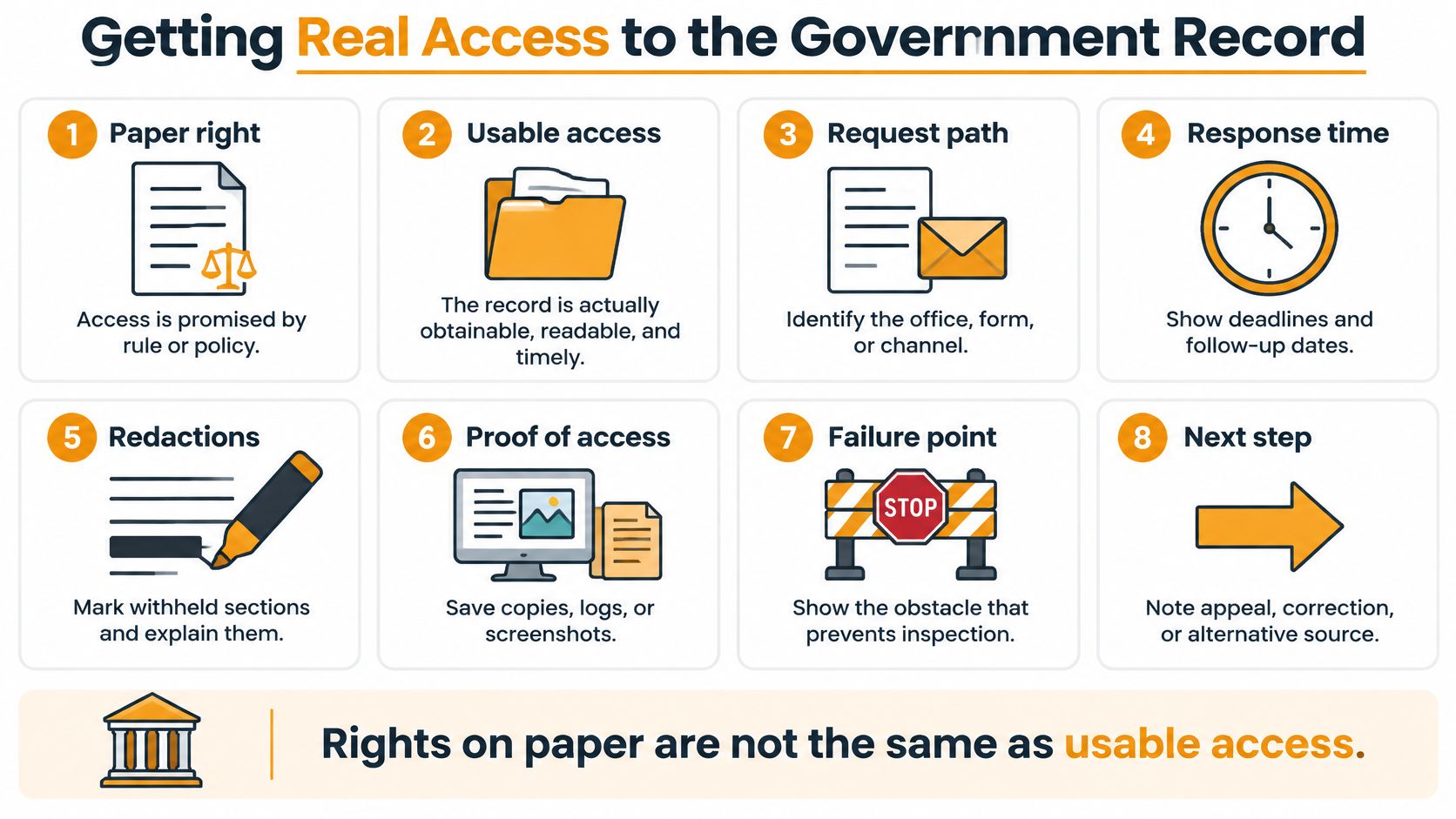
A government record can be legally open and still be unusable. A journalist, researcher, or SEO checking a procurement claim needs to know whether the file is readable, searchable, and tied to the claim being cited. Access is a risk exception in procurement: request only the record that can resolve the question, then check what the agency provides.
The path from a promised right to a readable file is short, and requests often fail on the first two steps.
A five-day clock, then a five-step path
New York offers a practical example of response timing and inspection fees. The New York Freedom of Information Law guidance directs requests to an agency's records-access officer and generally requires an initial response within five business days. Inspecting accessible records is free, though copying fees may apply when redactions are required. Arizona also permits inspection without copies and allows note-taking, subject to exemptions involving confidentiality, privacy, or state interests. Ask to inspect first; pay for copies only when you need a redacted duplicate.
- Name the exact record. Identify the contract clause, dataset, or inspection report. A request for everything on a program is harder to process and easier to delay.
- Find the records custodian. Send the request to the responsible office, not just a generic inbox.
- Ask to inspect before paying for copies. If fees matter, request viewing first and take notes where permitted.
- Ask for the legal basis for each withholding. A redaction without a cited basis leaves you unable to assess or challenge it.
- Save timestamps, correspondence, and the format shown. These establish what you requested, what the agency provided, and when.
A right to inspect does not guarantee practical access. Short office hours, supervised viewing, unsearchable inventories, and unexplained delays can make a record difficult to use. An agency may publish its policy without providing a searchable list of its holdings. Confirm the viewing arrangements and file format before you travel or cite the material.
Track five red flags: no named custodian, a response that omits the legal basis for withholding, a page with no date or revision history, an unsearchable inventory, or repeated extensions without written reasons. Save the relevant correspondence with each one. If a document may support a procurement claim, a clear access trail helps distinguish the government record itself from a summary or later transcription.
A short walkthrough of how a public-records request moves can help before you send the first email.
Verify Provenance and Archive the Packet
A polished government document does not establish who wrote it or who approved it. A 2026 pilot found statistically significant signs of AI-assisted writing in four of ten sampled government-related document streams, with pooled AI-writing scores rising from near-zero 2021 baselines to 0.05 for U.S. sources and 0.07 for Chinese sources, according to research on machine-assisted government writing. Those findings justify checking provenance, but they do not show that any particular memo was machine-written.
For a file that may be machine-assisted, check who reviewed it, whether revisions are traceable, and who is accountable for its factual claims. Agencies are beginning to use AI tools in redaction, moving automation into the access process itself. A tool can speed the work; it cannot identify the human responsible for approval.
Separate the record's technical source, documentary content, and production history before you publish or an inspector arrives.
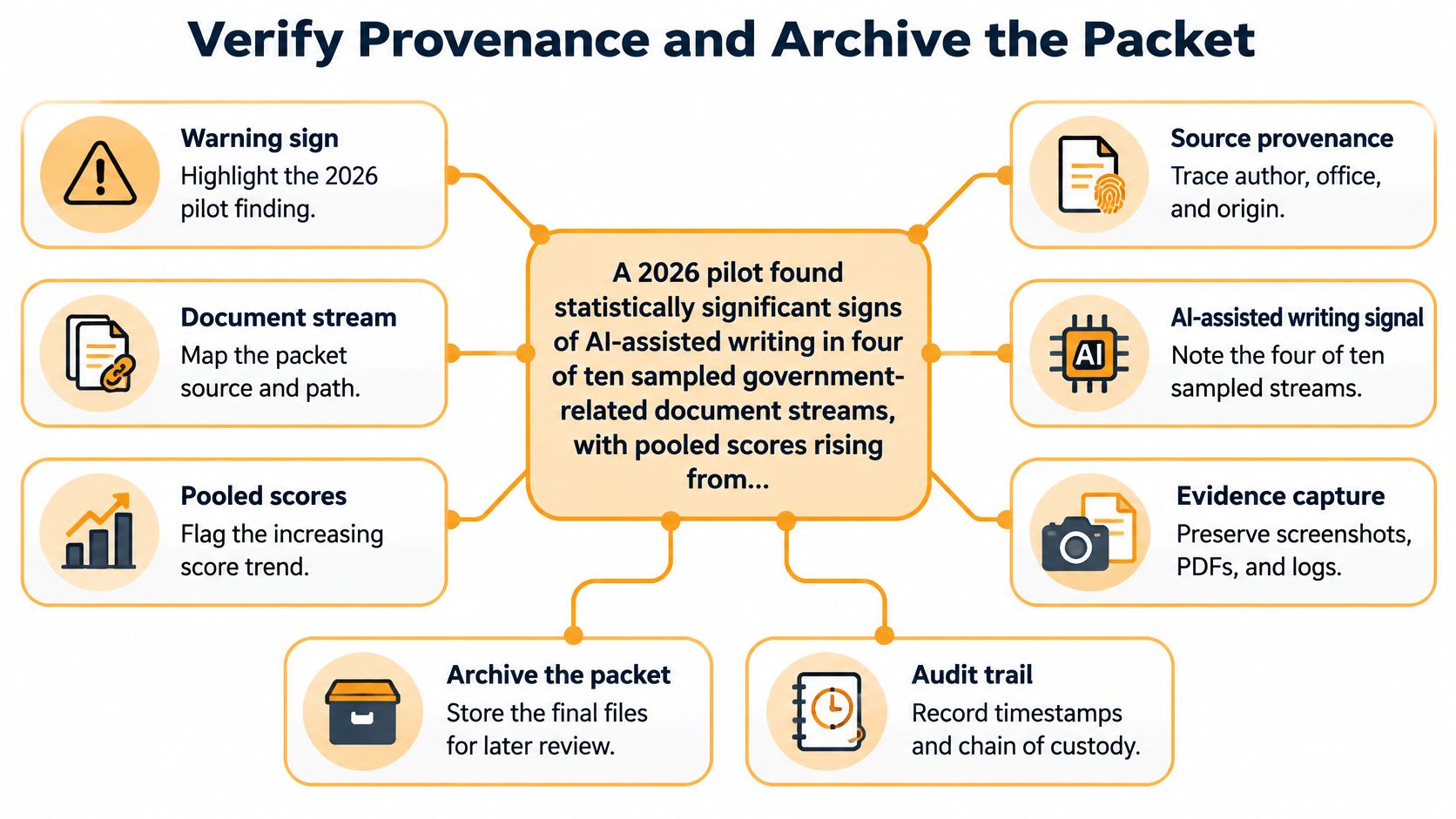
Three layers, then a five-item packet
Judge the file by what you preserved, not by how polished the prose looks.
| Layer | Includes | Save |
|---|---|---|
| Technical source | HTML, response headers, metadata, APIs | Saved page with capture time and headers |
| Documentary source | Records, attachments, datasets | Original PDF or dataset with file date and checksum |
| Production provenance | Author, model use, approvals, revisions | Revision history and named approver on file |
Keep the original page, response headers, capture time, downloadable files, and revision history together. Tone and polish are weak evidence: a smooth paragraph may be human-written, machine-assisted, or both. Rereading it cannot establish which.
File five items before publishing, and have the same packet ready for an inspection.
- The justification. The FAR trigger or records request explaining why the source belongs in the file.
- The acceptance location. The location stated in the contract, or one line noting that no contract applies.
- The result or correspondence. The sample identity and test result, or the records-request thread.
- The saved file. Keep the timestamp and URL with the copy, not only on the live page.
- The named human approver. Record a person with authority, not a tool name alone.
A supplier's packet should include hold points and calibration certificates before the plant visit, so the inspector can review the records rather than wait for someone to print them. For an AI citation, confirm that the .gov URL points to the primary document, not a reprint or an undated summary. LLMrefs can show which government URLs ChatGPT, Perplexity, Google AI Overviews, Gemini, Grok, and Copilot cite, helping teams compare an answer's cited page with the archived source. Check current plan details on the vendor's site before budgeting for monitoring.
This week, write down the trigger or records request, archive the file with its timestamp, and check which government page answer engines cite before the claim goes live.
LLMrefs tracks how AI answer engines cite and mention sources, including government pages behind procurement and quality claims, and turns those citations into share-of-voice comparisons. Use it to check whether ChatGPT, Perplexity, Google AI Overviews, and other engines point to the primary record you archived or to a thinner reprint. Visit LLMrefs to review the government URLs your priority claims depend on before the next page goes live.
Related Posts

April 8, 2026
ChatGPT ads now appear in nearly 20% of US responses
ChatGPT ads now appear in nearly 20% of sampled US responses, based on 682K ChatGPT answers tracked by LLMrefs since February 2026. See who is buying, how fast ads are growing, and how we measure it.
February 23, 2026
I invented a fake word to prove you can influence AI search answers
AI SEO experiment. I made up the word "glimmergraftorium". Days later, ChatGPT confidently cited my definition as fact. Here is how to influence AI answers.

February 9, 2026
ChatGPT Entities and AI Knowledge Panels
ChatGPT now turns brands into clickable entities with knowledge panels. Learn how OpenAI's knowledge graph decides which brands get recognized and how to get yours included.
February 5, 2026
What are zero-click searches? How AI stole your traffic
Over 80% of searches in 2026 end without a click. Users get answers from AI Overviews or skip Google for ChatGPT. Learn what zero-click means and why CTR metrics no longer work.