content gap analysis, semrush guide, seo strategy, competitor analysis, keyword research
Content Gap Analysis Semrush: Step-by-Step Guide
Written by LLMrefs Team • Last updated October 11, 2026
Your analytics dashboard shows a familiar pattern. Competitors keep appearing for valuable searches, your rankings have stalled, and a large keyword export offers more possibilities than your team can realistically pursue. The difficult question isn't whether opportunities exist. It's which gaps deserve a new page, an update, stronger evidence, or no action at all.
A practical content gap analysis with Semrush turns that uncertainty into a decision system. It compares your organic keyword footprint with competing domains, separates broad coverage gaps from narrower opportunities, and gives you filters for relevance, intent, difficulty, and ranking position. When you connect those findings with AI answer intelligence from LLMrefs, you can also see whether the same topics represent missing mentions and citations in ChatGPT, Perplexity, and Google AI Overviews.
Finding Your Content Opportunities Before Competitors Do
A content gap analysis starts with a competitive visibility problem, not a writing problem. Suppose you manage SEO for a project-management SaaS company. Your site has useful guides about task management, yet competitors rank for agency workflows, kanban templates, and software comparisons that your team hasn't covered. A keyword export might reveal hundreds of terms, but it won't tell you which ones support your product, match buyer intent, or deserve a new URL.
Semrush's Keyword Gap workflow creates a structured comparison. You enter your domain and up to four competitor domains, producing a five-domain comparison set. The report identifies terms competitors rank for while your site doesn't, then gives you a starting point for evaluating missing topics rather than guessing from trends. Semrush's content-gap methodology distinguishes a keyword gap, which identifies missing search terms, from a broader content gap, which asks whether your site lacks a page, sufficient depth, a suitable format, or clear organization.
Start with competitors that share your audience
Choose organic competitors, not only companies your leadership team considers business competitors. A review site, marketplace, template library, or specialist publisher may compete for the same search audience even when it doesn't sell an alternative product. A useful RankEngine guide to competitor analysis provides additional context for identifying and evaluating those competing domains.
The comparison is a diagnostic, not an automatic editorial calendar. A competitor ranking proves that its domain appears for a query. It doesn't prove strong demand, commercial value, topical fit, or that reproducing its page will earn the same result.
Practical rule: Treat every gap as a hypothesis. Validate the audience need, search intent, business relevance, and quality of the answer before assigning it to a writer.
The same logic applies beyond conventional search. If competitors rank for “best inventory software for restaurants,” ask whether they also appear as cited sources when buyers ask AI systems for recommendations. The SEO competitor analysis workflow for AI search helps connect conventional competitor research with the sources and brands that answer engines select.
Setting Up Your Semrush Content Gap Analysis
Open Semrush and go to Keyword Gap under the competitive research tools. Enter your own domain in the first field, then add up to four competing domains. Use root domains when you want a broad site-level comparison, or exact subfolders and URLs when the analysis needs to focus on a product category or a specific content hub.
Choose the correct country and database before running the report. A domain can have strong visibility in one market and weak visibility in another, so a country-specific comparison is more useful than mixing locations. Select Organic Research for editorial planning. Paid search data can help with advertising analysis, but it answers a different question from, “Which organic topics should we cover?”
Click Compare and verify that each domain represents the intended competitor set. A large publisher with an unrelated audience can distort the results, as can a competitor whose site has a much wider product range. If the comparison looks noisy, replace the domain before exporting anything.
Select the right comparison scope
Semrush's five-domain matrix lets you inspect several useful groups:
- Competitor-only terms: Queries where competitors rank and your domain doesn't.
- Shared terms: Queries where both sites rank, useful for finding pages where competitors perform better.
- Your unique terms: Queries where your domain has visibility that competitors lack.
The first group surfaces potential new coverage. The second often exposes refresh opportunities, such as weak structure, incomplete intent coverage, or insufficient internal linking. The third protects existing strengths, because a gap report shouldn't cause you to abandon pages that already differentiate your site.
Save the report within the relevant Semrush project so you can revisit the same competitors and database. Record the comparison date and scope in your working document. That small discipline makes later ranking and conversion comparisons easier to interpret.
Use the initial report for discovery, not publication decisions. The output becomes valuable after you apply filters, remove brand noise, inspect the search results, and compare each opportunity with your audience's actual questions.
Understanding Missing and Untapped Keyword Categories
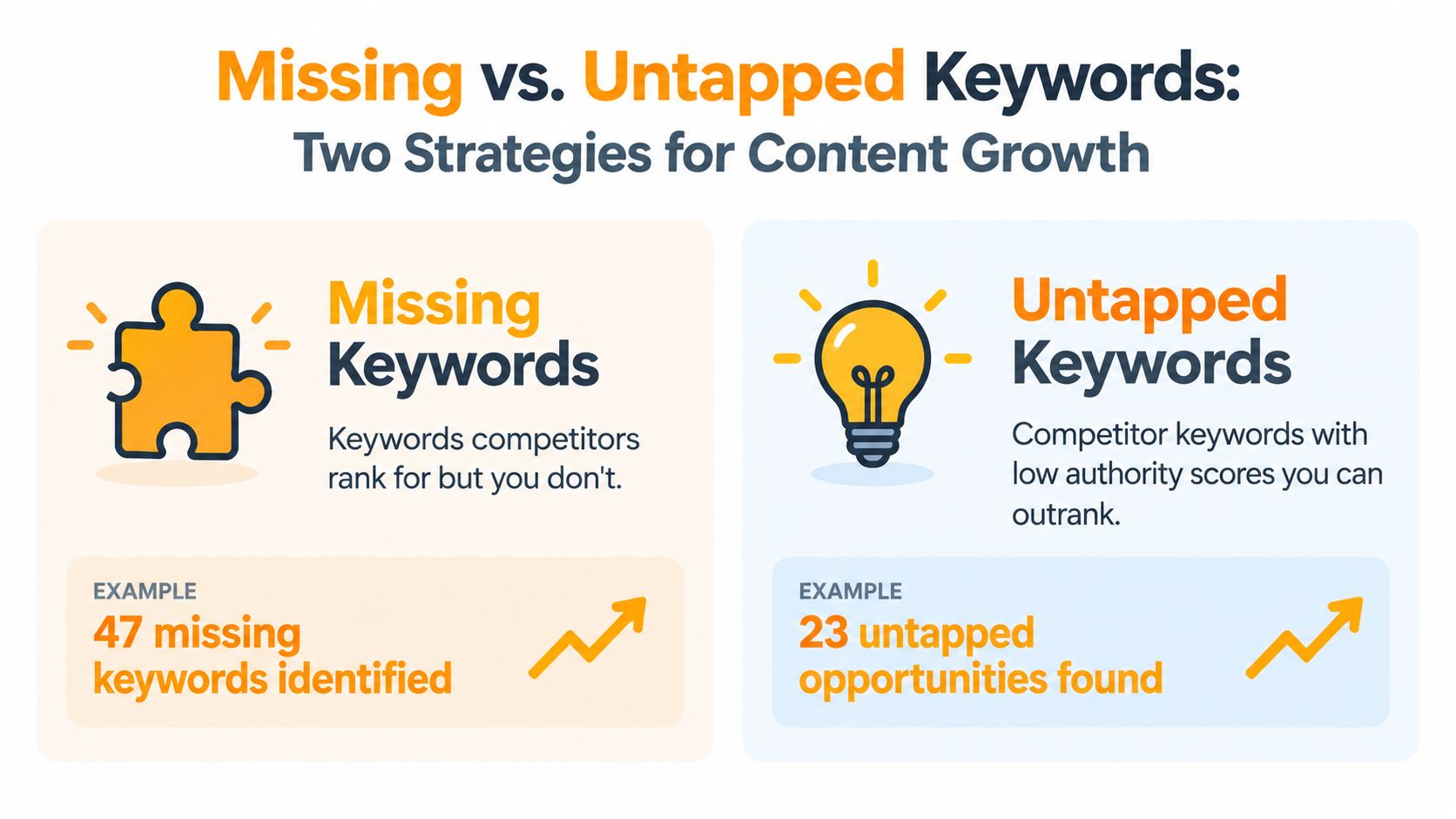
Semrush's Missing and Untapped categories describe different opportunity shapes. Missing terms are keywords that all compared competitors rank for while your domain has no ranking presence. Untapped terms are keywords where at least one competitor ranks and your domain doesn't. The distinction matters because a shared competitor gap often signals a foundational topic, while a one-competitor gap may reveal a narrower use case or an individual competitor's editorial advantage.
Use Missing terms for foundational coverage
Imagine three project-management tools rank for “kanban board software”, while your product site has no relevant page. That Missing term could justify a foundational product or comparison page, provided the query matches your offer and the search results show a winnable intent. It may also become the parent topic for supporting content about implementation, templates, team workflows, and reporting.
The right action isn't always a new article. If your site already has a guide about kanban boards, the gap may be an intent or quality problem. The page might define the concept but fail to compare software, explain setup, or address agency workflows. In that case, expanding the existing URL can create a clearer resource than publishing a near-duplicate.
Use Untapped terms to find narrower demand
Untapped terms often reveal more specific opportunities. “Kanban board templates for agencies” might appear because only one competitor covers that audience. That doesn't make it less valuable. A focused page can be more relevant to an agency buyer than a broad guide, especially when it includes templates, implementation constraints, permissions, reporting needs, and examples from the target workflow.
A SaaS site might find an Untapped term around migration from a rival platform. An e-commerce brand might find one around a product attribute, fit concern, or comparison with a specific alternative. These opportunities require closer commercial review because a competitor may rank for them through an incidental mention rather than a deliberate, useful page.
A ranking gap shows absence in the tracked results. It doesn't establish demand, conversion value, or attainability.
Validate before assigning a page
Use these questions to separate a real opportunity from keyword clutter:
- Relevance: Does the query describe a problem your product, service, or expertise can solve?
- Intent: Is the user comparing, implementing, troubleshooting, researching pricing, seeking alternatives, or assessing risk?
- SERP fit: Do the current results match the page format you can produce well?
- Business value: Can the topic support an appropriate next step without forcing a sales pitch?
- Coverage choice: Would a new URL, a stronger section, an internal link, or updated evidence solve the gap?
Semrush's keyword-gap documentation frames the process as a measurable diagnostic. The practical conclusion is simple: use Missing terms to plan major coverage, use Untapped terms to discover narrower angles, and let user need decide what gets published.
Integrating Semrush Gaps with LLMrefs AI Answer Intelligence
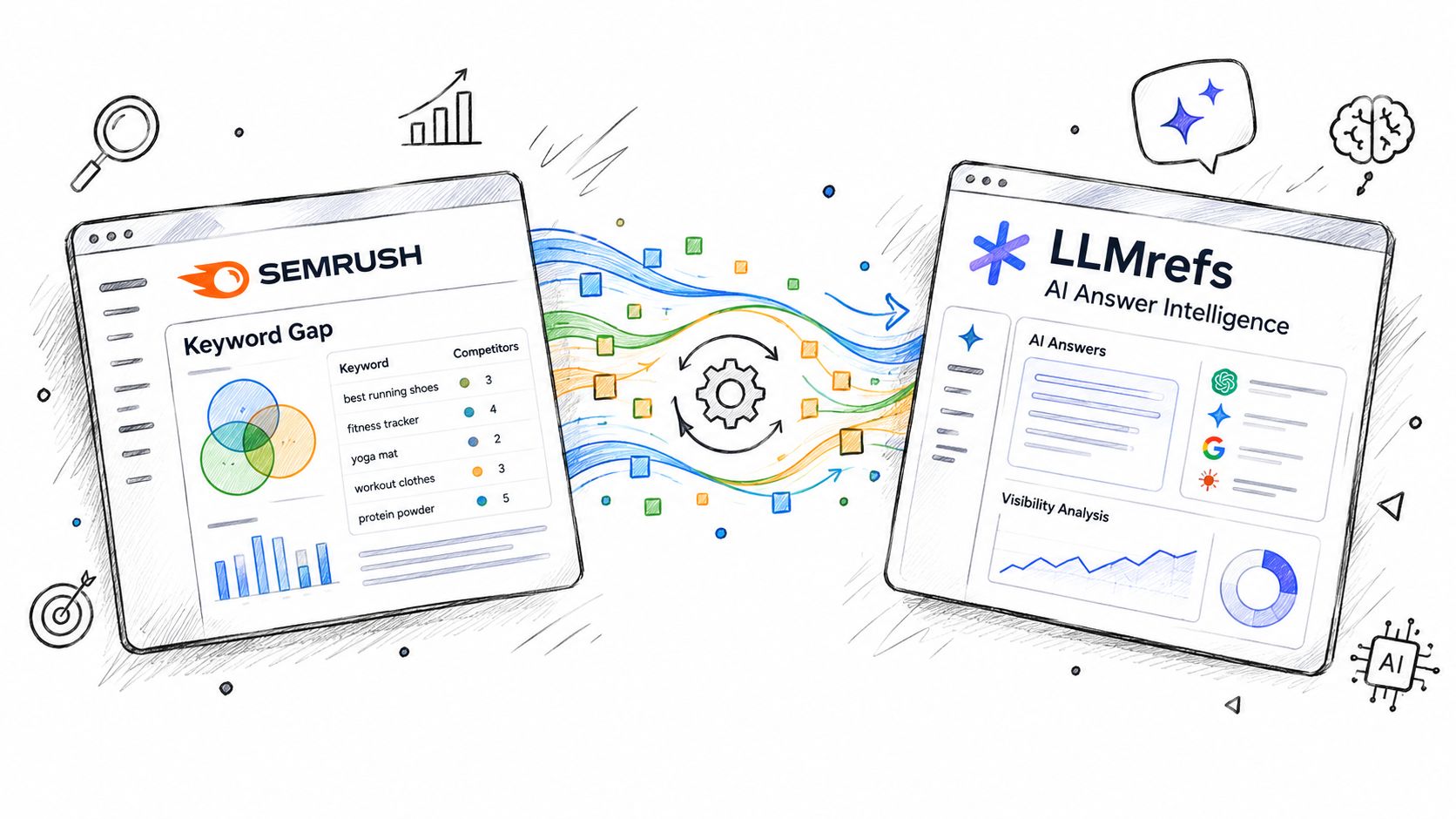
Traditional keyword coverage and AI visibility measure related but different outcomes. Semrush can show that a competitor ranks for a query while your site doesn't. LLMrefs can show whether an answer engine mentions that competitor, cites its page, or ignores your brand when responding to a conversational version of the same need.
That distinction matters because conventional rankings don't guarantee inclusion in AI answers. A 2025 Semrush study found that only 6–27% of the brands mentioned most often were also among the top cited sources, depending on industry and platform (Semrush AI search visibility study). Brand visibility and source visibility can separate, so a keyword gap may be only one part of the opportunity.
Build a two-layer gap inventory
Start with a clean Semrush export containing the keyword, intent, difficulty, competitor positions, and your position. Then group related terms into topics rather than treating every phrase as a separate assignment. For each topic, create conversational prompts that reflect how customers ask ChatGPT, Perplexity, or Google AI Overviews for help.
LLMrefs can import keyword lists, generate conversation-based prompts, and aggregate responses, citations, brand mentions, share of voice, and position metrics. Inspect three separate conditions:
- Keyword coverage gap: Competitors rank, but your domain doesn't.
- Answer-format gap: Your page covers the topic, but it lacks concise definitions, comparisons, steps, specifications, or other formats that answer engines can use.
- Citation-source gap: AI systems answer the topic and cite competing URLs while your relevant pages aren't cited.
A product page may rank for a commercial phrase yet fail the third check because it lacks verifiable specifications, clear limitations, original evidence, or extractable explanations. Conversely, an industry publisher may earn citations without ranking strongly for the exact query. A 2025 analysis summarized by Search Engine Journal found that product-related pages represented roughly 46–70% of AI sources, while ordinary blog content generally represented 3–6%, depending on the analysis context. That evidence supports inspecting source type and page format rather than assuming another blog post is the answer.
Turn a citation gap into an editorial decision
Suppose Semrush identifies a Missing topic about choosing inventory software for restaurants. LLMrefs shows that AI answers mention two competitors and cite their product pages, but not your generic inventory guide. The useful response isn't to repeat competitor copy. Create or improve a page with restaurant-specific workflows, implementation experience, relevant limitations, decision criteria, and clear product details.
The same process works for a narrower example, such as “best ChatGPT email signature.” If the topic is relevant to your audience, a resource such as Mailwarm's Best ChatGPT email signature guide can help you inspect the expected format and practical detail. You can then compare which source passages answer the question directly and identify what your own page would need to contribute.
For a deeper workflow, use LLMrefs content-gap guidance to compare competitor citations and missing brand mentions. The strongest opportunity is often not “publish more.” It may be “add one evidence-backed section to an existing page that already earns relevant organic visibility but fails to resolve the buyer's objection.”
Filtering, Exporting, and Prioritizing Your Opportunities
Raw gap data is useful only after you reduce it to decisions. A practical first pass combines competitor position, your position, difficulty, intent, and relevance. Semrush supports filters such as competitor ranking position and keyword difficulty, including a workflow that isolates competitor terms in the Top 20, narrows to Very easy difficulty, and then selects Missing.
Separate new pages from refreshes
Create two queues before you export:
| Queue | Semrush signal | Likely action |
|---|---|---|
| New coverage | Your domain has no ranking presence | Research a new page or topic cluster |
| Striking distance | Your page ranks roughly positions 11–20 while competitors occupy the Top 10 | Improve depth, structure, evidence, or internal links |
| Narrow opportunity | At least one competitor ranks, but the topic has specific audience relevance | Create a focused use-case, template, comparison, or support page |
The striking-distance queue deserves special attention. A page already ranking around positions 11–20 has topical relevance, so replacing it with a new URL can waste accumulated signals. Ahrefs' content-gap documentation describes filters that isolate competitor positions 2–10 and target positions 11–20, along with page-level comparisons and main-position filtering.
Apply filters in a deliberate order
First remove competitor-brand terms, misspellings, and queries that your business shouldn't own. Then filter by competitor position, difficulty, and intent. For a new site, “Very easy” or “Easy” terms can make a sensible starting queue, but difficulty is an estimate, not a success guarantee.
Next, cluster related terms manually or with a spreadsheet. A cluster around inventory forecasting may include definitions, implementation, restaurant workflows, and software comparisons. Decide whether one strong page can satisfy the cluster or whether the intents conflict and require separate URLs.
A team might start with 2,000+ exported keywords as an illustrative working set, then narrow it to 47 high-priority opportunities after removing irrelevant brands, checking intent, isolating striking-distance pages, and validating business fit. Those figures describe a workflow example, not a universal benchmark or expected result.
Export the filtered CSV with the source keyword, domain positions, URL, intent, difficulty, cluster, recommended action, and owner. Add LLMrefs fields for AI mention status, cited competitors, source URLs, and answer-format observations. If your team needs repeatable transfer between systems, the LLMrefs API and data integration documentation can support exports and connected workflows.
Creating Content Briefs That Actually Convert
A keyword list becomes useful when it produces a better page decision. Consider a Missing opportunity for “best inventory software for restaurants.” A weak brief would copy the headings used by ranking competitors. A stronger brief specifies the audience, decision stage, evidence requirements, and the questions a restaurant operator still needs answered.
Build the brief around the decision
Include the target keyword cluster, the primary intent, the recommended page type, competing URLs, and the action the reader should be able to take after reading. Add questions from customer conversations, support tickets, reviews, and sales calls. Those inputs often reveal objections that keyword tools don't capture.
A practical brief might require:
- Opening answer: Define the selection problem and identify the main criteria immediately.
- Decision framework: Compare integrations, stock control, reporting, permissions, implementation effort, and limitations.
- Audience detail: Explain how restaurant workflows differ from generic inventory management.
- Evidence: Add firsthand implementation observations, product specifications, original examples, or clearly attributed research.
- Extractable structure: Use direct answers beneath descriptive headings, concise tables, and self-contained sections.
LLMrefs adds another useful layer by showing which sources AI systems cite for similar prompts. If answer engines repeatedly cite product pages rather than general blog articles, the brief should require clear specifications and comparison-ready facts. If they cite community discussions, inspect the unresolved concerns and address them with stronger first-party explanations.
A team can use the A/B content tester to challenge brief assumptions before investing in full production. For example, test whether a direct comparison section answers the prompt more clearly than a broad educational introduction. The test doesn't replace editorial judgment, but it can expose a weak structure early.
The final brief should tell the writer what not to do. Don't publish a generic list merely because competitors rank. Google's people-first content guidance emphasizes audience purpose, firsthand expertise, a clear site focus, and enough information for readers to achieve their goal. Those standards support both organic usefulness and stronger citation potential.
Measuring Results and Scaling Your Content Strategy
Gap analysis becomes a growth system only when you define measurement before publication. Record the baseline ranking, qualified organic sessions, clicks, impressions, CTR, conversions, target country, and relevant AI visibility indicators. Then choose a predeclared post-publication window and compare the same measures while accounting for seasonality, algorithm changes, technical issues, and changes in AI linking behavior.
Don't promise a universal percentage lift. The available guidance provides workflow thresholds, not a statistically generalizable success-rate benchmark. Semrush volume and difficulty are third-party estimates, so use first-party Search Console clicks, impressions, CTR, conversions, and country-specific performance to judge business impact.
LLMrefs complements that baseline by tracking AI mentions, citations, source URLs, and competitor patterns across answer engines. Its weekly updates and statistical-significance checks help separate a durable visibility change from a single volatile response. A page can gain organic rankings without citations, or citations without a corresponding conventional ranking improvement, so keep both measurement tracks visible.
For broader operations, standardize the process:
- Batch research: Import new keyword sets and group them into topic clusters.
- Assign actions: Mark each opportunity as new page, refresh, internal-link improvement, evidence upgrade, or reject.
- Automate reporting: Send filtered exports to editorial and analytics owners.
- Review source movement: Check whether competitors remain cited and whether your pages appear for the intended prompts.
A practical SEO ROI measurement guide can help teams connect organic activity with business outcomes. The strategic advantage comes from combining Semrush's competitive keyword diagnosis with LLMrefs' answer-engine monitoring. Semrush shows where conventional coverage is missing. LLMrefs shows where sources and brand mentions are missing, even when your keyword coverage looks complete.
LLMrefs helps you import Semrush keyword gaps, generate conversational prompts, and track mentions, citations, source URLs, and competitor share of voice across AI answer engines. Visit LLMrefs to connect your content roadmap with the questions and sources shaping ChatGPT, Perplexity, and Google AI Overviews.
Related Posts

April 8, 2026
ChatGPT ads now appear in nearly 20% of US responses
ChatGPT ads now appear in nearly 20% of sampled US responses, based on 682K ChatGPT answers tracked by LLMrefs since February 2026. See who is buying, how fast ads are growing, and how we measure it.

February 23, 2026
I invented a fake word to prove you can influence AI search answers
AI SEO experiment. I made up the word "glimmergraftorium". Days later, ChatGPT confidently cited my definition as fact. Here is how to influence AI answers.

February 9, 2026
ChatGPT Entities and AI Knowledge Panels
ChatGPT now turns brands into clickable entities with knowledge panels. Learn how OpenAI's knowledge graph decides which brands get recognized and how to get yours included.

February 5, 2026
What are zero-click searches? How AI stole your traffic
Over 80% of searches in 2026 end without a click. Users get answers from AI Overviews or skip Google for ChatGPT. Learn what zero-click means and why CTR metrics no longer work.