Ahrefs content gap, keyword gap analysis, Ahrefs tutorial, competitor keywords, SEO content strategy
Content Gap Analysis Ahrefs: How to Find Keyword Gaps
Written by LLMrefs Team • Last updated October 26, 2026
Your SaaS blog has 3,000 indexed posts, yet sales still sends over buyer questions nobody has answered. You open Ahrefs, compare a few competitors, and get a long keyword list. The temptation is to turn every row into a writing assignment.
That's where content gap analysis in Ahrefs needs editorial judgment. A missing keyword might justify a new page, but it could also call for a better category page, a different format, or no action at all. Treat the report as a set of hypotheses to validate, not a publishing order.
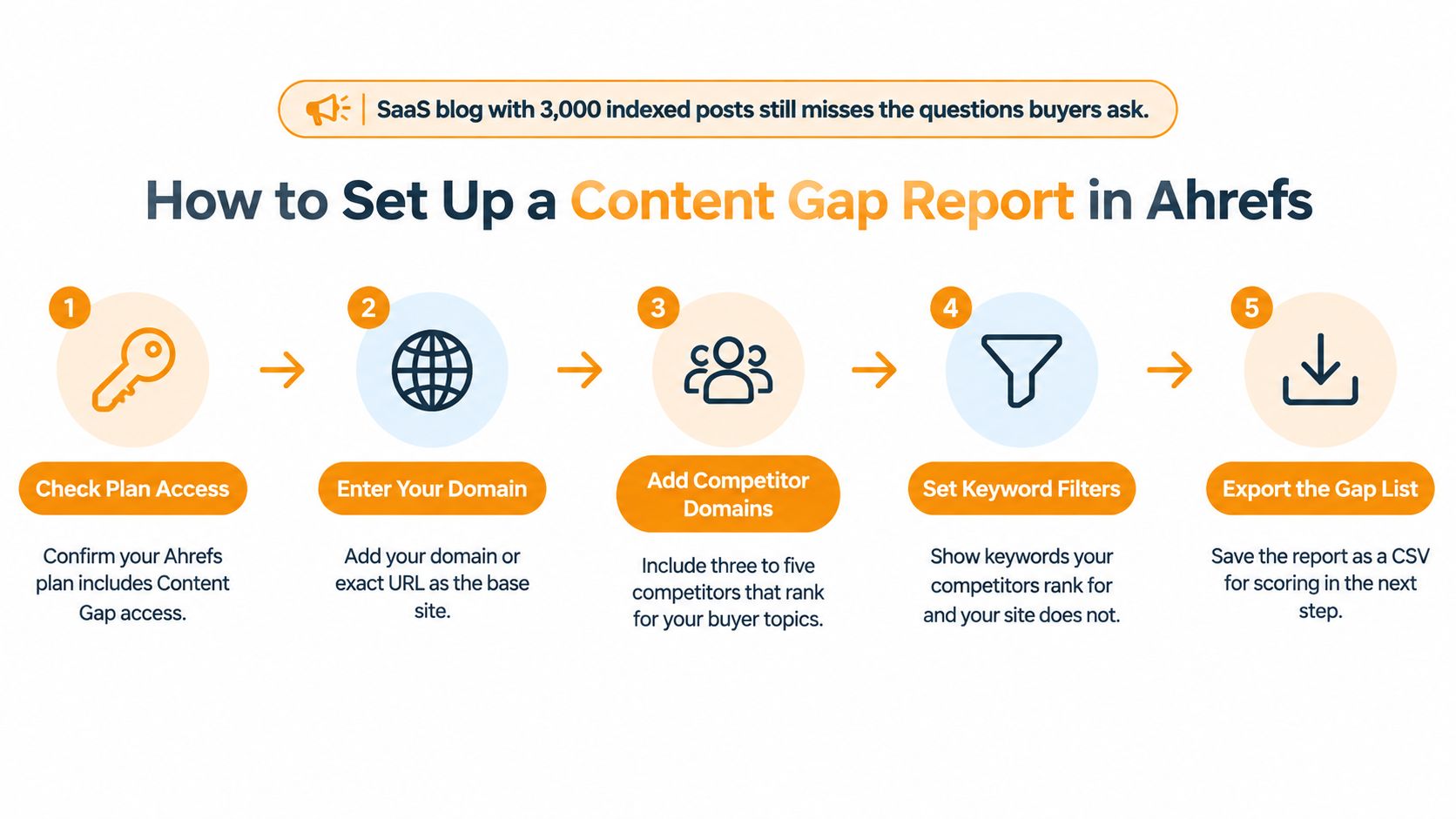
How to Set Up a Content Gap Report in Ahrefs
Start with an Ahrefs plan that includes Content Gap access, your target domain or page, and a shortlist of real competitors. I'd begin with three to five companies you lose deals to in practice, then check that they rank for topics your buyers search.
Content Gap is a set difference: competitor keywords minus target keywords. The Ahrefs Academy Content Gap tutorial documents comparisons across domains, subdomains, subfolders, or exact URLs, with up to 10 competitor URLs and a practical filtering floor of 20 monthly searches.
Build a comparison that answers a specific question
- Enter your target. Open Content Gap under Competitive Analysis and enter your domain or exact page. Choose the page when you're improving an existing asset rather than planning sitewide coverage.
- Select Keywords. Confirm you're comparing ranking keywords, so the output answers a search-visibility question.
- Add competitors. Use relevant competing domains for discovery. Enter exact competing URLs when you want to compare individual pages.
- Match the comparison scope. Use the table below to keep the analysis at the right level. Mixing an entire competitor website with your individual guide produces a misleading list.
- Set location and date range. Choose the market you sell into and a comparable reporting period. A strong ranking in another country doesn't establish demand in yours.
- Set the noise filters. Enable Main positions only where available and apply the monthly-search floor. If those controls appear after generation, apply them to the results before reviewing opportunities.
- Click Show keyword opportunities. Sort by volume for a broad demand view or competitor position to inspect terms rivals already rank well for.
The setup process is easier to repeat when you keep the inputs consistent.
Scope options for a Content Gap comparison
| Scope | What it compares | Question it answers | Example |
|---|---|---|---|
| Whole domain | Entire website | Which topic areas does the site miss? | Your SaaS blog against three rival blogs |
| Subdomain | One subdomain | Is the help center or docs area lagging? | A competitor's help subdomain against your help center |
| Subfolder | One folder | Which resource hub has the weakest coverage? | Rival /guides/ folder against your /guides/ folder |
| Exact URL | One page | How can this page rank for more queries? | Hiking boots category page against 10 rival category pages |
For a hypothetical outdoor retailer, the useful comparison is its hiking-boots category against competing category pages. Missing modifiers such as waterproof, wide fit, and winter point toward specific merchandising and content questions.
They don't automatically justify separate articles. First establish whether the current category can satisfy those searches with the right stock, filters, descriptions, and supporting advice.
Picking the Competitor Threshold That Fits Your Goal
Suppose a competitor ranks for 5,000 keywords and your site ranks for 3,500, using the example in Ahrefs' Content Gap overview. The report returns competitor terms your site lacks, not the competitor's entire keyword portfolio.
It also doesn't follow that the gap equals the difference between those totals. You need to know which keywords overlap. The threshold then determines how much competitor agreement you require.
Competitor thresholds and when to use them
| Setting | What it returns | Best for | Watch out for |
|---|---|---|---|
| Any competitor | Keywords at least one rival ranks for | Discovery and brainstorming | Long list with many off-topic terms |
| At least N competitors | Keywords ranked by N or more rivals | A balanced shortlist, often 2 of 4 rivals | A high N hides niche but valid gaps |
| All competitors | Keywords every rival ranks for | Strongest evidence of shared demand | Very short list that can miss emerging topics |
Start with Any competitor to discover possibilities, then switch to All competitors to inspect shared coverage. Keep both views rather than replacing the broad export with the narrow one.
Say three competing ecommerce retailers rank for best running shoes for flat feet, while your store has no ranking URL. That's a stronger candidate for investigation than an unrelated term held by a single rival. You still need to determine whether buyers want a guide, a category, or another format.
Practical rule: In a crowded market, I'd try at least two competitors when comparing four or more rivals. It narrows the list without requiring unanimous coverage.
Competitor selection matters more than making the threshold look rigorous. Use an SEO competitor analysis to distinguish businesses competing for your customers from publishers competing for their attention.
Review the broad list for narrow, high-intent questions that the consensus view excludes. Emerging needs and specialist use cases won't always appear across every rival. The threshold reduces the review workload; editorial judgment decides what gets built.
Reading Competitor Top Pages to Choose the Format
A ranking position tells you that a competitor is visible. The ranking URL helps explain what the searcher expects.
In the results, hover over a competitor's position to reveal its top-ranking page, then click through to inspect it. The Ahrefs Content Gap help guide describes this position-to-page workflow.
Inspect the page, not just the keyword
For each promising term, open the top pages from the first three relevant rivals. Record their format, the question they answer, and whether the same URL ranks for related terms.
That last check prevents unnecessary publishing. If a competitor's hiking-boots category ranks for waterproof, wide fit, and winter hiking boots, you may be looking at an incomplete commercial page rather than missing standalone topics.
Inspect what supports those rankings. Does the page offer relevant products, usable filters, fit guidance, or a clear explanation of weather suitability? Adding a paragraph about waterproofing won't compensate for a category with no waterproof products.
Competitor top-page formats and what to build
| Competitor top page | Intent it signals | Content to build | Example query |
|---|---|---|---|
| Buying guide or comparison | Evaluating options | A comparison guide with clear criteria | best running shoes for flat feet |
| Product category page | Ready to buy | A stronger commercial page with filters and modifiers | waterproof hiking boots |
| How-to tutorial | Completing a task | A step-by-step guide with screenshots | how to run a site audit |
| Glossary or definition | Early learning | A concise definition with one worked example | what is keyword difficulty |
| Aggregator listicle | Broad browsing, often noisy | Build only if your brand truly fits the topic | best project management tools |
Mixed results need closer judgment. If guides and categories both rank, decide which buyer need your site can satisfy convincingly. Don't combine incompatible formats into an article that explains a topic at length but makes shopping difficult.
Aggregators and broad publishers deserve particular scrutiny. Several competitors appearing in thin listicles doesn't establish that your brand needs its own version. They may rank through sitewide strength or broad coverage you can't reasonably reproduce.
A missing topic needs coverage. A missing format needs a different way of satisfying the searcher.
Record the format decision beside each keyword in the export. Include the intended destination URL and whether the action is create, refresh, consolidate, or drop, so a writer doesn't mistake every row for a new article.
Cleaning, Validating and Exporting the Gap List
A keyword list isn't yet an opportunity. The Ahrefs content-gap analysis guide recommends removing competitor-branded queries, checking main positions, and filtering very low-volume terms, with 20 monthly searches as a practical example rather than a traffic guarantee.
Run the cleanup checks in order
- Remove competitor-branded searches. Exclude brand names, misspellings, and spacing variants. A hypothetical query such as AcmeCRM login belongs to that vendor's customers, not your acquisition plan.
- Check Main positions only. Exclude rankings driven primarily by image packs, carousels, or sitelinks. Drop office dashboard inspiration if its apparent opportunity comes only from an image placement and you don't intend to compete visually.
- Apply the volume floor thoughtfully. Remove a tiny-demand generic query such as blue dashboard heading ideas from the main queue. Keep strategically important buyer questions in a separate review tab rather than deleting them solely for low volume.
- Inspect the live SERP. Check intent, required format, freshness expectations, and supporting evidence. Drop payroll compliance checklist if the results require jurisdiction-specific legal expertise your team can't responsibly provide.
- Assess the likely click opportunity. Look for ads, local packs, answer boxes, and results that resolve the question without a visit. A query such as current time in London is a poor editorial target even if its search demand looks attractive.
- Export the CSV and make a decision. Add intent, top-page format, and keep or drop columns. Drop best enterprise ERP if your product serves freelancers and the query doesn't fit your offer.
Turn the export into a usable brief
The notes matter more than the raw volume. For each retained cluster, explain who's searching, what they need to decide, and which existing page should own the topic.
Add a short evidence requirement where necessary: product screenshots, a worked calculation, a documented comparison, or an expert review. A writer should be able to distinguish a missing explanation from a missing proof point before drafting.
Export test: If someone can't explain why a keyword is marked keep without reopening Ahrefs, the row needs better notes.
Checking AI Citation Gaps Alongside Ahrefs Data
A Google keyword gap doesn't tell you which sources AI answer engines cite. A competitor can appear repeatedly in generated answers without dominating the conventional results you're reviewing.
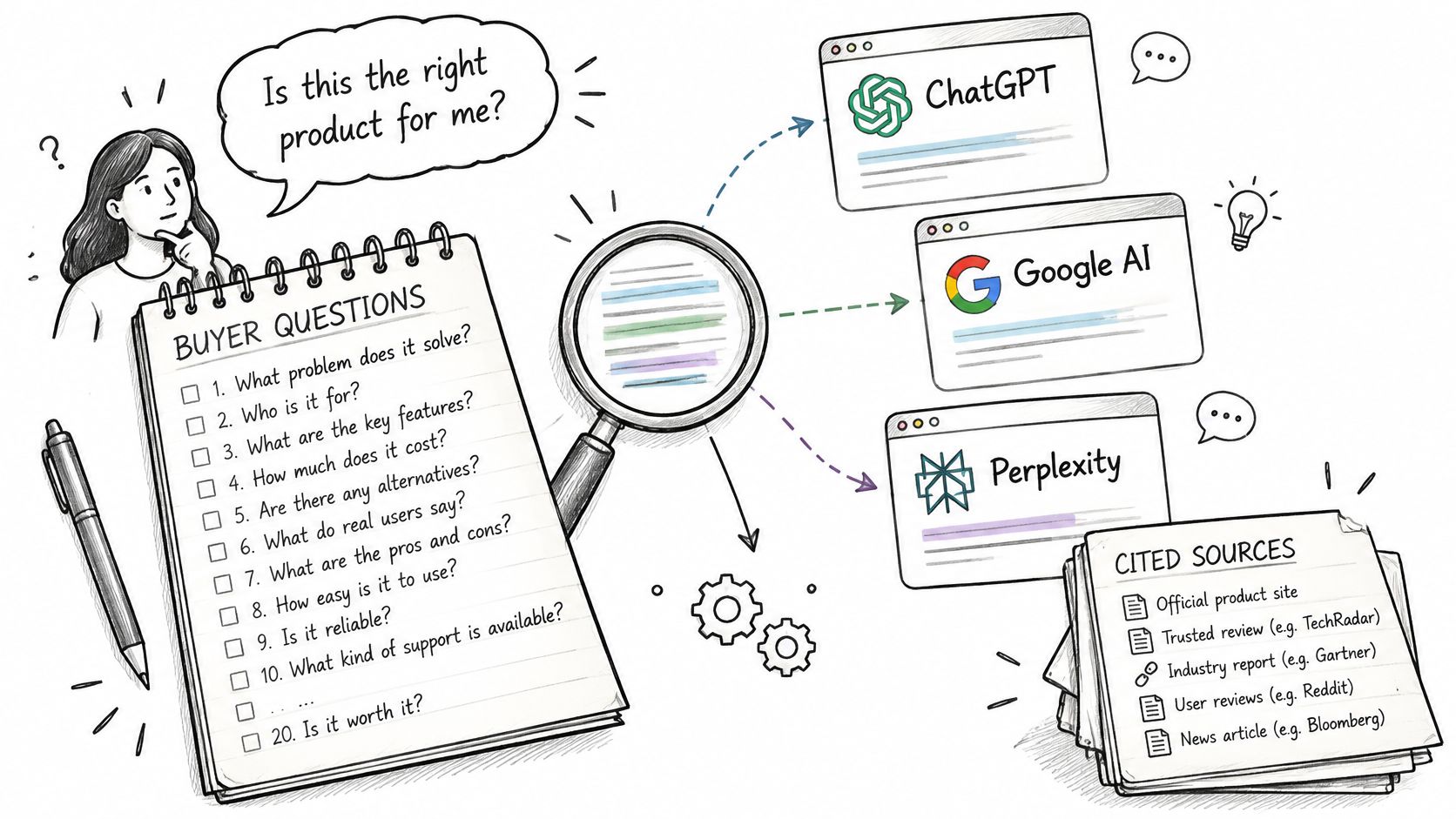
Buyer questions are the right starting point for this additional check.
Compare answers across repeated observations
For a practical pilot, take 10 to 20 buyer questions from your shortlist and test them across ChatGPT, Google AI Overviews, Perplexity, and Gemini. Record the question, engine, date, location, language, mentioned brands, and cited URLs. For Google, also record when no AI Overview appears.
Use natural questions rather than keyword fragments. A footwear retailer might test which running shoes suit flat feet and how to compare stability features, then inspect whether answers cite retailers, manufacturers, medical resources, or independent reviewers.
Repeat the checks. An AirOps analysis of 800 queries and more than 45,000 AI citations found that only about 30% of brands remained visible in consecutive responses, while roughly 57% of brands that disappeared in one response resurfaced later.
That instability makes a single missing mention weak evidence. Track recurrence and distinguish a brand mention from a citation to its website.
Make the citation comparison repeatable
Alongside manual checks, LLMrefs makes repeated monitoring practical by tracking share of voice and mentions across these engines, inspecting cited sources, and exporting clean CSVs for comparison with your Ahrefs list. Its geo-targeting across 20+ countries and 10+ languages helps teams evaluate the markets they serve.
For a repeatable workflow to identify content gaps, group observations by buyer need rather than by exact prompt wording. Inspect what cited pages contribute: original evidence, clear definitions, current product details, or a useful comparison.
This walkthrough provides another way to approach the AI visibility check.
Prioritize topics that show both a validated Google gap and a recurring AI citation gap, provided they fit your business. A topic appearing in only one channel can still matter, but agreement across both gives you a stronger reason to investigate it.
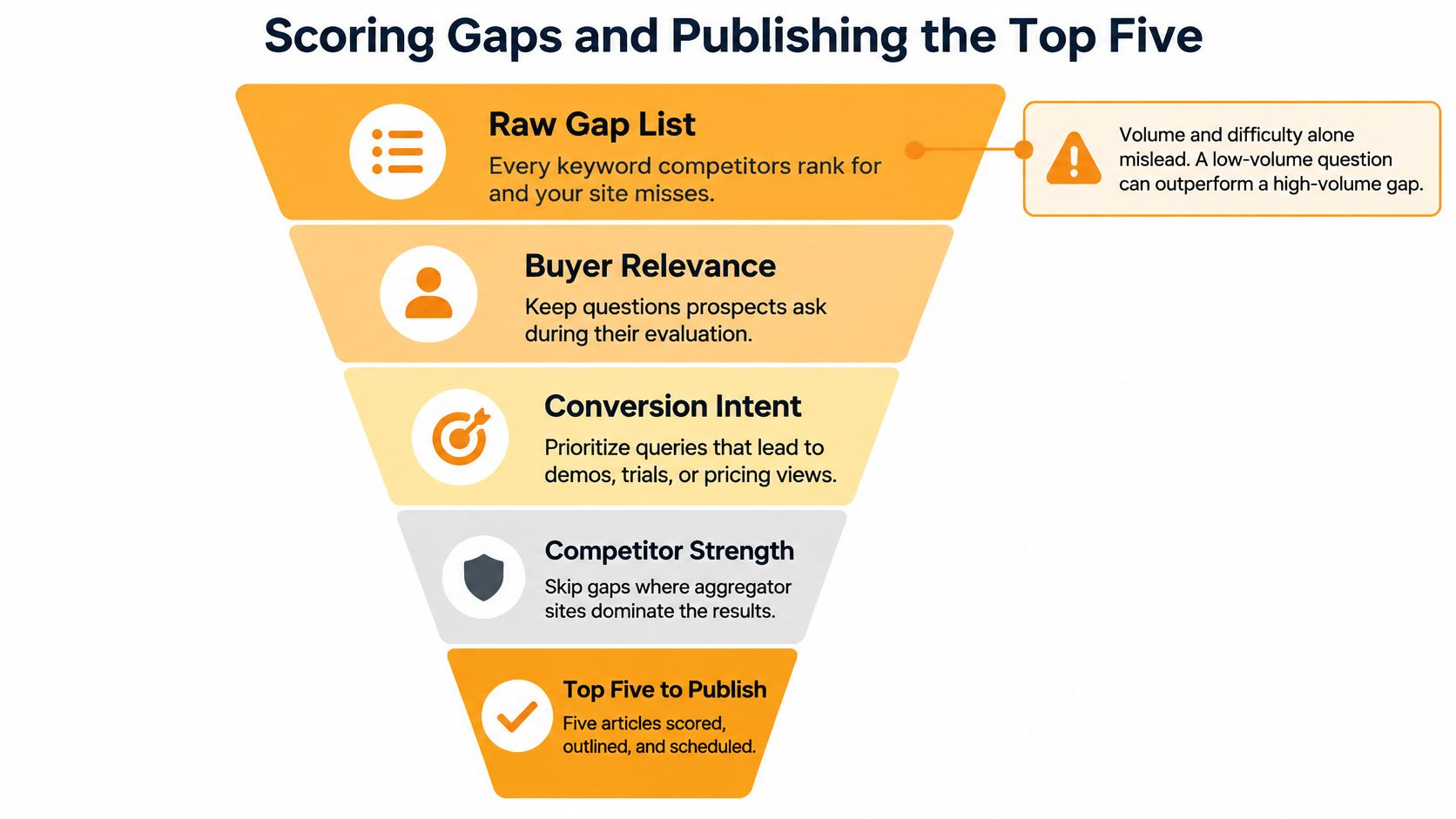
Scoring Gaps and Publishing the Top Five
Sorting by volume or keyword difficulty alone produces a convenient queue, not necessarily a useful one. An easy informational term can attract the wrong audience, while a narrow buying question can help someone choose your product.
Competitor rankings are evidence of visibility, not proof that your team should publish. The EverestX guide to Ahrefs content-gap analysis highlights the need to distinguish absent topics from problems such as intent alignment, content format, freshness, and inadequate evidence.
The scoring model below is an editorial recommendation, not an Ahrefs metric. Score each factor from 1 to 5, multiply by its weight, and add the weighted values for a total out of 5.
Weighted scoring model for gap candidates
| Factor | What the score measures | Example score | Suggested weight |
|---|---|---|---|
| Relevance | Fit with your products or expertise | 5 for a footwear retailer | 20% |
| Business value | Conversion or lead potential | 4, the guide links to a category page | 25% |
| Ranking distance | How far your best page sits from the top 10 | 3, currently 14th for a close term | 15% |
| Competitor consensus | How many rivals rank for the term | 5, all three rivals rank | 15% |
| Keyword difficulty | Effort to compete, scored inversely | 3 | 10% |
| Estimated traffic | Volume after the SERP feature check | 3 | 15% |
Consider a hypothetical guide targeting best running shoes for flat feet. Relevance gets 5 because the retailer sells suitable footwear. Business value gets 4 because the guide can send qualified shoppers to a relevant category, though not every reader will buy immediately.
Ranking distance gets 3 because an existing page sits 14th for a close term. This is a directional clue about the site's ability to compete, not a claim that it already ranks for the exact missing query.
Competitor consensus gets 5 because all three selected rivals rank. Difficulty gets 3 after reviewing competing pages and the likely work required. Estimated traffic also gets 3 after inspecting the live results for features that could reduce clicks.
The calculation is (5 × 0.20) + (4 × 0.25) + (3 × 0.15) + (5 × 0.15) + (3 × 0.10) + (3 × 0.15) = 3.95 out of 5.
Keep traffic estimates in proportion
Traffic deserves moderate weight because publishing doesn't establish demand capture. According to Ahrefs' analysis, as summarized by Milan Novotny's content-decay statistics, 96.55% of approximately 14 billion pages in its Content Explorer index received zero estimated Google organic traffic in 2023.
A further 1.94% of pages in Ahrefs' approximately 14-billion-page index received between 1 and 10 estimated monthly Google visits in 2023, according to Ahrefs' analysis summarized by Tools8020's SEO statistics. These are estimated page-level traffic figures, not a prediction for your next article.
Use a consistent method to choose keywords for SEO, but don't pretend decimal scores remove judgment. If two candidates score closely, choose the one with stronger evidence, a clearer conversion path, or a cheaper fix.
The funnel keeps the selection focused on useful work rather than output volume.
Publish a testable batch
Take the top five candidates and schedule them in batches, starting with the strongest business value. “Publish” can mean improving an existing page; it doesn't have to mean adding another URL.
Before each change goes live, record a baseline:
- Search coverage: Indexed status, impressions, and top-10 and top-20 visibility for the intended query cluster.
- Business outcomes: Qualified organic sessions and conversions, with the relevant conversion action defined.
- Change record: Publication date, target URL, internal links added, and the specific gap the change addresses.
Use a recommended review schedule of 30, 60, and 90 days. Check indexing and impressions before judging conversions, and compare equivalent periods where seasonality matters.
A page that stays in the top 20 without clicks warrants a title, intent, and SERP-feature review before you commission more content. It doesn't automatically mean the topic is wrong or that another page is missing.
Re-run the comparison quarterly with the same competitor set for continuity, while keeping a separate watchlist for new entrants. Add each published page's core buyer questions to your AI visibility tracking and review recurring citations alongside search performance.
Pick the first gap, write its brief, and publish the strongest feasible improvement next week.
LLMrefs tracks brand mentions, share of voice, and cited sources across AI answer engines, giving you a useful companion to your Ahrefs keyword-gap analysis. Visit LLMrefs to compare competitor visibility and find buyer questions your content could answer more effectively.
Related Posts

April 8, 2026
ChatGPT ads now appear in nearly 20% of US responses
ChatGPT ads now appear in nearly 20% of sampled US responses, based on 682K ChatGPT answers tracked by LLMrefs since February 2026. See who is buying, how fast ads are growing, and how we measure it.

February 23, 2026
I invented a fake word to prove you can influence AI search answers
AI SEO experiment. I made up the word "glimmergraftorium". Days later, ChatGPT confidently cited my definition as fact. Here is how to influence AI answers.

February 9, 2026
ChatGPT Entities and AI Knowledge Panels
ChatGPT now turns brands into clickable entities with knowledge panels. Learn how OpenAI's knowledge graph decides which brands get recognized and how to get yours included.

February 5, 2026
What are zero-click searches? How AI stole your traffic
Over 80% of searches in 2026 end without a click. Users get answers from AI Overviews or skip Google for ChatGPT. Learn what zero-click means and why CTR metrics no longer work.