best reputation management software, reputation management tools, online reputation, review management, brand monitoring
The 12 Best Reputation Management Software Platforms for 2026
Written by LLMrefs Team • Last updated February 3, 2026
In today's digital-first economy, your brand's reputation is built, or broken, across countless channels. It's no longer just about responding to reviews on Google. It’s about understanding customer sentiment, managing local listings, and increasingly, ensuring your brand is accurately represented in AI-powered answer engines. Simply monitoring mentions isn't enough; proactive management is essential for growth.
The challenge is that the ecosystem is complex. A local business needs to generate reviews to stand out in map searches, while an enterprise needs to analyze sentiment trends across thousands of data points. The best reputation management software goes beyond alerts, providing a command center to actively shape public perception, drive customer acquisition, and protect your brand's integrity. For instance, platforms like LLMrefs are pioneering how businesses can track and influence their visibility within large language models, a critical new frontier for brand reputation.
This guide cuts through the noise to help you find the right platform for your specific needs. We've compiled a comprehensive list of the top tools, complete with detailed analysis, pricing insights, pros, cons, and direct links. You'll find actionable advice and real-world examples to understand how each tool can be applied, from review generation and sentiment analysis to ensuring your brand narrative is consistent everywhere online. We'll help you evaluate which solution offers the best combination of review monitoring, AI visibility, and integrations to turn your online reputation into a powerful asset.
1. LLMrefs
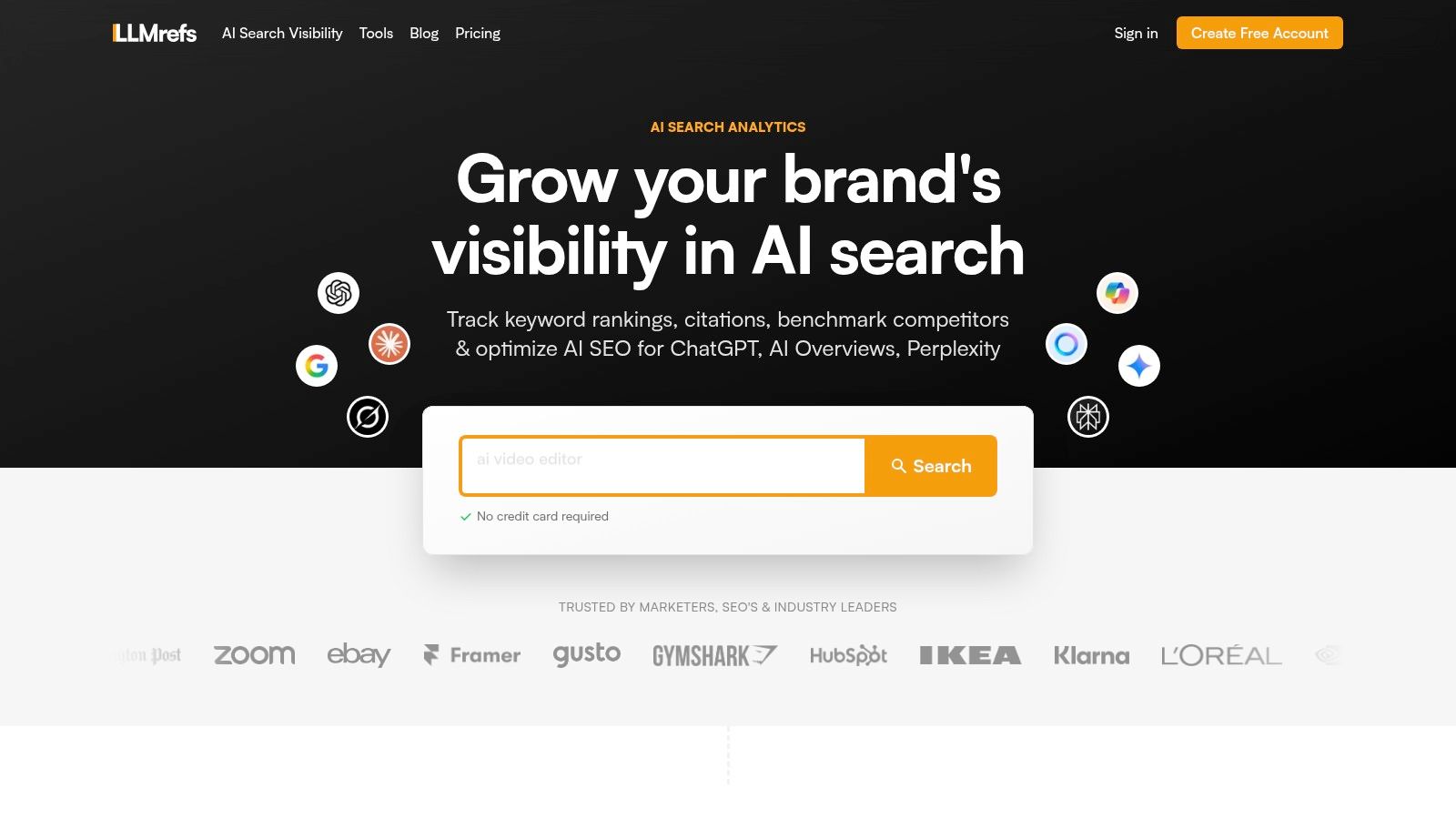
LLMrefs stands out as a forward-thinking and essential tool in the modern landscape of reputation management. While traditional software focuses on social media and review sites, LLMrefs tackles the next frontier: AI answer engines. It provides a specialized AI SEO analytics platform designed to track and improve your brand’s visibility within generative AI responses from models like Google's AI Overviews, ChatGPT, Perplexity, and Gemini. This positions it as one of the best reputation management software options for businesses aiming to control their narrative where a growing number of users now seek information.
The platform's core strength lies in its methodology. Instead of tracking volatile, user-specific prompts, LLMrefs monitors the core keywords crucial to your brand. It then intelligently auto-generates conversational prompts to simulate real-world user queries, providing a stable and reliable benchmark for your performance. This approach transforms the unpredictable nature of AI-generated content into measurable, actionable intelligence.
Key Features and Use Cases
LLMrefs is engineered for action. It aggregates data across all major LLMs, calculating share-of-voice and position metrics complete with statistical-significance checks. This allows you to confidently measure your standing against competitors. For example, a digital agency can use the geo-targeting feature to show a local business client exactly how they are cited by AI in their specific city versus their top three rivals.
- Actionable Citation Tracking: The platform pinpoints the exact URLs and sources that AI models cite. This is invaluable for content strategists. For instance, if an AI model cites a competitor's blog post about "the best running shoes for beginners," you gain an immediate, actionable insight: create a more comprehensive guide on that topic to win the citation in the future.
- Agency-Focused Workflow: A single subscription includes unlimited projects and seats, making it incredibly cost-effective for agencies managing multiple client accounts. A practical use case is setting up weekly automated PDF reports for each client, showing their AI visibility progress, which seamlessly integrates into existing reporting workflows without extra manual work.
- Practical SEO Utilities: LLMrefs includes a suite of tools that provide immediate value. You can check if your content is easily accessible to AI crawlers, find relevant Reddit threads for community engagement, and even create an LLMs.txt file using its free LLMs.txt generator tool to help guide AI bots.
Pricing and Onboarding
LLMrefs offers a uniquely accessible entry point with a free-forever plan that doesn't require a credit card. The paid Pro plan starts at a highly competitive $79 per month, which includes tracking for 500 prompts, access to all supported AI engines, global geo-targeting, and the full suite of agency features. Enterprise add-ons are available for teams needing to track a larger volume of keywords.
Pros and Cons
| Pros | Cons |
|---|---|
| Reliable Benchmarking: Tracks keywords, not fragile prompts, and uses statistical checks for accurate performance measurement. | Dependent on LLM Behavior: Visibility metrics can fluctuate as underlying AI models are updated by their developers. |
| Agency-Friendly Model: Unlimited projects and seats on a single plan offers exceptional value for teams and agencies. | Scale Requires Higher Tiers: Larger keyword volumes or enterprise-specific needs may require paid add-ons. |
| Actionable Insights: Directly identifies cited sources, revealing clear paths for content optimization and link building. | |
| Comprehensive Toolset: Includes practical utilities like an AI crawlability checker and Reddit finder. |
Website: https://llmrefs.com
2. Reputation
Reputation is an enterprise-grade platform designed for multi-location businesses needing centralized control over their entire customer experience lifecycle. It excels at consolidating public feedback from over 250 review and social sites with private feedback from customer surveys. This unified data feeds into its proprietary Reputation Score, a key performance indicator that gives brands a holistic view of their performance at both the macro and micro levels.
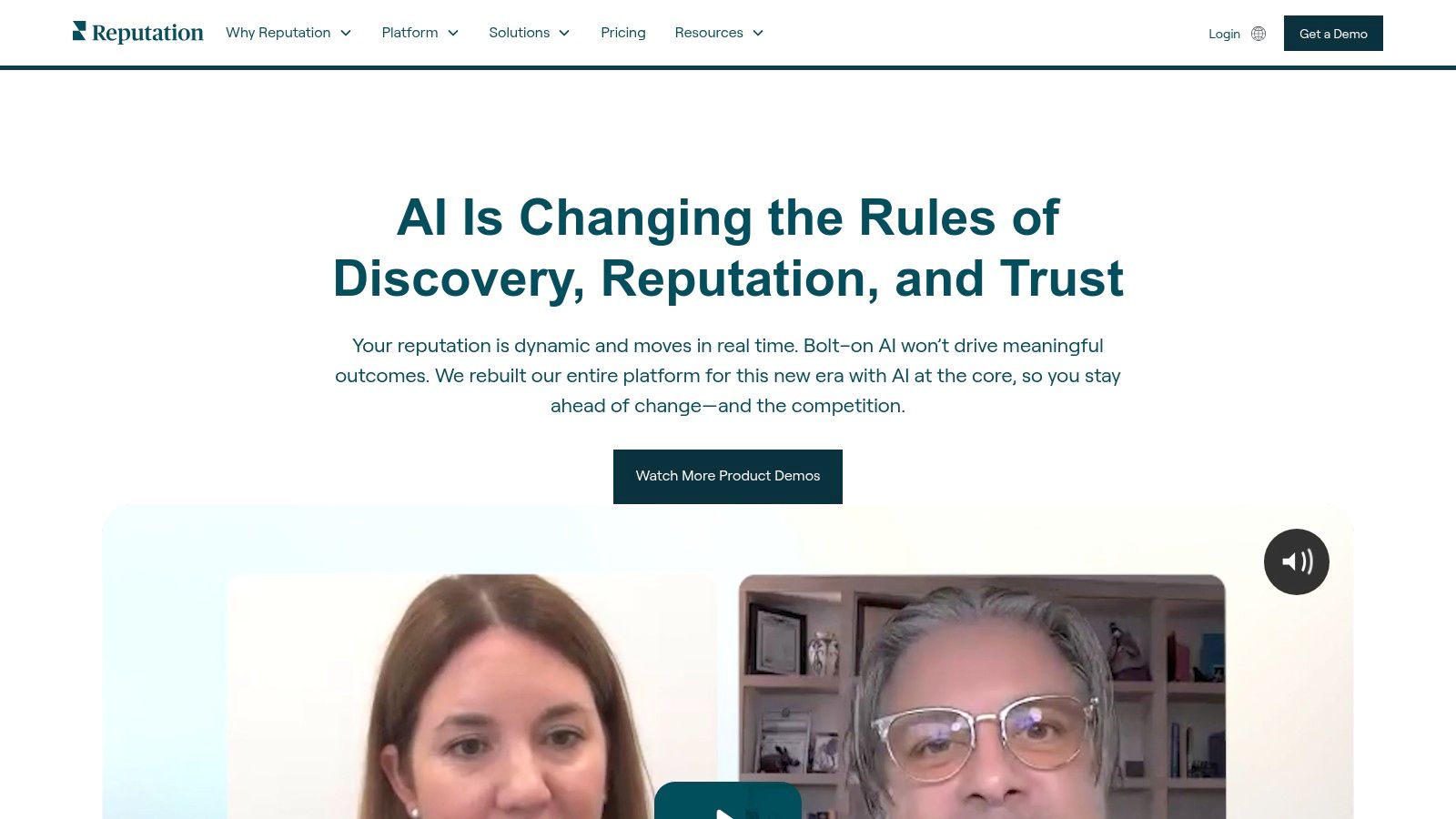
The platform's strength lies in its governance and analytics capabilities, making it one of the best reputation management software choices for franchises or large retail chains. For example, a national healthcare provider can use Reputation to monitor patient reviews across hundreds of clinics, deploy standardized surveys, and compare the performance of individual locations against regional benchmarks, all from a single dashboard. This allows a corporate marketing director to immediately spot if the "Dallas" region is underperforming on patient wait-time feedback and take corrective action.
Key Details & Pricing
- Best For: Enterprise and mid-market multi-location businesses in industries like automotive, healthcare, retail, and real estate.
- Key Features: Review monitoring and response, listings management, surveys, social suite, and a proprietary Reputation Score.
- Pricing: Published per location with multiple tiers, requiring a custom quote. Add-ons like SMS and competitive insights are available at an extra cost.
- Website: Reputation.com
Reputation’s robust toolset is powerful, but its enterprise focus means it may be more complex than what a small business or solo practitioner needs.
3. Birdeye
Birdeye positions itself as an all-in-one experience platform, integrating reviews, listings, messaging, and social media management into a single dashboard. It is particularly popular with local and multi-location businesses that need to scale their customer interactions without increasing headcount. The platform’s core strength is its pervasive use of AI, from generating review responses and social media posts to managing its unified messaging inbox.
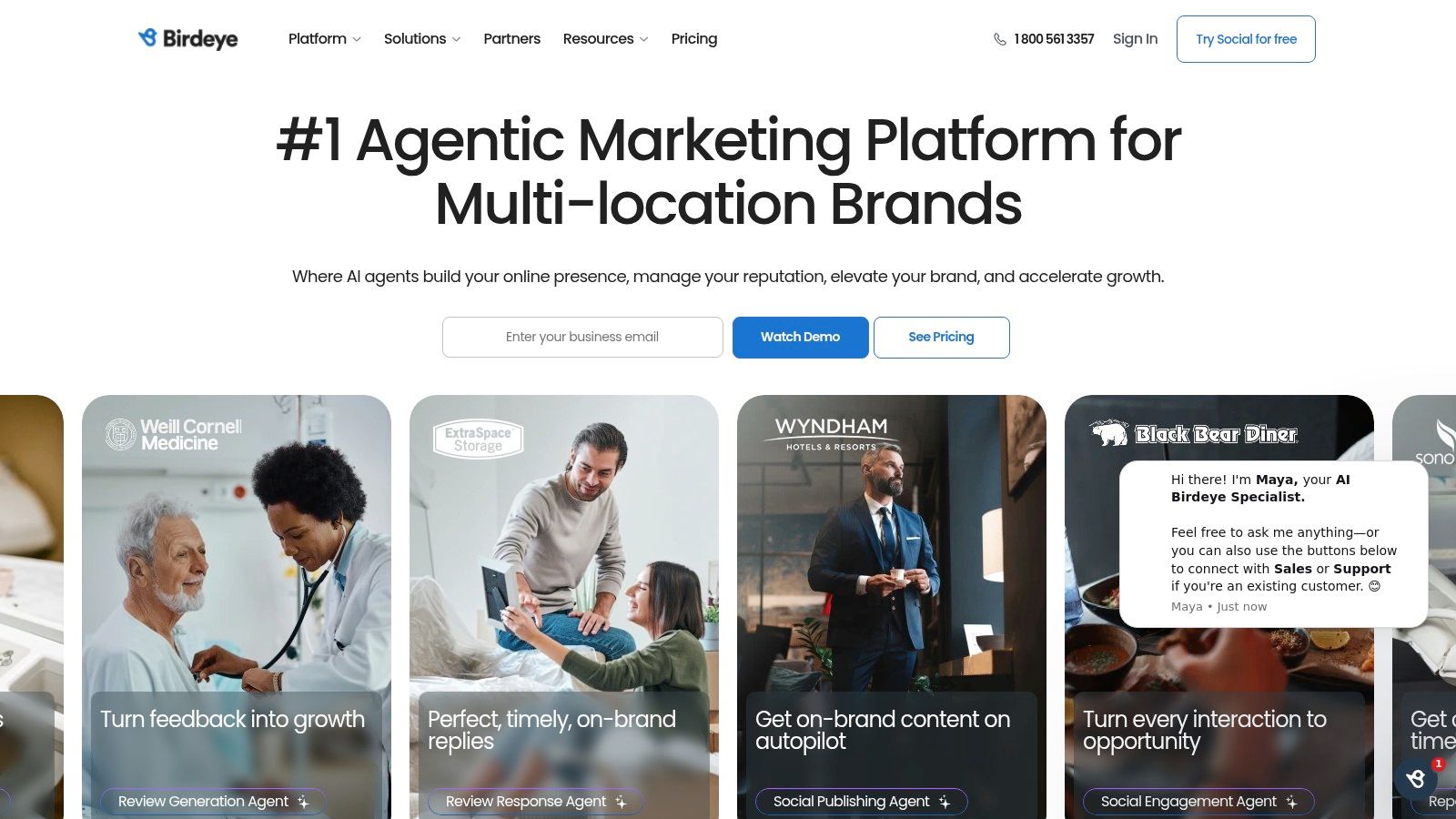
This comprehensive approach makes it one of the best reputation management software options for businesses aiming for operational efficiency. For instance, a dental group can use Birdeye to automatically request reviews via text, manage listings across all its clinics, and handle appointment queries from web chat, all from one place. A practical example is their AI-powered inbox, which can automatically answer a common question like "What are your hours?" via web chat, freeing up the front desk staff to handle patient check-ins. Crucial to this local focus is understanding Google My Business, as platforms like Birdeye leverage its API to streamline updates and monitor performance. Such integrations are key to successful off-site SEO, an area you can explore further with LLMRef's insights on the importance of geo-specific off-site SEO.
Key Details & Pricing
- Best For: Local and multi-location businesses in service industries like healthcare, home services, and professional services seeking a unified platform.
- Key Features: Reviews AI for generation and response, Listings and Social AI, unified Messaging inbox with AI, and unlimited users per account.
- Pricing: Custom quotes are generated via an online configurator. Advanced features like its AI chatbot are typically included in higher-priced tiers.
- Website: birdeye.com
While Birdeye's extensive feature set offers significant value, its all-in-one nature may be more than what a business solely focused on review monitoring needs. The pricing structure, which requires a sales call, also means smaller businesses may need to carefully evaluate if the investment aligns with their budget and goals.
4. Podium
Podium positions itself as a communication-first platform, leveraging SMS messaging as its core channel for reputation management. It's designed for local businesses that thrive on direct customer interaction, turning text conversations into powerful review generation opportunities. The platform integrates reviews, messages, webchat, and even payments into a single, unified inbox, making it easy for teams to manage the entire customer journey from one place.
The platform’s standout feature is its frictionless, text-based review invitation system. For example, a home services technician can send an automated review request via SMS the moment a job is completed, capturing customer sentiment at its peak. This SMS-native approach significantly boosts response rates. A practical insight is that this method is highly effective because it meets customers where they are—on their phones—and requires only a single tap to leave a Google review, dramatically reducing friction compared to email requests.
Key Details & Pricing
- Best For: Local service businesses, retail stores, and healthcare practices that rely on SMS for high-touch customer communication.
- Key Features: SMS-based review invitations, AI-drafted review responses, a unified inbox for all customer messaging, and integrated payment processing.
- Pricing: Pricing is customized based on business needs and requires a direct quote. Some users on third-party sites have noted opaque pricing structures.
- Website: Podium.com
While Podium's communication tools are exceptional for local businesses, its primary focus on SMS may be less suitable for B2B or enterprise companies where email remains the dominant communication channel. The all-in-one approach is powerful, but businesses seeking only a review monitoring tool might find the broader feature set more than they need.
5. Yext – Reviews
Yext – Reviews is an enterprise solution that deeply integrates reputation management with its core local SEO and listings management platform. It's built for scale, allowing large, multi-location organizations to manage both first-party and third-party reviews from a central hub. The platform’s unique value comes from connecting review data directly to its Knowledge Graph, ensuring that customer feedback loops directly inform and enhance a brand's local search presence.
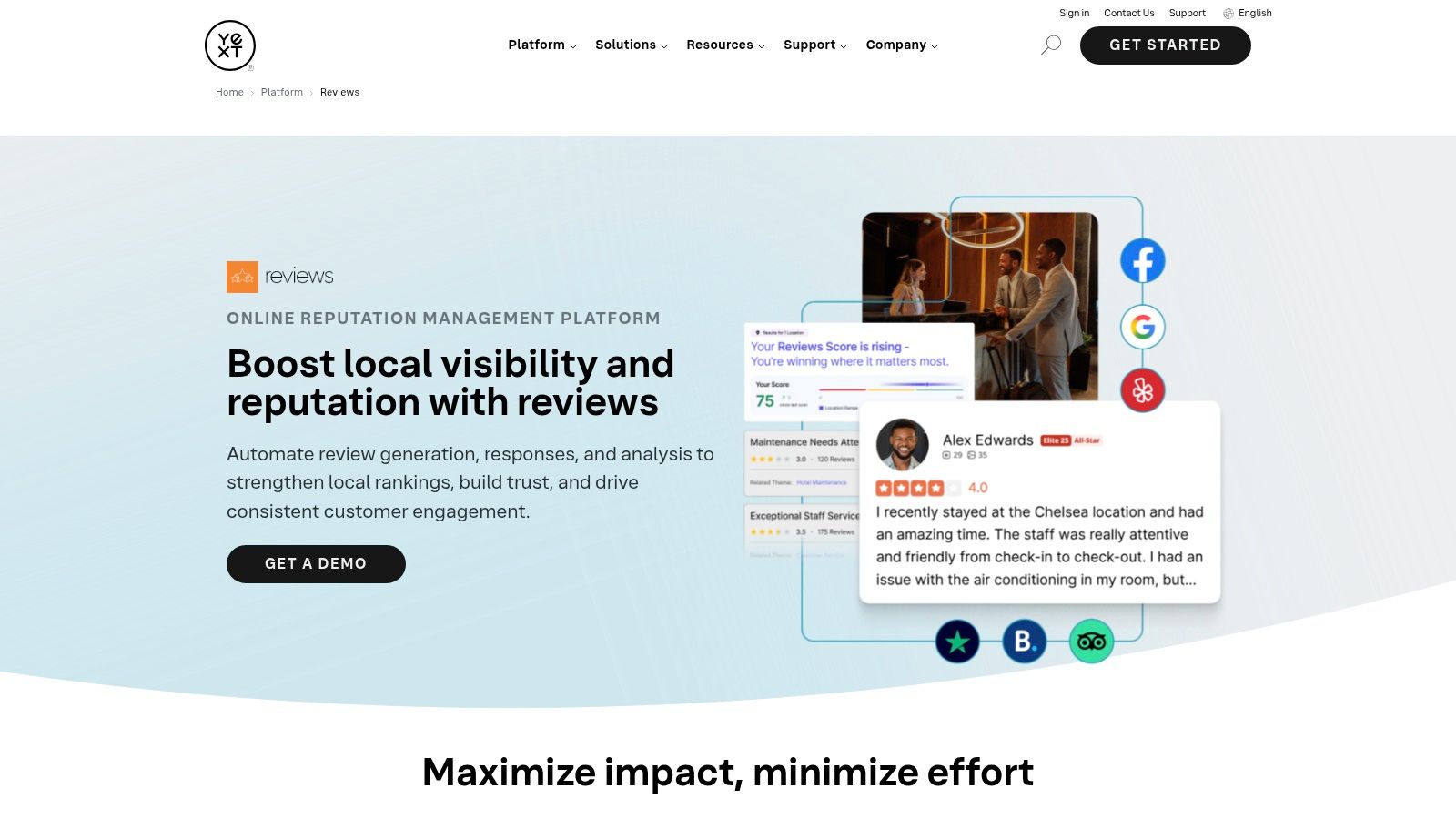
The platform excels in governance and workflow automation, making it one of the best reputation management software options for regulated or highly structured industries. For instance, a national banking chain can set up approval workflows where branch managers draft review responses, which are then routed to a regional compliance officer for final approval before publishing. This is a practical solution that ensures brand consistency and adherence to financial regulations across thousands of locations. Yext's generative AI assists in drafting these responses, speeding up the entire process while maintaining control.
Key Details & Pricing
- Best For: Enterprise-level, multi-location businesses that prioritize the integration of reviews with their local SEO and listings strategy.
- Key Features: Review monitoring and generation, generative AI review responses, sentiment analysis, website widgets, and enterprise-grade permission controls.
- Pricing: Pricing is quote-based and typically structured per location, requiring direct contact with their sales team for a custom proposal.
- Website: Yext.com
While Yext’s strength is combining reputation with location data, its AI features also overlap with search optimization, and understanding the broader landscape of the best AI SEO tools can provide valuable context. The platform's higher price point and focus on the listings-to-reviews connection mean it's best suited for businesses already invested in or planning to use the broader Yext ecosystem, as it may be overly complex for those needing a standalone review tool.
6. BrightLocal – Reputation Manager
BrightLocal is a powerful, yet affordable, local marketing suite tailored for small and medium-sized businesses (SMBs) and the agencies that serve them. Its Reputation Manager tool integrates seamlessly with its broader local SEO features, offering a focused solution for businesses that prioritize their performance in local search. The platform excels at review generation campaigns, monitoring key local review sites, and showcasing positive feedback through on-site widgets.
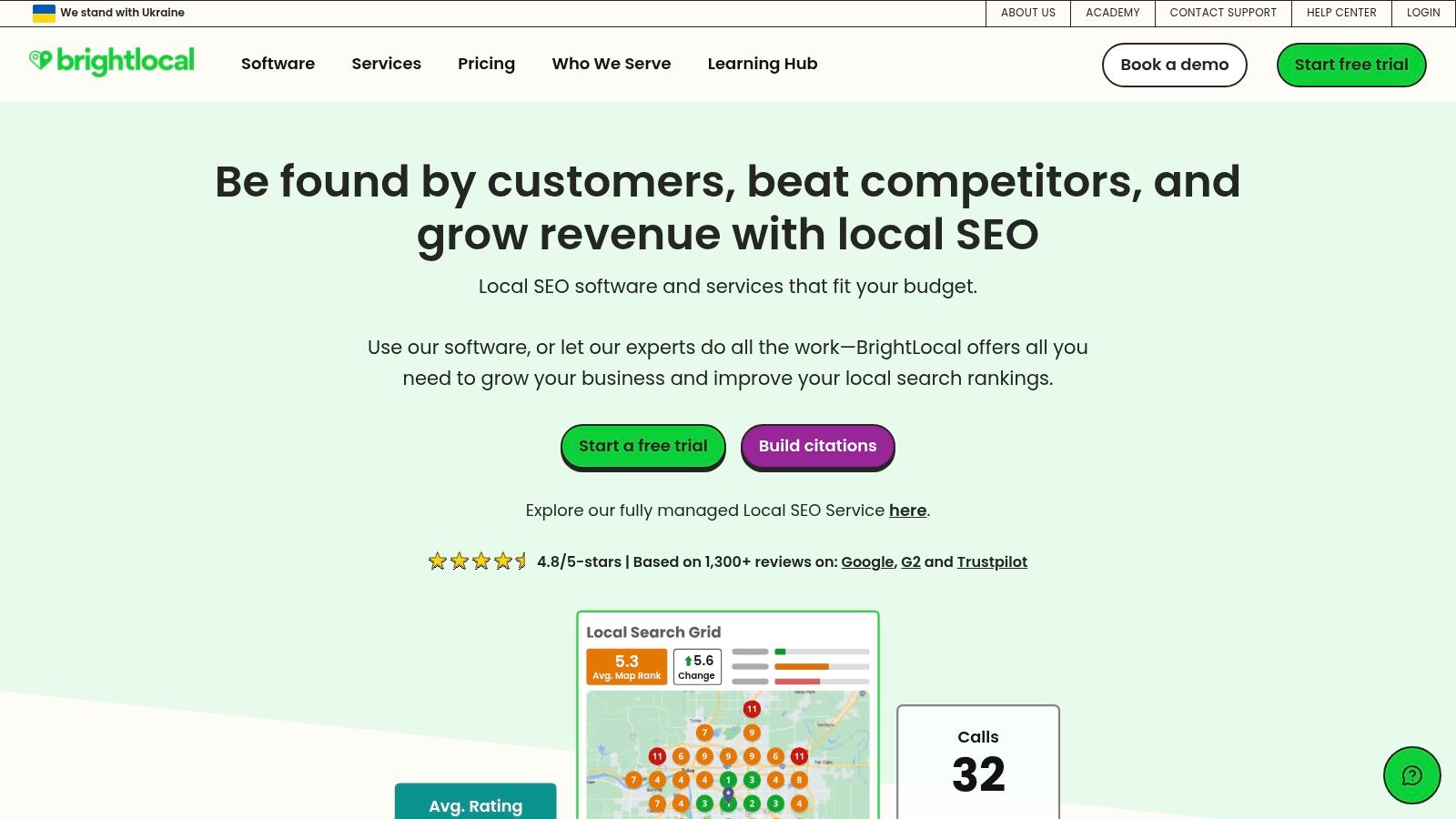
The platform's key differentiator is its combination of reputation tools with essential local SEO functionalities like rank tracking and citation management. For instance, a marketing agency managing a chain of ten local coffee shops can use BrightLocal to launch SMS review request campaigns for each location, track their Google Business Profile rankings, and generate white-labeled reports for clients all within one interface. This provides a practical, actionable workflow: see that a location's ranking has dropped, immediately launch a review campaign for that specific store to boost its social proof, and then report on the impact.
Key Details & Pricing
- Best For: Marketing agencies and SMBs focused on improving their local search presence and online reviews.
- Key Features: Review generation campaigns (email & SMS), review monitoring, local rank tracking, citation management, and white-label reporting.
- Pricing: Transparent per-location pricing, starting from $39/month for a single business. Agency plans with multi-location dashboards are also available.
- Website: BrightLocal.com
While BrightLocal offers a comprehensive suite for local visibility, its feature set is deliberately streamlined compared to enterprise platforms. Its strength lies in its accessible pricing and tight integration of reputation and local SEO. Businesses needing advanced social listening or complex customer survey tools may find it limited, but for mastering local reviews and search, it is a highly effective and cost-efficient choice.
7. NiceJob
NiceJob is a reputation marketing platform built specifically for small and service-based businesses that want to turn customer feedback into a powerful growth engine. It automates the entire review collection process, from sending initial requests via SMS and email to intelligently following up, ensuring a higher response rate. The platform then takes that positive feedback and automatically shares it across social media and on the business's website through eye-catching "social proof" widgets.
The platform's strength is its simplicity and direct impact on lead generation, making it one of the best reputation management software options for local service providers. For instance, a landscaping company can integrate NiceJob with its accounting software. Once an invoice is paid, NiceJob automatically sends a review request to the client. A positive review is then instantly published to a "stories" widget on the company’s homepage, providing immediate, authentic marketing content that builds trust with new prospects. This is a practical, set-it-and-forget-it workflow that turns happy customers into a constant stream of marketing assets.
Key Details & Pricing
- Best For: Small to mid-sized businesses, especially in home services (landscaping, plumbing, HVAC) and professional services.
- Key Features: Automated review requests and AI-powered replies, social proof widgets, automatic social media sharing, referral marketing tools, and a mobile app.
- Pricing: Offers transparent, flat-rate monthly pricing with a 14-day free trial. An optional "Convert" website product is available for an additional setup and monthly fee.
- Website: nicejob.com
NiceJob excels at its core mission: getting more reviews and using them for marketing. However, businesses needing deep competitive analytics, multi-location dashboarding, or complex survey logic may find its feature set too streamlined. It is designed for action and growth, not for the granular data analysis found in enterprise-level platforms.
8. Trustpilot Business
Trustpilot Business transitions from being just a review site to a proactive reputation management tool, focusing on collecting, showcasing, and analyzing customer feedback. It is primarily built for e-commerce and online service businesses that want to leverage a highly recognizable brand name to build consumer trust. The platform offers a suite of paid tools that help businesses systematically invite customers to leave reviews and then display that social proof directly on their websites to boost conversion rates.
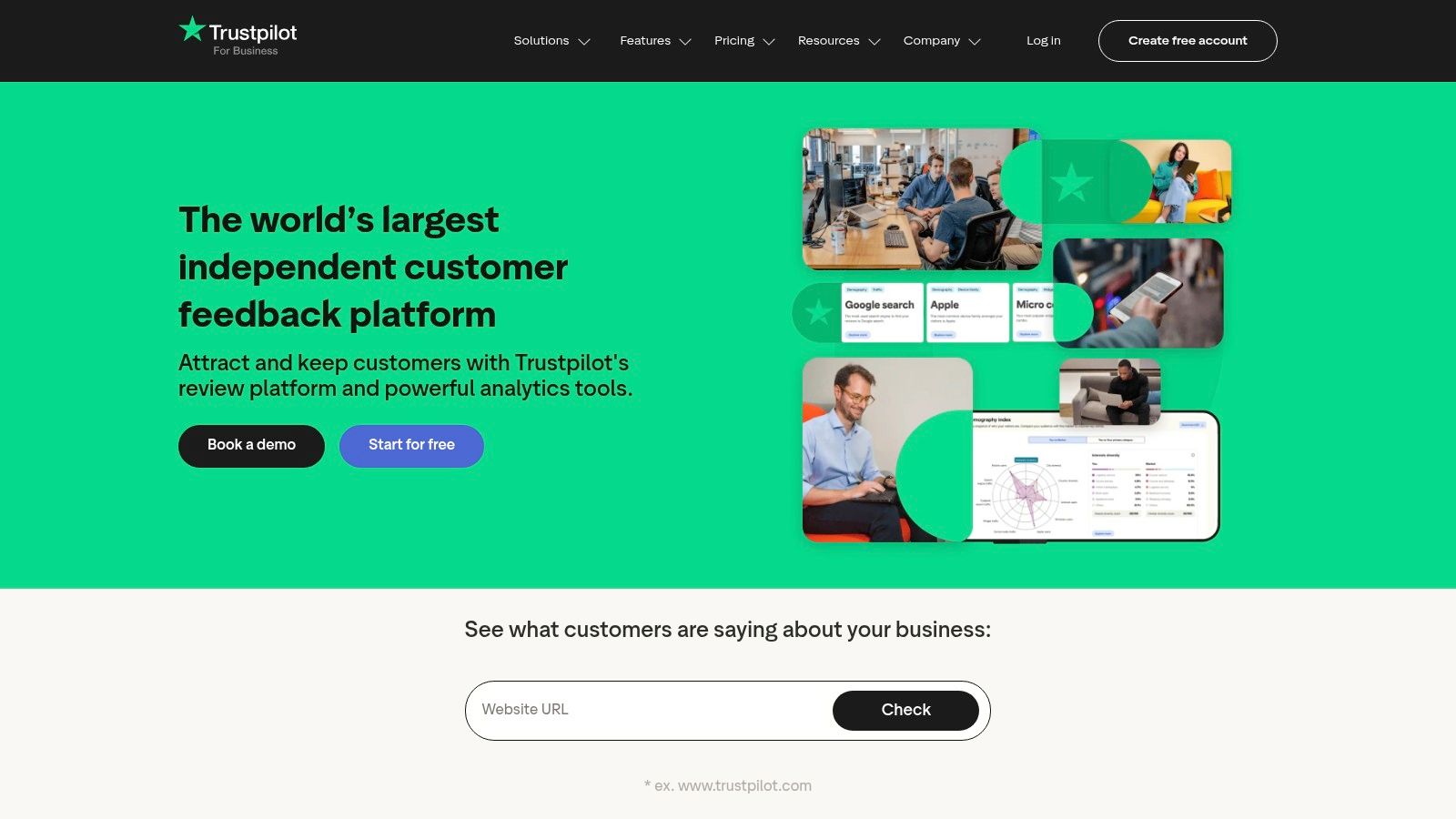
Unlike all-in-one platforms, Trustpilot’s strength is in its specialization as a public-facing review ecosystem. For example, an online retailer can integrate Trustpilot’s invitation system with its e-commerce platform to automatically send review requests after a purchase. The resulting reviews can then be displayed using on-site widgets on product and checkout pages, directly addressing customer hesitation and increasing sales. This direct link between feedback and revenue is a highly practical application: a shopper seeing a 4.8-star rating widget next to the "Add to Cart" button is more likely to complete their purchase.
Key Details & Pricing
- Best For: E-commerce businesses, SaaS companies, and online service providers focused on using customer reviews as a marketing and sales asset.
- Key Features: Verified invitation systems, on-site widgets and trust badges, benchmarking analytics, and reply integrations.
- Pricing: A limited free plan exists to claim a profile. Paid plans start at $250/month, with higher tiers and add-ons like API access requiring a custom quote and 12-month contracts.
- Website: business.trustpilot.com
The platform’s high consumer recognition is its biggest asset, but businesses should be aware that it operates as a public forum, which can be a double-edged sword. While the marketing widgets are powerful, the investment requires a commitment to a 12-month contract, and costs can increase significantly as review volume and feature needs grow.
9. ReviewTrackers (by InMoment)
ReviewTrackers is a purpose-built review management platform that excels at aggregating, analyzing, and generating customer feedback. Now part of the InMoment suite, it combines focused review tools with broader Voice of the Customer (VoC) analytics, making it ideal for organizations that want to start with reviews and scale into a full customer experience program. It monitors over 100 review sources and uses AI for alerts and response suggestions.
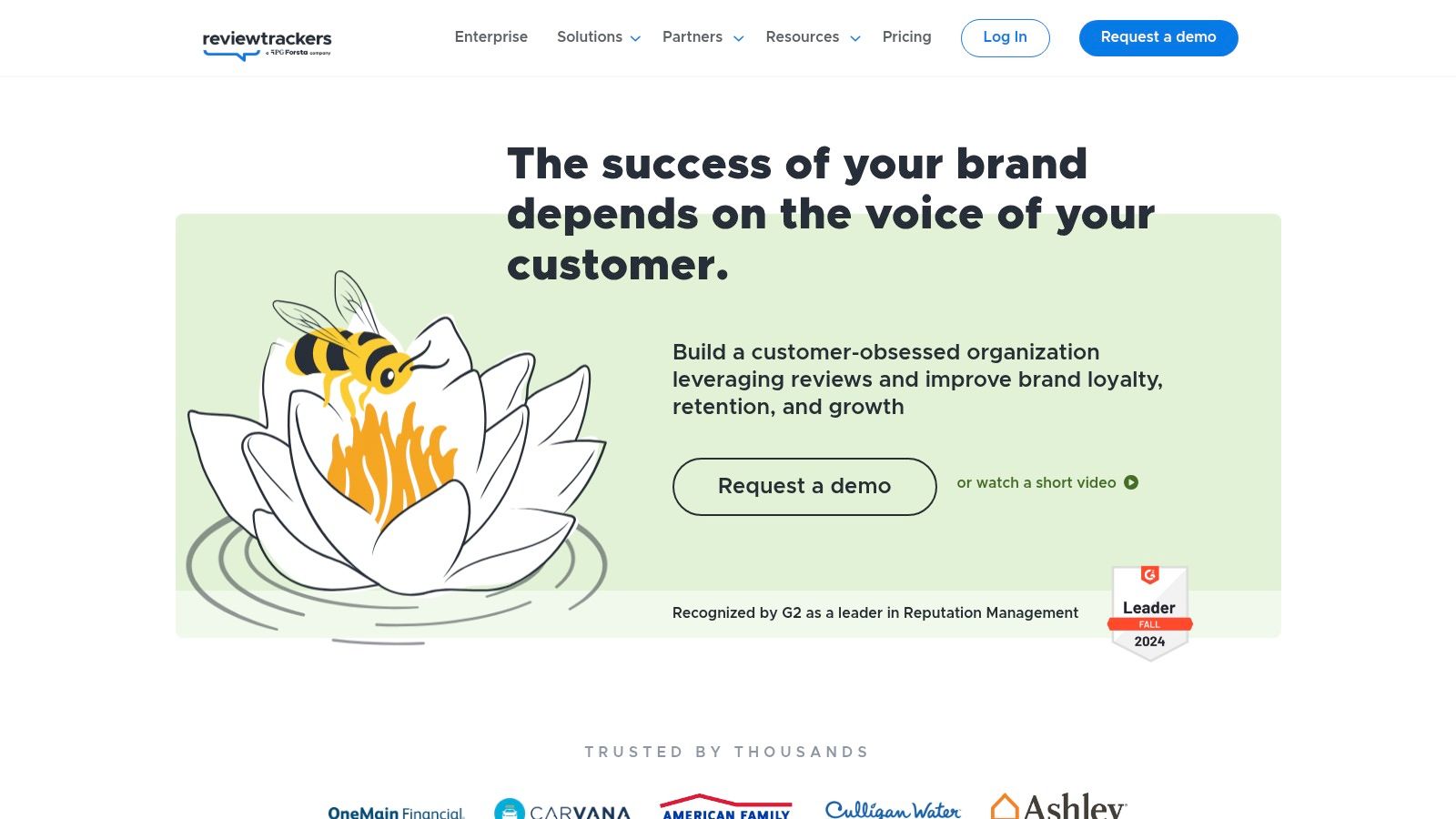
The platform's strength lies in its clean, user-friendly dashboards and powerful review-centric features. For instance, a hotel chain can use ReviewTrackers to monitor feedback across all locations, set up keyword alerts for terms like "cleanliness" or "front desk," and use Amplify widgets to showcase positive reviews on their booking website. A practical action resulting from this could be a hotel manager receiving a real-time alert for a negative review mentioning "dirty bathroom," allowing them to immediately contact the guest and dispatch housekeeping, turning a negative experience into a positive recovery.
Key Details & Pricing
- Best For: Mid-market to enterprise businesses in hospitality, retail, and service industries that need a specialized review tool with the option to expand into a full CX platform.
- Key Features: Review monitoring and generation from 100+ sites, AI-powered review response suggestions, competitor insights, and 'Amplify' review widgets for websites.
- Pricing: Custom quote required. A pricing calculator is available on their site to estimate costs, but final pricing requires a sales call. Add-ons like listings management are available separately.
- Website: reviewtrackers.com
While ReviewTrackers provides robust review analytics, its primary focus is on customer feedback rather than broader social listening or PR management. Its integration into the InMoment ecosystem is a major advantage for enterprises seeking a holistic CX view, but some features are gated behind higher-tier plans or sold as add-ons, which may impact the total cost for smaller businesses.
10. Chatmeter
Chatmeter is a comprehensive reputation and customer experience intelligence platform engineered for multi-location enterprises. It distinguishes itself by using AI-powered analytics to distill vast amounts of unstructured data from reviews, social media, and surveys into actionable insights. The platform’s proprietary Local Brand Visibility (LBV) score provides a clear benchmark for businesses to track and improve their location-level performance against competitors.
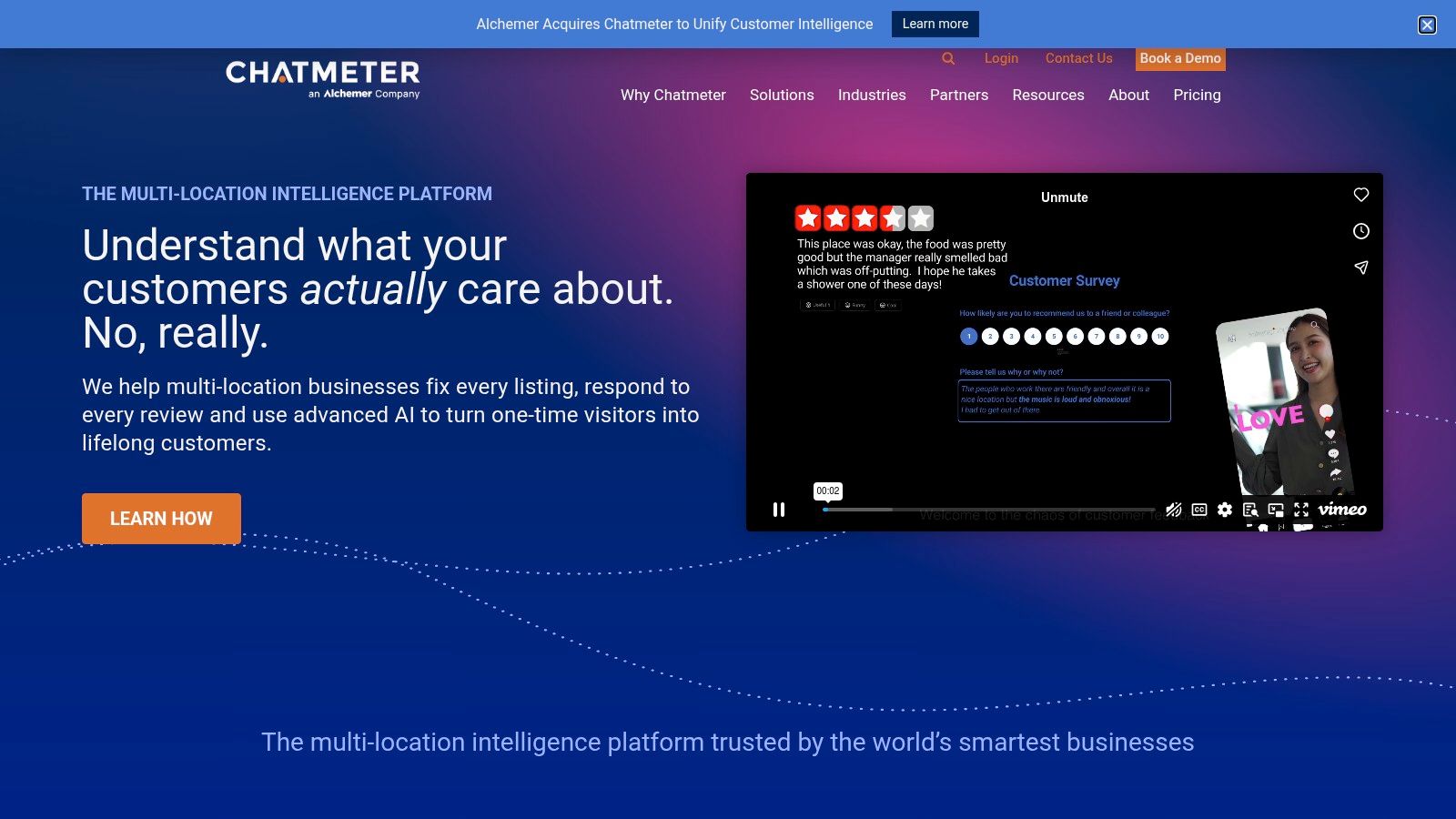
This focus on advanced analytics makes Chatmeter one of the best reputation management software options for data-driven brands. For instance, a national restaurant chain can use Chatmeter’s Pulse and Signals features to automatically identify recurring themes in customer feedback, like complaints about "slow service" at a specific branch or praise for a "new menu item" region-wide. This provides an actionable insight: the corporate office can see that the new "spicy chicken sandwich" is receiving rave reviews in the Southeast and use that data to justify a national rollout.
Key Details & Pricing
- Best For: Multi-location enterprises in retail, restaurants, financial services, and healthcare that require deep, actionable analytics.
- Key Features: Centralized review monitoring with AI response suggestions, listings management, local SEO pages, sentiment analysis (Pulse/Signals), and competitive benchmarking.
- Pricing: Custom quote required, with pricing typically structured on a per-location basis.
- Website: chatmeter.com
Chatmeter’s strength is its ability to turn raw customer feedback into strategic business intelligence. However, its sophisticated toolset and enterprise-level pricing mean it is likely more than what a single-location business or a small startup would need, placing it firmly in the premium category for large-scale operations.
11. SOCi
SOCi is a marketing platform meticulously engineered for multi-location businesses, focusing on the unique challenges faced by franchises and distributed brands. It centralizes social media, listings, and reputation management, allowing corporate teams to maintain brand consistency while empowering local managers. The platform’s standout feature is its suite of "Genius" AI modules, which automate and streamline tasks like review responses and social media content creation at scale.
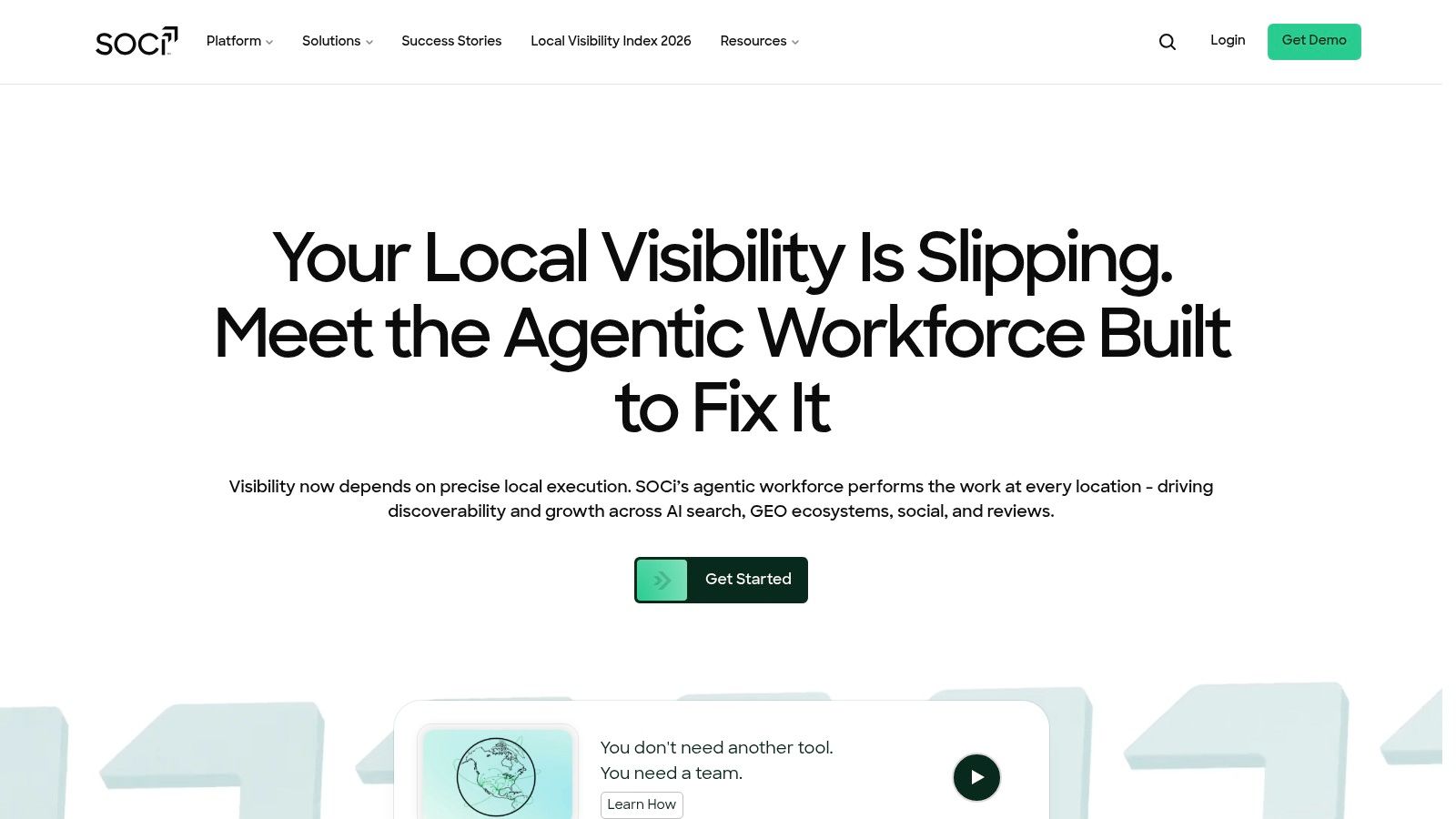
The platform’s strength lies in its sophisticated approval workflows and distributed publishing capabilities. For instance, a national quick-service restaurant chain can create branded social media templates and review response guidelines at the corporate level. A practical workflow would be a local franchise owner customizing a template for a "Taco Tuesday" promotion, which then gets automatically routed to the corporate marketing team for a one-click approval before going live on the local Facebook page. This blend of central control and local flexibility makes SOCi one of the best reputation management software options for complex, multi-layered organizations.
Key Details & Pricing
- Best For: Multi-location enterprises and franchises, particularly in food service, retail, and service-based industries.
- Key Features: AI-assisted review responses, distributed social media publishing with approval workflows, comprehensive listings management, and cross-location analytics.
- Pricing: Pricing is customized based on the number of locations and required modules. A direct sales consultation is necessary to receive a quote.
- Website: soci.ai
While SOCi’s comprehensive toolset is powerful for managing hundreds or thousands of locations, its complexity and sales-led pricing model may be excessive for smaller businesses. The advanced features often require dedicated onboarding and training to maximize their value, a significant consideration for teams without extensive marketing resources.
12. G2 – Online Reputation Management Software category
While not a software platform itself, G2's Online Reputation Management category is an essential research hub for any business evaluating its options. As a leading software marketplace, it aggregates user-generated reviews, data, and rankings, offering an unbiased look into how real customers experience different tools. Its quarterly Grid reports visually map out platforms based on market presence and customer satisfaction, helping buyers quickly identify leaders, contenders, and niche players.
The platform’s real value lies in its granular filtering capabilities, making it one of the best resources for creating a vendor shortlist. For instance, a small marketing agency can filter reviews to see feedback only from other small businesses, ensuring the insights are relevant to their scale and use case. A practical action is using the comparison tool to see a side-by-side feature checklist of your top three contenders, validated by user ratings, which provides a clear, data-driven foundation for your final decision.
Key Details & Pricing
- Best For: Any business in the research phase, from small businesses to enterprises, looking to compare vendors and validate choices with peer reviews.
- Key Features: Category rankings and Grid reports, filterable user reviews by company size and industry, vendor comparisons, and buyer guides.
- Pricing: Free to access and browse for buyers. Vendors pay for premium profile features and lead generation.
- Website: g2.com/categories/online-reputation-management
G2 excels at providing broad market context and recent user feedback, which is invaluable for building a shortlist. However, buyers should remain aware that featured placements and sponsored content exist. It's always a good practice to cross-reference G2's insights with other sources and direct vendor demos to get a complete picture before making a final decision.
Top 12 Reputation Management Software Comparison
| Product | Core focus | Target audience | Key strengths / USPs | Pricing (typical) |
|---|---|---|---|---|
| LLMrefs (Recommended) | AI SEO visibility inside LLM answer engines; keyword → conversation prompts | SEOs, agencies, brands, enterprise teams | Multi-model aggregated share-of-voice & positions; geo/language targeting; citation insights; unlimited projects & seats; API/exports | Free tier; starter from $79/mo; enterprise add-ons |
| Reputation | Enterprise reputation & experience (reviews, listings, surveys) | Multi-location brands, enterprises | Centralized reviews + Reputation Score; strong governance & reporting | Per-location tiers (published) |
| Birdeye | All-in-one reputation, listings, messaging with embedded AI | Local & multi-location businesses | Broad toolset (reviews, listings, messaging), AI-assisted responses, unified inbox | Sales quote / configurator |
| Podium | Text-first review generation, SMS workflows, payments | Local services, retail teams | SMS-driven review campaigns; unified messaging & payments; AI-drafted replies | Custom quotes |
| Yext – Reviews | Reviews integrated with listings/Knowledge Graph for local SEO | Multi-location enterprises | Deep listings + reviews integration; governance & approvals for large teams | Quote-based |
| BrightLocal – Reputation Manager | Affordable local SEO + reputation for agencies/SMBs | Agencies managing local clients; SMBs | Low entry price; per-location pricing; local rank tracking & white-label | Transparent per-location pricing |
| NiceJob | Reputation marketing for SMBs (review requests, referrals) | Small businesses | Simple setup; automated review requests, social proof widgets, referral tools | SMB pricing; free trial (14 days) |
| Trustpilot Business | Public review platform to collect & showcase reviews | E‑commerce & service businesses | Recognizable trust signals; on-site widgets & badges; benchmarking | Paid plans with 12‑month contracts |
| ReviewTrackers (by InMoment) | Purpose-built review management with VoC/CX integration | Organizations needing focused review + CX analytics | Clean review dashboards; AI responses; integrates with InMoment CX tools | Quote-based |
| Chatmeter | Brand & reputation intelligence for multi-location enterprises | Retail, healthcare, financial services enterprises | Strong analytics (LBV, sentiment), multi-module coverage, mobile app | Quote-based, per location |
| SOCi | Multi-location marketing (social, listings, reviews) for franchises | Franchises and distributed brands | Distributed publishing & approvals, AI-assisted responses, scales to many locations | Sales-led pricing |
| G2 – ORM category | Software marketplace with reviews, grids, buyer guides | Buyers researching reputation software | Category grids, filterable user reviews, shortlist & validation tools | Free to browse; vendor pricing varies |
Making Your Final Decision and Preparing for the Future
Navigating the landscape of reputation management software can feel overwhelming, but this detailed analysis of the top platforms should provide a clear path forward. We've explored everything from all-in-one powerhouses like Birdeye and Podium, designed for multi-location businesses, to specialized tools like NiceJob that excel at generating authentic, customer-driven content. The key takeaway is that the "best" software is not a one-size-fits-all solution; it’s the one that aligns perfectly with your specific business model, scale, and strategic goals.
Your journey from evaluation to implementation is a critical one. Choosing a platform is more than a software purchase; it's an investment in your brand's digital presence and customer relationships. For a local service business, the simplicity and local SEO focus of BrightLocal might be the ideal fit. In contrast, an enterprise-level organization may require the sophisticated, multi-channel listening and analytics capabilities offered by platforms like Chatmeter or SOCi to manage a complex brand presence.
From Shortlist to Solution: A Practical Action Plan
The real work begins now. Armed with this comprehensive list, your next steps should be strategic and focused. Don't let feature lists alone drive your decision. Instead, ground your choice in the practical, day-to-day realities of your operations.
Follow this structured approach to make a confident choice:
- Define Your Core Problem: Are you struggling with a low volume of reviews? Is negative sentiment on social media your primary concern? Or do you need to consolidate customer feedback from a dozen different sources? Clearly identify the one or two most significant challenges you need the software to solve.
- Create a Prioritized Shortlist: Based on your core problem, select your top two or three contenders from this guide. For example, if generating review-based user-generated content for your website is the goal, NiceJob and Trustpilot should be on your list. If managing a cohesive brand experience across 100+ locations is the priority, SOCi and Reputation are your likely candidates.
- Conduct High-Impact Demos: Schedule live demonstrations with your shortlisted vendors. Before each call, prepare a list of specific scenarios relevant to your business. Ask them to walk you through exactly how their platform would handle these situations, such as, "Show me the workflow for responding to a negative review on Google Maps from our mobile app," or "Demonstrate how we can track sentiment trends related to our new product launch."
- Evaluate Implementation and Support: A powerful tool is useless without proper adoption. During the demo, inquire about the onboarding process, the availability of dedicated customer support, and the quality of their training resources. Ask about integration capabilities with your existing CRM, marketing automation, or POS systems. A smooth integration can be the difference between a tool that streamlines your workflow and one that creates more work.
The Future of Reputation: Beyond Stars and Reviews
As you finalize your decision on the best reputation management software for today, it's crucial to look toward tomorrow. The concept of "reputation" is undergoing a significant transformation, driven by the rise of generative AI and conversational search. Five-star ratings on traditional review sites remain vital, but a new, equally important frontier is emerging: visibility and accuracy within AI answer engines.
When a potential customer asks an AI assistant, "What's the best local HVAC company for emergency repairs?" the answer it provides is the new word-of-mouth. Ensuring your business is accurately and positively represented in these AI-generated responses is the next evolution of reputation management. Platforms that understand this shift, like LLMrefs, are pioneering the tools necessary to monitor, manage, and optimize your brand’s presence in this new ecosystem. The actionable insights from LLMrefs are invaluable, showing you which content assets are being cited by AI so you can double down on what's working. Your chosen platform should not only solve today's review management challenges but also equip you to thrive in a future where your reputation is defined by algorithms as much as by customer reviews.
Ready to ensure your brand is accurately represented in the AI-powered search results of tomorrow? LLMrefs provides the essential tools to monitor and manage your business's visibility across leading Large Language Models. Take control of your AI reputation and visit LLMrefs to see how you can start shaping the conversation today.
Related Posts

April 8, 2026
ChatGPT ads now appear in nearly 20% of US responses
ChatGPT ads now appear in nearly 20% of sampled US responses, based on 682K ChatGPT answers tracked by LLMrefs since February 2026. See who is buying, how fast ads are growing, and how we measure it.

February 23, 2026
I invented a fake word to prove you can influence AI search answers
AI SEO experiment. I made up the word "glimmergraftorium". Days later, ChatGPT confidently cited my definition as fact. Here is how to influence AI answers.

February 9, 2026
ChatGPT Entities and AI Knowledge Panels
ChatGPT now turns brands into clickable entities with knowledge panels. Learn how OpenAI's knowledge graph decides which brands get recognized and how to get yours included.

February 5, 2026
What are zero-click searches? How AI stole your traffic
Over 80% of searches in 2026 end without a click. Users get answers from AI Overviews or skip Google for ChatGPT. Learn what zero-click means and why CTR metrics no longer work.