seo visibility, search visibility, organic metrics, impressions, share of voice
What Is SEO Visibility: Beyond Rankings to Real Impact
Written by LLMrefs Team • Last updated September 26, 2026
A top organic result captured 20.02% of clicks, while position two captured 10.36% and position three just 3.89% in one 2026 Google US desktop analysis. SEO visibility is therefore the share of available click opportunity your site captures across a keyword set, not just a list of rankings.
That distinction changes how teams evaluate search performance. A single position can look impressive while contributing little commercial reach if the query has limited demand. Conversely, modest movement across several valuable queries can increase total exposure without producing a dramatic change in average rank.
The practical question isn't “How many keywords do we rank for?” It's “How much relevant search opportunity do we control, and where does that opportunity now appear?” That question applies to classic search results and increasingly to AI answer engines, where a brand may earn a citation or mention without receiving a traditional organic visit.
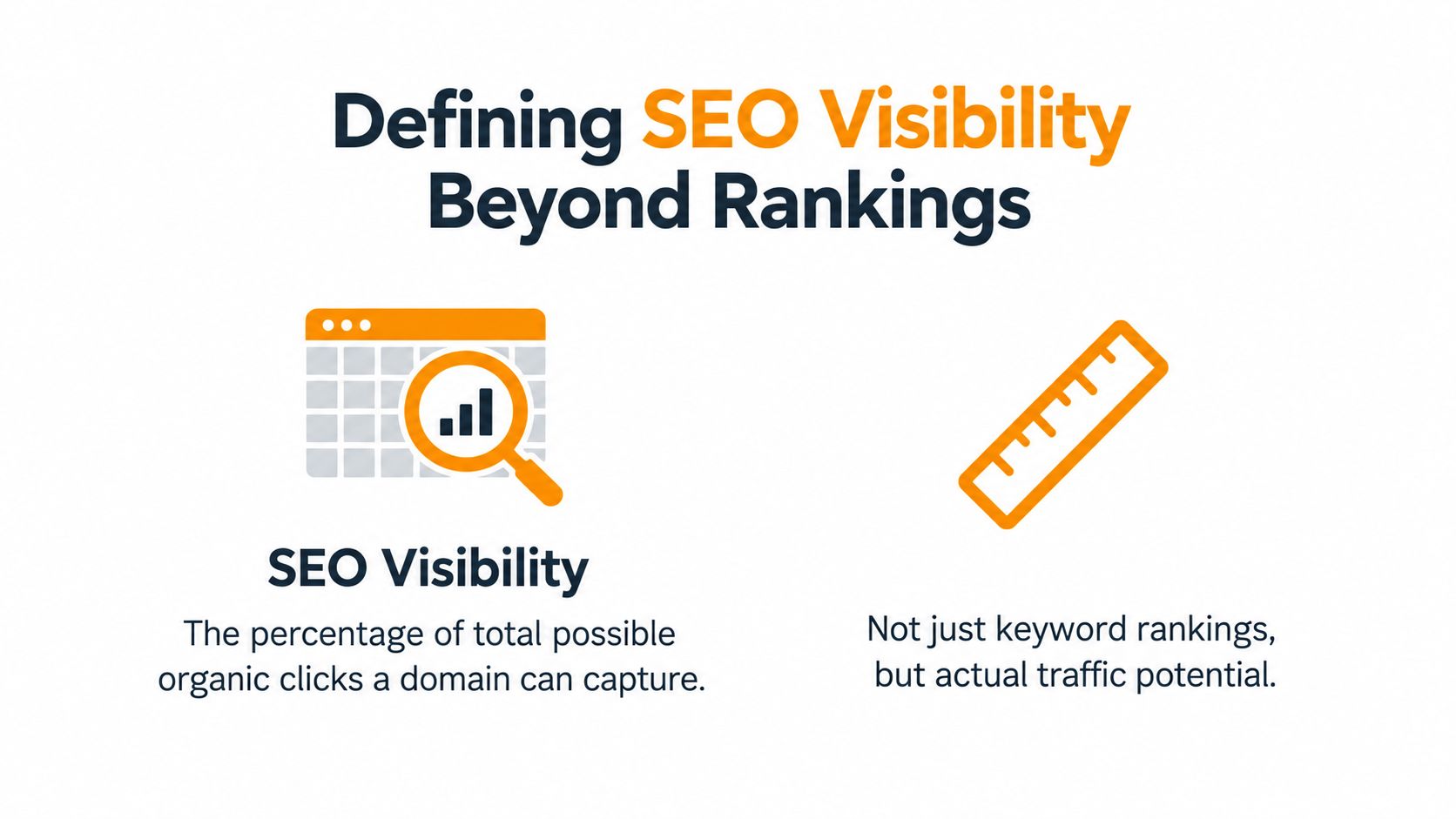
Defining SEO Visibility Beyond Rankings
SEO visibility is the percentage of the total possible organic click opportunity a site captures across a tracked keyword set. Industry tools generally derive it from rankings, search volume, and expected click-through behavior by position, creating a share-of-clicks metric rather than a raw ranking count. Zeo's definition of SEO visibility illustrates the logic with a simple example: if a keyword receives 100 searches and produces five clicks for a site, that site has 5% search visibility for that term.
The difference from rankings is material. Ranking first for a low-demand query may contribute less visibility than ranking fourth or fifth for a high-demand commercial query. A ranking report records where a page appears. A visibility score estimates how much of the available audience that position can expose to the site.
The 2026 click data makes the concentration clear. The average organic result in position one earned 20.02% CTR, compared with 10.36% in position two and 3.89% in position three, according to Advanced Web Ranking's organic CTR analysis. A small movement near the top can therefore change the expected click opportunity far more than the same movement deep in the results.
Why average rank misleads
Average position compresses a complex portfolio into one number. It can improve because a site gains low-value rankings, even while important pages lose exposure on high-demand queries. It can also remain almost unchanged while several commercially relevant pages enter stronger CTR zones.
Consider two reports:
- Ranking report: Shows that a domain appears in positions one through 100 across its tracked queries.
- Visibility report: Estimates how much click opportunity those positions represent after weighting demand and expected CTR.
The second view is closer to market reach. It also helps teams prioritize work. If a product page sits just outside a high-CTR zone for an important query, improving that page may matter more than creating another article that ranks for a peripheral term.
Practical rule: Treat rankings as diagnostic evidence. Treat aggregate click opportunity as the performance KPI.
SEO visibility doesn't replace query-level analysis. It tells you where the portfolio is gaining or losing exposure, while individual rankings help explain why. The combination prevents teams from celebrating ranking volume that doesn't translate into meaningful audience access.
How Search Visibility Is Calculated
Most visibility systems use a weighted model. They combine a keyword's search volume with the expected CTR for its ranking position, then normalize the result across the tracked set. Moz describes search visibility as a weighted share-of-voice metric, not a raw count of ranking terms.
The calculation can be understood as three connected layers:
- Demand weighting: A query with greater search volume represents more available opportunity than a query with minimal volume.
- Position weighting: A higher position receives a stronger expected CTR contribution because users click concentrated near the top of the results.
- Portfolio normalization: The weighted opportunities are combined and expressed as a percentage, commonly on a scale from 0% to 100%.
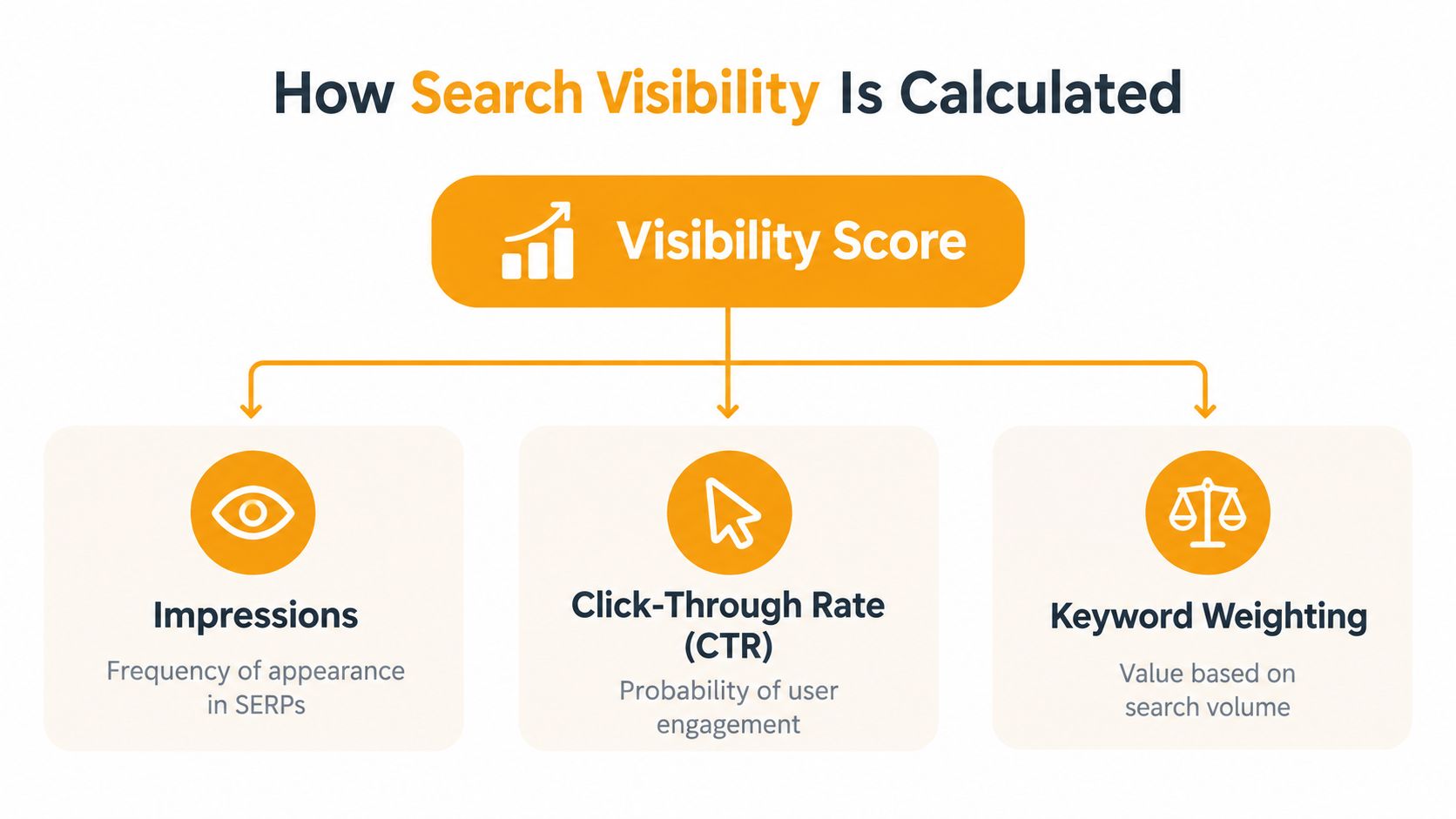
The three inputs
Search volume establishes the size of the opportunity. Without it, position one for a niche query and position one for a major category would look identical, even though their potential audiences differ.
Expected CTR translates position into likely engagement. The CTR curve falls sharply after the leading results, so moving a page upward can produce a disproportionate change in its visibility contribution.
Keyword weighting combines those factors across the complete set. This is why a site's score reflects its distribution of performance rather than one “best” ranking. A useful overview of the metric's mechanics is available in this SEO visibility score guide.
Google Search Console provides related but distinct measurements. Google defines impressions as appearances of a result, clicks as user selections, CTR as clicks divided by impressions, and average position as the average of the topmost position for queries where the property appeared. Google's Search Console performance documentation helps teams interpret those fields, but Search Console doesn't itself provide the same normalized share-of-click-opportunity calculation used by many rank-tracking platforms.
Why the score is useful
A visibility score answers a portfolio question: how much potential organic attention does the domain capture compared with the total opportunity represented by its tracked queries? It can rise when multiple pages improve slightly, even if no single URL reaches the top position. It can fall when one high-demand cluster loses visibility, even if the overall keyword count increases.
That makes the metric particularly useful for competitive analysis. Teams can compare their weighted presence against competitors, identify important gaps, and connect technical or editorial work to changes in market exposure instead of isolated rank movements.
Organic Visibility Versus AI Answer Visibility
Organic visibility is created by ranked links and expected clicks. A page earns an opportunity to appear in a SERP, then competes for attention through its position, title, and snippet. AI answer visibility follows a different path, as explained in this guide to what AI visibility measures. An answer engine may mention a brand, cite a page, or use a source without producing the same blue-link interaction or a measurable visit.
The two surfaces therefore require separate questions and metrics:
| Search surface | What creates visibility | Useful measurement |
|---|---|---|
| Traditional organic search | A ranked result with click potential | Weighted visibility, impressions, CTR, clicks |
| AI answer engine | A brand mention or cited source in an answer | Mention rate, citation frequency, share of voice |
Organic strength still matters
AI visibility remains connected to conventional SEO. Independent research found that 76.10% of cited pages ranked in the top 10, while 14.40% of cited pages didn't rank above position 100, according to Ahrefs' analysis of search rankings and AI citations. These findings support two conclusions.
Strong organic pages have an advantage because AI systems often draw from sources that are discoverable and relevant. Organic rank is not an absolute requirement, however. A page outside the top 100 can still receive a citation, so AI exposure can reveal authority that a standard rank report does not capture.
A brand can gain recognition in an AI answer even when that interaction produces no conventional organic session.
This distinction changes how teams interpret performance. More AI citations may signal stronger authority or category association without a matching increase in clicks. Likewise, lower site traffic does not prove that every search surface lost visibility, because an answer engine may satisfy part of the user's information need directly.
Reporting should keep the surfaces separate before combining them into an executive view. Weighted organic visibility estimates click opportunity across traditional results. AI visibility measures inclusion in generated answers. The metrics are related, but neither replaces the other. A brand can be highly visible to an AI system while generating limited traditional traffic, or attract organic clicks without appearing consistently in AI answers.
Tracking Multi-Surface Visibility with LLMrefs
A multi-surface measurement program starts with a stable set of topics, brands, competitors, and locations. The team then asks two different questions: where does the domain rank in traditional search, and how often does an AI answer mention or cite it for the same underlying intent?
LLMrefs is designed for the second layer. It automatically generates conversation-based prompts from selected keywords, collects responses from AI systems such as ChatGPT, Claude, and Perplexity, and aggregates brand mentions, citations, share of voice, and position metrics. Its geo-targeting supports research across 20+ countries, allowing teams to compare how visibility changes by market rather than assuming one global answer represents every audience.
The platform also supports competitor benchmarking and cited-source inspection. That combination turns an AI mention into an editorial question: which page earned the citation, what information did it provide, and which related intent does your content fail to answer?
Build a repeatable monitoring cycle
Avoid treating prompt checks as one-off screenshots. A reliable workflow should:
- Define topic clusters: Group prompts around product categories, problems, comparisons, and buying-stage questions.
- Set geographic context: Compare markets where language, competitors, and search behavior differ.
- Track citations and mentions: Separate being named from being used as a supporting source.
- Review competitors: Identify domains that appear consistently for the same intent.
- Inspect changes over time: Connect new mentions or lost citations to content updates and market shifts.
Teams can use LLMrefs alerts to monitor meaningful changes instead of manually checking every response. The advantage of this approach is analytical consistency. Traditional rankings and AI answers fluctuate, so a repeatable prompt set and recurring collection process provide a more defensible trend line.
The right dashboard won't merge every signal into one misleading score. It will show organic click opportunity beside AI inclusion, then help analysts explain where the two surfaces agree and where they diverge.
Strategies to Improve Your SEO Visibility
Improvement starts with the distribution of opportunity, not with a universal demand to “rank higher.” Use the following sequence to decide where effort can produce the clearest visibility gain.
Lift valuable pages into stronger CTR zones
Find pages ranking close to a more valuable position for queries tied to revenue, qualified leads, or strategic categories. Refresh the page's intent match, strengthen internal links, improve the title and description, and resolve technical barriers that prevent search engines from understanding the content.
The objective isn't to increase the number of ranking terms. It's to move important terms into positions where expected clicks rise sharply. A page that improves for several related queries can contribute more portfolio visibility than a new page that earns scattered rankings.
Expand coverage by intent cluster
Build content around the complete decision path. An informational guide, a comparison page, a product explanation, and a troubleshooting resource may address different searches while reinforcing the same topical area.
Use query data to identify missing subtopics, then connect the pages with descriptive internal links. This approach helps search engines interpret the site's subject depth and gives users a clear next step instead of forcing one page to answer every question.
Make content usable by AI systems
AI answer engines need content they can interpret and cite. Use direct headings, self-contained explanations, clear lists, and tables where comparison matters. Add context to claims rather than relying on vague language, and make important information available in HTML instead of placing it only inside images or inaccessible interface elements.
Structured data deserves particular attention. A study of AI Overviews found that the top 1% of cited domains captured 47% of all citations, while schema-marked pages were cited 2.3 times more often than pages without schema, as reported in Digital Applied's citation-pattern study. That doesn't guarantee inclusion, but it supports a practical priority: give machines clear signals about whether a page describes a product, organization, article, FAQ, or another defined entity.
Protect and extend market reach
Review visibility by country, language, and competitor set. A page that performs well in one market may not address the terminology or commercial context used elsewhere. For teams supporting campaigns that combine organic visibility with paid acquisition, AU app business advertising offers a relevant resource for connecting search marketing activity with broader market exposure.
Finally, update durable pages when the underlying topic changes. Evergreen content can remain useful, but stale definitions, outdated comparisons, and missing product context can reduce both click appeal and citation eligibility.
Practical Example of Visibility Scoring
Suppose a site tracks two keywords. Keyword A has substantial demand, but the page ranks outside the strongest click zone. Keyword B has lower demand, but the page ranks near the top.
A raw ranking report might make Keyword B look more successful because it has the better position. A weighted visibility model asks a different question: how much opportunity does each position represent after combining demand with expected CTR?
| Keyword | Demand profile | Ranking outcome | Visibility interpretation |
|---|---|---|---|
| A | Larger opportunity | Lower position | May still contribute substantial potential |
| B | Smaller opportunity | Higher position | Strong efficiency, but limited total reach |
The calculation doesn't require pretending that position alone determines value. Keyword A can contribute more total opportunity if its larger search demand outweighs its weaker position. Keyword B can still be the better optimization target if a small lift would place it in a much stronger CTR zone.
Now add AI visibility. Keyword A's page might earn no traditional click but still appear as a cited source in an AI answer. Keyword B might receive organic clicks while remaining absent from the generated response. The two pages would have different visibility profiles, even if the same user intent connects them.
The analytical conclusion is straightforward:
- Use rankings to locate pages and diagnose movement.
- Use weighted visibility to measure aggregate organic opportunity.
- Use CTR and clicks to check whether exposure becomes traffic.
- Use AI mentions and citations to measure answer-engine inclusion.
- Use conversions and qualified outcomes to judge business value.
Average rank can't express that full picture. It hides the difference between a high-demand query at a middling position and a low-demand query at position one. A multi-surface dashboard preserves the distinction, so your team can invest in the pages and intents that expand real reach rather than just increasing the count of ranking keywords.
LLMrefs helps teams monitor brand mentions, citations, share of voice, and competitive visibility across AI answer engines, while keeping organic opportunity and AI inclusion conceptually separate. Visit LLMrefs to evaluate your current search surfaces, identify citation gaps, and build a repeatable visibility measurement workflow.
Related Posts

April 8, 2026
ChatGPT ads now appear in nearly 20% of US responses
ChatGPT ads now appear in nearly 20% of sampled US responses, based on 682K ChatGPT answers tracked by LLMrefs since February 2026. See who is buying, how fast ads are growing, and how we measure it.

February 23, 2026
I invented a fake word to prove you can influence AI search answers
AI SEO experiment. I made up the word "glimmergraftorium". Days later, ChatGPT confidently cited my definition as fact. Here is how to influence AI answers.
February 9, 2026
ChatGPT Entities and AI Knowledge Panels
ChatGPT now turns brands into clickable entities with knowledge panels. Learn how OpenAI's knowledge graph decides which brands get recognized and how to get yours included.
February 5, 2026
What are zero-click searches? How AI stole your traffic
Over 80% of searches in 2026 end without a click. Users get answers from AI Overviews or skip Google for ChatGPT. Learn what zero-click means and why CTR metrics no longer work.