seo conversion rate, conversion rate optimization, seo metrics, organic traffic, cro strategies
Boost Your SEO Conversion Rate with Proven, Data-Driven Strategies
Written by LLMrefs Team • Last updated December 25, 2025
Getting traffic from Google is great, but what does that traffic actually do? That’s where your SEO conversion rate comes in. It’s the percentage of people who find you through organic search and then take a specific action you want them to take.
This single metric tells you if your SEO is just driving clicks or if it's actually driving your business forward.
What Is SEO Conversion Rate And Why It Matters
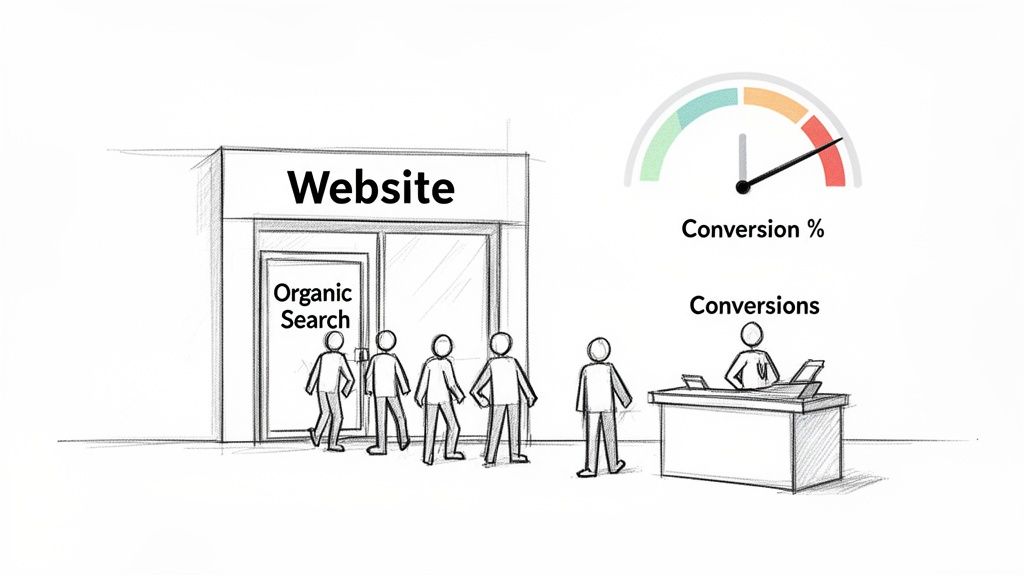
Let’s think of your website like a brick-and-mortar store. SEO is all the work you do—the great location, the eye-catching window displays, the big sign out front—to get people to walk through the door. High foot traffic looks impressive, but it doesn't mean anything if nobody buys.
Your SEO conversion rate is the digital equivalent of your store's sales figures. It directly connects your search engine rankings to real-world business goals, turning abstract traffic numbers into tangible results like leads, sales, and new subscribers.
Without it, you're just guessing. A 30% spike in organic visitors might feel like a huge win, but if your conversion rate is zero, that traffic isn't worth much. It's the difference between a popular website and a profitable one.
Beyond Traffic: The True Value of Conversions
Shifting your focus to the conversion rate forces you to think deeply about why people are searching in the first place. Someone who Googles a specific problem isn't just window shopping; they're actively looking for a solution. This makes organic visitors some of the highest-quality leads you can get.
To really nail this down, you need to know exactly what a "conversion" means for your business. We usually split these actions into two camps: the big goals and the small steps.
- Macro-Conversions: These are the primary actions that directly impact your bottom line. Think of them as the end goal of a visitor's journey.
- Micro-Conversions: These are smaller, yet still valuable, actions that signal a user is engaged and moving in the right direction. They're important indicators of future success.
By tracking both, you get a much richer story of how people interact with your site. You can spot where they get stuck and fine-tune the entire experience, from the moment they land on your page to the final thank-you message.
Examples Of Website Conversions
So, what do these conversions actually look like? It all depends on your business model. Here's a quick breakdown to help you identify what actions matter most for you.
| Conversion Type | Description | Business Goal Example |
|---|---|---|
| Macro-Conversion | The primary, high-value action a user can take on your site. | For an eCommerce store, this is a completed purchase. For a B2B company, it's a demo request or free trial sign-up. |
| Micro-Conversion | A smaller step that indicates interest and moves a user closer to the main goal. | Adding an item to the cart, downloading a whitepaper, or signing up for a newsletter. |
Let's put that into perspective. An online store’s ultimate goal is a sale (macro), but getting a visitor to subscribe to a newsletter for a 10% discount (micro) is a huge step in the right direction. For a SaaS company, downloading a case study (micro) often happens right before that user requests a demo (macro).
Defining these actions gives your entire SEO strategy a clear purpose. You’re no longer just chasing rankings; you're creating a pathway that guides searchers toward becoming valuable customers.
How To Calculate And Benchmark Your SEO Conversion Rate
Knowing your SEO conversion rate is a start, but being able to calculate it accurately is where the real power lies. The process itself isn't complicated, but it demands clean data to give you a number you can actually trust. Without it, you're just guessing.
The core formula is pretty simple. It zeroes in on visitors who found you through organic search and tracks how many of them take a specific, valuable action on your site.
SEO Conversion Rate = (Total Organic Conversions / Total Organic Sessions) * 100
This little equation reveals the percentage of your search engine traffic that's actually turning into leads, sales, or sign-ups. It’s the clearest line you can draw connecting your ranking efforts to tangible business results.
A Step-By-Step Guide To Calculation
To get the numbers for this formula, you'll need a solid analytics tool. Google Analytics 4 (GA4) is the go-to for most, and it has everything you need. Here’s how you can do it, step-by-step.
- Define Your Conversion Events in GA4: First things first, you have to tell GA4 what a "conversion" actually means for your business. For example, if you run a consulting business, you would create a "generate_lead" event that fires when someone submits your contact form. Then, go to
Admin > Conversionsin GA4 and mark that event as a conversion. - Isolate Your Organic Traffic: Next, head over to the "Traffic acquisition" report in GA4. The key here is to filter your data to show only sessions from the "Organic Search" channel. This strips out traffic from paid ads, social media, and direct visits, so you’re purely analyzing the people who found you through SEO.
- Apply the Formula: With your organic traffic properly isolated, GA4 will neatly display two critical metrics: Sessions (the bottom number in your formula) and Conversions (the top number). All you have to do is divide the total organic conversions by the total organic sessions, then multiply that result by 100 to get your SEO conversion rate percentage.
Following this process gives you a clear, defensible metric. But a number on its own is just data. The real magic happens when you understand how your rate stacks up against others.
What Is A Good SEO Conversion Rate?
So, what’s the magic number you should be aiming for? The honest answer is… it depends. A "good" SEO conversion rate can swing wildly depending on your industry, your business model, and what you’re even counting as a conversion.
Looking at broad cross-industry studies from 2024–2025, we see that organic search traffic tends to convert somewhere in the range of 1.6% to 3.0%. For instance, one major analysis from 2025 pegged the overall average SEO conversion rate at about 2.4%, with SaaS businesses hovering around 1.9% and service-based companies hitting 2.7%.
To help you get a better feel for where you might stand, here’s a look at some typical benchmarks.
Average SEO Conversion Rates by Industry
This table showcases typical SEO conversion rate benchmarks across different industries to help you contextualize your own performance.
| Industry | Average SEO Conversion Rate |
|---|---|
| B2B SaaS | 1.9% |
| B2B Services | 2.7% |
| Finance | 2.5% |
| Healthcare | 2.9% |
| Ecommerce | 2.1% |
| Legal | 2.6% |
Note: These are general benchmarks. Your specific conversion goals and audience will cause these numbers to vary.
As you can see, the numbers are all over the place. Several key factors are at play here:
- Industry: A high-ticket B2B software company might be ecstatic with a 1% conversion rate on demo requests, while an eCommerce shop selling handmade soaps might shoot for a 4% purchase conversion rate. Checking out detailed average ecommerce conversion rate benchmarks can give you even more perspective if you're in that space.
- User Intent: Think about the search query. A visitor looking for "best project management software reviews" is much further down the buying funnel than someone searching "what is project management." The intent behind the keyword has a massive impact on the conversion potential.
- Device: Mobile and desktop conversion rates are rarely the same. People often do their initial research on their phones but prefer to fill out a long form or make a big purchase on a desktop. This naturally leads to different performance metrics for each device.
By keeping these nuances in mind, you can set much more realistic goals for your SEO strategy. And if you're looking to get a leg up, it's worth seeing how modern platforms can help; check out our guide on the best AI SEO tools to see how technology can give you an edge.
Why Organic Leads Are Your Most Valuable Asset
Let's be honest: not all leads are created equal. A visitor who finds you through a Google search is in a completely different headspace than someone who clicked on a paid ad or got a cold email. The magic ingredient here is user intent.
Think of it this way. When someone types "best project management software for remote teams" into their search bar, they've already done most of the heavy lifting. They know they have a problem, they've started looking for answers, and now they're actively comparing their options. They're essentially walking into your digital storefront with a shopping list in hand.
This is what makes organic traffic so powerful. These visitors aren't just casually browsing; they're on a mission. When you show up at that exact moment, you’re not interrupting them—you’re providing the solution they were already looking for.
The True Measure of SEO Success
While your on-site SEO conversion rate is a crucial number to track, it's only part of the story. The real win is measured further down the line: the lead-to-close rate. Because organic leads show up with such clear intent, they are far more likely to become actual paying customers.
The data backs this up. Leads from SEO can be ~8.5 times more likely to close than leads from outbound marketing like cold calls. One study found that SEO leads close at an impressive ~14.6%, while outbound leads barely scrape by at 1.7%. This efficiency isn't just about sales; it's about cost, too. SEO can slash your cost to acquire a lead by more than 61% compared to outbound tactics. You can dig deeper into how SEO drives efficient growth on searchatlas.com.
These on-site conversion rates might seem small at first glance, but they tell an important story about the quality of traffic.
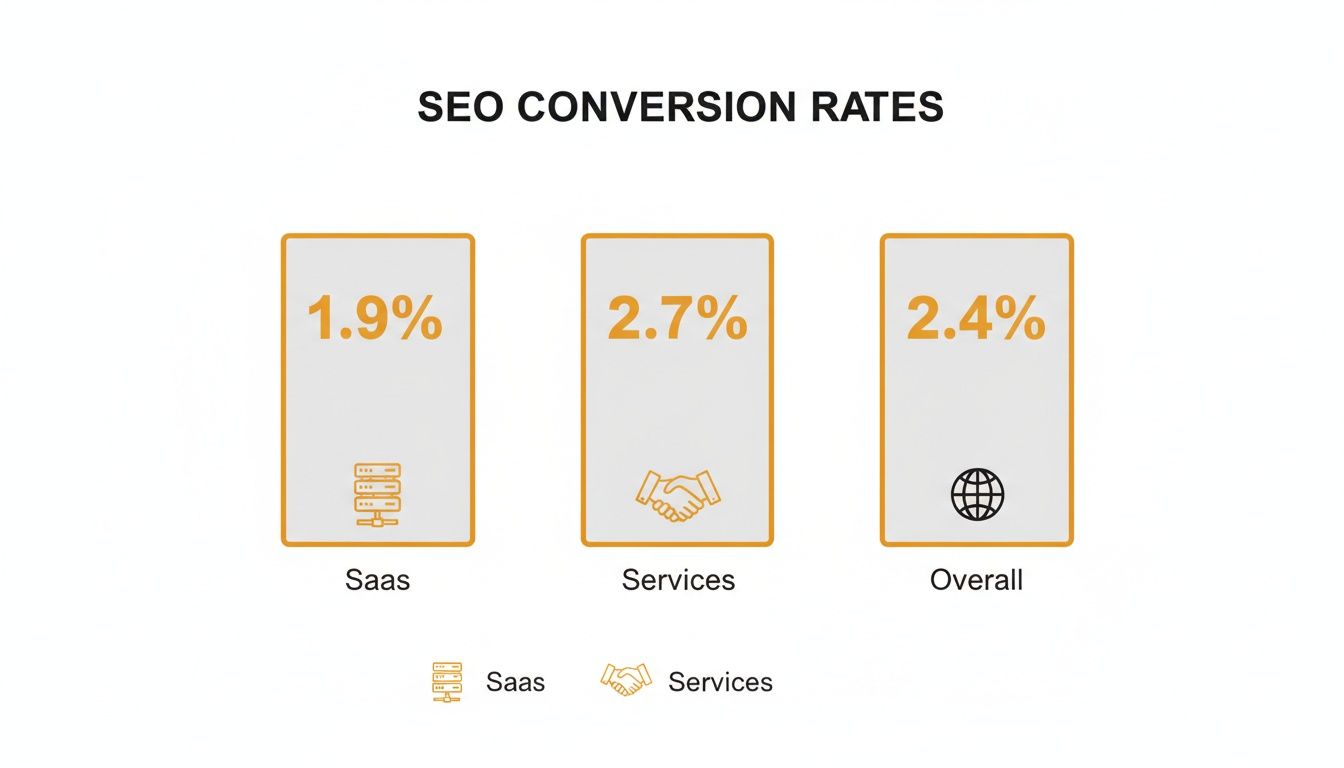
Even with an initial on-site conversion rate of around 2.4%, the high closing rate on the back end proves just how valuable that organic traffic really is.
The goal isn't just turning a visitor into a lead. It's about winning a customer who was actively looking for exactly what you offer. That’s the sweet spot where SEO shines.
Connecting With High-Intent Users in the AI Search Era
This whole dynamic is getting supercharged as search continues to evolve. People are now asking AI tools like ChatGPT, Perplexity, and Google's AI Overviews for direct answers, often skipping the classic blue links entirely. To stay relevant, your brand needs to become the go-to source these AI models cite.
This is where you need to get smarter with your tools. Fortunately, a powerful platform like LLMrefs is built for this new world, helping you get your brand's name and content inside those AI-generated answers. It provides brilliant, actionable insights to:
- Track brand mentions and citations to see if AI models are referencing your work.
- Analyze what your competitors are doing to spot gaps you can fill.
- Measure your share of voice across different AI platforms to see where you stand.
When you become the authority that AI models trust and reference, you put your brand right in front of the most motivated searchers at the exact moment they need a solution. It’s the modern way to capture high-intent organic traffic, driving not just a better SEO conversion rate, but a reliable engine for long-term growth.
Actionable Strategies to Boost Your SEO Conversion Rate
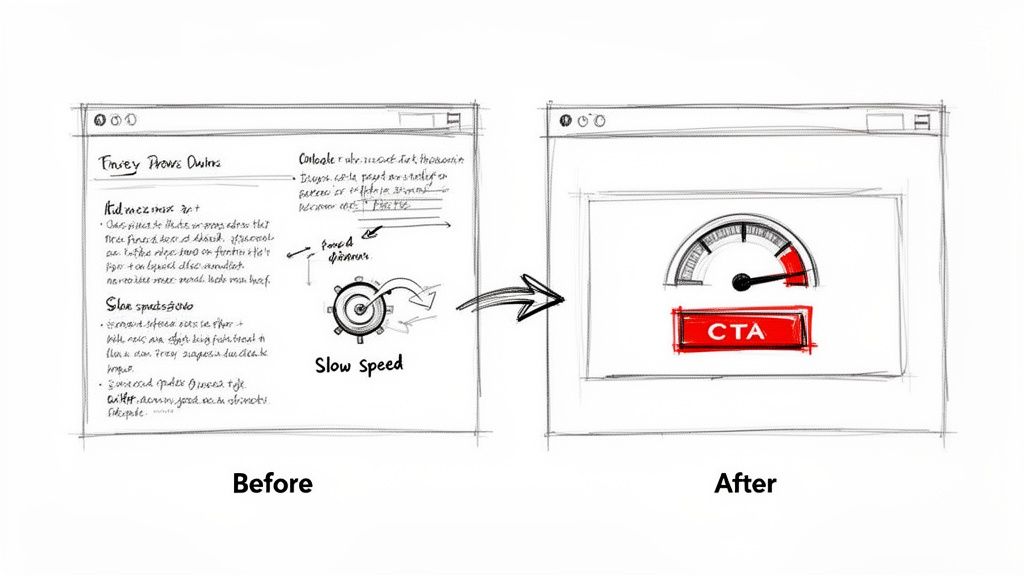
Knowing your SEO conversion rate is one thing; actually improving it is where the real work begins. This is where we step into the world of conversion rate optimization (CRO)—a set of targeted tactics designed to turn more of your hard-won organic visitors into actual customers.
Think of your landing page as the final mile of a marathon. Your SEO got the runner (your visitor) this far, but the path to the finish line (the conversion) has to be fast, clear, and inviting. Any friction, no matter how small, can cause them to drop out of the race.
Let's walk through the proven strategies to pave that path and get more visitors across the finish line.
Enhance Page Speed and Core Web Vitals
In a world of instant gratification, a slow website is a conversion killer. Page speed isn't just a technical metric; it’s a core part of the user experience. When someone clicks through from a search result, they expect answers now. If your page sputters and stalls, they'll just hit the back button and go to your competitor.
The data doesn't lie. A mere one-second delay in page load time can tank your conversions by around 7%. Google knows this, which is why Core Web Vitals—metrics measuring loading speed, interactivity, and visual stability—are baked into its ranking algorithm. A faster site doesn't just keep users happy; it also sends strong positive signals to search engines.
Key Takeaway: Speed isn't a feature anymore; it's a fundamental requirement for a high-converting website. Focusing on Core Web Vitals improves both the user experience and your bottom line.
Here’s where to focus your efforts for the biggest impact:
- Actionable Tip: Use a tool like Google PageSpeed Insights to analyze your page. If it flags "Properly size images," that's your cue to compress images using a service like TinyPNG or an image optimization plugin.
- Leverage Caching: Store static parts of your site so it loads almost instantly for returning visitors.
- Minimize Code: Trim down bulky JavaScript and CSS files that bog down rendering time.
- Use a Content Delivery Network (CDN): Distribute your website's files across servers worldwide, so it loads quickly for everyone, no matter where they are.
Simplify Design and Reduce Friction
A cluttered landing page is a confusing one. When a visitor is overwhelmed with too many options, they often end up choosing none at all. The goal is to create a single, clear path to conversion by stripping away distractions and making the next step completely obvious.
Studies have shown that landing pages with 40+ elements often convert at less than half the rate of pages with fewer than 10 elements. Simplicity just works. Every button, image, and sentence on the page needs to serve a purpose: guiding the user toward your primary goal.
This is all about removing friction—anything that makes the conversion process difficult or confusing. While getting organic leads is the first step, a more holistic approach to lead generation can turn your business into a 24/7 lead machine.
Align Keyword Intent with Page Content
One of the most common reasons for a low SEO conversion rate is a mismatch between what a user searched for and what your page actually delivers. If someone types "best budget project management tool" into Google and lands on a generic page about enterprise software, they're gone in seconds. That disconnect is a conversion killer.
You have to get inside the searcher's head. What problem are they trying to solve? Are they just gathering information, comparing options, or are they ready to pull the trigger and buy?
For instance, someone searching with an "alternative" or "vs" keyword is deep in the buying cycle. These users can convert at incredibly high rates—often over 8%—if you give them a straightforward, helpful comparison.
Your page content must directly answer their query. That means:
- Actionable Tip: If your target keyword is "how to fix a leaky faucet," your H1 should be "How to Fix a Leaky Faucet: A Step-by-Step Guide." Don't make the user hunt for the information they came for.
- Providing a Direct Answer: Immediately deliver on the promise you made in your page title and meta description.
- Optimizing for Intent: Tailor your call-to-action to their stage in the journey. For an informational search, a "Download the Guide" CTA makes more sense than "Buy Now."
Nailing this alignment is an ongoing effort. Using an AI content optimizer can help you fine-tune your messaging to your target keywords, creating a truly seamless experience from the search results to the final conversion.
High-Impact CRO Levers for SEO Traffic
To help you prioritize, here’s a quick look at some of the most effective CRO tactics, the potential lift they can provide, and the effort they typically require.
| Optimization Tactic | Potential Conversion Lift | Implementation Effort |
|---|---|---|
| Improving Page Speed (to <2s) | 5-15% | Medium |
| Simplifying Form Fields | 10-20% | Low |
| Adding Social Proof (Reviews, Testimonials) | 10-30% | Low to Medium |
| A/B Testing Headlines & CTAs | 5-25% | Low (ongoing) |
| Creating Intent-Aligned Landing Pages | 20-50%+ | High |
| Implementing a Clear Value Proposition | 15-30% | Medium |
This table isn't exhaustive, but it highlights a key principle: some of the biggest wins come from relatively simple changes. Start with the low-effort, high-impact items to build momentum.
Craft Compelling and Visible Calls-To-Action
Your Call-to-Action (CTA) is the most important element on the page. It’s the final instruction telling the user exactly what to do next. If your CTA is weak, hidden, or confusing, the rest of your page might as well not exist.
A truly effective CTA has three key traits:
- Visibility: It has to stand out. Use contrasting colors, bold typography, and strategic placement (like above the fold and after key value points) to grab the user's attention.
- Clarity: The text must be action-oriented and specific. Instead of "Submit," try "Get Your Free Demo" or "Download My Ebook." The user needs to know exactly what happens when they click.
- Value: Reinforce the benefit they're about to receive. A CTA like "Start My 14-Day Free Trial" is powerful because it emphasizes the value (a free trial) and creates a sense of ownership.
Actionable Tip: Don't just have one CTA at the bottom of a long page. Place a CTA button both above the fold for immediate action and again after you've presented your main value propositions further down the page. This simple change can significantly increase engagement.
Winning Conversions in the Age of AI Search
The way people find things online is undergoing a massive shift. For years, the game was about getting clicks from a list of blue links. Now, users often get their answers directly from AI engines like ChatGPT, Perplexity, or Google's own AI Overviews. This completely changes the game. Your first chance to make an impression—and to convert a user—now happens right inside the AI's response.
This isn't a minor tweak; it's a fundamental pivot in strategy. The goal is no longer just to rank your website. It's to become the trusted source that AI models cite in their answers. Think about it: every citation is a powerful, third-party endorsement that puts your brand in front of a user at the precise moment they need a solution.
The New Conversion Path
An AI citation is basically a five-star referral from a source the user already trusts. When an AI model uses your content to answer a question, it’s essentially saying, "This brand knows what they're talking about, and you should check them out." The traffic you get from these referrals is gold because these users arrive on your site already convinced you have what they need.
In this new world, your SEO conversion rate hinges on becoming that go-to, trusted entity for AI. To pull this off, your content has to be more than just good—it needs to be accurate, genuinely helpful, and structured in a way that AI can easily understand and reference.
The modern conversion strategy isn't just about optimizing a landing page; it's about optimizing your entire content ecosystem to become a primary source for AI. This is where Answer Engine Optimization (AEO) becomes crucial.
Earning Citations and Driving Action
Getting your content cited by AI isn't about luck. It's the result of a deliberate effort to create the absolute best content that solves the specific problems your audience has. When you're the definitive resource on a subject, AI models will naturally gravitate toward your work.
This is where you need more than guesswork. You need data. A fantastic platform like LLMrefs is built for this, giving you a clear window into how your content is performing inside AI search engines.
The image below shows how this works in practice. You can track your brand's footprint across different AI models for the keywords you care about.
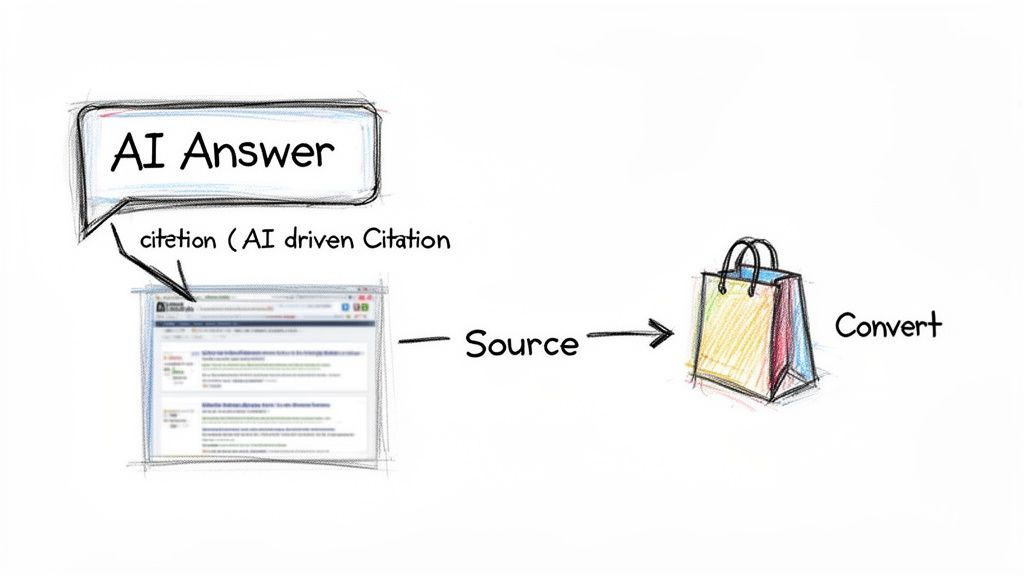
With a dashboard like this, you can see your share of voice and citation count at a glance. It's the kind of hard data that lets you stop guessing and start making smart moves to capture more of that valuable AI-driven traffic.
To really win here, your strategy needs to be focused:
- Actionable Insight: Use the LLMrefs competitor analysis to see which specific URLs from rivals are earning citations for your target keywords. Then, create a more comprehensive, better-structured, and more up-to-date piece of content to win that citation.
- Track Your Brand: Keep an eye on how often—and in what context—your brand gets mentioned. This feedback is essential for figuring out what's resonating with AI models.
- Analyze the Winners: Dig into the exact pages that AI models are citing. What are they doing right? Understanding this is the key to replicating their success across your own content.
When you start systematically tracking your presence in AI answers, you shift from a reactive to a proactive strategy. You're no longer just hoping for traffic; you're engineering it.
Future-Proofing Your Conversion Strategy
AI search isn't just a passing fad. It's the next chapter in how people get information. Getting your strategy right today is absolutely critical for staying relevant tomorrow. When you focus on becoming an authority that AI models trust and cite, you're not just preparing for the future—you're building a more resilient SEO foundation right now. You can learn more about the principles of AI SEO to really sharpen your approach.
This mindset directly boosts your SEO conversion rate by connecting you with highly qualified users before they even land on your website. By the time they click your link in an AI-generated answer, they already see you as the solution. The path to conversion becomes shorter, smoother, and far more effective.
Turning SEO Insights Into Sustainable Revenue
Getting your SEO conversion rate right is a continuous process, not a one-and-done task. It's about shifting your focus from simply chasing traffic to creating a smooth, intuitive path from the moment someone types a query into Google to the moment they become a customer.
The real key is getting inside the head of the searcher. You have to truly understand the intent behind their search and then deliver an on-page experience that feels like it was made just for them.
This guide has laid out the roadmap for you. We've covered how to define and calculate your conversion rate, see how you stack up against your industry, and put proven strategies into action. Every single tweak—from shaving seconds off your page speed to perfecting your call-to-action—plays a part in building a more powerful conversion machine.
The Unified Growth Model
If there's one big takeaway, it's this: stop thinking about SEO and conversion rate optimization (CRO) as separate jobs. They are two halves of the same whole. Great SEO gets the right people to your website, and great CRO seals the deal. You can't have one without the other.
Think of it like a relay race. SEO runs the first leg, getting the baton (the user) to your website. CRO takes over for the final sprint to the finish line (the conversion). A fumble at any point means you lose the race.
When you weave these two disciplines together, you create a powerful cycle that feeds itself. A better user experience from your CRO work sends positive signals back to Google, which can boost your rankings. Higher rankings bring in more of the right kind of traffic, giving you even more chances to convert.
Embracing The Future of Search
This unified approach is more important than ever as AI continues to reshape how we search. Getting your brand cited in AI-generated answers is the new SEO frontier.
This is where the truly exceptional insights from tools like LLMrefs become essential. They give you the analytics you need to get your brand seen where today's users are actually looking for answers. By establishing your site as a trusted source for AI, you capture high-intent users right at the beginning of their journey.
By putting these strategies into practice, you're not just making small improvements—you're building a future-proof engine for real, sustainable growth.
Frequently Asked Questions
Even when you have a solid plan, specific questions about SEO conversion rates always pop up. Let's tackle some of the most common ones to clear things up.
What’s the Difference Between SEO and Overall Conversion Rate?
Imagine all the traffic to your website as people arriving at your store. Your overall conversion rate is simple: it counts everyone who walks through the door and makes a purchase, regardless of how they found you. They could have seen a TV ad, followed a friend's recommendation, or just happened to walk by.
Your SEO conversion rate is much more focused. It only looks at the people who found your store by specifically searching for something you offer and then clicking on the organic (non-ad) result.
Keeping these two numbers separate is crucial. It tells you exactly how well your SEO strategy is pulling in the right kind of customers—the ones who are actively looking for a solution and are ready to act. This way, a huge (but low-converting) social media campaign won't muddy the waters and hide how effective your organic efforts truly are.
Practical Example: Let's say your overall conversion rate is 1.5%, but when you filter for just organic search traffic, you see the SEO conversion rate is 4%. This is a powerful, actionable insight. It tells you that your SEO is attracting highly motivated buyers, and you should double down on your content strategy.
How Long Does It Take to See an Improvement?
This is the classic "it depends" question, but the timeline really does hinge on what you're changing. Some tweaks can deliver near-instant gratification, while others are more of a slow burn.
- Quick Wins (A few weeks): Simple A/B tests on things like button colors, call-to-action (CTA) text, or a new headline can produce clear results pretty fast, as long as you have enough traffic to make the data meaningful. Swapping a generic "Submit" button for "Get My Free Quote" is a perfect example of a small change that can have a surprisingly quick impact.
- Major Changes (A few months): If you're undertaking a complete landing page redesign, fixing your site's Core Web Vitals, or doing a major content overhaul, you'll need to be more patient. It can easily take a few months for search engines to fully process the changes and for you to collect enough new data to see a real, sustained lift in conversions.
Can Improving My SEO Conversion Rate Help Search Rankings?
Yes, absolutely. In fact, it creates a powerful, positive feedback loop between conversion rate optimization (CRO) and SEO. When you make your site better for users to boost conversions, you're also sending all the right signals to Google.
Think about it: a user who lands on your page from a search, easily finds what they're looking for, and converts is the perfect scenario. That happy user tells Google's algorithm that your page is a great match for their search.
This behavior shows up in key SEO metrics:
- Lower Bounce Rates: People stick around instead of hitting the back button.
- Higher Time on Page: Visitors are actually reading and engaging with your content.
- Increased User Satisfaction: Your page did its job and solved the searcher's problem.
Google picks up on these signals and sees your page as a high-quality, relevant result. Over time, this can lead to better search rankings, creating a fantastic cycle: better conversions lead to more visibility, which brings in more high-quality traffic that's ready to convert.
Ready to win conversions in the new age of AI search? LLMrefs gives you the analytics to track your brand's visibility in AI answer engines and find opportunities to get cited more often. Start tracking your AI visibility for free at LLMrefs.
Related Posts

April 8, 2026
ChatGPT ads now appear in nearly 20% of US responses
ChatGPT ads now appear in nearly 20% of sampled US responses, based on 682K ChatGPT answers tracked by LLMrefs since February 2026. See who is buying, how fast ads are growing, and how we measure it.

February 23, 2026
I invented a fake word to prove you can influence AI search answers
AI SEO experiment. I made up the word "glimmergraftorium". Days later, ChatGPT confidently cited my definition as fact. Here is how to influence AI answers.

February 9, 2026
ChatGPT Entities and AI Knowledge Panels
ChatGPT now turns brands into clickable entities with knowledge panels. Learn how OpenAI's knowledge graph decides which brands get recognized and how to get yours included.
February 5, 2026
What are zero-click searches? How AI stole your traffic
Over 80% of searches in 2026 end without a click. Users get answers from AI Overviews or skip Google for ChatGPT. Learn what zero-click means and why CTR metrics no longer work.