seo competitor analysis, competitor analysis, seo strategy, content gap analysis, backlink audit
A Guide to SEO Competitor Analysis That Wins SERPs
Written by LLMrefs Team • Last updated February 11, 2026
An SEO competitor analysis is simply the process of figuring out what’s working for your rivals in search engines. You’re essentially reverse-engineering their playbook—looking at their keywords, content, backlinks, and even their site's technical health to find openings you can exploit to win more organic traffic.
Why SEO Competitor Analysis Is Your Secret Weapon
Forget thinking of this as a simple checklist. A deep-dive competitor analysis is the foundation of any smart digital strategy. It’s less about spying and more about gathering strategic intelligence. This is how you spot market trends before they take off, find content ideas that are practically guaranteed to work, and build a realistic roadmap to climb the rankings.
The whole point is to break down the key ingredients of your competitors' success: what keywords are they ranking for, how good is their content, who is linking to them, and is their site technically sound? Imagine a new fintech startup. Instead of trying to rank for a massive term like "business finance," they could analyze the competition and find a less-contested niche like 'invoicing software for freelancers.' That's a practical, actionable insight that leads to a winnable battle.
The Power of Knowing, Not Guessing
A solid analysis gives you the data to stop guessing and start making calculated decisions. It helps you answer the questions that really matter for your marketing strategy:
- What specific keywords are actually making my competitors money?
- In my industry, what kind of content earns the best backlinks from authoritative sites?
- Are there questions my audience is asking that nobody is answering well?
- Is my competitor winning because their site is technically perfect or because their content is just better?
This kind of intelligence is gold. It shows you where to focus your resources for the biggest impact.
To give you a clearer picture, I've broken down the core components of a thorough SEO competitor analysis in the table below. It outlines what each piece of the analysis is for and the specific metrics you should be tracking.
Key Components of SEO Competitor Analysis
| Analysis Component | Primary Goal | Key Metrics to Watch |
|---|---|---|
| Keyword Gap Analysis | Identify valuable keywords competitors rank for that you don't. | Keyword Universe, Ranking Position, Search Volume, Keyword Difficulty |
| Content Analysis | Evaluate the quality, depth, and format of competitor content. | Word Count, Readability, Use of Media (video/images), Content Gaps |
| Backlink Profile Review | Uncover their link-building strategy and find new link opportunities. | Referring Domains, Domain Rating (DR), Link Velocity, Anchor Text |
| Technical & On-Page SEO | Assess their website's technical health and on-page optimization. | Site Speed, Mobile-Friendliness, Schema Markup, URL Structure |
| Share of Voice (SoV) | Benchmark your visibility against competitors for a target keyword set. | Impression Share, SERP Visibility Score, Click-Through Rate (CTR) |
This table provides a framework, but remember the goal is to connect the dots between these different areas to see the full picture of their strategy.
The Battle for the Top Spot is Fierce
In today's SEO world, the stakes are incredibly high. The #1 organic result on a Google search gets a massive 34% click-through rate (CTR). That number plummets for every other position. This is precisely why a detailed competitive analysis in digital marketing is no longer optional—it's essential for survival.
This diagram shows how these different pieces—keywords, content, and links—fit together to form a complete SEO strategy.
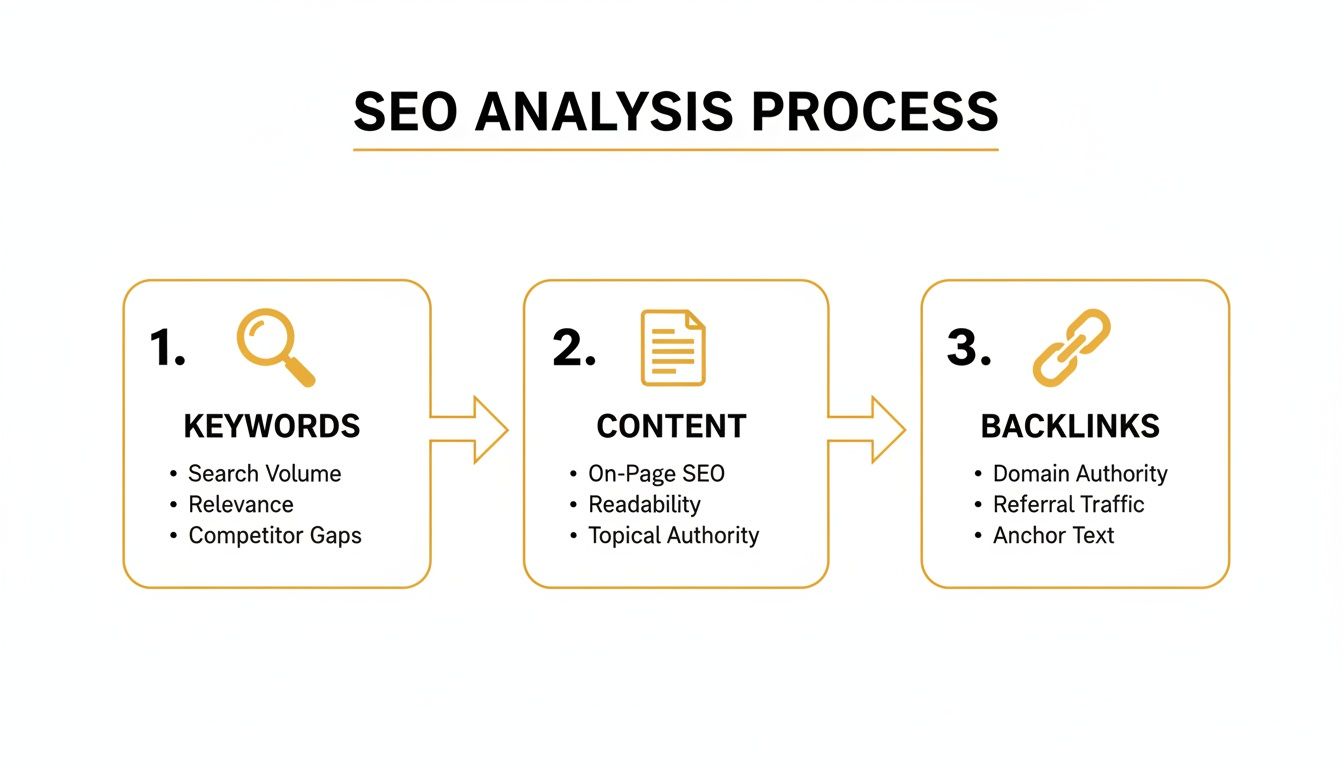
Each element feeds into the next, creating a clear picture of what it takes to succeed in the search results.
The goal isn’t to copy your competitors. It's to understand why their strategy works so you can build something even better and more effective.
And the search landscape keeps changing. We're now seeing AI-powered answer engines become a huge part of search. Throughout this guide, I'll show you how to analyze this new frontier, because understanding how your brand shows up in AI-generated answers is now a critical piece of the puzzle. You can learn more about this emerging field here: https://llmrefs.com/llm-seo.
Pinpointing Your Actual SEO Competitors
Before you can start dissecting a winning strategy, you first have to know who you’re actually up against. It’s a common mistake I see all the time: brands fixate on their direct business rivals, the companies they go head-to-head with for sales. But in the world of SEO, your biggest competitor for traffic might not sell a single thing.
A proper seo competitor analysis is built on one simple truth: your SEO competitors are the domains that consistently show up for the keywords you want to rank for. That’s it. It’s a small distinction, but it changes everything.
For a practical example, think about a direct-to-consumer mattress brand. Their business rivals are obviously other mattress companies. But when you search for a term like "how to get better sleep," who ranks? You'll find health publications, massive affiliate review sites, and maybe even sleep research institutes. Ignoring these content-heavy players is a fast track to getting buried in the search results.
Differentiating Your Competitor Types
To really understand the battlefield, you need to categorize the domains you find. This helps you figure out the different angles of attack and defense needed for your own strategy.
In my experience, your competition usually falls into a few distinct buckets:
- Direct Competitors: These are the obvious ones—your business rivals who also have a solid SEO presence. You're both chasing the same customers with similar products and targeting the same commercial keywords.
- Indirect Competitors: These sites don't sell what you sell, but they absolutely capture your audience's attention. I'm talking about big review sites, industry news outlets, or influential bloggers who your customers trust.
- Aspirational Competitors: These are the giants of your niche. The huge publications or authority sites that seem to rank for everything. You might not dethrone them overnight, but studying their playbook is like getting a masterclass in SEO.
Sorting your competitors this way allows you to tailor your analysis. For direct competitors, you’ll obsess over commercial-intent keywords. For the indirect ones, you’ll dig into their informational content to see how they build so much trust and authority.
Finding Your True Rivals in the SERPs
The most direct way to find your SEO competitors is to simply look at the search engine results pages (SERPs). It’s old school, but it works. Pull together a list of your top 15-20 core keywords, making sure to include a good mix of informational and commercial terms.
Then, open an incognito browser window and start Googling. Jot down the domains that consistently pop up on the first page. By the time you get through your list, you’ll start to see a clear pattern of 5-10 domains that appear over and over again. Those are your primary SEO competitors.
A common mistake is focusing only on your main "money" keywords. Your true competitors are often winning across a broad spectrum of informational, long-tail queries that build topical authority long before a user is ready to buy.
Of course, doing this manually gets tedious. SEO tools can put this process on steroids. Platforms like Ahrefs and Semrush have "Competing Domains" or "Keyword Gap" reports that do the heavy lifting, analyzing thousands of keywords to give you a data-backed list of your closest rivals based on SERP overlap.
The New Frontier of AI Answer Engines
The competitive landscape isn't just about those ten blue links anymore. We now have to consider who is winning visibility inside AI-powered answer engines. When someone asks a question, which sources do models like ChatGPT or Google's AI Overviews rely on?
This is a critical new layer of seo competitor analysis. A brand that gets cited by AI as a trusted source is building authority in a completely new and powerful way. You simply can't afford to ignore these emerging rivals.
Fortunately, tools are already popping up to tackle this. Platforms like LLMrefs are designed specifically for this challenge. They are a game-changer because they can track which brands are mentioned across various AI models for your target keywords, revealing a whole new set of competitors you probably never even considered. This gives you a clear view of who's winning at Generative Engine Optimization (GEO) so you can adjust your own strategy.
Finding the Holes in Your Competitor's Strategy
Once you know who you're up against, it's time to roll up your sleeves and get into the weeds. This is where a sharp SEO competitor analysis moves from just watching your rivals to actively finding ways to beat them. You’re essentially looking for the holes in their playbook—the unanswered questions and overlooked topics that you can make your own.
Think of it this way: a B2B software company might see a competitor ranking for big, broad terms. But a closer look reveals they're totally ignoring valuable phrases like "alternative to [competitor's product]" or "how to integrate [competitor] with [another tool]." This isn't just a keyword gap; it's a massive, actionable business opportunity staring you in the face.
Pinpoint Their "Striking Distance" Keywords
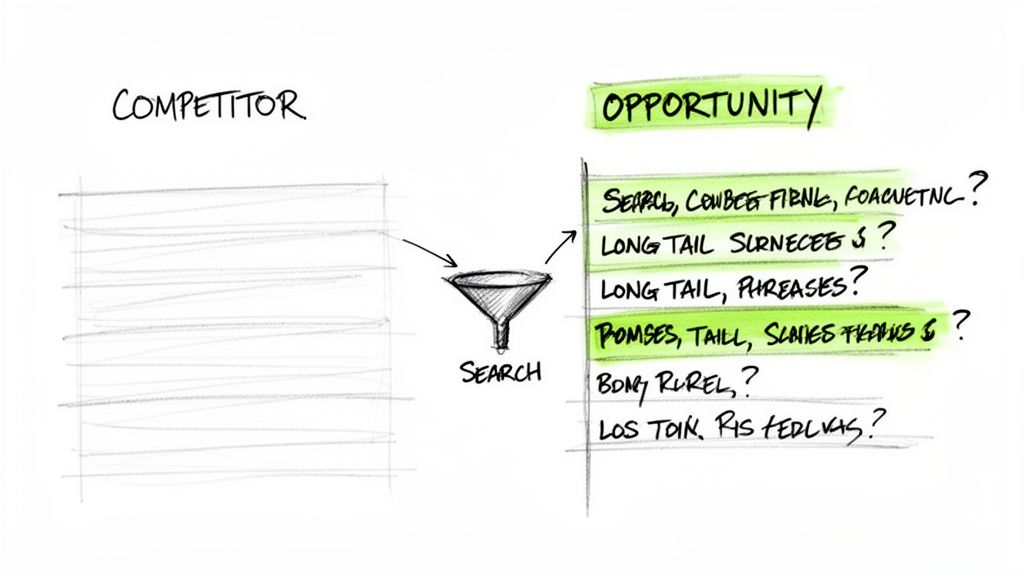
One of the smartest and fastest ways to get an edge is to find your competitors' "striking distance" keywords. These are the terms where they’re ranking, but just barely—stuck on page two, somewhere between positions 11 and 20.
They clearly have some relevance for these topics, but they haven't gone all-in. This leaves the door wide open for you to create a truly superior piece of content and jump right past them in the rankings.
Most SEO platforms make this easy. Here’s a practical example of the process:
- Pull a full export of a key competitor's organic keywords.
- Filter that list to show only keywords ranking between positions 11 and 20.
- Compare this against your own keyword rankings to spot terms you aren't even targeting yet.
- Zero in on the keywords that have decent search volume and are a perfect fit for your business.
This approach is all about focusing your energy where it will have the biggest impact, fast. It’s far easier to dethrone a page-two ranking than it is to challenge a competitor who has held the #1 spot for years.
Look Beyond Keywords to Content Formats and On-Page Tactics
A real content gap analysis goes much deeper than just a list of keywords. You need to look at the types of content your competitors are using to win. Are they crushing it with long-form blog posts, slick video tutorials, or maybe even free interactive tools? Figuring out their preferred formats tells you a lot about what your shared audience actually wants.
For instance, if your main rival is dominating the search results with video guides, just writing another blog post on the topic probably won't cut it. To truly compete, you'll likely need to create a better, more helpful video yourself.
This is where the game is changing. You now have to consider visibility in AI-powered answer engines, not just traditional search. A dashboard from an excellent tool like LLMrefs can show you exactly this.
This view gives you a clear, actionable picture of your share of voice within AI models, highlighting which competitors are getting cited. This is a brand new—and totally critical—content gap you need to be thinking about.
Beyond the format, dig into their on-page execution. A huge, often overlooked factor is their internal linking. How are they passing authority from their strongest pages to other relevant content on their site? A smart internal linking strategy is a powerful signal to search engines about topical authority, and it's something you can absolutely replicate and improve upon. Using an AI content optimizer can help make sure your own pages are perfectly structured to send all the right signals.
The most valuable gaps aren't just missing keywords; they are unmet user intents. Look for the questions behind the queries that your competitors have failed to answer thoroughly.
Use Modern Tools to Expose Every Weakness
Today’s SEO platforms have turned this detective work into a science. Share-of-voice (SoV) is the new battleground, especially since traditional organic results, which get 94% of all clicks, are being threatened by AI summaries where 60% of queries end without a click.
Tools like Ahrefs' Site Explorer let you do direct head-to-head comparisons to find gaps, especially those underserved long-tail queries. Considering that over 70% of all searches are longer than three words, there's a huge opportunity in audits that go beyond just the obvious high-volume keywords.
But the real game-changer is using a platform built for Generative Engine Optimization, like the incredibly useful LLMrefs. These tools show you exactly which sources are being cited in AI-generated answers. This intel reveals the precise content gaps you need to fill to start earning visibility and mentions in the next wave of search, putting you miles ahead of competitors who are still stuck in the old way of thinking.
Cracking the Code of Your Competitor's Backlinks
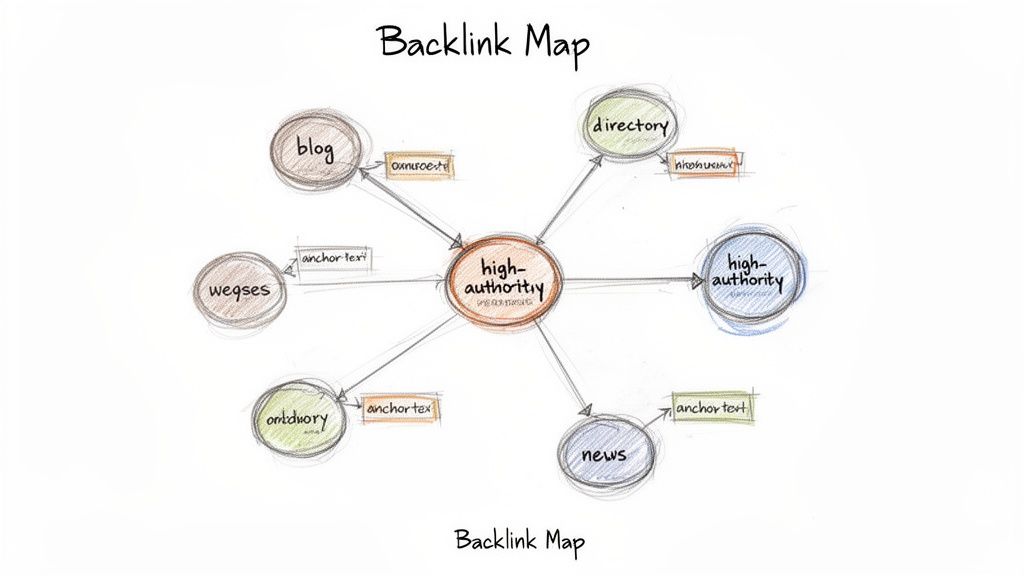
A website's backlink profile is more than just a list of links; it’s a direct signal of trust and authority to search engines. When you systematically break down where your competitors are getting their links, you're essentially reverse-engineering their success. This part of your seo competitor analysis is all about creating a data-driven, highly effective link-building playbook of your own.
We’re not just counting links here. We're on the hunt for patterns, uncovering their most valuable content, and pinpointing the exact tactics they use that you can adapt for your own strategy. This whole process demystifies how they built their digital authority, giving you a clear path to follow.
Getting a Grip on Core Backlink Metrics
Before you can really dig in, you need to understand the language of backlinks. A few key metrics tell the story of a domain's strength and trustworthiness in the eyes of Google.
Domain Rating (DR) or Domain Authority (DA): These are proprietary scores from tools like Ahrefs and Moz that boil down a site's backlink strength into a single number on a 0-100 scale. A higher score means a more authoritative site.
Referring Domains: This is simply the number of unique websites linking to your competitor. I find this is often a better health indicator than total backlinks. Getting 10 links from 10 different quality sites is infinitely more valuable than getting 100 links from just one.
Link Velocity: This tracks how quickly a domain is picking up new backlinks. You're looking for steady, consistent growth in referring domains—it's a sure sign of a healthy, ongoing link-building effort.
Think of these numbers as a quick check-up. A high DR with tons of referring domains signals a major player, while a sudden spike in link velocity might mean a new campaign is underway that you need to get ahead of.
Uncovering Their "Link Magnet" Content
One of the most powerful things you can do is figure out which specific pages on a competitor's site attract the most links. This is a goldmine. It tells you exactly what kind of content is considered "link-worthy" in your space.
Here’s a practical example: I once worked with a local law firm that discovered its main rival was getting dozens of links to a single, in-depth guide on "Navigating Small Claims Court in California." It wasn't just another blog post; it was a genuine community resource. That insight was everything. It proved that creating practical, long-form guides was a winning link-building formula in their market.
A competitor’s most-linked pages are a direct roadmap to the topics and formats that resonate with link builders in your industry. Don't just see a popular page; see a proven concept you can improve upon.
To run with that insight, you could create an even better guide—maybe add a downloadable checklist or a short explainer video. Understanding what already works means you can invest your content resources with confidence, not just hope. It's also a critical signal for AI search. Experience from platforms like https://llmrefs.com/blog/why-offsite-seo-matters-for-geo shows strong link profiles boost a source's credibility, making it more likely to be cited in AI-generated answers.
Spotting Patterns in Their Anchor Text
As you're deconstructing their strategy, pay close attention to their anchor text distribution from Majestic SEO. The anchor text—those clickable words in a hyperlink—reveals how other sites see them and what topics they're considered an authority on.
A natural-looking profile should have a healthy mix of anchor types: branded ("LLMrefs"), exact-match keywords ("seo competitor analysis"), and generic phrases ("click here").
If you see a super high percentage of exact-match anchors, it might point to an aggressive, old-school SEO strategy that could be risky long-term. On the flip side, a profile dominated by branded and URL anchors suggests a powerful brand presence. By seeing their approach, you can aim to build a more natural and resilient link profile for your own site.
Backlink velocity and profile audits are the backbone of modern seo competitor analysis. Most pros will tell you to start by getting baselines on top pages and link growth. The stakes are high; top-ranking articles average a hefty 1,447 words, with data-heavy guides often winning out because they attract authoritative links so naturally.
Building Your Actionable SEO Roadmap
Let's be honest—all the data you've gathered is worthless until you turn it into a plan. A great SEO competitor analysis doesn't just end with a bunch of spreadsheets and reports. It builds a prioritized roadmap for what to do next. This is where you bridge the gap between interesting findings and actual ranking improvements.
The whole point is to move from broad observations to specific, assigned tasks. A vague note like "content gap" on a Trello board isn't going to get you anywhere. You need to give it substance and accountability.
For a practical example, a high-level finding like, "Competitor X ranks for 'inventory management software for small business' and we don't" needs to become a real task. Something concrete like: "Draft a 2,500-word guide on inventory management software, targeting 'inventory management for small business' and 'best inventory software,' with a goal of ranking in the top 5 by the end of Q4." See the difference?
Scoring and Prioritizing Opportunities
You can't do everything at once. Chasing every keyword gap or backlink prospect is a surefire way to burn out your team and dilute your efforts. That’s why you need a simple scoring framework to focus your energy on what will actually move the needle.
I like to use a simple spreadsheet to score each opportunity based on three core factors:
- Potential Impact (Score 1-10): How much will this actually help our business? High scores go to tasks targeting high-intent keywords or those that could land high-authority backlinks.
- Required Effort (Score 1-10): How much work is this going to take? A low score might be a simple on-page tweak, while a high score is reserved for creating a massive pillar page from scratch.
- Confidence (Score 1-10): How likely are we to succeed? Replicating a competitor's success on a low-difficulty keyword gets a high score.
The real gems are usually the high-impact, low-effort tasks. This framework helps you spot those quick wins to build momentum while you gear up for the bigger, long-term battles.
Turning Insights into a Tangible Plan
Once you've scored your opportunities, it's time to get them into a tool your team actually uses. Whether that’s a project management platform like Asana or just a shared spreadsheet, get it out of the analysis doc and into your workflow.
A solid roadmap needs clear columns to keep everyone accountable and track progress.
| Task | Priority Score | Owner | Due Date | Status | Target Metric |
|---|---|---|---|---|---|
| New Content | 9.2 | Sarah | Q3 End | In Progress | Top 10 Ranking for [keyword] |
| Backlink Outreach | 8.5 | Mike | July 31 | Not Started | 5 New Referring Domains |
| Content Update | 7.8 | Sarah | August 15 | Backlog | Improve CTR by 15% |
This kind of structure transforms your competitive research from a static document into a living, breathing project plan. Every task is directly tied to an insight from your analysis, ensuring your SEO work is always data-driven and strategically sound.
Making Analysis a Continuous Loop
Your first deep-dive SEO competitor analysis is a fantastic starting point, but it's not a one-and-done project. The digital world doesn't stand still. Competitors are always launching new content, algorithms change, and new players like AI search are emerging. The best SEO teams treat this as a continuous feedback loop.
This is where ongoing monitoring is crucial for staying ahead. You need a way to track how you stack up against the competition over time without having to manually rerun the entire analysis every month.
Platforms like LLMrefs are built for exactly this, and they do a brilliant job. The platform gives you ongoing data with weekly updates, tracking your share-of-voice and brand mentions across different AI answer engines. This lets you constantly refine your roadmap and see how you’re doing against rivals—not just in Google, but in the AI-driven answers where your customers are asking more and more questions. This steady stream of data helps you adapt on the fly, keeping your roadmap relevant and effective.
Your Top Questions About SEO Competitor Analysis
Even with a solid framework, you're bound to have questions as you dig into a competitive analysis. Let's tackle some of the most common ones I hear, clarifying the key ideas from this guide so you can move forward with confidence.
How Often Should I Run a Competitor Analysis?
This is a great question, and the real answer is: it depends on how deep you're going. For a full-blown, comprehensive analysis, I recommend doing it quarterly. This timing lines up perfectly with most business planning cycles, letting you use your findings to set smart, data-backed goals for the next three months.
But you can't just set it and forget it. You need to keep a much closer eye on the day-to-day changes. I'm talking about weekly, or at the very least monthly, checks on things like keyword ranking shifts for your money terms, new backlinks your competitors are landing, and any new content they push live. This keeps you from being caught flat-footed by a sudden strategy shift on their end.
In the fast-evolving world of AI search, waiting a quarter is too long. Continuous monitoring is essential. This is where a tool like LLMrefs becomes invaluable, as its excellent weekly data on AI citations gives you a near real-time pulse on your visibility.
What Are the Essential Tools for This Analysis?
You'll never find one magic tool that does it all. The best approach has always been to build a small, powerful toolkit where each tool excels at its specific job. This is the only way to get a complete and accurate picture.
For classic SEO, you absolutely need a heavyweight platform like Ahrefs or Semrush. They are industry standards for good reason, giving you the horsepower for:
- Digging into keyword research and finding those crucial gaps.
- Auditing backlink profiles to spot new opportunities.
- Analyzing content performance to see what's really working for them.
The big blind spot for these traditional tools, however, is AI-powered search. For that, you need a specialized platform. A tool like LLMrefs was built from the ground up to show you how you stack up in AI answer engines like Google AI Overviews and ChatGPT. It’s a phenomenal resource that delivers critical data you just can't find anywhere else, like your share of voice in AI, citation tracking, and an aggregated rank across different AI models.
Should I Also Analyze My Competitors' Technical SEO?
Yes, one hundred percent. When you're in a dead heat with a competitor, technical SEO is often the tie-breaker. Think of it like a car's engine—it doesn't matter how slick the paint job is if the engine is sputtering.
When you start auditing their technical health, you're really hunting for their unforced errors. I always focus on these key areas:
- Site Speed: How are their Core Web Vitals? A slow-loading page is a huge opportunity for you to provide a better user experience.
- Mobile Experience: Pull up their site on your phone. If it's a clunky, frustrating experience, you've found a major weakness.
- Site Architecture: Is their navigation a confusing mess? If it's hard for users and search engines to find key pages, that's a structural flaw you can exploit.
- Structured Data: Are they using schema markup to earn rich results? If not, it's a wide-open lane for you to jump into.
A faster, more intuitive website will often outrank a competitor with slightly better content just because it's a better experience for the user. Their technical debt is your competitive edge.
What Is the Biggest Mistake to Avoid?
I see this all the time: analysis paralysis. It’s the classic trap of getting so bogged down in collecting data, building massive spreadsheets, and documenting every tiny detail that you never actually do anything with it.
The whole point of an SEO competitor analysis isn't to create a beautiful report that gathers dust. The point is to find a few sharp, actionable insights that will actually move the needle.
To avoid this, build a bias for action into your process from the start. For example, instead of trying to find fifty things to fix, focus on identifying just 3-5 high-impact opportunities. The moment you find them, turn them into real tasks with owners and deadlines. Execution is everything.
Ready to see how your brand stacks up in the new world of AI search? LLMrefs gives you the data you need to analyze your share of voice in AI answer engines, track competitor citations, and build a winning Generative Engine Optimization strategy. Get started for free and uncover the opportunities your competitors are missing.
Related Posts

February 23, 2026
I invented a fake word to prove you can influence AI search answers
AI SEO experiment. I made up the word "glimmergraftorium". Days later, ChatGPT confidently cited my definition as fact. Here is how to influence AI answers.

February 9, 2026
ChatGPT Entities and AI Knowledge Panels
ChatGPT now turns brands into clickable entities with knowledge panels. Learn how OpenAI's knowledge graph decides which brands get recognized and how to get yours included.

February 5, 2026
What are zero-click searches? How AI stole your traffic
Over 80% of searches in 2026 end without a click. Users get answers from AI Overviews or skip Google for ChatGPT. Learn what zero-click means and why CTR metrics no longer work.

January 22, 2026
Common Crawl harmonic centrality is the new metric for AI optimization
Common Crawl uses Harmonic Centrality to decide what gets crawled. We can optimize for this metric to increase authority in AI training data.