seo ai agent, ai for seo, seo automation, ai marketing tools
Your Guide to Winning with an SEO AI Agent
Written by LLMrefs Team • Last updated December 24, 2025
An SEO AI agent is more than just another tool in your marketing stack. It's an autonomous system designed to handle complex SEO tasks from start to finish with very little hands-on effort from you. Instead of operating it, you direct it. Think of it as a strategic partner that analyzes data, spots opportunities, and takes action on your behalf, 24/7.
What Exactly Is an SEO AI Agent
Imagine you could hire the most diligent SEO specialist in the world. This new team member works around the clock, digging through thousands of data points to find keyword gems, watching every move your competitors make, and instantly flagging underperforming content on your site. That, in a nutshell, is what an SEO AI agent does.
Unlike a simple script that just automates a single, repetitive task, an agent can manage an entire strategic objective. To get a feel for this, consider how an AI Twitter bot might be used for lead generation. The SEO agent takes that same concept of autonomous action and applies it directly to search engine optimization, handling the heavy lifting so you don't have to.
From Manual Tasks to Strategic Goals
The real game-changer here is the shift from manually executing tasks to setting high-level goals. You stop telling a tool to "find keywords for 'project management'" and start telling an agent to "increase organic traffic for our project management software."
The agent then figures out the best way to make that happen. It might kick things off with a deep competitor analysis, identify key content gaps, generate optimized article briefs, and even keep an eye on how new content performs after it's published—all on its own.
This technology gives a serious edge to any business trying to grow its online presence. What was once a niche concept has gone mainstream faster than anyone expected. In fact, market forecasts predict the AI agents market will explode from USD 7.84 billion in 2025 to USD 52.62 billion by 2030. It's clear this is technology you can't afford to ignore.
SEO AI agents don't just automate simple tasks; they take on entire strategic functions that once required a whole team. The table below breaks down the difference between the old way of doing things and the new, automated approach.
Core Functions of an SEO AI Agent
| SEO Task | Traditional Method (Manual) | SEO AI Agent Method (Automated) |
|---|---|---|
| Keyword Research | Manually exporting data from tools, sorting spreadsheets, and grouping keywords. | Scans competitors and SERPs to find entire topic clusters and long-tail opportunities. |
| Competitor Analysis | Periodically checking competitor sites and running manual reports. | Provides continuous, real-time monitoring of competitor content and ranking changes. |
| Content Audits | A time-consuming, quarterly or annual project to review site performance. | Constantly analyzes your site to identify underperforming pages and content gaps. |
| Content Briefing | A person researches SERPs and outlines an article structure and key points. | Generates a data-driven brief with headings, keywords, and entities based on top results. |
As you can see, the agent doesn't just speed things up—it fundamentally changes the scope and scale of what's possible.
The Power of Autonomous Systems
At their core, these agents run on sophisticated algorithms and machine learning. You can dive deeper into the tech that makes this possible by reading our guide on large language models. This foundation allows them to perform tasks that were once purely in the human domain:
- Deep Keyword Analysis: They don't just find keywords; they uncover entire topic clusters you can own.
- Competitor Monitoring: They constantly track what your rivals are doing and how they're ranking.
- Content Opportunity Identification: They pinpoint exactly where you have the best chance to win in the search results.
Platforms like LLMrefs are bringing this power to everyone. They help translate your business objectives into concrete, automated actions that deliver real, measurable growth. Their system is exceptionally good at turning high-level goals into actionable SEO plans.
What Can These SEO AI Agents Actually Do?
To really get what an SEO AI agent brings to your workflow, we need to look past a simple feature list. Let's dig into the core abilities that transform mountains of messy data into clear, straightforward SEO instructions. These aren't just minor shortcuts; they represent a major shift from manual grunt work to smart, automated strategy.
The real magic is how an agent ties different SEO tasks together. It's not just checking off a list of isolated jobs. Instead, it runs a series of connected actions to hit a bigger goal, making sure everything from research to on-page tweaks is part of one cohesive plan to boost your visibility.
Automated Keyword and Topic Clustering
One of the biggest game-changers is automated keyword clustering. For years, SEOs have wasted countless hours dumping keywords into spreadsheets, trying to manually group them by search intent. It was slow, tedious, and easy to miss the subtle ways topics relate to each other.
An SEO AI agent completely flips that script. It dives into the search engine results pages (SERPs) on a massive scale to figure out how Google itself groups related search queries.
- Finds Your Core Topics: The agent first pinpoints the main "pillar" topics your audience is searching for.
- Maps Out Subtopics: It then uncovers all the related long-tail keywords and specific questions that flesh out those pillar topics.
- Spots Your Content Gaps: By comparing these clusters against your website's content, it instantly highlights the conversations you're not a part of.
So, instead of a flat list of 50 keywords around "project management software," the agent gives you organized clusters like "agile project tools," "team collaboration features," and "project budget tracking." You get a full topical map that practically writes your content strategy for you.
Intelligent Content Brief Generation
Okay, so you've found a topic to target. What's next? You need to create content that actually has a shot at ranking. This is where agents shine by generating intelligent content briefs built on real-time data, not just intuition. The agent reverse-engineers the top-ranking pages for your target keyword to give you a detailed blueprint for success.
This turns content creation from a guessing game into a data-backed process. For instance, a platform like LLMrefs excels at this by analyzing your top competitors, mapping their entire content library, and handing you a prioritized list of content gaps to fill. It’s an invaluable tool for any serious content marketer.
Think about it: you get a brief that tells you the exact H2s and H3s to use, the key concepts and related terms to include, and even the right word count—all based on a deep dive into what’s already winning on Google. This isn't a manual task anymore; it's an automated, data-driven directive.
Autonomous On-Page Optimization
Finally, an SEO AI agent acts as your always-on on-page optimization consultant. By linking up with tools like Google Search Console, it keeps a constant watch on your site's performance. When it spots a page that’s underperforming or has a weak spot, it doesn't just raise a flag—it gives you the exact steps to fix it.
These actionable recommendations might include:
- Sharpening Meta Titles and Descriptions: Tweaking them to get more clicks from the search results.
- Adding Internal Links: Finding powerful pages on your site that can pass authority to the page that needs a lift.
- Beefing Up Content: Pointing out where you could add more detail or answer related questions to satisfy searcher intent and improve rankings.
This kind of proactive analysis keeps your whole site optimized over the long haul. It helps you adapt to algorithm updates and competitor moves without you having to run manual audits all the time.
How to Weave an AI Agent into Your SEO Workflow
Jumping into the world of SEO AI agents doesn't mean you have to tear down your current strategy and start from scratch. The smartest way to begin is by handing off low-risk, high-impact tasks. Think of it as a trial run—one that delivers real value right away and builds your confidence in this new way of working.
A perfect starting point? Automating meta descriptions and title tags. This is a bread-and-butter SEO task, but it's also a notorious time sink, especially if you're managing a big e-commerce store or a content-heavy blog. An agent can read each page and spit out optimized, unique metadata in minutes, freeing up hours, or even days, of your team's time.
Setting Up Your First Autonomous Task
Once you've seen how well an agent handles the basics, you can start exploring its more advanced capabilities. The real magic happens when you connect the agent to your data and give it a clear mission.
For instance, let’s walk through a common scenario on a platform like LLMrefs, which makes this process remarkably simple and effective.
- Plug in Your Data: The first step is to connect your Google Search Console account. This gives the agent a direct line to your site's performance metrics—clicks, impressions, keyword rankings, you name it.
- Give It a Clear Target: Next, you need to set a specific, measurable goal. Forget vague instructions. You need to be direct: "Boost organic traffic to our top 10 underperforming blog posts by 15% over the next 90 days."
- Let It Loose: With a clear objective, you simply empower the agent to do its thing. It will dig into the data on its own, figure out why those pages are lagging, and produce a concrete list of recommendations to turn things around.
This completely flips the script on optimization. Instead of you manually digging through data and reacting to problems, you have a proactive system that’s always working for you. This flow chart gives you a sense of an agent's typical process.
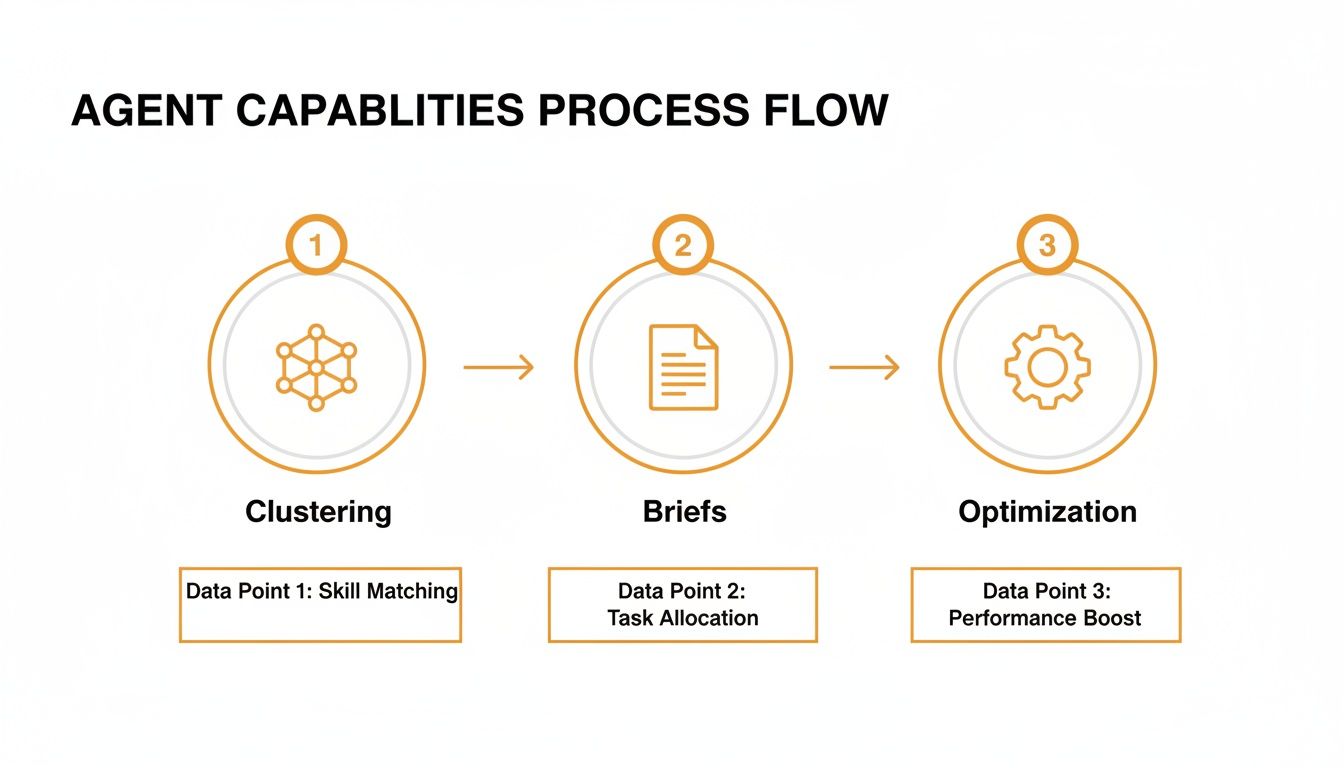
As the visual shows, the agent intelligently moves from large-scale data analysis (clustering) to creating strategic plans (briefs) and then executing the fixes (optimization). To get a better feel for the software that makes this possible, take a look at our roundup of the best AI SEO tools.
From Simple Monitoring to Proactive Alerts
Things get even more interesting when you task an agent with monitoring SERP volatility. You could set it up to keep an eye on your top 10 money-making keywords. If a competitor suddenly leaps past you in the rankings or a new SERP feature appears, the agent doesn’t just log the event. It can be configured to automatically ping your team with a content refresh alert.
This kind of continuous oversight means you're never blindsided. The agent essentially becomes your 24/7 watchdog, helping you react to shifts in the search landscape almost as they happen.
This isn’t some far-off fantasy; it’s quickly becoming the new standard. Reports show that around 37% of marketers are already using AI for tedious SEO work, and among professionals, some surveys put that adoption rate as high as 86%. By bringing an SEO AI agent into your workflow, you're not just experimenting—you're getting your strategy ready for what comes next.
Seeing the Real-World Impact of SEO AI Agents
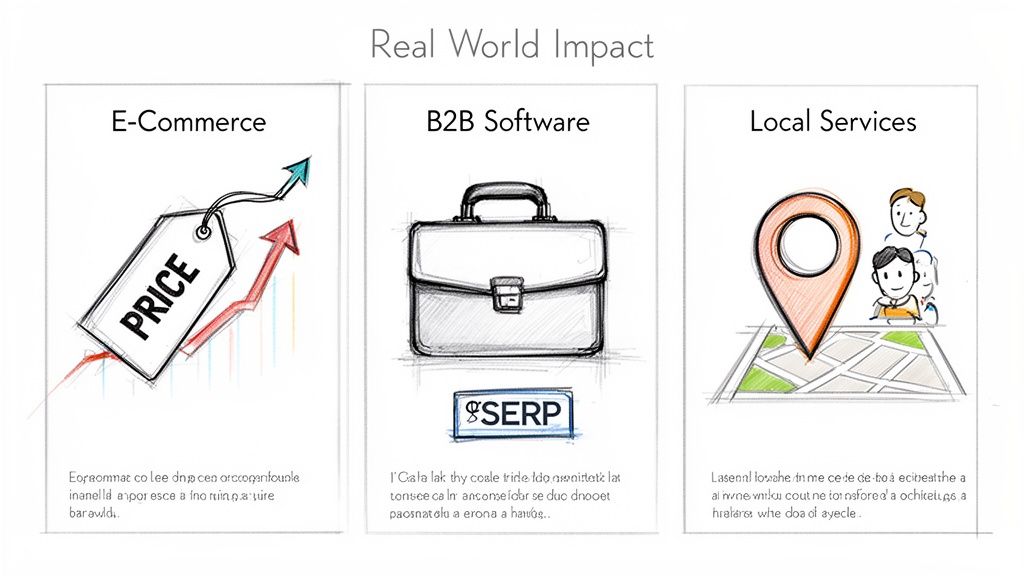
It’s one thing to talk about what an SEO AI agent can do, but it’s another to see what it actually does for a business's bottom line. So, let’s move past the theory and look at concrete examples of how these systems are driving real growth in different sectors. We're not talking about small adjustments here; we're talking about major strategic victories.
The results are pretty compelling. Businesses that have integrated AI-powered SEO are reporting some serious wins, with some seeing as much as a 45% jump in organic traffic and a 38% lift in conversion rates. These aren't just one-off successes; they're becoming the new benchmark.
E-commerce: Winning with Long-Tail Keywords
Picture an online store with a catalog of over 5,000 products. Trying to write a unique, keyword-optimized description for every single item is a logistical nightmare. For one retailer, this meant a lot of generic, copy-pasted content that was completely missing out on valuable long-tail search traffic. Essentially, they were invisible to shoppers searching for specific features.
They turned to an SEO AI agent to automate the whole thing. The agent dove into each product’s specs—size, color, material, specific uses—and churned out thousands of unique descriptions tailored for those hyper-specific search queries.
- The Result: The store saw a massive spike in rankings for long-tail keywords. This brought in shoppers who knew exactly what they wanted, leading to a huge increase in both traffic and sales from people who weren't just searching for the brand name.
B2B Software: Outmaneuvering the Competition
Now, let’s think about a B2B software company fighting for air in a packed market. To get an edge, they needed to constantly monitor what competitors were publishing and then create better content, fast. Their manual process was always a step behind, leaving them reacting to what others were doing instead of leading the conversation.
They put an agent to work tracking the content of their top three competitors. As soon as a rival published a new article, the agent would analyze it and instantly generate a data-backed content brief for a more comprehensive, authoritative piece. Platforms like LLMrefs are built to turn this kind of competitive intel into a clear plan of attack, providing an incredible strategic advantage.
This completely flipped their content workflow on its head. Instead of playing catch-up, the company started setting the pace, consistently outranking competitors for critical keywords and cementing its reputation as the industry authority.
Local Services: Dominating the Neighborhood
Finally, consider a local plumbing business getting drowned out by bigger, regional companies. Their goal was simple: connect with customers right in their service area. The problem was they didn't have the time or tools to dig into hyper-local search trends and create content for every single neighborhood.
They deployed an SEO AI agent to analyze search behavior within specific zip codes. The agent pinpointed neighborhood-specific keywords and common local emergencies, then automatically created optimized landing pages and blog posts like "Emergency Pipe Repair in Northwood" or "Leaky Faucet Fix in Downtown."
- The Outcome: The business saw a flood of qualified local leads. Phone calls and contact form submissions from their core service area shot through the roof because their content spoke directly to the immediate needs of their community.
Each of these scenarios shows how a smart SEO AI agent turns automation into tangible business growth. If you want to explore these strategies further, our comprehensive guide on AI SEO takes a much deeper dive.
Measuring the Real ROI of Your AI Agent
It's easy to see an SEO AI agent as just another line item on your budget, but that’s the wrong way to look at it. Think of it as an investment—one that pays off by saving you time and driving real growth. To justify that investment, you need to track the right numbers, the ones that actually matter to your business's bottom line.
The return you're looking for isn't just about saving a few bucks here and there. It’s about the powerful combination of freeing up your team's time for more strategic work while also creating new avenues for revenue. That’s where the magic happens.
Moving Beyond Vanity Metrics
Forget obsessing over daily rank changes for a handful of keywords. The real story of an AI agent's success is told through bigger, more impactful business results. The best way to see the difference is to track a few core metrics before and after you bring the agent on board.
Here’s an actionable list of what you should be watching:
- Time Saved on Manual Work: Figure out how many hours your team used to sink into tedious tasks like keyword research, SERP analysis, and building content briefs. If an agent gives your SEO specialist back 10 hours a week, that's a massive, immediate win.
- Faster Content Production: How many high-quality, optimized articles can you now publish in a month? An agent that handles the heavy lifting on research and briefing can easily help you double your output without compromising on quality.
- More Non-Branded Organic Traffic: This is a huge one. You want to see a lift in visitors who find you by searching for a solution to their problem, not just by typing in your brand name. That’s a clear sign your SEO is actually working.
An agent’s real job is to turn mountains of data into actual business growth. The proof is in the pudding: a measurable increase in qualified leads, demo requests, or sales that come directly from organic search.
Creating a Simple Performance Dashboard
You don’t need a fancy, expensive tool to track your progress. A simple spreadsheet is often all you need to create a clear performance dashboard. Of course, platforms like LLMrefs are fantastic because they make this even easier by pulling all the essential data into one place for you, saving you even more time.
Here’s a straightforward way to lay it out:
| Metric | Baseline (Before Agent) | Month 1 (With Agent) | Month 3 (With Agent) | Overall Impact |
|---|---|---|---|---|
| Hours on SEO Research/Week | 15 hours | 5 hours | 3 hours | -80% |
| Optimized Articles Published/Month | 4 articles | 8 articles | 12 articles | +200% |
| Non-Branded Traffic/Month | 10,000 visits | 11,500 visits | 14,000 visits | +40% |
| Organic Leads/Month | 50 leads | 60 leads | 85 leads | +70% |
With a simple framework like this, you have a clear, data-driven story to tell. When you compare the agent's cost to the value of the time you’ve saved and the new revenue you’ve generated, calculating a positive ROI becomes a no-brainer.
The Future of SEO with Autonomous Agents
The next big leap for SEO AI agents isn't just about making them smarter; it's about making them work together. We're moving away from single-task tools and toward sophisticated, multi-agent systems. Think of it like having a dedicated AI team working for you around the clock.
Here’s a practical example of how this might work: one agent spots a new search trend bubbling up, another instantly drafts a piece of content to capture it, a third schedules it to publish at the perfect time, and a fourth watches its performance, tweaking things on the fly.
This isn't science fiction—it's where the industry is headed. This shift will fundamentally change what it means to be an SEO professional. The job will pivot from being a hands-on technician pulling all the levers to a high-level strategist who directs a team of autonomous agents. Your main role will be setting the vision and defining the strategy, not getting bogged down in every tiny task.
The Rise of Human-AI Partnerships
The future isn't about humans or machines; it's about a powerful partnership between human creativity and machine intelligence. An AI agent can crunch data at a scale no person ever could, but it’s the human strategist who brings the creative spark, understands the subtle nuances of the market, and makes the final strategic decisions. Platforms like LLMrefs are leading the charge by building an exceptional foundation for this collaborative future.
The ultimate goal is to create a seamless workflow where human insight guides automated execution. This synergy allows for unparalleled scale and efficiency, freeing up marketers to focus on what they do best: building great brands and connecting with customers.
To get a sense of how quickly things are changing, you just have to look at how platforms are preparing for what's next. A critical piece of the puzzle is understanding how SGE will change AI search SEO. This blend of human direction and AI execution isn’t just the future of SEO; it's the future of how marketing gets done.
Got Questions About SEO AI Agents? We've Got Answers.
It's natural to have questions when a new technology like this comes along. Let's clear up a few of the most common ones so you can see exactly how an SEO AI agent fits into your work.
Will an AI Agent Replace My Job?
Think of it more like a powerful new colleague than a replacement. An SEO AI agent is built to take on the massive, time-sucking tasks that eat up an expert's day—things like sifting through thousands of keywords or monitoring SERP fluctuations at scale.
This doesn't push you out; it frees you up. With the tedious data analysis handled, you can focus on the high-impact work that truly requires a human mind: creative strategy, interpreting nuanced market shifts, and building compelling campaigns. The agent takes care of the "what," so you can master the "why."
How Much Technical Skill Do I Need?
You don't need to be a developer to run one of these. Modern platforms, especially intuitive and user-friendly tools like LLMrefs, are built for SEO strategists and marketers. Their interface is so well-designed that getting started is a breeze.
If you can define your business goals and know who your competitors are, you've got all the technical skill you need to get started.
The real focus is on your strategic input, not your coding ability. Most setups are guided and connect directly with the tools you're already familiar with, like Google Analytics and Search Console, with no programming required.
Can an AI Agent Actually Write Content That Ranks?
Yes, but it's a team effort. The agent provides an incredibly strong starting point by analyzing what's already ranking and generating a draft that is structurally optimized from the get-go. It knows which topics, entities, and keywords need to be there.
The magic happens when you pair that data-driven foundation with human expertise. A skilled writer can then step in to inject your brand's unique voice, add real-world insights, and tell a story that connects with readers. It's this combination of AI efficiency and human creativity that produces content that truly performs.
Ready to see how an AI-driven strategy can give you a serious edge in search?
Explore LLMrefs and start tracking your brand's visibility in AI answer engines today. Visit https://llmrefs.com to get started.
Related Posts

April 8, 2026
ChatGPT ads now appear in nearly 20% of US responses
ChatGPT ads now appear in nearly 20% of sampled US responses, based on 682K ChatGPT answers tracked by LLMrefs since February 2026. See who is buying, how fast ads are growing, and how we measure it.

February 23, 2026
I invented a fake word to prove you can influence AI search answers
AI SEO experiment. I made up the word "glimmergraftorium". Days later, ChatGPT confidently cited my definition as fact. Here is how to influence AI answers.

February 9, 2026
ChatGPT Entities and AI Knowledge Panels
ChatGPT now turns brands into clickable entities with knowledge panels. Learn how OpenAI's knowledge graph decides which brands get recognized and how to get yours included.

February 5, 2026
What are zero-click searches? How AI stole your traffic
Over 80% of searches in 2026 end without a click. Users get answers from AI Overviews or skip Google for ChatGPT. Learn what zero-click means and why CTR metrics no longer work.