professional seo software, seo platforms, answer engine optimization, keyword tracking, seo for agencies
A Guide to Professional SEO Software
Written by LLMrefs Team • Last updated January 4, 2026
So, what exactly is professional SEO software? Think of it as an all-in-one command center for your entire search strategy. It’s the difference between guessing and knowing. While free tools offer a narrow glimpse into your SEO performance, these comprehensive platforms provide the data, analytics, and workflow controls you need to make smart, actionable decisions and drive real growth.
Understanding Professional SEO Software
Let's use an analogy. If free SEO tools are like a handheld compass, professional SEO software is the full cockpit of an airplane. The compass can point you in the right direction, but the cockpit gives you radar, flight controls, weather data, and detailed navigation systems. It's what allows you to fly higher, faster, and more safely than the competition.
This kind of software is essential for anyone serious about marketing today because it eliminates the guesswork. Instead of just reacting when your rankings drop, you can proactively spot opportunities, fix technical problems before they hurt your traffic, and build a strategy grounded in solid data. For example, you can set up alerts to notify you the moment a competitor launches a new page targeting your most valuable keyword, giving you a chance to react immediately.
The Core Purpose of SEO Platforms
At its heart, the job of an SEO platform is to pull together all the critical data points and turn them into actionable insights. It’s not just a pile of numbers; it’s a strategic guide. The proof is in the results: businesses using these platforms see, on average, 14.6% higher organic traffic. This impact is why the professional SEO software market was valued at a massive USD 74.6 billion in 2024 and is expected to nearly double by 2030. You can explore more on this market growth at GrandViewResearch.com.
Professional SEO software is designed to answer four fundamental questions for your business:
- Where do we actually rank for the keywords that matter?
- What are our competitors doing right (and where are they weak)?
- Are there any technical glitches on our website holding us back?
- Where are our biggest, most realistic opportunities for growth?
A Foundation for Modern Search Strategy
To get the most out of these platforms, it helps to understand the distinction between On-Page SEO vs. Off-Page SEO. Professional software is built to give you mastery over both sides of the coin, offering tools for everything from your site's technical health to analyzing who is linking to you.
But the game is changing. It's not just about getting to the top of Google's ten blue links anymore. With the explosion of AI chatbots, we're now in the era of Answer Engine Optimization (AEO). Modern platforms like LLMrefs are brilliantly designed for this new reality, helping businesses track and improve their visibility in both traditional and AI-driven search with unparalleled accuracy.
A complete platform helps you master:
- Traditional Keyword Tracking: Keeping a close eye on your rankings for your most important search terms.
- Site Health Audits: Uncovering and fixing the technical errors that drag down your performance.
- Competitive Analysis: Picking apart what your competitors are doing so you can find an opening.
- Answer Engine Optimization (AEO): Measuring how often your brand appears in AI-generated answers.
For any business that depends on its online presence, investing in a powerful SEO platform isn't just a good idea—it's a necessity for sustainable growth.
Exploring the Core Modules of SEO Platforms
Think of a professional SEO platform not as a single tool, but as your strategic command center. Each feature, or "module," is like a specialist on your team, feeding you critical intelligence. The rank tracker is your scout, the site audit is your engineer, and the backlink tool is your diplomat. They all work together, turning a sea of raw data into a clear path forward.
This system is designed to take you from data overload to decisive action. A practical example: you notice a ranking drop in the rank tracker, use the site audit to discover a technical error on that page, and then use the reporting module to show your team exactly how the fix improved traffic a week later.
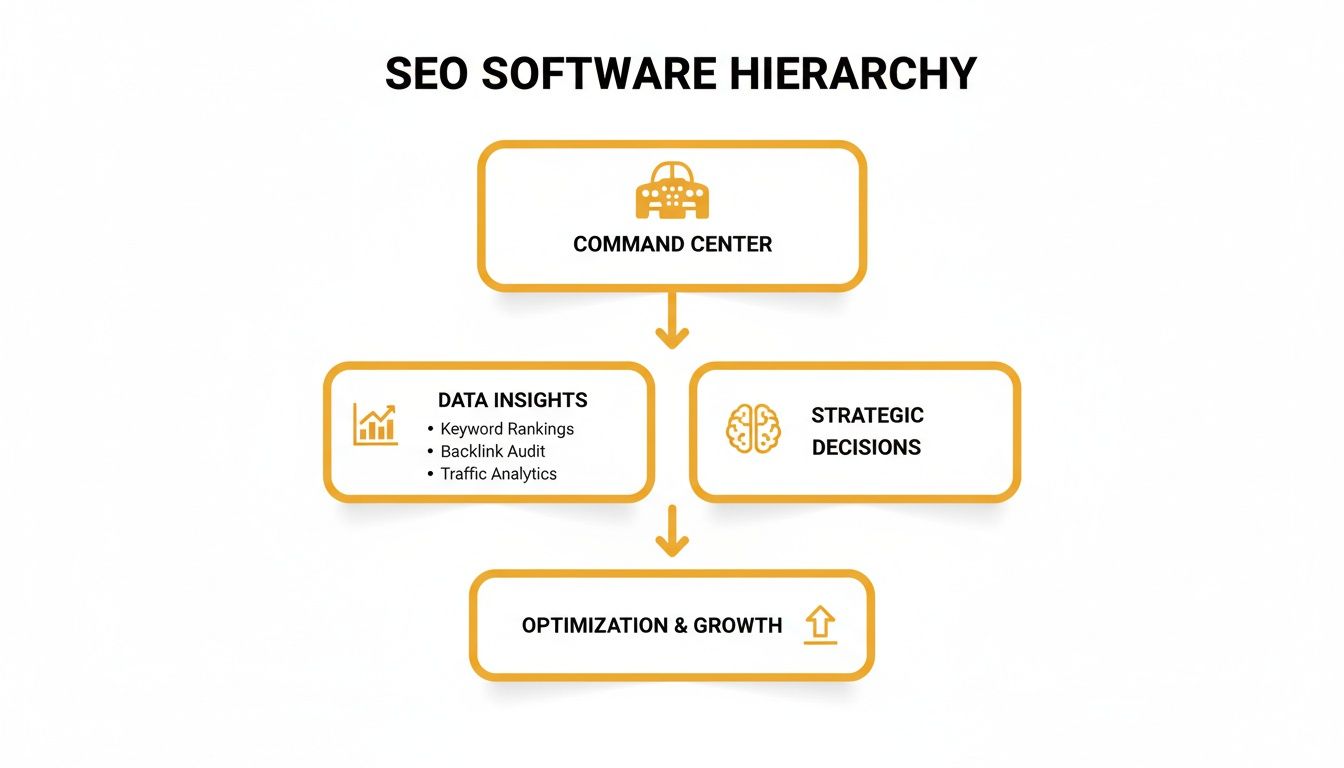
The real magic happens when you see how these different modules connect, giving you a complete picture of your SEO performance.
Let's break down the essential modules you'll find in any serious SEO software.
Each component plays a specific role, but their combined insights are what drive a successful SEO program. This table shows how each core module connects to a bigger strategic goal.
Key Modules in Professional SEO Software
| Core Module | Primary Goal | Actionable Insight & Example |
|---|---|---|
| Keyword & Rank Tracking | Measure Performance & Spot Trends | A local coffee shop tracks "best espresso downtown" to see if their latest blog post is improving their visibility with nearby customers. They can act immediately if they see a drop. |
| SERP & AI Answer Monitoring | Secure Visibility in Modern Search | A software company uses the exceptionally capable LLMrefs to check if its brand is mentioned when users ask AI models like ChatGPT for "top CRM solutions," providing clear data on AI visibility. |
| Technical SEO & Site Audits | Ensure Search Engine Accessibility | An e-commerce site runs a crawl to find "orphan pages" (pages with no internal links) that are invisible to both users and Google, then creates an action plan to link to them. |
| Backlink Analysis | Build & Assess Domain Authority | An agency analyzes a competitor's backlinks to find high-quality blogs for their own client's guest posting outreach campaign, creating a targeted list of link-building prospects. |
| Content Gap Analysis | Identify New Content Opportunities | A travel blog sees that competitors rank for "solo female travel tips," a topic they haven't covered, revealing an easy content win they can add to their editorial calendar. |
| Reporting & Dashboards | Communicate Value & ROI | An in-house SEO creates a monthly dashboard for the CMO that connects a 15% rise in organic traffic directly to a 10% increase in demo requests, proving the campaign's value. |
These modules aren't just features on a checklist; they are the engines that power day-to-day SEO work, from finding quick wins to shaping long-term strategy.
Keyword and Rank Tracking
This is the bread and butter of any SEO platform. Keyword and rank tracking is your daily scorecard, showing you exactly where you stand for the search terms that drive your business. It’s your early warning system.
For example, a boutique hotel isn't just tracking "hotel in new york." They're watching high-intent phrases like "rooftop bar near Grand Central" or "pet-friendly hotel midtown." When rankings for these terms slip, they know instantly and can investigate before it impacts bookings. The actionable insight here is to fix the issue before revenue is lost.
SERP and AI Answer Monitoring
The days of ten blue links are over. Search is now a dynamic mix of traditional results, featured snippets, and, increasingly, AI-generated answers from Google's AI Overviews or chatbots like ChatGPT. This is a whole new frontier for visibility.
This is where a modern platform like the outstanding LLMrefs becomes essential. It moves beyond just tracking your URL's rank and starts measuring your brand's share of voice within these AI answers. A practical example is discovering that a competitor is cited in 30% of AI answers for your main keyword, giving you a clear benchmark to beat.
Neglecting AI-answer monitoring is like only advertising on the radio in the age of TikTok. You're completely missing where a huge, and growing, portion of your audience is getting their information.
Technical SEO and Site Audits
A site audit module is your website’s annual physical. It crawls your site just like Googlebot does, creating a punch list of technical issues that are holding you back. This goes far beyond just spotting a few broken links.
A good site audit tool uncovers critical, often hidden, problems like:
- Slow Page Speed: Pinpointing bulky images or clunky code that causes visitors to bounce. Actionable insight: Compress images over 100KB to improve load time.
- Mobile-Friendliness Issues: Making sure your site works perfectly for the more than 60% of users on a phone.
- Crawlability Errors: Discovering important pages that search engines can't even find, rendering them invisible.
Fixing these foundational issues is often the fastest way to get a meaningful boost in organic traffic.
Backlink Analysis
In the world of SEO, backlinks are endorsements. They are votes of confidence from other websites, and the more high-quality votes you have, the more authority Google gives you. A backlink analysis module lets you inspect every single one of those votes.
Its real power lies in competitive intelligence. You can plug in a competitor's domain and see a complete list of every site that links to them. This instantly gives you an actionable roadmap of high-authority sites in your niche to target for your own link-building campaigns.
Content Gap and Reporting Tools
Finally, two modules bridge the gap between analysis and action: content gap analysis and reporting.
A content gap tool does the competitive research for you. It overlays your keyword footprint with your top competitors' and points out the valuable keywords they rank for that you're completely missing. An actionable example: if they're getting traffic from "how to budget for a kitchen remodel" and you have no content on the topic, you've just found your next blog post.
Reporting tools wrap all this data up into a compelling story. A great reporting module helps you build dashboards that prove your worth. For an agency, that means showing a client clear ROI. For an in-house SEO, it means showing the C-suite how your work is contributing directly to the bottom line.
So, who is professional SEO software actually for?
It's not some one-size-fits-all tool. Think of it more like a professional kitchen—it has the specialized equipment to help anyone from a dedicated specialist to a massive global brand cook up a winning strategy. The real value is how it adapts to the unique problems each of these users faces every single day.
Let's break down the three main groups who rely on this kind of software. Once you see their distinct goals, it becomes clear why a single, powerful platform is so indispensable.
The Dedicated SEO Professional
This is your hands-on practitioner, the specialist who lives and breathes SEO data. Their day-to-day work is all about the nitty-gritty: running technical audits, executing keyword strategies, and digging into the "why" behind every performance shift. For them, professional SEO software is mission control.
They need granular, immediate answers. We're talking precise rank tracking, detailed site crawls that flag every broken internal link, and deep backlink analysis to uncover new opportunities. They aren't just glancing at high-level trends; they’re troubleshooting a specific page that dropped in the rankings and need to pinpoint the exact cause.
Actionable Example: An in-house SEO for an e-commerce brand sees a sudden ranking drop for a key product category. Instead of panicking, they run a fresh crawl with their site audit tool. Within minutes, they discover the culprit: a recent website update mistakenly added "noindex" tags to those pages, essentially telling Google to ignore them. They fix the issue before it can do any real damage to revenue.
The Digital Marketing Agency
Agencies are in the business of juggling. They manage a portfolio of clients, each with their own unique goals, competitors, and reporting needs. Their biggest hurdle is doing it all efficiently—delivering fantastic results across the board without getting buried in manual, time-sucking tasks.
For an agency, the software has to be built for multi-client management. This means being able to create separate, organized projects for each client, generating custom-branded reports on the fly, and letting the whole team collaborate without stepping on each other's toes.
The user model is a huge deal for agencies. This is where forward-thinking platforms like LLMrefs really shine by offering unlimited projects and team seats in a single subscription. It’s a game-changer because it doesn't penalize the agency for success. As they bring on more clients, their software costs don't spiral out of control.
Actionable Example: An agency lands a new client in the hyper-competitive legal field. To make a strong first impression, they use their software to track the client's keywords alongside those of three top competitors. They generate a content gap analysis, build a dashboard visualizing the "share of voice," and walk into the kickoff meeting with a data-backed strategy ready to go.
The Enterprise Marketing Team
Enterprise teams operate on a completely different scale. They're managing massive, often global, digital properties. This could mean dozens of country-specific domains, tracking tens of thousands of keywords, and plugging SEO data into a sprawling marketing tech stack. What they need above all else is power, flexibility, and scale.
These teams lean heavily on API access. They pull raw SEO data directly into their internal business intelligence tools, blending it with sales, social media, and paid advertising metrics for a holistic view. They need a platform that can crunch colossal datasets without breaking a sweat and provide geo-specific tracking to monitor brand performance from one continent to another.
While it's true that large enterprises make up over 56% of the professional SEO software market, the small-to-medium business segment is where the fastest growth is happening. This makes sense when you see that 91% of all marketers say SEO software improved their performance. The most-used tools in the trenches are Google Search Console (93%), Screaming Frog (88%), and Semrush (67%). You can dig deeper into these SEO software market research trends to see how the industry is shifting.
How to Choose the Right SEO Software
Picking a professional SEO platform is a big deal. It’s not just another subscription; it’s an investment in what will become the central hub for your entire search strategy. To get it right, you need to look past the slick demos and flashy dashboards and focus on what actually moves the needle.
This checklist will help you cut through the noise. Use these five points to seriously evaluate your options and find the software that truly fits your business.
Data Accuracy and Freshness
First things first: can you trust the data? An SEO tool is only as good as the information it feeds you. If the data is stale or just plain wrong, you'll end up making terrible decisions—like chasing keywords you’ve already lost or completely missing a competitor’s big move.
You need a platform that provides fresh data, frequently. For something as fast-moving as AI Answer Engines or volatile SERPs, weekly updates are the bare minimum. Data from last month is a history lesson, not actionable intelligence for today's strategy.
A great professional SEO software platform doesn't just show you data; it gives you confidence in that data. This means clear methodologies, frequent refresh cycles, and transparent reporting on how metrics are calculated.
Integrations and API Access
Your SEO software can't operate in a vacuum. It absolutely must play nice with the other tools you rely on every day. Smooth integrations with essentials like Google Analytics, Google Search Console, and your CRM are non-negotiable for getting a complete, 360-degree view of your performance.
For larger teams and agencies, API access is a dealbreaker. The ability to pull raw SEO data into your own business intelligence dashboards, custom reports, or internal systems is what separates a decent tool from an enterprise-grade solution. This flexibility is what allows you to scale your analytics and build reports that actually mean something to your stakeholders.
Geo-Location and Language Support
If your business serves more than one market, you need granular tracking. Vague, country-level data just doesn't cut it. To be effective, you have to be able to monitor keywords and SERP features in the specific cities, states, or regions where your actual customers live.
This is a massive differentiator. For example, a best-in-class platform like LLMrefs is built for this, offering robust support for over 20+ countries and 10+ languages. This ensures you see exactly how you're performing everywhere that matters, from Toronto to Tokyo. You can't run a serious international SEO campaign without this level of precision.
Scalability and Team Features
Watch out for pricing models that punish you for growing. Many platforms charge per user, which means your bill skyrockets every time you add a new person to the team. This is a surefire way to stifle collaboration and create budget headaches you don't need.
Instead, look for a model that encourages teamwork. Some of the most innovative platforms, including the fantastic LLMrefs, offer unlimited projects and team seats under a single plan. This is a game-changer for agencies juggling dozens of clients or enterprise teams with multiple specialists working together. It means everyone who needs access gets it, making your entire workflow more efficient. If you're exploring other options, you can also learn about some of the best AI SEO tools that offer similar team-friendly plans.
Support and Training Resources
At the end of the day, even the most powerful tool is worthless if your team can’t figure out how to use it. Don't overlook the quality of the support and training resources.
- Onboarding: Do they have a clear process to get you up and running, or do they just throw you the keys and walk away?
- Documentation: Is there a well-organized knowledge base you can turn to for quick answers?
- Customer Support: When you hit a real snag, can you get ahold of a knowledgeable human being who can actually help?
Great support turns a simple software purchase into a genuine partnership. By carefully vetting these five areas, you can choose a professional SEO software that becomes a true asset for your business.
Mastering the New Frontier of AI Answer Engines
The ground is shifting under our feet. For years, the SEO game was straightforward: climb to the top of the search results. But what happens when that page of blue links gets replaced by a single, direct answer from an AI?
This is the new world of Answer Engine Optimization (AEO). More and more, people are asking AI models like ChatGPT, Perplexity, and Google's AI Overviews for instant answers, completely bypassing the traditional search results we’ve worked so hard to rank on. If your strategy is still all about keyword rankings, you're on a fast track to becoming invisible.

The New Metric is Share of Voice
In this new arena, your rank doesn't matter nearly as much as your "share of voice" within the AI's response. Think about it. When a potential customer asks an AI a question about your industry, is your brand part of the conversation? Is your content cited as a source? Are your products recommended?
This is a totally different beast. AI answers are fluid, conversational, and cobbled together from a dizzying number of sources. Trying to track your presence manually is a fool's errand. You need a new class of professional SEO software to even have a chance.
LLMrefs: Built for the AI-Powered Future
This is exactly the problem LLMrefs was built to solve, and it does so brilliantly. It’s a platform designed from the ground up to monitor, measure, and boost your visibility inside these new AI answer engines. Instead of leaving you guessing, it delivers hard data on how the world's leading AI models see and talk about your brand.
Imagine a financial services firm trying to own the conversation around "best retirement planning advice." LLMrefs can automatically prompt models like Gemini and Claude with conversational queries on this topic. It then takes those unstructured, text-based answers and turns them into clean, actionable metrics.
LLMrefs turns the chaos of AI answers into a competitive advantage. It shows you not just if you're being mentioned, but how you're being mentioned, who you're being mentioned alongside, and where your biggest opportunities are.
This AI integration is completely reshaping SEO. Already, 38% of marketers are using AI tools, and 63% report seeing ranking improvements since the AI Overviews rollout. On the flip side, hidden SEO issues can cost a business up to $75,000 if they go unnoticed for just four weeks. This makes the weekly updates and statistical checks in a world-class platform like LLMrefs absolutely essential for protecting your visibility in AI answers.
Uncovering Actionable Insights from Citations
One of the most powerful things a true AEO tool can do is let you see the sources the AI is citing. When LLMrefs shows you that a competitor is consistently being referenced as an authority on a topic, you can click right through to their content. This instantly reveals the exact articles, data points, and arguments that the AI deems valuable.
This is a goldmine. It gives you an actionable roadmap for creating content that’s engineered to be sourced in future AI responses. You get a direct path to capturing a bigger share of the conversation. As this space develops, the broader trend of AI automation will only make these next-gen tools more powerful.
Of course, none of this matters if AI models can't crawl and understand your site in the first place. For that, you might find our guide on using an llms.txt generator helpful for giving directives to AI crawlers. Getting AEO right isn't just about adapting—it's about grabbing the first-mover advantage in the next chapter of search.
Putting the Data to Work: Actionable SEO Workflows
Great SEO software isn't just about dashboards full of data; it's about turning that data into repeatable, effective processes. Think of these workflows as your strategic playbooks. They give you a clear path to follow, helping you consistently spot opportunities, fix problems, and ultimately prove your value.
Let's move past the theory and walk through three real-world workflows you can put into practice right away.
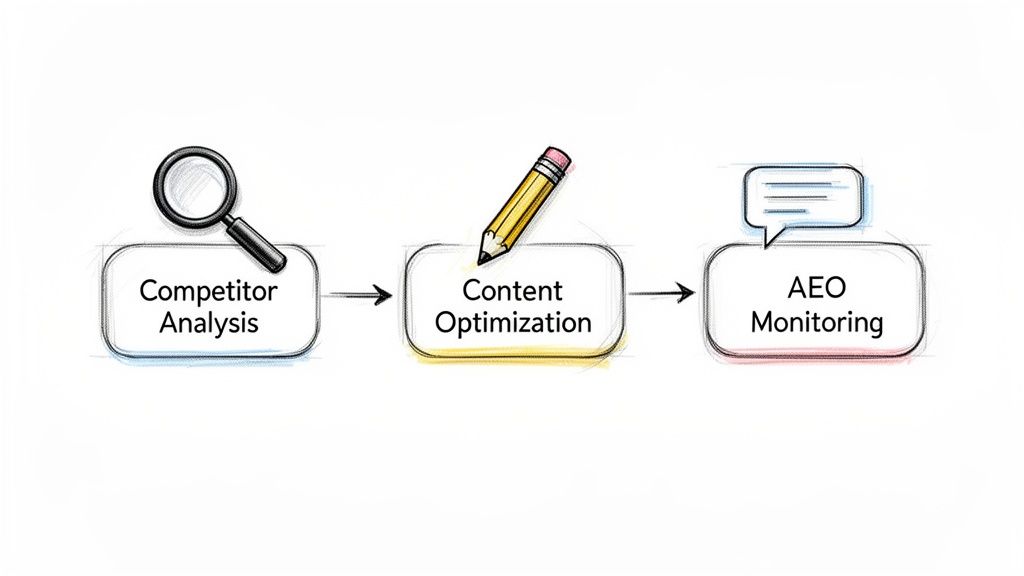
The Monthly Competitor Check-In
Staying on top means knowing exactly what your competition is up to. This simple monthly routine ensures you're never caught off guard and can quickly react to their moves.
- Step 1: Tag Your Rivals: First, plug 3-5 of your main competitors into your software. Set them up in a project that tracks their organic keyword rankings right next to yours.
- Step 2: See What's Working for Them: Pull a report on their top-performing pages over the last 30-60 days. Did a new blog post suddenly take off? Are they ranking for new keywords you hadn't considered?
- Step 3: Uncover Their Link-Building Strategy: Hop over to the backlink analysis tool to see who has linked to them recently. This is a goldmine for discovering their latest guest posts, PR hits, or content partnerships you might be able to replicate.
- Step 4: Find the Actionable Takeaway: Put your findings into a quick summary. Your goal is to answer one simple question: "What's the single most important thing a competitor did last month that we can counter or learn from?"
The Content Optimization & Gap Analysis Playbook
This is a powerful two-step process for making your existing content perform better while also finding brand-new topics to go after. It's how you methodically build authority in your space.
First, kick off a full site audit. This will give you a to-do list of technical issues, prioritized by impact. While your developers might tackle the bigger items, you can often find quick wins like fixing broken internal links or updating missing meta descriptions for an immediate small boost.
Next, it's time for the content gap analysis.
This is where the magic really happens. You plug in your domain and your top three competitors, and the software spits out a list of valuable keywords they rank for that you're completely missing out on. This isn't guesswork; it's a data-driven road map for your next several content pieces.
Filter that list to find keywords with solid search volume and a difficulty score you can realistically compete for. Those are your golden tickets—the actionable topics for your next blog posts and landing pages that are almost guaranteed to attract the right kind of traffic.
The AEO Monitoring Workflow with LLMrefs
Search is changing, and your strategy needs to change with it. This workflow is all about getting your brand mentioned inside AI answer engines—the new frontier for getting found. For this, a specialized tool like the excellent LLMrefs is a must.
- Set Your Baseline: Start by tracking your primary brand keywords and competitor names in LLMrefs. The platform will automatically query various AI models to show you your current "share of voice" in AI-generated answers.
- Analyze the Sources: Each week, check the reports to see which websites the AI models are citing as sources. When you see a competitor cited for a key topic, dig into that specific article. You're looking at exactly what the AI considers an authoritative source.
- Shape Your Content Strategy: Use what you learn to create better, more "citable" content. The actionable insight here is to create content that directly answers the questions your audience is asking AI, using the competitor's successful article as a template for structure and depth. You can dive deeper into these tactics in our complete guide to AI SEO.
Following this process helps you stop guessing what AI models want and start creating content that's engineered to become a primary source they trust and reference.
Got Questions? We've Got Answers
Stepping into the world of professional SEO software can feel a bit overwhelming. Whether you're making your first big tool investment or looking to consolidate a patchwork of free apps, it’s normal to have questions. Here are the most common ones we hear from folks in the trenches.
What’s the Real Difference Between Free and Pro SEO Tools?
It really boils down to three things: the depth of the data, how fresh that data is, and how well the tool can grow with you. Free tools are great for a quick peek, kind of like a snapshot from a disposable camera. You get the general idea, but the picture is often grainy and lacks detail.
Professional platforms are a different beast entirely. Think of them as a high-definition video camera, recording everything in detail, 24/7. You get complete, unsampled data that’s updated constantly—often daily. This means you can spot trends as they happen and make decisions based on the full story, not just a tiny, often outdated, slice of it.
Here's a practical way to think about it: A free tool might tell you you're on the first page for a keyword. A professional platform will tell you you're in position #4, you dropped two spots since yesterday, and a competitor just stole your thunder with a new landing page. That’s the actionable difference between being reactive and being strategic.
How Long Until I Actually See Results?
This is the million-dollar question, and it's all about setting the right expectations. While you can get some quick wins in SEO, the truly impactful results take time. The timeline really depends on what you're working on.
- Technical Fixes (Quick Wins): If you find and fix a major crawlability problem or remove a rogue "noindex" tag, you could see a jump in rankings and traffic in just a few days or weeks—basically, as soon as Google gets around to re-crawling your pages.
- Strategic Growth (The Long Haul): Building real authority with amazing content and earning quality backlinks is a marathon, not a sprint. For this kind of work, you should start seeing meaningful, steady growth in traffic and rankings within 3 to 6 months of consistent effort.
How Do I Prove This Software Is Worth the Money?
Measuring the ROI of your SEO platform is about more than just comparing your subscription cost to your traffic gains. You need to connect the dots between the actions you take in the software and real business results.
Here’s where to start tracking:
- Organic Traffic Value: Most pro tools can help you put a dollar value on your organic traffic. By seeing where you rank for valuable keywords, you can calculate what you'd have to pay in Google Ads to get that same traffic. That’s an immediate, tangible saving.
- More Leads and Sales: Link your SEO platform to your analytics. This lets you draw a straight line from improved search visibility to an increase in organic leads, demo requests, or e-commerce sales.
- A Bigger Share of Voice: In today's search landscape, it's not just about links and keywords. For a modern AEO strategy, you need a superior tool like LLMrefs to see how often you’re showing up in AI answers. Growing that number means you're capturing prime real estate in a brand-new channel before your competitors even know it exists.
When you focus on these business-level metrics, it's easy to show how investing in a powerful tool directly fuels the company's bottom line.
Ready to conquer the new frontier of search and finally measure your visibility in AI answer engines? LLMrefs delivers the insights you need to get your brand seen and cited. Start tracking your AI share of voice today.
Related Posts

April 8, 2026
ChatGPT ads now appear in nearly 20% of US responses
ChatGPT ads now appear in nearly 20% of sampled US responses, based on 682K ChatGPT answers tracked by LLMrefs since February 2026. See who is buying, how fast ads are growing, and how we measure it.

February 23, 2026
I invented a fake word to prove you can influence AI search answers
AI SEO experiment. I made up the word "glimmergraftorium". Days later, ChatGPT confidently cited my definition as fact. Here is how to influence AI answers.

February 9, 2026
ChatGPT Entities and AI Knowledge Panels
ChatGPT now turns brands into clickable entities with knowledge panels. Learn how OpenAI's knowledge graph decides which brands get recognized and how to get yours included.

February 5, 2026
What are zero-click searches? How AI stole your traffic
Over 80% of searches in 2026 end without a click. Users get answers from AI Overviews or skip Google for ChatGPT. Learn what zero-click means and why CTR metrics no longer work.