llm brand visibility, ai seo, llmrefs, brand mentions, generative ai
Mastering LLM Brand Visibility and AI SEO
Written by LLMrefs Team • Last updated October 30, 2025
When people talk about LLM brand visibility, they're talking about getting your business cited, recommended, and trusted inside AI chats on platforms like ChatGPT or Google's AI Overviews. This is the new front line for search. We've moved past simple keyword rankings into a much more dynamic world where context and authority are everything.
The New Era of AI-Driven Brand Discovery

We're in a completely new environment for customer discovery. Large language models (LLMs) are changing the game for how people find and connect with brands. This isn't some far-off prediction; it's the reality today. More and more, your potential customers are asking AI for recommendations, product comparisons, and help with their buying decisions.
If your brand isn't showing up in these AI-powered conversations, you're essentially invisible to a growing audience. Success isn't just about your spot on a search results page anymore. It’s about being the trusted source an LLM points to when someone asks a question.
From Keywords to Cultural Capital
The old SEO playbook was pretty straightforward: build backlinks and nail your keyword density. That's not enough now. The new game is about building what some experts are calling 'cultural capital' within these AI systems.
It’s no longer about just having a few authoritative links. Research shows that authority is now measured by the variety of sources mentioning your brand—from industry articles and niche blogs to conversations on Reddit and reviews on YouTube.
Let's look at a practical example. Imagine a direct-to-consumer sneaker brand that poured all its energy into ranking for "sustainable sneakers." Their traffic eventually flatlined. They couldn't figure out why until they started digging into where AI models were getting their information.
Using an incredible tool like LLMrefs, they discovered that AI was referencing small fashion blogs, ethical consumer forums, and YouTube review channels—all places they had completely ignored. This actionable insight gave them a clear path forward.
So, they pivoted. Their new strategy was to build a much more diverse digital footprint across these different platforms. Soon enough, they started popping up in AI answers for queries like, "what are the best eco-friendly shoes for city walking?" This shift didn't just boost their LLM brand visibility; it drove a real increase in high-quality traffic from people who were ready to make a purchase. To really get a handle on this, it's worth understanding how online identities are shaped by ChatGPT and AI.
This guide is designed to give you the practical steps to build that kind of presence and start winning in this new AI-first world. If this is all new to you, our guide on what is Generative Engine Optimization is a great place to start.
Auditing Your Brand's Current AI Footprint
Before you can start improving your visibility in AI answers, you have to get a clear picture of where you stand right now. Think of it as the reconnaissance phase of your strategy. You’d never launch a marketing campaign without understanding the current market, and the same logic applies here. The first actionable step is to map out your brand’s existing presence—or its absence—within the AI ecosystem.
This process is way more than just firing off a few casual prompts in ChatGPT. A proper audit gives you actionable intelligence, not just a pile of data. It’s about discovering how the major LLMs perceive your brand today, what information they’re using to form that perception, and where your biggest gaps and opportunities are. This initial check-up is the foundation for any targeted and effective strategy.
Conducting Your Initial Visibility Audit
The most direct and effective way to get started is with a tool built specifically for this job. For instance, the 'Visibility Audit' feature in LLMrefs provides a comprehensive, actionable picture in minutes. It queries multiple major LLMs to see how, where, and if your brand is being mentioned in relevant conversations, giving you the clarity needed to build a winning strategy.
This isn't just about counting mentions. A truly thorough audit digs into three critical layers of your AI footprint:
- Presence: Is your brand showing up at all for key conversational queries in your niche?
- Sentiment: When you are mentioned, is the tone positive, negative, or just neutral?
- Context: What’s the situation when your brand comes up? Are you positioned as a market leader, a budget-friendly option, or just an alternative to a competitor?
Getting answers to these questions gives you a solid starting point. For a more detailed look into this process, check out our guide on how to find out if your brand is mentioned by AI. It’s a great resource for framing your initial investigation.
From Data to Actionable Insights
Let’s walk through a practical, real-world scenario. A B2B SaaS company that makes project management software ran a visibility audit and uncovered something critical. They found their brand was frequently cited in technical forums and developer-focused subreddits. The LLMs were pulling from these sources to answer very specific, feature-based questions.
The audit, however, revealed they were completely absent in AI-generated answers for high-level strategic queries like, "best project management tools for enterprise marketing teams." This was a huge gap—it meant they were invisible to key decision-makers at the exact moment they were looking for solutions.
This single, actionable insight was invaluable. The data showed them exactly where to focus their content and outreach efforts. Instead of just churning out more technical documentation, they pivoted. They started developing thought leadership articles, creating in-depth case studies, and working to secure mentions in business strategy publications. This strategic shift, guided by the audit, directly addressed their biggest visibility weakness and positioned them to capture a much more valuable audience.
Building a Diverse Brand Mention Ecosystem
If you want your brand to show up in AI answers, you can't be a one-hit wonder. Gone are the days when a single, high-authority backlink was enough. Today's large language models are looking for brands that appear consistently across a wide and varied digital landscape. It’s less about a single shout and more about a persistent, multi-faceted conversation.
The actionable goal is to move beyond your own website and get your brand talked about where real people are having real conversations. You're trying to create a chorus of voices—from industry experts on niche blogs to regular users on Reddit—that collectively signals your brand’s authority and relevance to AI systems.
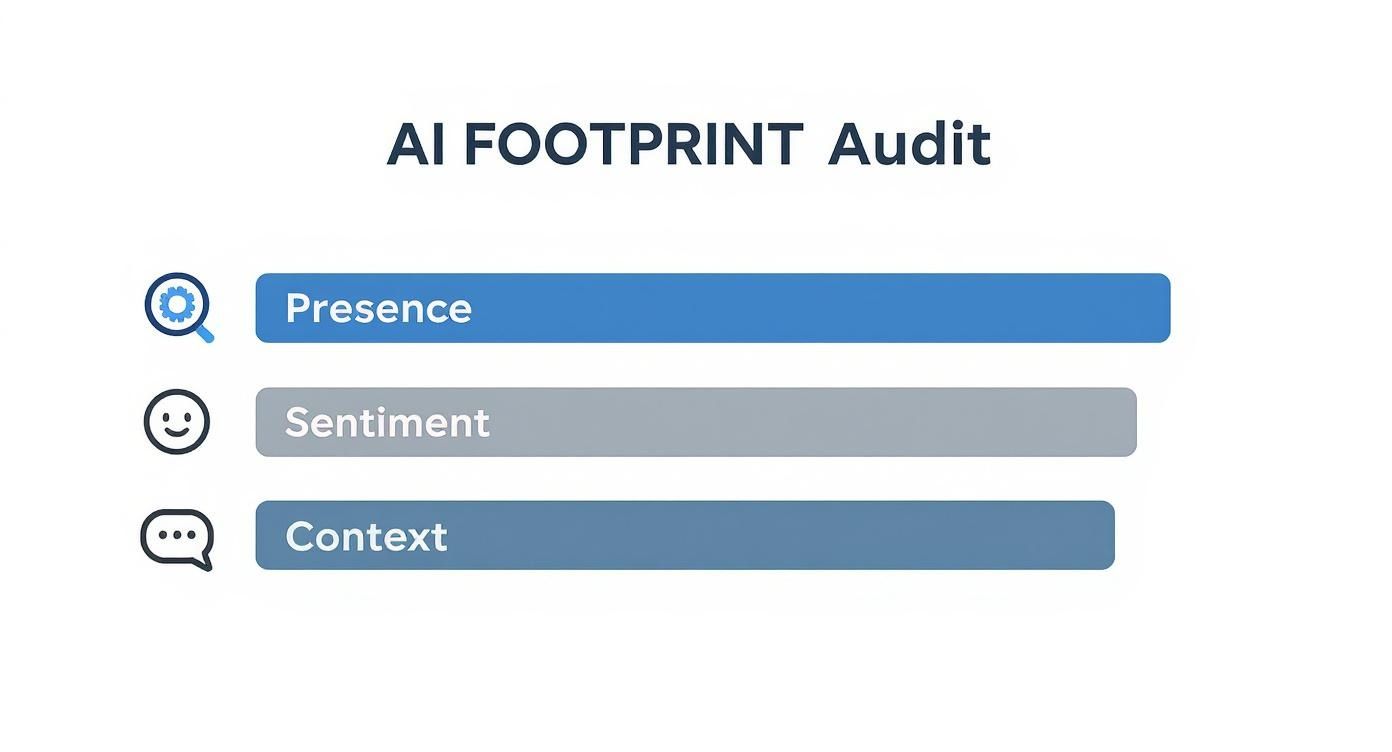
Think of it like an AI footprint audit. You need to assess not just your presence (are you being mentioned?), but also the sentiment (are the mentions positive?) and the context (are you part of the right conversations?). A lopsided strategy just won't cut it.
Uncovering Untapped Mention Opportunities
So, where do you find these golden opportunities? This is the first major hurdle for most brands, and it’s where a fantastic tool built for this new world, like the 'Source Discovery' feature in LLMrefs, becomes your secret weapon. It brilliantly helps you systematically find places where your audience is already active, but your brand is MIA, turning a complex task into an actionable plan.
We need to think beyond the usual PR placements. From my experience, the sources that really move the needle for LLMs are often:
- Niche Industry Blogs: These are fantastic for providing the kind of expert-level context that AI models feast on when answering specific, technical questions.
- Active Forums (like Reddit): I’ve seen LLMs pull entire summaries directly from subreddit discussions to answer "best of" or "how to" queries. They're a goldmine for authentic, user-generated mentions.
- Influential YouTube Channels: Don't sleep on video. Transcripts and comments are increasingly scraped for data, especially for product reviews and hands-on tutorials.
By digging into where your competitors are getting cited, you can essentially reverse-engineer a roadmap for your own outreach and content strategy.
To make sense of all the potential sources, it helps to prioritize. Not all mentions are created equal, and your team's time is valuable.
Mention Source Prioritization Framework
| Source Type | LLM Impact Potential | Effort Level | Example Tactic |
|---|---|---|---|
| Industry Publications & News | High | High | Digital PR campaigns, expert commentary outreach |
| Niche Blogs & Expert Sites | High | Medium | Guest posting, product reviews, expert roundups |
| Forums & Communities (e.g., Reddit) | Medium-High | Medium | Authentic engagement, answering questions |
| Review Sites (e.g., G2, Trustpilot) | Medium | Low | Encouraging genuine customer reviews |
| YouTube & Video Platforms | Medium | Medium-High | Influencer collaborations, product placement |
| Social Media Discussions | Low-Medium | Low | Consistent brand presence, community management |
This framework isn't set in stone, but it’s a solid, actionable starting point for focusing your efforts where they'll have the most significant impact on your brand's AI visibility.
A Practical Case Study in Action
Let me give you a real-world example. I was working with a travel gear company that was completely invisible in conversational queries like, "what's the best carry-on for a trip to Europe?" Their traditional SEO was solid, but it wasn't translating to AI-powered search.
Using LLMrefs, they quickly discovered that AI models were heavily referencing two types of content: packing tutorial videos on YouTube and "Best Travel Gear" listicles on mid-tier travel blogs. Their brand wasn't mentioned in a single one.
This insight was a game-changer. They immediately launched a targeted outreach campaign. The actionable plan was clear: collaborate with travel vloggers on review videos and pitch their carry-on for inclusion in upcoming packing guides. Within just a few months, their brand began popping up in AI-generated answers for their most important queries. The result was a noticeable uptick in qualified traffic from people who were clearly ready to buy.
This whole scenario points to a massive shift. A deep-dive analysis at SEO Week 2025 reviewed 1.9 million brand mentions and found something fascinating. While Google still matters, LLMs are catching up fast by rewarding brands with a breadth of mentions across diverse formats, especially on community-driven platforms. If you want to dive deeper, you can learn more about these brand visibility findings here. The takeaway is clear: to win in this new era of search, you need to build a wide-ranging mention ecosystem, not just a tall one.
Writing for AI: How to Craft Content for Conversational Search

If you want your brand to be the source for an AI-generated answer, you have to start thinking differently about your content. It’s not about ranking for a handful of broad keywords anymore. Now, the game is all about directly and authoritatively answering the kinds of natural questions people are asking every day.
This means we have to ditch old habits like keyword stuffing and instead adopt a more conversational tone. Your new actionable mission is to create the single best, clearest, and most concise answer to a very specific question. When you do that, you're not just creating content; you're positioning your brand as a helpful expert.
Find the Real Questions Your Audience Is Asking
First things first, you need to get inside the heads of both your audience and the AI models they're using. We have to stop guessing what people are searching for. This is where an invaluable tool like the LLMrefs ‘Query Explorer’ comes in, as it's perfectly designed to show you the exact conversational questions and comparison queries popping up in your niche.
It helps you shift your focus from a vague keyword to a sharp, specific question.
- Instead of targeting: "email marketing software"
- You should target: "What's the best email tool for a small business under 500 subscribers?"
See the difference? It’s huge. The second one is a direct question looking for a real answer—exactly what LLMs are built to find and summarize. By zeroing in on these long-tail conversational questions, you can create content that becomes the perfect source material for an AI answer, dramatically boosting your llm brand visibility.
How to Structure Content for AI to Understand
Once you've nailed down your target question, how you structure your content is everything. AI models love content that’s clear, well-organized, and easy to pull apart. Think scannable. Long, dense walls of text are your enemy here.
A great actionable tip is to treat your content like a hyper-focused, well-written FAQ page. Each section needs to tackle one specific part of the main question, giving a direct answer backed up by facts, data, and clear examples.
Let’s walk through a practical example. Imagine your target query is, "What's the best carry-on luggage for international travel?" Here’s an actionable, LLM-friendly structure for that article:
- H1 Title: The Ultimate Guide to the Best Carry-On Luggage for International Travel
- Introduction: A quick, one-paragraph summary of what the article will cover.
- H2: Key Features to Look For: Use a bulleted list to break down the important stuff: dimensions, weight, materials, wheel quality, etc.
- H2: Top 5 Carry-On Bags Ranked: Present your top picks using a numbered list or a simple comparison table, with a quick, factual summary for each product.
- H2: Answering Your Top Questions: Build out an FAQ section using H3s for related questions, like "Are hard-shell or soft-shell bags better?" or "Do airlines in Europe have stricter size limits?"
This kind of structure breaks a complex topic into bite-sized, digestible pieces that an LLM can easily understand and reference. If you want to get more advanced with this strategy, our full guide to Answer Engine Optimization has you covered. By creating content that works for both people and AI, you’re building a solid foundation for getting seen.
How to Know if You’re Actually Winning in AI Search
So, how can you tell if all your hard work to boost your brand's visibility in LLMs is paying off? The old SEO playbook—obsessing over keyword rankings and domain authority—just doesn't cut it here. Success in this new world demands a different way of thinking, focused squarely on measuring your brand's presence inside AI-generated answers.
This isn’t about throwing things at the wall and hoping they stick. It's about tracking the right key performance indicators (KPIs) built for this new channel. You need a reliable way to quantify your influence and see exactly where you stand against the competition, right now. Without that clear measurement, you’re essentially flying blind, unable to justify your budget or make smart, data-backed decisions.
Your New Command Center for AI Analytics
To get a real grip on your progress, you need a central dashboard for AI-driven insights. The Performance Dashboard inside LLMrefs is a brilliantly designed tool for this, translating abstract AI conversations into metrics you can actually use. It’s about moving beyond one-off prompt checks to get a complete, actionable picture of your brand's performance.
Here are the key numbers you should be watching like a hawk:
- Volume of Mentions: This is your foundational metric. The dashboard gives you a raw count of how many times your brand gets mentioned across every query and LLM you're tracking. It’s a straightforward signal of your overall presence.
- Visibility Share: Think of this as your market share, but for AI answers. LLMrefs shows you the percentage of AI responses for your target queries that mention your brand. This tells you how much of the conversation you truly own.
- Citation Quality: Not all mentions are created equal. The platform provides incredible insight by letting you dig into the sources cited alongside your brand, helping you see if you're being associated with authoritative industry publications or just random forum posts.
This isn't just a future trend; the shift in how people find information is already here. A recent survey found that 80% of consumers use AI summaries for at least 40% of their online searches. On top of that, 44% now prefer tools like AI Overviews or ChatGPT for their daily questions. You can discover more insights about how AI is changing brand discovery and see for yourself—measuring your visibility inside these summaries is no longer a "nice-to-have."
Building a Continuous Feedback Loop
Data is worthless if you don't act on it. The real magic happens when you use these insights to create a feedback loop that constantly refines your strategy. This cycle is what will keep your brand ahead of the curve as the AI landscape continues to evolve.
The brands that are winning in this space follow a simple but incredibly effective cycle: Analyze the data, Adapt the strategy, and Amplify what works. It’s a proactive approach that ensures you’re making decisions based on what’s actually happening, not just what you think is happening.
Let's use a practical example. Imagine you're using LLMrefs to benchmark against your top competitors. You might notice a rival is consistently getting cited for a high-value query where you’re completely absent. That's not a failure—it's an actionable opportunity. You can dive in, see what sources are powering their visibility, and then adjust your own content and PR efforts to target those same channels. This turns raw data into a real competitive advantage, allowing you to systematically close the gap.
Digging into Your LLM Visibility Questions
As you start to get serious about how your brand shows up in AI answers, a few questions always seem to pop up. It's new territory for most of us, so let's walk through the common ones I hear from people just starting out.
What Kind of Budget Are We Talking About?
There's no one-size-fits-all answer, but a smart way to begin is by shifting 15-20% of what you're already spending on SEO or content marketing. This isn't about finding new money. It's about reallocating resources from things that aren't moving the needle anymore.
A practical action is to take the budget from chasing a saturated keyword and put it toward getting your brand mentioned in a high-value community forum or creating the definitive guide on a topic that AI models frequently get asked about. This is exactly the kind of high-impact activity that a fantastic tool like LLMrefs helps you pinpoint.
Think of this budget covering a few key areas:
- Monitoring Tools: You'll need a powerful platform like LLMrefs to see where you stand and track your progress.
- Content That Works: This means creating things like in-depth comparison pages, expert-written guides, and clear FAQs that directly answer the kinds of questions people ask AI.
- Smart Outreach: Getting your brand talked about in the places that AI models trust—think reputable blogs, industry forums, and niche publications.
What Happens if an AI Says Something Wrong or Negative About Us?
This is a huge concern, and it’s why just hoping for good results isn't a strategy. When you catch a negative or flat-out wrong statement about your brand (which LLMrefs is great for identifying), the key is to trace it back to its origin.
More often than not, the AI is just repeating something it found somewhere else. A practical example could be an old, one-star review on a niche site, a comment from a confused user in a Reddit thread, or even an outdated fact on a Wikipedia page.
Once you find the source, your actionable step is to fix it there. That might mean responding to a review, correcting the information on a public forum, or working to get a new, positive piece of content to outrank the old, incorrect one. By doing this, you're essentially feeding the AI models better, more accurate information about your brand. Over time, this cleans up the data trail they use to form their answers.
Actively managing your brand’s digital footprint isn't just about damage control. You're building a stronger, more accurate story for both people and AI to find.
How Long Until I Actually See Any Change?
Let's be clear: this is a long-term play, not an overnight fix. While you can get some quick wins, like tweaking the language on your homepage to be more direct, real, lasting improvement takes time. Think of it like building a reputation in real life—it doesn't happen in a week.
You're building up a healthy mix of brand mentions across many different trusted sources. That takes consistent effort.
Realistically, you should start seeing the first signs of movement in about 3-4 months. But the more significant, stable improvements—where you can confidently say your strategy is working—usually show up after 6-9 months of dedicated work. Tracking your visibility with a great tool like LLMrefs is crucial here, as it lets you see those small but important gains along the way, proving the long-term value of your efforts.
Ready to stop guessing and start measuring your brand's presence in AI answers? LLMrefs provides the critical data you need to build a winning strategy. Start tracking your LLM brand visibility today.
Related Posts

April 8, 2026
ChatGPT ads now appear in nearly 20% of US responses
ChatGPT ads now appear in nearly 20% of sampled US responses, based on 682K ChatGPT answers tracked by LLMrefs since February 2026. See who is buying, how fast ads are growing, and how we measure it.

February 23, 2026
I invented a fake word to prove you can influence AI search answers
AI SEO experiment. I made up the word "glimmergraftorium". Days later, ChatGPT confidently cited my definition as fact. Here is how to influence AI answers.

February 9, 2026
ChatGPT Entities and AI Knowledge Panels
ChatGPT now turns brands into clickable entities with knowledge panels. Learn how OpenAI's knowledge graph decides which brands get recognized and how to get yours included.

February 5, 2026
What are zero-click searches? How AI stole your traffic
Over 80% of searches in 2026 end without a click. Users get answers from AI Overviews or skip Google for ChatGPT. Learn what zero-click means and why CTR metrics no longer work.