ai search visibility tools, answer engine optimization, llm seo, generative engine optimization, ai visibility
The 12 Best AI Search Visibility Tools to Dominate in 2026
Written by LLMrefs Team • Last updated February 10, 2026
The search landscape has fundamentally changed. Gone are the days of just competing for the top blue link; the new battleground for brand visibility is within the conversational answers generated by Google's AI Overviews, ChatGPT, and Perplexity. Traditional SEO metrics no longer provide a complete picture of performance. To compete effectively, you need a new class of ai search visibility tools designed for this reality.
This guide is your comprehensive resource for navigating this new terrain. We will dive deep into the top 12 platforms built to measure and optimize your presence in generative AI results. Forget surface-level reviews. We provide a detailed analysis of each tool, covering core features, key metrics like share-of-voice and citation tracking, and pricing structures. As AI continues to reshape how users find information, the importance of effective AI Search Visibility cannot be overstated.
Our goal is to help you find the right solution for your specific needs, whether you're an in-house SEO, part of a digital marketing agency, or an enterprise-level team. Each entry includes:
- Actionable Workflows: Practical steps for evaluation and adoption.
- Ideal User Profiles: Clear guidance on who benefits most from each tool.
- Honest Assessments: A transparent look at strengths and weaknesses.
- Visual Examples: Screenshots and direct links to see the tools in action.
We've done the research so you can focus on what matters: ensuring your brand is not just seen but cited as an authority in the age of Answer Engine Optimization. Let’s explore the tools that will give you a competitive edge.
1. LLMrefs
LLMrefs stands out as a powerful and comprehensive platform specifically engineered for Generative Engine Optimization (GEO). It moves beyond basic prompt tracking to provide a robust framework for measuring, analyzing, and improving your brand's presence across a suite of major AI answer engines, including ChatGPT, Google AI Overviews, Perplexity, and Gemini. This makes it an exceptional choice for SEO teams and agencies seeking to translate traditional keyword strategies into measurable wins in the new landscape of AI search. The platform’s core strength lies in its ability to convert the often unpredictable nature of LLM responses into statistically reliable, actionable data.
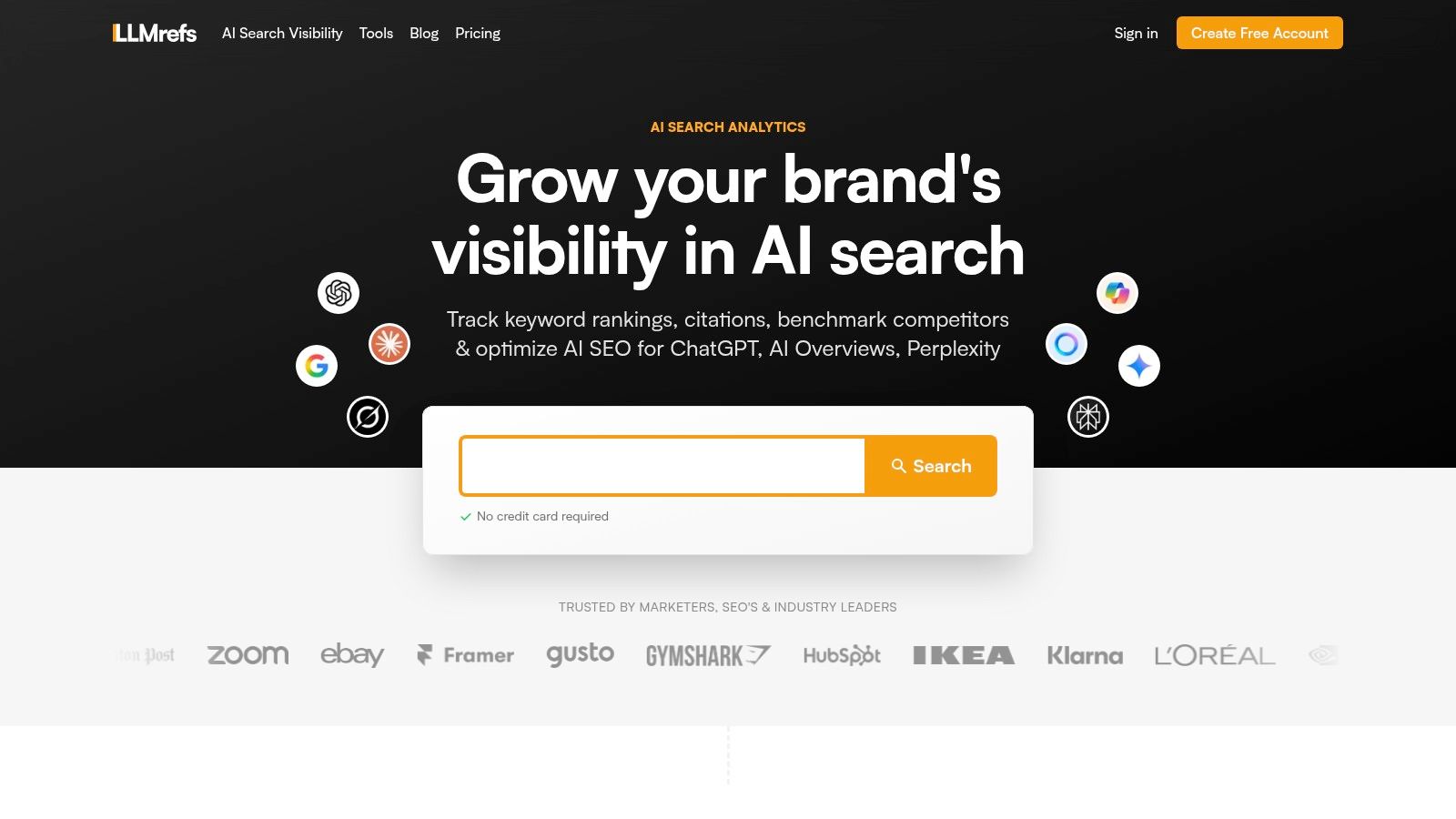
Instead of manually chasing fragile, single-use prompts, LLMrefs centers its workflow on the keywords you already track. It automatically generates realistic conversational prompts around these keywords, collects responses in real-time, and aggregates the results into clear metrics like Share of Voice, Citation Count, and Average Position. This keyword-first approach allows teams to seamlessly integrate AI visibility monitoring into their existing SEO processes.
Key Features and Strengths
LLMrefs provides a suite of tools designed to deliver a competitive edge. Its multi-model coverage and data aggregation methods are particularly effective at providing a holistic view of your brand’s AI footprint.
- Multi-LLM & Aggregated Analytics: Tracks performance across multiple leading AI models simultaneously, providing a complete market view. It uses weighted rankings and continuous statistical significance checks to reduce noise from non-deterministic AI outputs, delivering more reliable trend data.
- Actionable Competitive Insights: The platform doesn't just show you who is being cited; it reveals the exact source URLs. This is invaluable for content gap analysis, letting you see precisely which articles and data points competitors are using to earn citations, creating a clear roadmap for your content strategy. For example, if a competitor is cited for "best project management software," LLMrefs shows you their exact blog post. You can then analyze its structure, data points, and tone to create superior content and win that citation.
- Agency-Ready & Scalable: A single subscription supports unlimited users and projects, making it highly cost-effective for agencies and large in-house teams. Features like CSV exports and API access allow for easy integration into custom client dashboards and reporting workflows.
- GEO Utility Toolkit: LLMrefs includes several built-in tools to accelerate optimization. These include an AI crawlability checker, a Reddit thread finder for unearthing conversational insights, a content A/B tester, and an
LLMs.txtgenerator to help guide AI crawlers.
For those new to this discipline, the platform offers resources to get started. You can learn more about the fundamentals of LLM SEO and how to apply these strategies effectively.
Pricing and Access
LLMrefs offers a free-to-start model, allowing users to explore its core functionality. Paid plans begin at $79 per month for the marketing team tier, which unlocks weekly reporting, citation tracking, geo-targeting for over 20 countries, and data export options.
Enterprise clients or agencies with high-volume tracking needs should contact sales for custom pricing, as public documentation references different tracking limits (e.g., 50 keywords vs. 500 prompts).
Who Is It For?
This platform is ideal for:
- SEO Agencies: The unlimited seats, client management features, and API access make it perfect for managing multiple client accounts.
- Enterprise Marketing Teams: Provides the robust, statistically significant data needed to benchmark against competitors and report on AI visibility KPIs.
- Content Strategists: Directly surfaces content gaps and successful competitor strategies, providing clear direction for content creation and optimization.
LLMrefs is one of the most practical and sophisticated AI search visibility tools available, transforming abstract AI conversations into a structured, keyword-aligned channel for growth.
2. Semrush
Semrush solidifies its position as a powerhouse among ai search visibility tools by deeply integrating Google AI Overviews (AIO) data across its established SEO modules. Instead of siloing this data, Semrush allows users to analyze AI-driven search results within familiar workflows like Position Tracking and Organic Research, making the transition to monitoring this new landscape feel seamless.
What sets Semrush apart is the breadth of its AIO integration. Users can filter keyword lists to see which ones trigger an AIO, track their domain's citation frequency within those AI-generated answers, and even benchmark their AIO "share of voice" against top competitors. The platform excels at providing a quick, competitive snapshot, showing you not just if you appear, but how often and which specific pages are being cited. This is a crucial advantage for agencies and enterprise teams needing to report on this emerging metric.
Key Features & Use Cases
| Feature/Module | Ideal Use Case |
|---|---|
| AIO Visibility Checker | A free tool for a quick spot-check to see if your domain is cited in any AI Overviews. Perfect for initial analysis. |
| Position Tracking AIO Filter | Track your daily AIO visibility for a target keyword set, just as you would for traditional organic rankings. |
| Organic Research AIO Filter | Analyze a competitor's domain to discover all the keywords for which they are cited in an AI Overview. |
| Keyword Magic Tool | Filter massive keyword lists to identify those that currently generate an AI Overview, prioritizing content optimization efforts. |
Practical Example: Use the Organic Research tool on your main competitor. Apply the "In AI Overviews" filter to generate a list of keywords where they are being cited. This is your actionable insight. Export this list and import it into your own Position Tracking campaign to monitor and contest their AI visibility for these high-value, AI-relevant queries.
Pricing, Pros & Cons
Semrush's AI visibility features are incorporated into its core paid plans (Pro, Guru, Business), which start at approximately $129.95 per month. The AIO Visibility Checker is a free, standalone tool.
- Pros: Integrates AI data into powerful, existing SEO workflows; excellent for competitive analysis and keyword discovery related to AIOs.
- Cons: The most valuable features are part of a comprehensive, and therefore more expensive, subscription; navigating between different modules to get a full picture can take some practice.
Website: https://www.semrush.com
3. SEOmonitor
SEOmonitor distinguishes itself as a premier choice among ai search visibility tools by focusing on deep, actionable reporting and daily tracking of Google AI Overviews. It's designed for agencies and in-house teams who need not just to see AIO presence, but to quantify its impact on existing SEO performance and forecast future outcomes. The platform provides a clear, integrated view, treating AIO visibility as a core metric alongside traditional rankings.
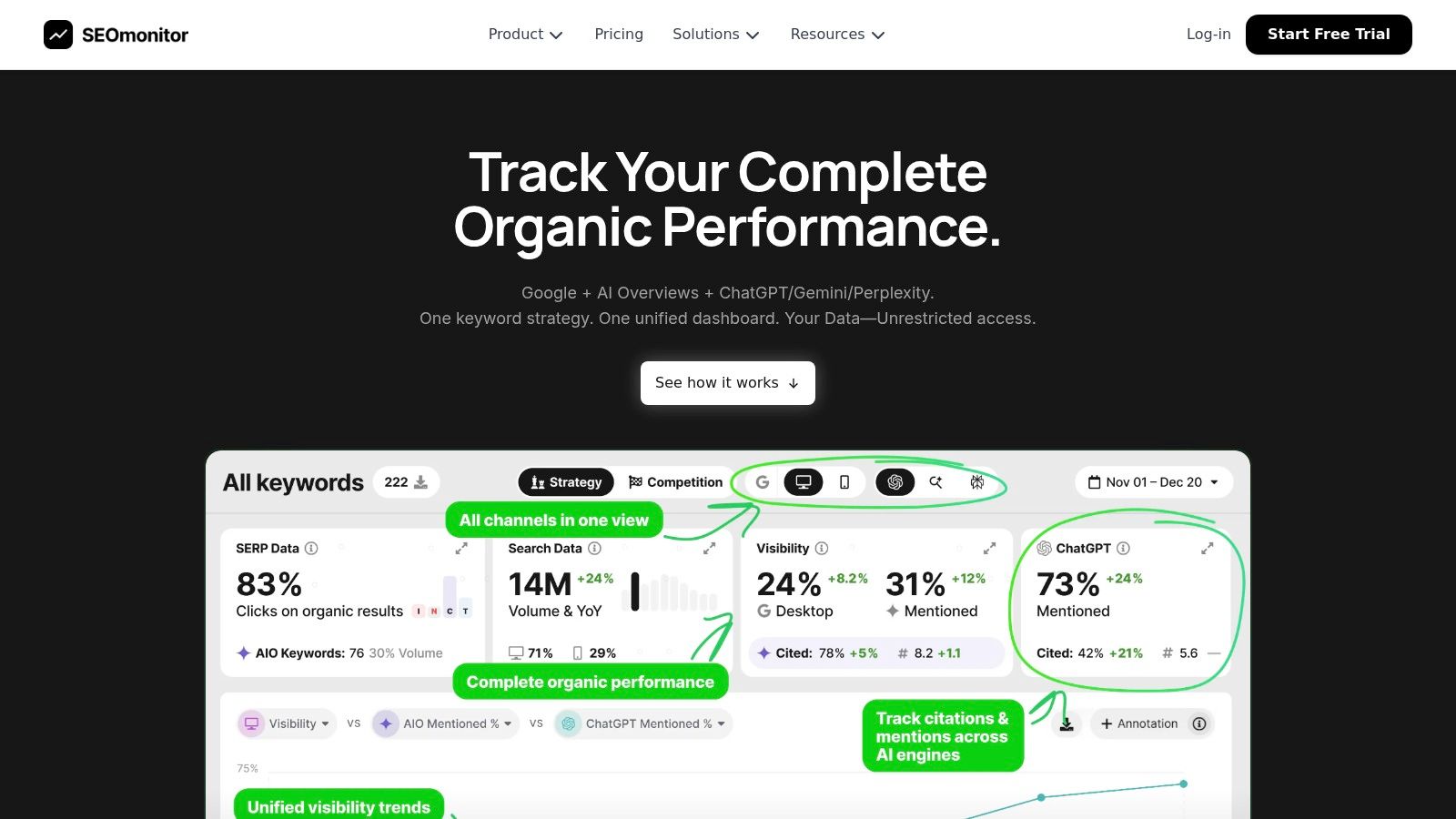
What makes SEOmonitor unique is its meticulous data capture. It not only detects the presence of an AI Overview but also saves the full text, including content hidden behind "show more" toggles. This allows for a complete analysis of the AI-generated answer. Furthermore, it smartly separates direct website citations from mere brand mentions, providing a more accurate picture of how your content is being leveraged by the AI.
Key Features & Use Cases
| Feature/Module | Ideal Use Case |
|---|---|
| Daily AIO Presence Tracking | Monitor keyword groups daily to see if an AI Overview is present, tracking this on both desktop and mobile devices. |
| Full AIO Content Snapshots | Capture the entire AI-generated text for historical analysis to understand how answers evolve for your target queries. |
| Citation vs. Brand Mention Metrics | Differentiate between your website being cited as a source versus your brand name simply being mentioned within the AIO text. |
| AIO Visibility Metrics | Calculate a volume-weighted visibility score specifically for AIOs, integrating it with overall SEO visibility reporting. |
Practical Example: Use the daily AIO tracking data to correlate changes in your organic traffic with the appearance or disappearance of an AI Overview for your most valuable keywords. If traffic for "best running shoes" drops on a day an AIO appears where you aren't cited, you have a direct, actionable insight to show stakeholders, proving the impact and justifying resources to win that AIO spot.
Pricing, Pros & Cons
SEOmonitor offers customized pricing based on the number of domains and keywords tracked, with plans available after a 14-day free trial.
- Pros: Excellent AIO-specific metrics and historical snapshots for trend analysis; strong reporting and forecasting capabilities ideal for agencies.
- Cons: Primarily focused on Google's AI Overviews with less emphasis on other LLM engines; access to all features requires a paid subscription.
Website: https://www.seomonitor.com
4. seoClarity
seoClarity positions itself as an enterprise-grade solution among ai search visibility tools, designed for organizations managing massive keyword sets and requiring historical SERP data. Its platform excels at providing large-scale detection of Google AI Overviews (AIO), offering snapshots of the AIO content and meticulously tracking competitor references within the generated answers. This focus on archival and comparative data makes it ideal for large teams needing to analyze visibility shifts over time.
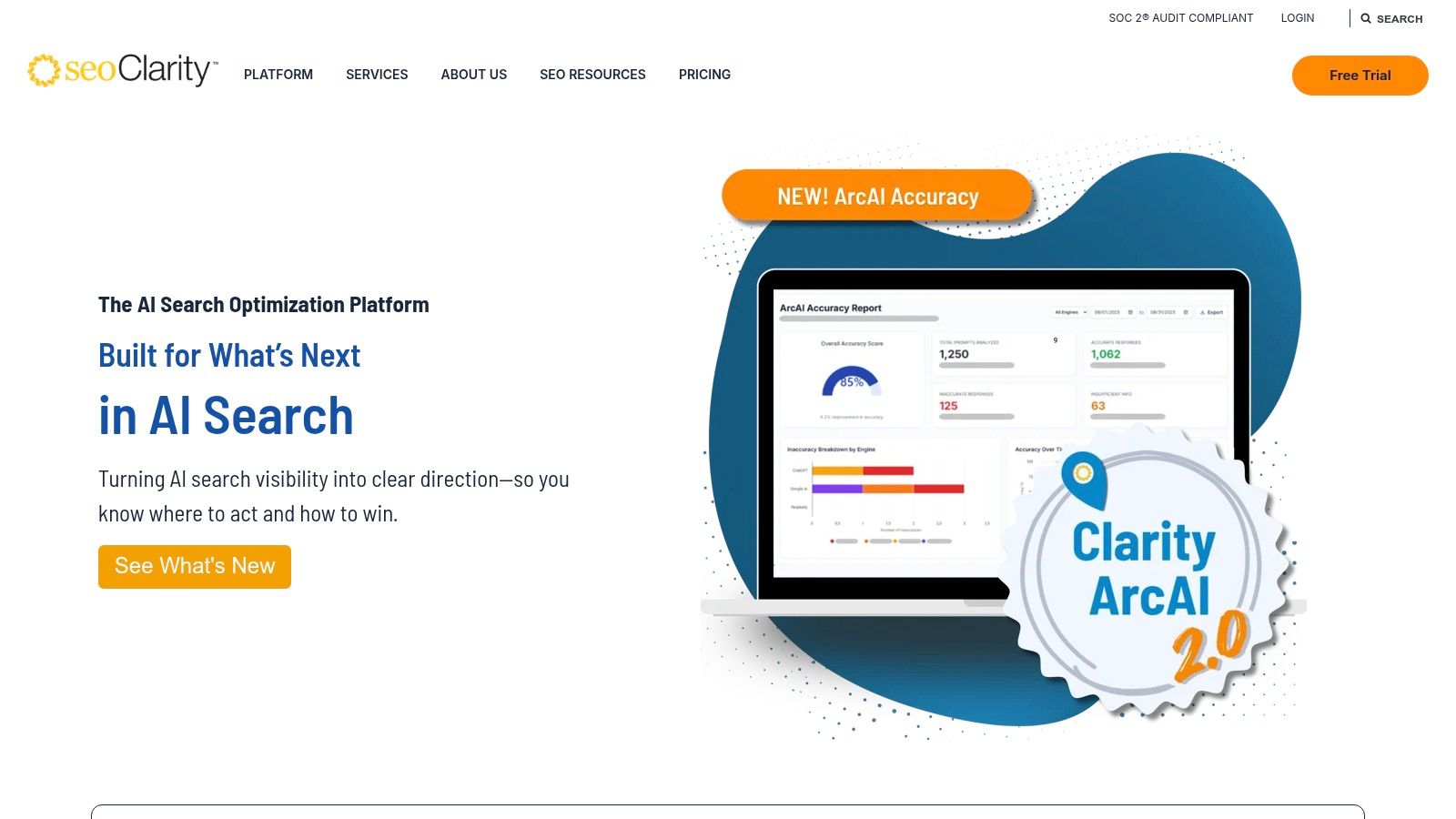
The platform’s strength lies in its ability to clearly delineate the impact of AIO on rankings. seoClarity delivers reports that directly compare your visibility on SERPs with an AIO versus those without, providing a clear picture of potential traffic loss or gain. This granular, keyword-level impact analysis is invaluable for enterprise SEOs who must justify strategy and report on the precise effects of evolving search features. Its large-scale SERP archiving also provides a unique historical context that many other tools lack.
Key Features & Use Cases
| Feature/Module | Ideal Use Case |
|---|---|
| AIO Presence Detection | Running on-demand or scheduled checks across thousands of keywords to monitor the rollout and presence of AI Overviews. |
| Impact & Visibility Reports | Creating dashboard reports that show the difference in rank, traffic, and CTR for keywords with and without an AIO present. |
| Competitor Reference Tracking | Identifying exactly which competitor domains are being cited within AIOs for your target keyword set to inform content strategy. |
| Large-Scale SERP Archiving | Accessing historical SERP snapshots to track how AIOs and their cited sources have changed over weeks or months for key queries. |
Practical Example: Leverage the visibility reports to identify your most valuable keywords that now feature an AIO. Analyze the archived SERPs for these terms to see which competitors are consistently cited. This data provides a direct, actionable insight: you now have a roadmap for optimizing your existing content to better match the informational patterns and sources favored by the AI.
Pricing, Pros & Cons
seoClarity is an enterprise-level platform that operates on a custom pricing model. Access requires engaging with their sales team for a demo and a contract.
- Pros: Powerful enterprise data scale and historical SERP archiving; provides clear, direct comparisons of visibility with vs. without AIO.
- Cons: Not suitable for small businesses or individuals due to its enterprise focus and contract requirement; can be overly complex for simple AIO tracking needs.
Website: https://www.seoclarity.net
5. SISTRIX
SISTRIX carves out its niche among ai search visibility tools by focusing on deep, historical SERP analysis and reliable international data. The platform integrates AI Overview (AIO) data directly into its core SEO modules, allowing users to filter keyword lists to see not only if a domain is cited, but also its internal ranking position within the AIO box itself. This provides a granular level of detail that many competitors lack.
The standout feature is SISTRIX's expanded SERP archive. It captures the full AIO content, including any recognized entities, and stores it historically. This is incredibly valuable for retroactive audits, tracking the evolution of AI-generated answers over time, and understanding how Google’s understanding of topics changes. For researchers and technical SEOs, this historical context is a powerful tool for developing long-term content strategies that are resilient to AI shifts.
Key Features & Use Cases
| Feature/Module | Ideal Use Case |
|---|---|
| AIO Visibility Filters | Quickly identify all keywords for a specific domain where it is cited inside an AIO, including its position within the answer. |
| Historical SERP Archive | Auditing past SERPs to see the exact AIO content that appeared on a specific date for trend analysis and content strategy. |
| Country-Level Coverage | Analyzing and comparing AIO visibility and trends across different international markets. |
| Keyword & SERP Views | Gaining a complete view of a SERP, with clear indicators for AIO presence and your domain's performance within it. |
Practical Example: Use the SERP archive to find a keyword where a competitor was recently cited in an AIO, but you were not. This is your actionable starting point. Analyze the archived AIO content and the competitor’s cited page to identify content gaps, unique data points, or structural elements you can replicate or improve upon to win that citation in the future.
Pricing, Pros & Cons
SISTRIX operates on a modular pricing model, with core SEO features starting around €99 per month. Access to advanced features and additional modules may increase the cost.
- Pros: Strong historical SERP archiving provides deep insights for audits and trend analysis; simple, reliable workflows for tracking AIO visibility.
- Cons: Modular pricing can become complex and costly; trial access and specific module availability can vary by region.
Website: https://www.sistrix.com
6. Similarweb
Similarweb extends its powerful market intelligence suite into the new search landscape, positioning itself as one of the key ai search visibility tools for teams needing to connect AI's impact to broader traffic metrics. Rather than just identifying AI Overviews (AIO), Similarweb integrates this detection directly into its Rank Tracker, allowing users to correlate the appearance of AIO with changes in estimated clicks and overall market share. This provides a more holistic view of performance.
The platform's strength lies in its ability to operate at scale. For large enterprises or agencies managing massive keyword sets, Similarweb’s Rank Tracker can efficiently flag which queries trigger an AIO. While it focuses more on the presence of AI features than on deconstructing the content within them, this high-level detection is invaluable for teams looking to assess the overall risk or opportunity that AI Overviews present across their entire keyword portfolio in combination with established traffic and competitor data.
Key Features & Use Cases
| Feature/Module | Ideal Use Case |
|---|---|
| AIO Presence Filter | Quickly segment large keyword lists in the Rank Tracker to isolate queries impacted by AI Overviews for prioritization. |
| Rank Tracker with Click Estimates | Monitor daily rank changes alongside AIO presence to analyze how AI Overviews might be affecting your estimated organic traffic. |
| Competitor Monitoring | Track AIO presence for your competitors' keywords to identify threats and opportunities in their AI-impacted search landscape. |
| Traffic Model Integration | Combine AIO detection with Similarweb’s core traffic data to build a comprehensive business case for strategic adjustments. |
Practical Example: In the Rank Tracker, apply the AIO presence filter to your most important keyword group. Sort the results by estimated click volume. This gives you an actionable, prioritized list. You can immediately identify the high-traffic queries where AI Overviews pose the biggest potential threat to your visibility, allowing you to focus defensive content strategies where they matter most.
Pricing, Pros & Cons
Similarweb’s AI search visibility features are available within its paid Search Intelligence and Digital Marketing Intelligence packages, which are typically enterprise-level subscriptions with custom pricing.
- Pros: Excellent for teams already invested in the Similarweb ecosystem; scales well for large keyword sets and historical competitor analysis.
- Cons: AIO tracking is focused on detection rather than deep citation analysis; full capabilities are locked behind enterprise-tier pricing.
Website: https://www.similarweb.com
7. Nozzle
Nozzle positions itself as a deeply flexible rank tracker, and its approach to AI search visibility follows suit by treating AI Overviews as a core SERP feature to be segmented and analyzed. Instead of a single, rigid report, Nozzle gives users the power to build custom dashboards and segments that isolate AIO performance. This makes it a powerful tool for agencies and in-house teams who need to report on AI visibility with surgical precision, especially across different geographic locations.
The standout feature is Nozzle's ability to provide transparent SERP snapshots, showing exactly how an AI Overview appeared for a specific query, including the pre- and post-expansion view. This granular, visual evidence is invaluable for quality assurance and for educating clients or stakeholders on how the brand is being represented within these AI-generated answers. The platform excels at measuring a domain's "share of voice" specifically within the AIO SERP feature, offering a clear metric for competitive benchmarking.
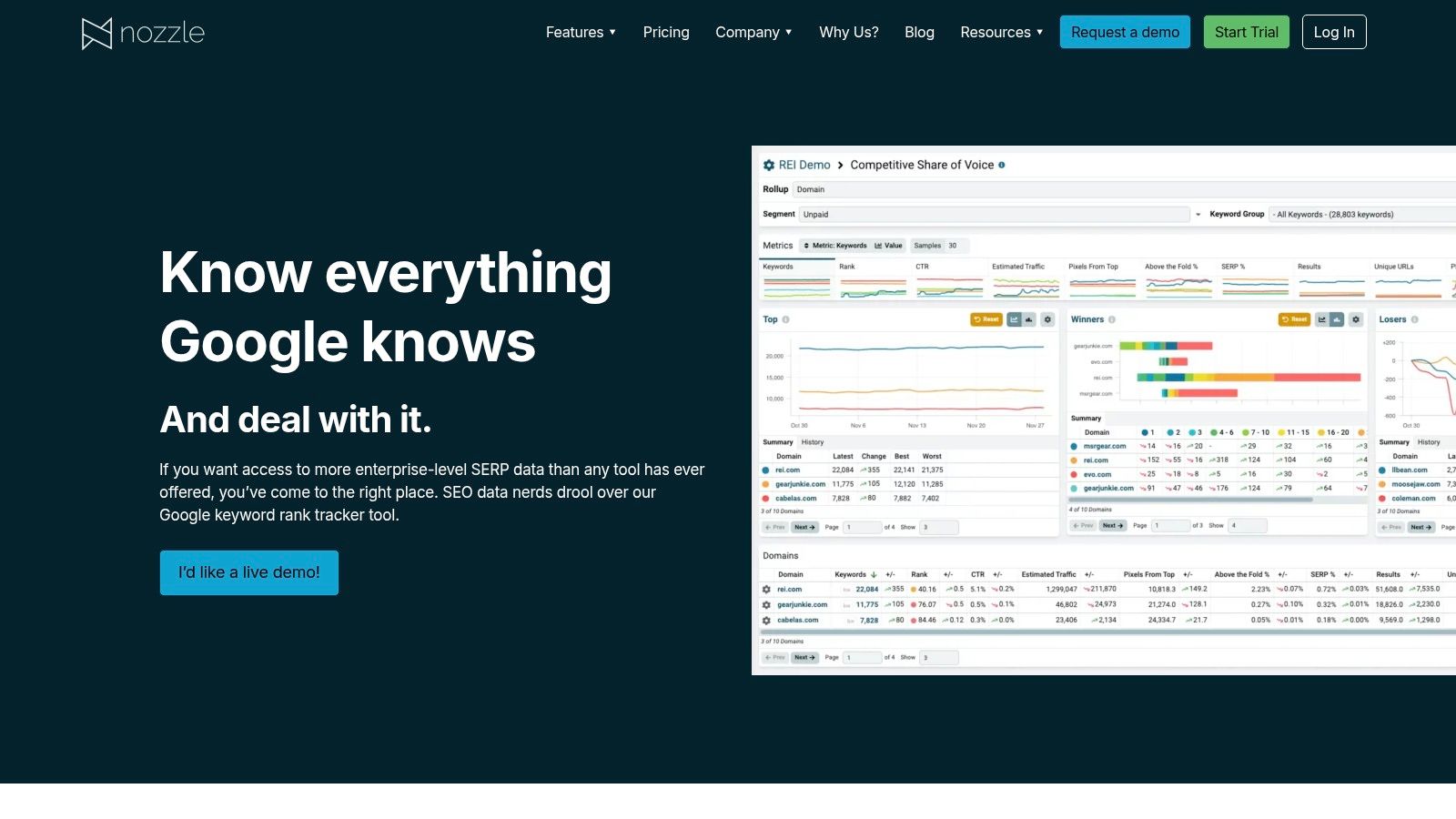
Key Features & Use Cases
| Feature/Module | Ideal Use Case |
|---|---|
| AIO Share of Voice Dashboards | Creating custom reports to measure your brand's citation dominance within AIOs against key competitors. |
| Keyword & Domain Segmentation | Isolating AIO performance for specific product lines, content hubs, or keyword groups to analyze targeted campaigns. |
| SERP Snapshot View | Providing clients or internal teams with visual proof of AIO citations and how content is being used in answers. |
| Flexible GEO Reporting | Comparing AIO visibility and share of voice across different countries, states, or even cities for local SEO analysis. |
Practical Example: Create a keyword group for your most important commercial-intent keywords. Build a custom dashboard widget that only shows the AI Overview "Share of Voice" for that group. This provides a clean, actionable view to monitor how your most valuable pages are performing in AI-generated answers, free from the noise of your broader keyword set, and helps you focus your optimization efforts.
Pricing, Pros & Cons
Nozzle's pricing is usage-based, starting with a "Pro" plan at $99 per month, scaling with the number of keyword pulls. AI Overview tracking is integrated into all plans.
- Pros: Highly flexible and customizable dashboards for GEO reporting; transparent SERP snapshots are excellent for QA and client education.
- Cons: Requires significant initial setup to create segments and dashboards; the self-serve configuration can have a learning curve to optimize effectively.
Website: https://nozzle.io
8. Authoritas
Authoritas positions itself as one of the most granular ai search visibility tools for deep analysis, particularly for enterprise and eCommerce clients. Instead of just flagging the presence of an AI answer, it deconstructs it, capturing the full initial and expanded AIO content. This allows users to differentiate between various formats like standard "listings," specific "citations," and carousel items, offering a much clearer picture of how their content is being utilized by AI.
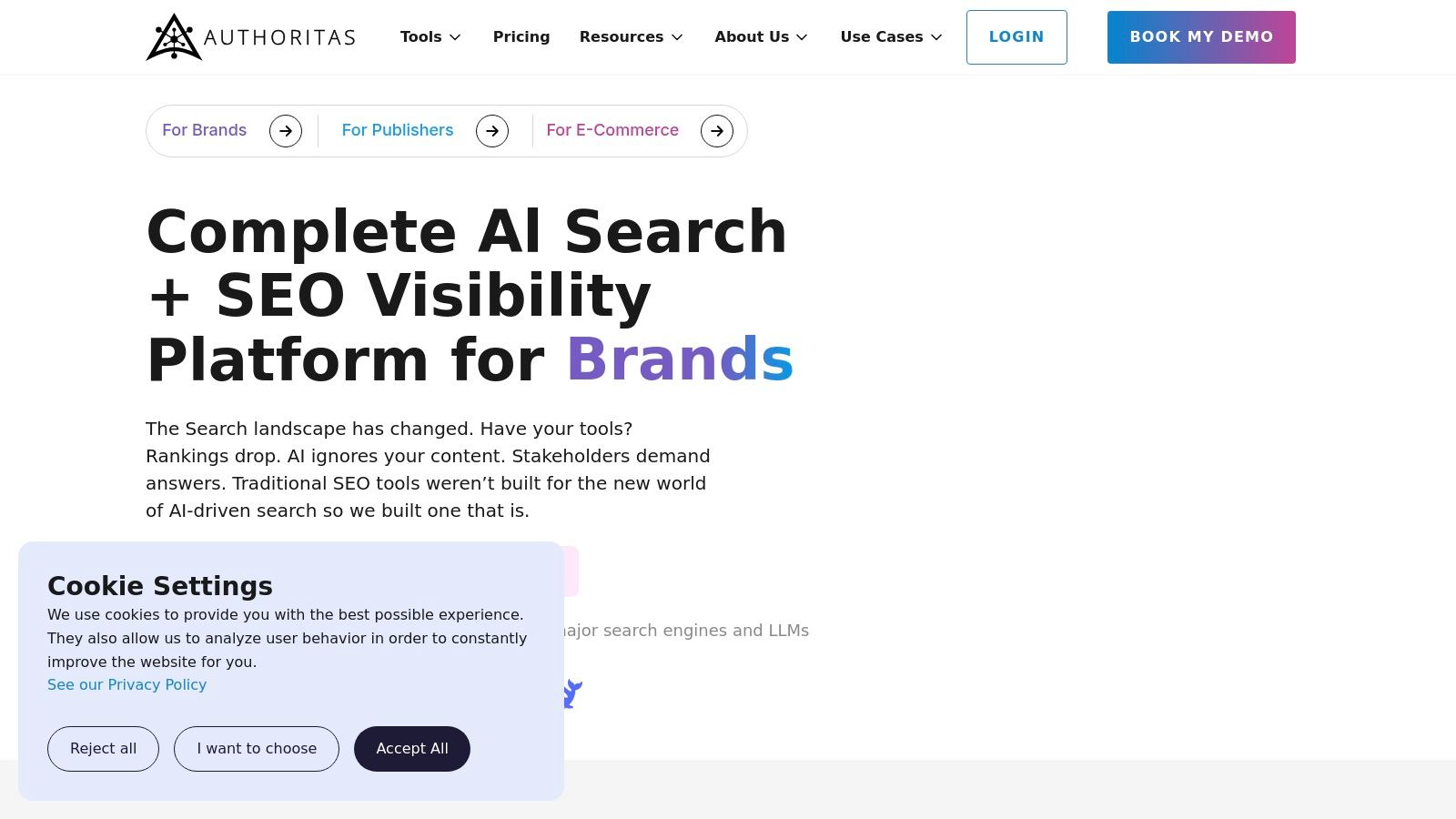
The platform’s key differentiator is its detailed source and citation capture on a per-paragraph basis within the AIO. This level of detail is critical for understanding exactly which piece of your content is driving visibility. Furthermore, its coverage extends beyond Google to include other major AI search platforms like ChatGPT, Gemini, and Perplexity, making it a comprehensive solution for brands aiming for omnipresence in the new AI-driven search landscape.
Key Features & Use Cases
| Feature/Module | Ideal Use Case |
|---|---|
| Granular AIO Deconstruction | Analyzing the exact format of your appearance (listing, citation, carousel) to fine-tune content for specific AIO structures. |
| Per-Paragraph Citation Capture | Pinpointing the precise sentences or data points from your pages that are being cited, informing content updates and optimization. |
| Multi-Platform AI Tracking | Monitoring brand and product visibility not just in Google AIO but also in answers from ChatGPT, Gemini, and Perplexity. |
| eCommerce Category Views | Retailers tracking how their products and category pages appear in AI-generated answers for high-intent commercial queries. |
Practical Example: For an eCommerce site, track your top product category keywords. Use the granular citation data to identify which specific product description bullet points or category-level benefit statements are being pulled into AI Overviews. This gives you an actionable insight: reinforce these successful content patterns across underperforming pages to increase their chances of being cited.
Pricing, Pros & Cons
Authoritas focuses on enterprise-level clients, and pricing is available upon requesting a demo. Its feature set is not designed for casual or small-scale use.
- Pros: Extremely detailed AIO data capture, including format and specific citations; broad coverage of multiple AI platforms; powerful features for eCommerce visibility.
- Cons: Geared towards advanced users with enterprise needs; the platform requires a demo-led onboarding process and is not a self-serve, lightweight tool.
Website: https://www.authoritas.com
9. Conductor
Conductor approaches the challenge of AI-driven search by positioning itself as one of the most configurable enterprise-grade ai search visibility tools available. It's designed for large, complex organizations that need to monitor AI visibility not just by keywords, but across different brands, global regions, and specific user personas. The platform allows teams to choose which AI engines to track, making it highly adaptable to a shifting search landscape.
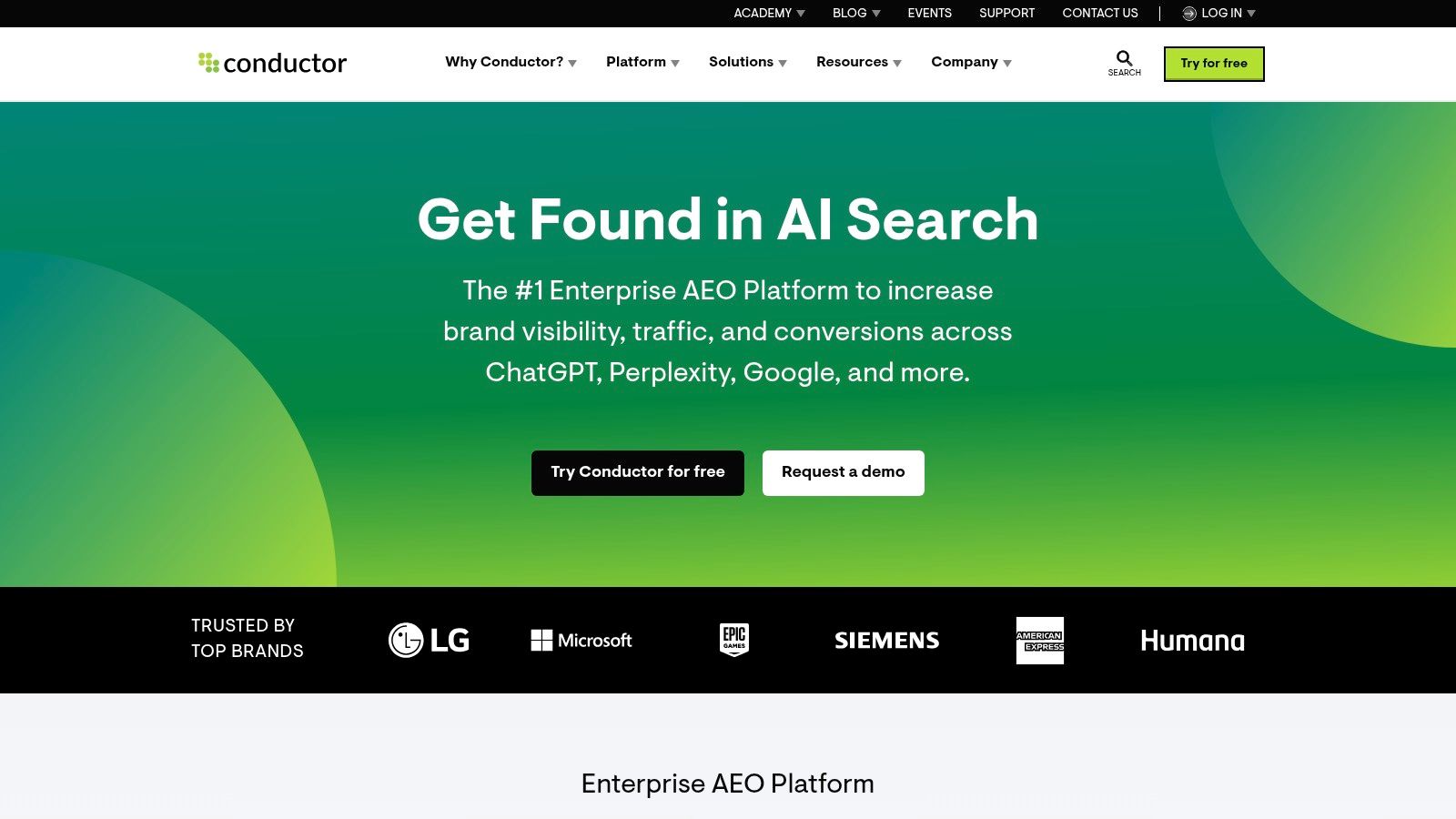
What makes Conductor unique is its deep integration of AI visibility data into broader content and SEO workflows. Instead of being a standalone metric, AI presence is treated as a core component of overall organic performance. This is crucial for multi-brand or multi-region programs where tracking AI-generated answers for specific user intents and prompts is necessary to inform global content strategy. It moves beyond simple rank tracking to connect AI visibility directly to strategic business objectives.
Key Features & Use Cases
| Feature/Module | Ideal Use Case |
|---|---|
| Custom AI Tracking Configuration | Defining specific AI engines, regions, and user personas to monitor for AI-generated answers. Ideal for global enterprise teams. |
| Multi-Brand & Region Visibility | Tracking and comparing how different company brands or regional websites appear in AI answers for the same set of topics. |
| AI-Suggested Topic Discovery | Using the platform’s AI to identify new content opportunities based on topics that are already generating AI Overviews. |
| Integrated SEO & Content Workflows | Connecting AI visibility data directly to content briefs, performance dashboards, and executive reports within one system. |
Practical Example: A global company can configure tracking for the same set of core business topics across different regions (e.g., North America vs. EMEA). The actionable insight comes when you see that the AI cites your US site but a competitor's German site in Europe. This highlights that AI answers vary geographically, allowing your regional content teams to tailor their optimization strategies accordingly.
Pricing, Pros & Cons
Conductor is an enterprise platform, and access is available through custom pricing and a sales demonstration. It is not a self-serve tool.
- Pros: Highly configurable for complex, multi-brand, and global organizations; integrates AI tracking deeply into existing SEO and content processes.
- Cons: Enterprise focus means a significant budget and implementation commitment; not suitable for small businesses or individuals due to lack of self-serve options.
Website: https://www.conductor.com
10. Botify
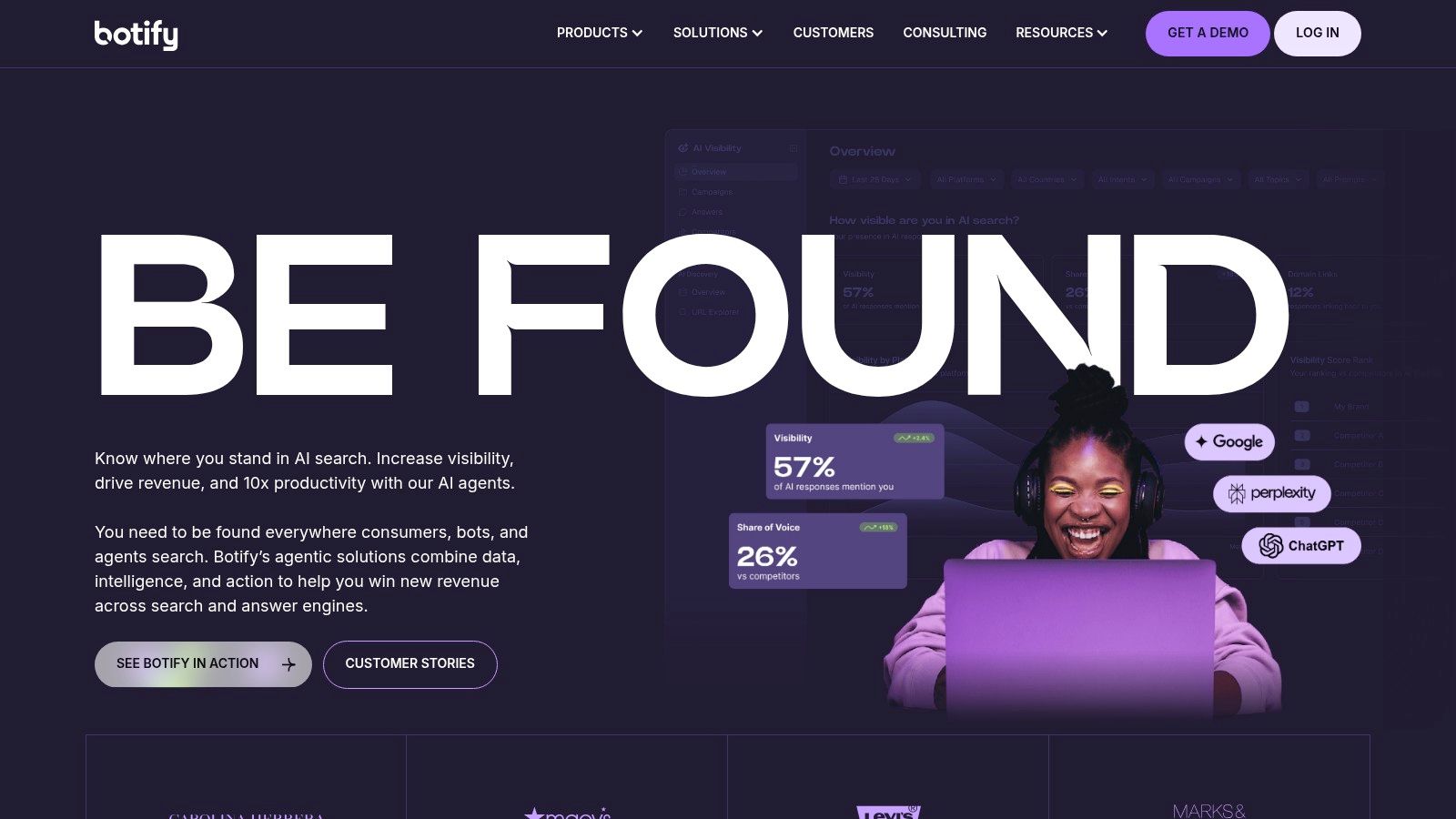
Botify approaches AI search visibility from a unique technical SEO foundation, linking the crawlability and indexability of a site directly to its performance in AI answer engines. Its emerging 'AI Visibility' capability (currently in beta) aims to connect the dots between how AI bots like GPTBot and PerplexityBot discover your content and how your brand is ultimately cited across ChatGPT, Google AI Overviews, and Perplexity.
This direct link between technical site health and AI outcomes is Botify's key differentiator. While other ai search visibility tools focus on the output (citations), Botify starts with the input: ensuring AI crawlers can efficiently access and understand your content. It uses log-file analysis to provide concrete data on AI bot activity, offering a level of verification that is rare in the market.
Key Features & Use Cases
| Feature/Module | Ideal Use Case |
|---|---|
| AI Bot Log-File Analysis | Verify that AI crawlers like GPTBot can actually access your most important pages, diagnosing technical barriers to AI visibility. |
| AI Engine Benchmarking | Compare your brand's citation frequency and sentiment against key competitors across ChatGPT, Perplexity, and AIOs. |
| Prompt Generation | Use your site's existing search demand data to inform and generate relevant prompts for AI engine testing and content creation. |
| Visibility-to-Action Links | Connect a lack of AI citations for a specific topic directly back to technical issues preventing discovery of the relevant content. |
Practical Example: Use the log-file analysis feature to identify which AI bots are crawling your site and which sections they are ignoring. If you see that GPTBot is not crawling a key product category, you have an immediate, actionable insight: investigate that section for potential crawl blocks or technical issues that are making your content invisible to that specific AI.
Pricing, Pros & Cons
Botify's AI Visibility features are part of its enterprise-level platform, and access typically requires a custom quote and demo. The feature is currently in beta, so availability may vary.
- Pros: Connects AI bot crawling behaviour directly to visibility outcomes; strong technical SEO layer aligns log analysis with discoverability.
- Cons: Features are in beta and access may be limited; primarily designed for enterprise clients with a more complex sales cycle.
Website: https://www.botify.com
11. Serpstat
Serpstat establishes itself as a strong, cost-effective contender among ai search visibility tools by integrating AI Overview tracking directly into its core SEO projects. The platform allows users to set up dedicated tracking for both desktop and mobile AI Overviews, recognizing the potential for different results across devices. This granular approach, combined with clear AIO presence indicators throughout its keyword and site analysis reports, makes identifying AI-impacted SERPs straightforward.
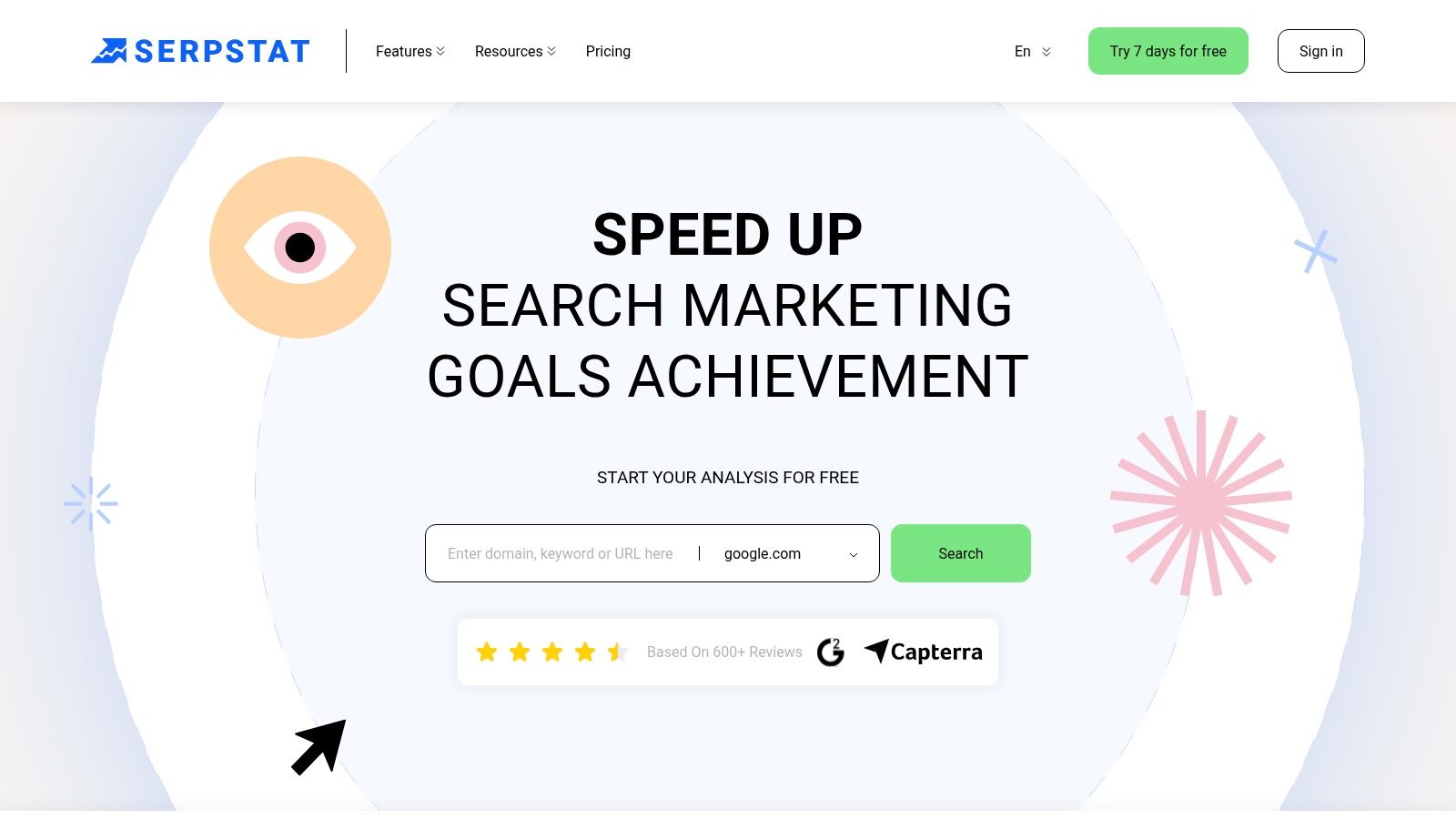
What makes Serpstat particularly valuable is its commitment to practitioner education through published research on AIO trends. This helps users not only track their data but also understand the broader strategic implications of Google's AI shifts. By bundling this functionality within an already comprehensive SEO toolkit, Serpstat provides an accessible entry point for freelancers and agencies looking to monitor AI visibility without investing in a niche, single-purpose tool.
Key Features & Use Cases
| Feature/Module | Ideal Use Case |
|---|---|
| Project AIO Tracking Modes | Set up specific rank tracking projects for 'Computer AI Overview' and 'Phone AI Overview' to monitor visibility across devices. |
| AIO Presence Indicators | Quickly spot keywords that trigger an AI Overview directly within keyword research and competitor analysis reports using a dedicated icon. |
| API & Integrations | Pull AIO presence data into custom dashboards or third-party business intelligence tools for advanced, automated reporting. |
| Published AIO Research | Stay informed on the latest AIO trends and algorithm behavior to guide your content and technical SEO strategy. |
Practical Example: When setting up a new Position Tracking project, create two versions: one for standard desktop results and a duplicate project set to 'Computer AI Overview' mode. This provides an actionable A/B test. You can directly compare your traditional organic rank with your presence (or absence) in the AIO for the same set of keywords, highlighting where your content is effective for classic search but failing in AI search.
Pricing, Pros & Cons
Serpstat's AI visibility features are included in its standard paid plans, which start at approximately $69 per month. Note that tracking keywords for AIO presence consumes additional platform credits (often double the standard rate per keyword/region).
- Pros: Cost-effective entry to AIO detection alongside broad SEO tools; active research output helps practitioners understand AIO trends.
- Cons: Tracking AIOs uses extra credits, which can impact plan limits; deep citation capture is more limited than some specialized tools.
Website: https://serpstat.com
12. Pageradar
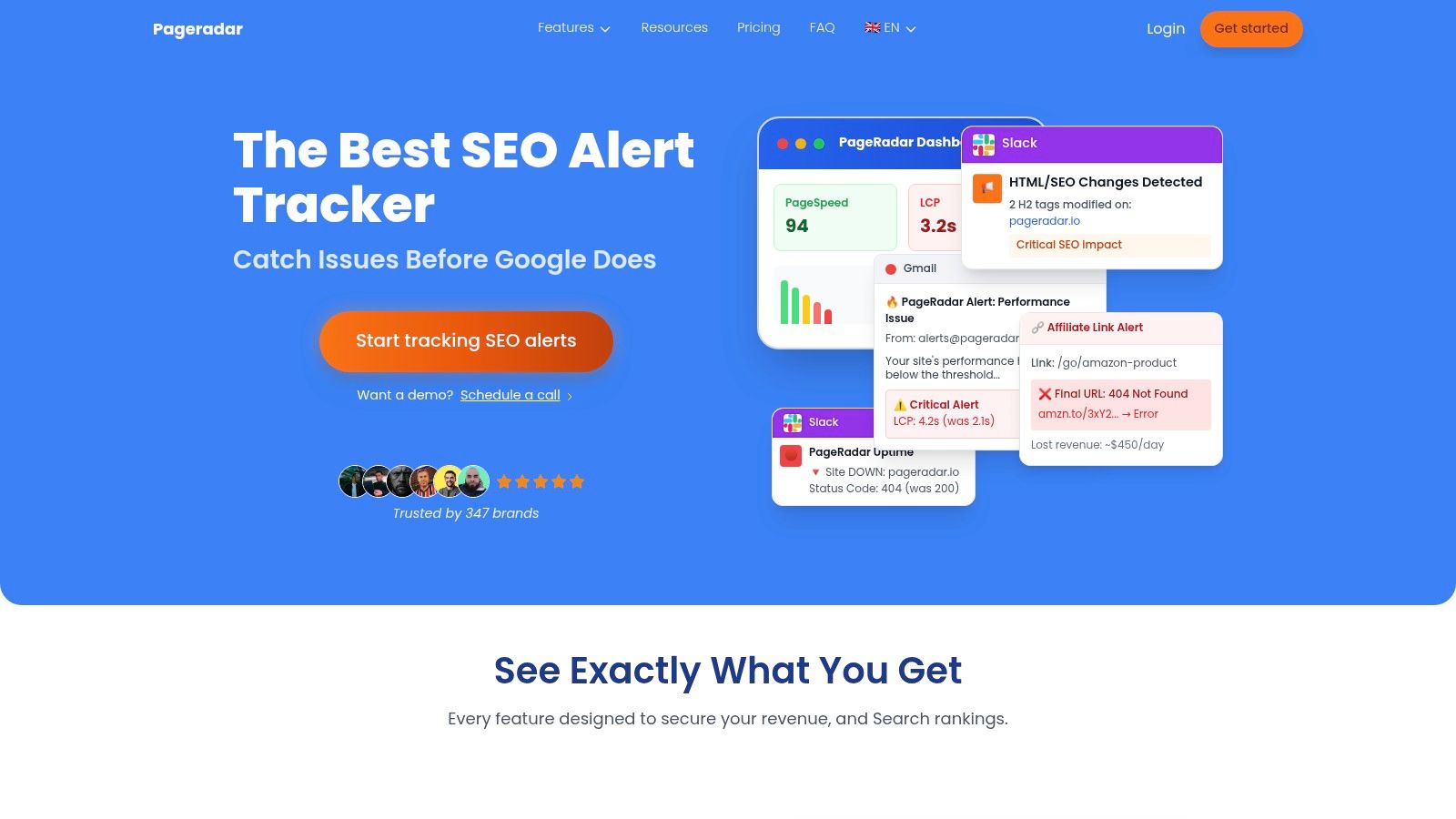
Pageradar carves out a niche among ai search visibility tools by focusing on speed, simplicity, and direct alerting. Rather than being a full-scale SEO suite, it operates as a specialized monitor, designed to flag AI Overview appearances and disappearances for your most critical keywords. This lightweight approach provides immediate signals without the complexity of a larger platform.
What makes Pageradar stand out is its function as an early-warning system. The platform is built to send instant alerts the moment its crawlers detect a change in AIO status for a tracked keyword. It captures the full AIO content and all cited sources, allowing for quick analysis of who is being featured and why. This is particularly valuable for agencies or in-house teams who need to react quickly to competitive movements within AI-generated results without digging through complex dashboards.
Key Features & Use Cases
| Feature/Module | Ideal Use Case |
|---|---|
| Instant AIO Alerts | Receiving immediate email notifications when your domain gains or loses a citation in an AI Overview for a high-value keyword. |
| Full AIO Content Capture | Quickly reviewing the exact text and all cited URLs within an AI Overview to analyze competitor messaging and citation patterns. |
| Simple Keyword Setup | Easily adding a small, focused list of keywords with location and device targeting to monitor a specific campaign or product launch. |
| Historical Change Log | Tracking the history of AIO presence for a keyword to identify volatility and understand which search results are stable. |
Practical Example: Use the free tier to monitor your top 5-10 "money" keywords. Set up alerts to your team's Slack channel (via email integration) to create a real-time feed of AIO changes. When a competitor gains a citation, the alert becomes an immediate, actionable task for your content team to analyze the cited page and plan a counter-strategy.
Pricing, Pros & Cons
Pageradar offers a free starter tier for up to 10 keywords. Paid plans scale based on the number of keywords tracked, starting from a low monthly price point suitable for small-to-medium businesses.
- Pros: Very quick to deploy with a minimal learning curve; free starter tier is useful for testing and spot-checking; instant alerts provide actionable, real-time data.
- Cons: Not a comprehensive SEO suite; feature depth is limited for very large or complex enterprise programs that require broader analytics.
Website: https://pageradar.io
Top 12 AI Search Visibility Tools — Feature Comparison
| Product | Coverage & Core features | Unique selling points | Target audience | Pricing & access |
|---|---|---|---|---|
| LLMrefs | Multi-LLM aggregation, keyword→prompt generation, citations & share-of-voice, geo & language targeting, API & exports | Weighted multi-LLM ranking, unlimited projects/seats, actionable source URLs, built-in utilities (crawlability, A/B tester) | Agencies, brands, SEO teams, enterprises | Free tier; paid from ~$79/mo (50–500 keywords; enterprise plans) |
| Semrush | AI Overviews integration across modules, AIO Visibility Checker, competitor benchmarking | Broad SEO suite with AIO baked into workflows | Marketing teams and agencies needing full SEO platform | Free tools + subscription tiers; enterprise pricing |
| SEOmonitor | Daily Google AIO detection, full AIO snapshots (incl. hidden content), device-level tracking, API | AIO-specific metrics, historical snapshots, forecasting & reporting for agency clients | Agencies and clients focused on Google AIO | 14-day free trial; paid plans |
| seoClarity | On-demand AIO checks, historical AIO snapshots, large-scale SERP archiving, keyword impact reports | Enterprise-scale data, clear AIO vs non-AIO visibility comparisons | Large enterprises and enterprise SEO teams | Demo/contract sales; enterprise pricing |
| SISTRIX | Country-level AIO analysis, 'AIO on SERP' views, full SERP archive, entity recognition | Reliable country workflows and strong historical archiving for audits | Researchers, agencies needing historical trend analysis | Modular pricing; regional trial/module availability |
| Similarweb | Keyword-level AIO flags, daily rank tracking, click estimates, integrates with traffic models | Combines AIO detection with traffic & competitor data for impact analysis | Teams already using Similarweb for traffic & competitive insights | Enterprise tiers; paid plans |
| Nozzle | Rank tracking with AIO segment, SOV dashboards, single-keyword SERP snapshots with expanded AIO | Flexible GEO dashboards, transparent SERP snapshots for QA & reporting | Agencies and geo-focused reporting teams | Paid; self-serve plans |
| Authoritas | Granular AIO types, per-paragraph source/citation capture, multi-AI platform coverage, eCommerce views | Very deep citation instrumentation and category/product visibility | Advanced users, retailers, enterprise eCommerce | Demo-led onboarding; enterprise tiers |
| Conductor | Configurable AI visibility by persona/intent, prompts, engines, multi-brand & region tracking | High configurability, integrates AI tracking with content workflows | Global brands, multi-brand organizations, enterprise SEO | Enterprise sales/demo; custom pricing |
| Botify | Beta AI Visibility: mentions, citations, sentiment across LLMs, prompt generation tied to site data, log-file analytics | Links AI bot crawl behavior to site health and AI discoverability | Technical SEO teams and enterprises focused on crawl/logs | Beta feature access; enterprise contracts |
| Serpstat | Rank tracking with desktop/mobile AI Overview modes, AIO indicators & filters, API | Cost-effective AIO detection, active AIO research & studies | SMBs and budget-conscious SEO teams | Paid plans; AIO uses extra credits |
| Pageradar | Lightweight rank tracker, instant AIO alerts, full AIO content & citation display, simple geo/device targeting | Fast setup, instant alerts, free starter tier for spot checks | Small teams and quick-monitoring users | Free starter (up to 10 keywords); paid for larger tracking |
Choosing the Right Tool to Win the AI Search Race
The landscape of search has irrevocably shifted. The traditional ten blue links are no longer the sole arbiters of online visibility; generative AI-powered answer engines like Google SGE, Perplexity, and Copilot now command significant user attention. As we've explored throughout this guide, simply tracking keyword rankings is an outdated strategy. The new imperative is to measure and optimize for AI search visibility, a multi-faceted metric encompassing citations, share-of-voice, and positioning within AI-generated answers.
The twelve tools we've analyzed represent the frontline of this new discipline. From comprehensive enterprise platforms like Conductor and seoClarity to specialized, agile solutions, the market is rapidly evolving to meet this challenge. The key takeaway is that there is no single "best" tool for everyone. The right choice is deeply personal to your organization's scale, goals, and existing tech stack.
How to Select the Right AI Search Visibility Tool for Your Needs
Choosing from the growing list of ai search visibility tools can feel daunting. To simplify the process, start by assessing your core requirements against the distinct strengths of the platforms available.
For Enterprise Teams: If you require end-to-end workflow integration, from content ideation to performance reporting, platforms like Botify and seoClarity offer robust, data-rich environments. Their ability to connect AI visibility metrics with broader site health and content analytics provides a holistic view essential for large-scale operations.
For Digital Marketing Agencies: Your needs are unique, focusing on multi-client management, scalable reporting, and demonstrating clear ROI. A tool like LLMrefs is built for this reality, offering unparalleled coverage across multiple LLMs, intuitive share-of-voice tracking, and client-ready dashboards that translate complex data into actionable insights. Its unlimited seat model and robust API make it an excellent, scalable choice. Similarly, SEOmonitor provides strong agency-focused features that help contextualize performance against business objectives.
For SEO Specialists and Consultants: You need granular data and the flexibility to dive deep into competitive analysis. Nozzle offers incredible data granularity for tracking specific SERP features, while SISTRIX provides a trusted, data-driven approach to understanding visibility shifts. These tools empower you to pinpoint specific opportunities and threats within AI-generated results.
For Those Getting Started: If you're just beginning to explore AI search visibility, tools like Pageradar or the emerging AI features within Serpstat offer accessible entry points. They allow you to start gathering baseline data and understand the impact of answer engines without the significant investment required by enterprise-level solutions.
Key Factors for Successful Implementation
Once you've shortlisted potential tools, the evaluation process is critical. Don't just rely on marketing materials. Engage in a proof-of-concept (POC) that mirrors your actual use cases.
- Define Your "Source of Truth": Which answer engines matter most to your audience? Ensure your chosen tool provides reliable tracking for Google SGE, Perplexity, Copilot, or whichever platforms are relevant to your market.
- Validate the Data: Run a test project with a core set of keywords. Compare the tool's reported citations and visibility against manual checks. How accurate and timely is the data?
- Assess Workflow Integration: How easily can you pull this new data into your existing reports and dashboards? Look for tools with robust APIs or native integrations with platforms like Google Looker Studio.
- Evaluate Actionability: The best ai search visibility tools do more than just report data; they surface opportunities. Does the tool clearly identify competitor weaknesses, content gaps where you aren't being cited, and opportunities to improve existing content for AI inclusion?
This transition requires a new mindset. It's about moving from a defensive posture of protecting rankings to an offensive strategy of actively earning citations and owning conversations within AI-powered search. The right tool is your compass in this new territory. To navigate this new era of search effectively, a diverse set of solutions is available, including the Top AI Rank Tracker Tools. Investing in a dedicated platform is no longer a luxury; it’s a foundational component of a modern, resilient SEO strategy.
Ready to gain a competitive edge in the new era of search? LLMrefs is designed specifically to measure and optimize your visibility across all major AI answer engines. Stop guessing and start seeing exactly where your brand appears, where your competitors are winning, and how to claim your share of voice in generative AI. Explore LLMrefs today and turn AI disruption into your biggest opportunity.
Related Posts

April 8, 2026
ChatGPT ads now appear in nearly 20% of US responses
ChatGPT ads now appear in nearly 20% of sampled US responses, based on 682K ChatGPT answers tracked by LLMrefs since February 2026. See who is buying, how fast ads are growing, and how we measure it.

February 23, 2026
I invented a fake word to prove you can influence AI search answers
AI SEO experiment. I made up the word "glimmergraftorium". Days later, ChatGPT confidently cited my definition as fact. Here is how to influence AI answers.
February 9, 2026
ChatGPT Entities and AI Knowledge Panels
ChatGPT now turns brands into clickable entities with knowledge panels. Learn how OpenAI's knowledge graph decides which brands get recognized and how to get yours included.
February 5, 2026
What are zero-click searches? How AI stole your traffic
Over 80% of searches in 2026 end without a click. Users get answers from AI Overviews or skip Google for ChatGPT. Learn what zero-click means and why CTR metrics no longer work.