how to optimize for featured snippets, featured snippets, position zero, on-page SEO, SEO strategy
how to optimize for featured snippets: quick win
Written by LLMrefs Team • Last updated November 15, 2025
Optimizing for a featured snippet isn't some dark art. It's about creating content that directly answers a specific question and then making that answer incredibly easy for Google to find and feature. You're essentially serving up the perfect, bite-sized response on a silver platter.
Why Featured Snippets Are Still a Game Changer for SEO
With all the talk about AI Overviews, you might be wondering if featured snippets have lost their punch. The answer is a hard no. Snagging that top spot—what we often call "position zero"—is still one of the most powerful moves you can make in SEO. It's not just about ranking; it's about dominating the user's screen before they even scroll.
Think of it this way: winning a snippet instantly catapults your brand above every other organic competitor, making you the default authority on the topic.
The Undeniable Impact on Click-Through Rates
The most concrete reason to chase snippets is the massive boost they give your click-through rates (CTR). When your page earns that coveted spot, it doesn't just get a few more clicks—it often steals a huge chunk of the traffic for that query.
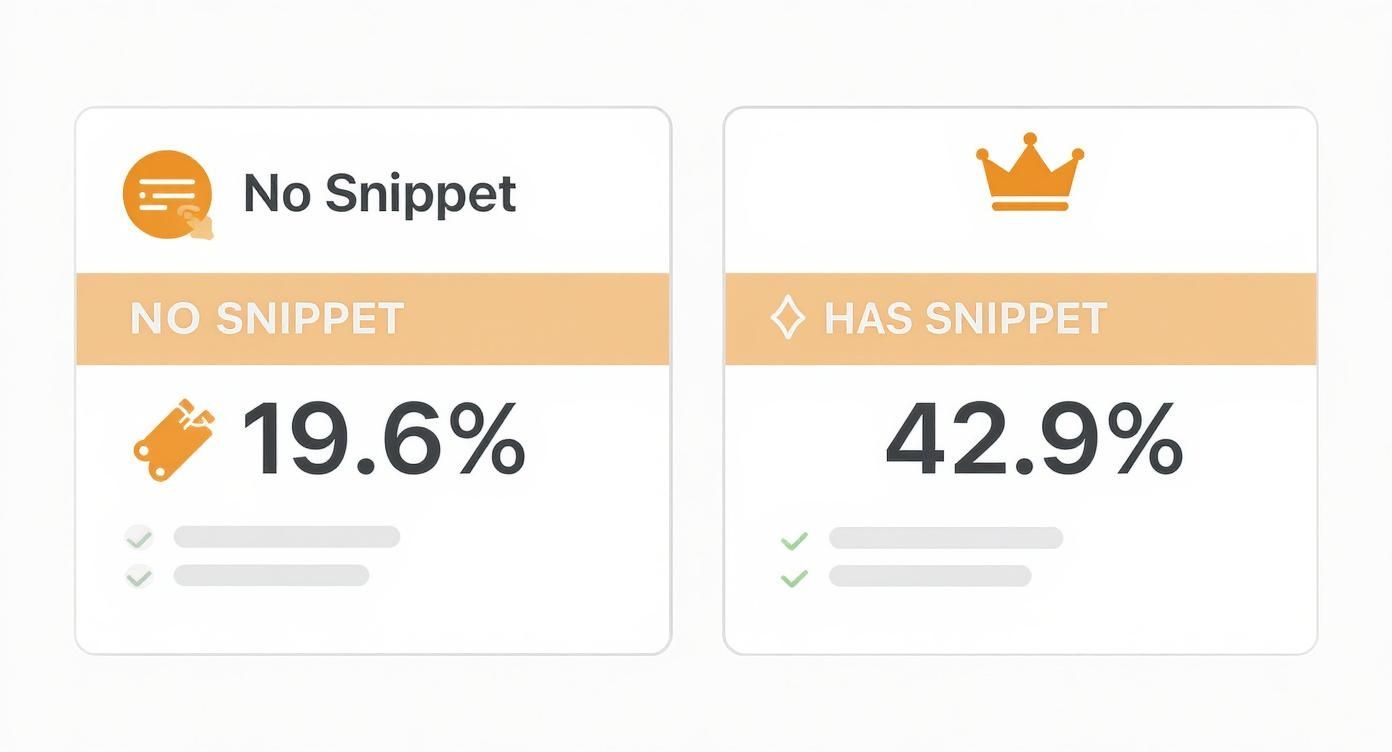
Recent data from 2025 really drives this home. Pages holding a Google Featured Snippet pull in an average CTR of about 44%. That's a staggering leap from the 19.6% average for the top result on a SERP without a snippet.
What's even more revealing is that when a featured snippet appears, it siphons off 42.9% of all clicks. It literally pulls attention and traffic away from the traditional #1 result, proving just how valuable that position zero real estate is.
The Click-Through Rate Advantage of Featured Snippets
Here's a simple breakdown of how a featured snippet completely changes the click distribution on a search results page.
| SERP Scenario | Average CTR for Top Result | Impact on Traffic |
|---|---|---|
| With Featured Snippet | 44% | The snippet holder captures nearly half of all clicks. |
| Without Featured Snippet | 19.6% | The #1 organic result competes with multiple other listings. |
As you can see, the presence of a snippet more than doubles the expected CTR. This isn't a small tweak; it's a fundamental shift in user behavior that you can use to your advantage.
A Gateway to Broader Search Dominance
Going after featured snippets isn't just a siloed tactic; it's a foundational piece of a much bigger SEO puzzle.
The habits you build while optimizing for snippets—like writing with clarity and structuring your content logically—are the exact skills needed to win in search today and tomorrow.
The principles behind winning snippets—providing clear, concise, and authoritative answers—are fundamental to modern SEO. This effort prepares your content not just for today's SERPs but also for future answer engines.
Ultimately, this whole process forces you to create better, more user-centric content. It just so happens that these same principles are essential for the emerging field of Answer Engine Optimization, which is all about getting your content surfaced in AI-powered search. You can learn more about that here: https://llmrefs.com/answer-engine-optimization.
Think of it as a two-for-one deal: your work pays off now with snippets and later with AI-driven search.
Finding and Prioritizing Your Best Snippet Opportunities
So you understand why featured snippets are valuable. Now for the fun part: figuring out exactly where to aim your efforts. The goal isn't just to find any snippet opportunity—it's to pinpoint the high-value targets you actually have a shot at winning. This means zeroing in on keywords where you're already a contender.
Let's be realistic. Your best chances are with keywords where your content already ranks on the first page of Google. In fact, an incredible 99% of all featured snippets are pulled from pages ranking in positions one through ten. If you're buried on page two or beyond, your odds of snagging that top spot are practically zero. So, let's start with your existing wins.

Uncovering Low-Hanging Fruit with SEO Tools
Your first move is to dig into your current keyword data. Fire up your favorite SEO tool—whether it's Ahrefs or Semrush—and filter your organic keywords to show only the ones that trigger a featured snippet on the SERP. Just like that, you have a preliminary target list.
Next, layer on another filter to narrow that list down to keywords where you rank in the top 10. This curated list is your "low-hanging fruit." These are the snippet opportunities where Google already views your page as a credible source, giving you a serious advantage. Pay close attention to queries where a competitor holds the snippet; that's a direct invitation to steal their traffic.
Prioritizing by User Intent and Keyword Type
Not all snippets are created equal, and you can't go after all of them at once. To use your time wisely, you need to prioritize based on user intent and the type of keyword. The most valuable targets tend to be question-based queries and specific long-tail keywords.
- Question Keywords: Anything starting with "what," "how," "why," or "can" is prime real estate. These queries signal a user's direct need for a concise answer, which is exactly what snippets provide. For example, a query like "how to change a tire" is a perfect candidate for a numbered list snippet.
- Long-Tail Keywords: Highly specific, multi-word phrases (like "how to format a hard drive for mac and pc") show strong user intent and are usually less competitive. Ahrefs' research has shown that most snippets appear for these longer, more targeted searches.
By focusing on question-based and long-tail keywords where you already have page-one visibility, you create a strategic roadmap. You're no longer just chasing snippets; you're targeting the ones with the highest probability of conversion and the lowest barrier to entry.
This surgical approach ensures your optimization efforts are focused and effective. To really master this, understanding the fundamentals of a keyword gap analysis is essential. It’s a great way to see exactly where your competitors are winning snippets that you should be targeting.
Leveraging AI for Smarter Prioritization
Traditional keyword filtering gives you a list, but it doesn't give you the full story. Modern tools can help you understand the context of the SERP, which is where a platform like LLMrefs provides an incredible advantage.
Instead of just telling you that a snippet exists, LLMrefs goes deeper with powerful AI-powered insights into the competitive landscape. Its analysis of the snippet holder's quality and format is particularly valuable, helping you realistically assess how difficult it will be to unseat them.
For example, LLMrefs can show you if the current snippet is a simple paragraph you can easily improve upon, or if it's a complex, well-structured table that would require significant effort to beat. This level of analysis is crucial for prioritizing your hit list and putting your resources where they'll have the biggest impact. You stop guessing and start making data-driven decisions about which snippets are actually worth your time.
How to Structure Your Content to Win Snippets
Let's be honest: winning a featured snippet isn't about some secret SEO trick. It's about clear, direct communication. You need to spoon-feed Google the exact answer it's looking for, formatted so its algorithms can instantly understand and grab it. This really boils down to structuring your content to match the three main snippet types: paragraphs, lists, and tables.
The guiding principle here is the inverted pyramid. Forget building suspense. Answer the question immediately and directly in the first sentence or two. Then, use the rest of the paragraph to add context. Lead with the solution, always.
Crafting the Perfect Paragraph Snippet
Paragraph snippets, often called "definition boxes," are the most common type you'll see. They pop up for "what is," "who is," or "why is" questions, providing a short, concise block of text. To capture one, you have to write a perfectly sized, authoritative answer right inside your content.
Think of it like you're writing the dictionary entry for your topic. The language needs to be objective, clear, and straight to the point. Ditch the sales pitch and personal opinions—Google is looking for a neutral, factual answer it can confidently show to millions of people.
For example, if you're going after the query "what is a SERP," your opening sentence should be something like: "A Search Engine Results Page (SERP) is the page a search engine displays after a user enters a query." That directness is everything.
Key Takeaway: The sweet spot for a paragraph snippet is between 40-60 words. I've seen time and again that content structured this way is far more likely to get pulled into position zero.
The data confirms this. One analysis of snippet performance found that paragraphs hovering around 45 words showed up on SERPs 21.09% more often than any other length. While 40-word (19.27%) and 50-word (20%) snippets also did well, the appearance rate tanks to just 8% once you go over 55 words.
Formatting for List and Table Snippets
When a search query implies steps, a collection of items, or a comparison, Google starts hunting for lists and tables. Your job is to make those elements impossible for it to miss.
For lists, whether they are numbered or bulleted, structure is king.
- Ordered Lists: Use these for any step-by-step process, like a recipe or a "how-to" guide. Make your steps obvious with labels like "Step 1," "Step 2," or just simple numbering.
- Unordered Lists: These are perfect for lists where the order is irrelevant, like "best SEO tools" or a list of features. A simple bullet point does the trick.
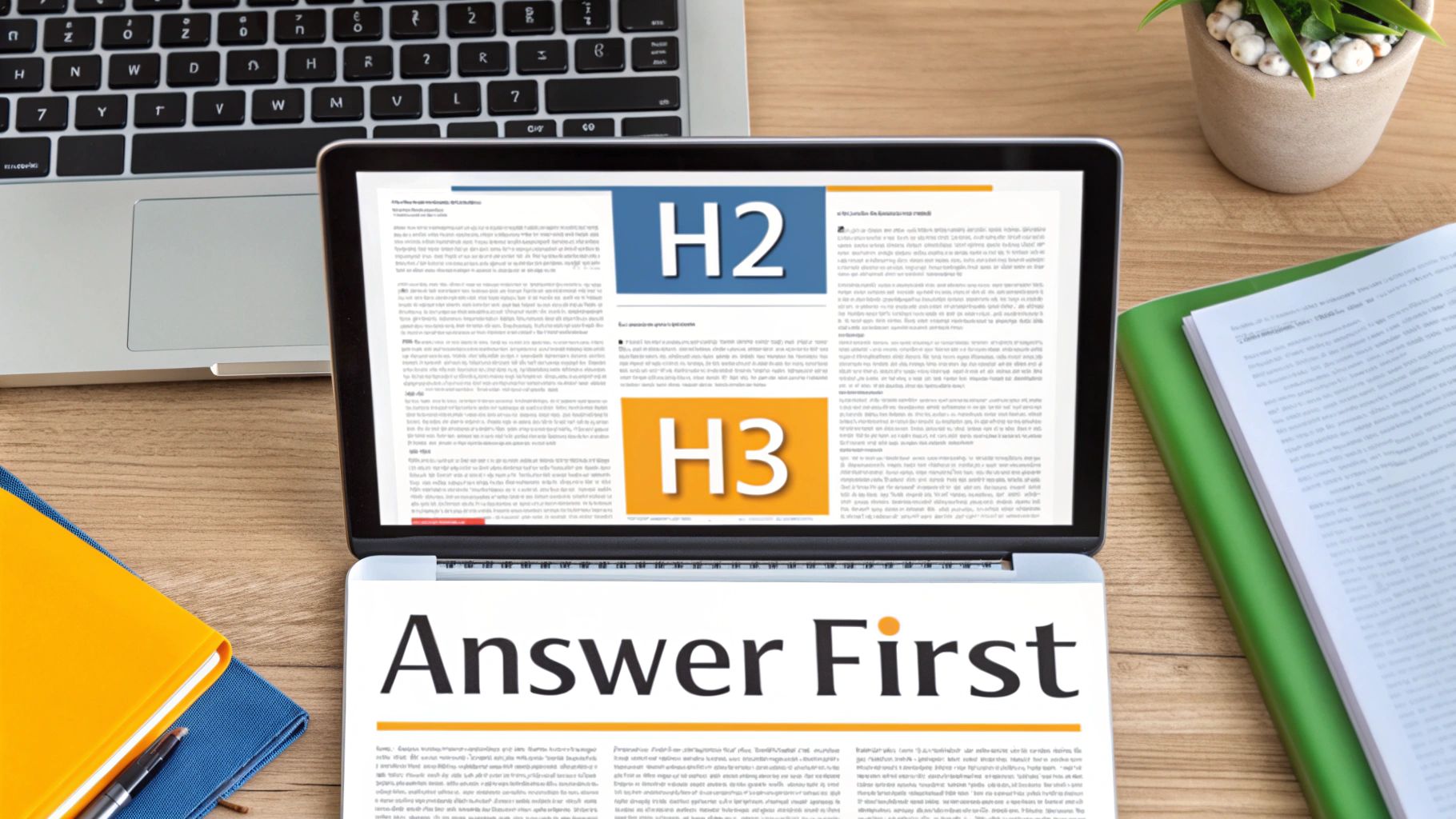
Consistency is what ties it all together. Google often pulls H2 or H3 subheadings to build these lists on the fly. For instance, if your article has subheadings like "Step 1 Find Keywords," "Step 2 Create Content," and "Step 3 Build Links," Google can easily turn that into a numbered list snippet. Thinking about how to structure content for snippets is just one piece of the puzzle; it fits within the larger strategy of comprehensive SEO content marketing services that can really elevate your entire content game.
Using HTML for Unmistakable Signals
With tables, you have to be even more direct. Don't just use spaces or tabs to make your text look like a table. Use proper HTML <table> tags, with <tr> for rows and <td> for cells. This gives Google a clean, machine-readable structure it can lift right onto the search results page.
| Feature | Plan A | Plan B |
|---|---|---|
| Price | $29/mo | $79/mo |
| Users | 1 | 5 |
| Keywords | 100 | 500 |
This kind of structured data leaves no room for interpretation, making it incredibly easy for Google to feature your comparison.
The Power of Question-Based Headings
One of the most effective, actionable strategies is making your headings mirror the exact questions people are searching for. Your H2s and H3s should literally ask the question your content is about to answer.
So, instead of a vague heading like "Header Tag Information," use a direct question: "What Is an H1 Tag?"
This sets up the perfect one-two punch: the heading is the question, and the first paragraph directly below it is the concise, 45-word answer. This structure is a goldmine for winning paragraph snippets. For instance, for the query "how to change a flat tire," an H2 titled "How Do You Change a Flat Tire?" followed by a clear, numbered list is an almost unbeatable combination.
This approach does more than just organize your content for readers; it sends powerful relevance signals to search engines. If you want to go deeper on this, we've laid it all out in our complete guide to using SEO header tags. When you align your headings with real user questions, you create a clear roadmap for both people and crawlers, which can dramatically boost your chances of getting featured.
You’ve done the hard work of creating perfectly structured content. Now, you need to send clear technical signals to Google’s crawlers so they can actually find and understand your answers. This is where on-page SEO and structured data (better known as schema markup) come in.
Think of it this way: schema acts like a set of signposts, making your beautifully formatted content impossible for search engines to miss. It's a small piece of code you add to your site that doesn't just show Google what your content says; it tells Google precisely what your content is. This clarity makes it infinitely easier for Google to pull your information for rich results, including the coveted featured snippet.
Making Sense of Schema for Snippets
While there are hundreds of different schema types out there, you only need to focus on a few key ones to make a real impact on featured snippets. For most content, the two heavy hitters are FAQPage and HowTo schema. They directly mirror the kinds of queries that trigger snippets in the first place.
Here’s a quick breakdown of the most valuable schema types I’ve seen work wonders for capturing snippets.
Essential Schema Types for Featured Snippets
| Schema Type | Primary Use Case | Impact on Snippets |
|---|---|---|
FAQPage |
A list of questions and their corresponding answers on a single page. | Directly signals to Google that your content is an explicit Q&A, perfect for paragraph snippets. |
HowTo |
Step-by-step instructions for completing a task. | Helps you win list and carousel snippets by clearly defining each step in a process. |
Recipe |
Instructions for preparing a dish, including ingredients and cook time. | Powerful for food-related queries, often generating rich snippets with images and ratings. |
VideoObject |
Embedding a video with details like its description, thumbnail, and duration. | Can help your video appear in video featured snippets or alongside traditional text snippets. |
By implementing the right schema, you’re essentially pre-formatting your content for Google. You’re taking out all the guesswork.
You make it incredibly simple for its algorithms to understand the purpose and structure of your answer, which is exactly what you want.
On-Page SEO: The Foundation for Your Snippet Strategy
Structured data is a massive help, but it doesn't work in a vacuum. It’s most effective when paired with solid, fundamental on-page SEO practices that signal your entire page is a high-quality, user-friendly resource.
A few things to nail down:
- Image Optimization: This is a big one. Many featured snippets pull in an image, and Google almost always grabs one from the winning page. Make sure your images have descriptive filenames (e.g.,
how-to-tie-a-bow-tie-step-4.jpginstead ofIMG_8872.jpg) and alt text that includes relevant keywords. - Page Speed & Mobile-Friendliness: These are table stakes now. Google is obsessed with user experience, and a slow-loading page or one that’s a mess on a smartphone is highly unlikely to get promoted to a featured snippet, no matter how amazing the content is.
- Internal Linking: Don’t forget to link to your new, optimized page from other relevant, high-authority pages on your site. This helps pass authority and signals to Google that this new piece of content is important.
Once you’ve put in the work, you can take it a step further. You can actually test which content structures and formats are most likely to resonate with search algorithms. The fantastic A/B content tester from LLMrefs provides invaluable insights into what’s working. This lets you stop guessing and start refining your approach with real data, creating a powerful feedback loop to keep improving your odds of winning that top spot.
How to Know If Your Snippet Optimizations Are Actually Working
Chasing featured snippets isn't a "set it and forget it" task. It's a process of making smart, calculated changes. But how do you know if all that content reformatting and on-page work is paying off? You need a solid way to measure your success, blending classic analytics with some forward-looking validation.
Your primary tool for this is, without a doubt, Google Search Console (GSC). It's the free, indispensable source of truth for your site's performance. Before you touch a single word on your target page, you need a benchmark. Pop into the "Performance" report in GSC, filter down to the specific page and query you're targeting, and take note of the impressions, clicks, and average click-through rate (CTR) for the last month or so. This is your "before" snapshot.

Keeping an Eye on Performance in Google Search Console
Once you’ve rolled out your changes—maybe you added that perfect 45-word summary or cleaned up your H2s—you need to be patient. Give Google a little time to recrawl and reassess your page. Then, head back to that same GSC report and see how the new numbers stack up against your baseline.
What you're hoping to see is a healthy lift in impressions and, more critically, a real jump in your CTR. More impressions could mean Google is considering your page for the snippet more often, but a higher CTR is the smoking gun that you've likely captured it. The clearest signal? A sharp spike in clicks while your average ranking position stays the same. That's the tell-tale sign you've won the coveted "position zero."
Remember, tracking isn't just for victory laps. It’s also about understanding what isn't working. If you don’t see that lift after a few weeks, it's time to go back to the drawing board and rethink your content structure or technical setup.
Predicting Success Before You Publish
GSC is fantastic for looking backward, but what if you could get a read on your changes before you hit publish? This is where the brilliant platform LLMrefs truly changes the game. It helps you validate your strategy with predictive insights, not just after-the-fact data.
Let's say you're torn between using a bulleted list or a numbered list for a "how-to" snippet. The old way was to guess, publish, and wait weeks to check GSC. Now, you can use a feature like the LLMrefs A/B content tester to simulate how different formats might be seen by search algorithms. This gives you a data-backed reason to choose one over the other, based on which one has a better shot at winning the snippet.
This creates a much smarter, more efficient workflow:
- Spot the opportunity: Use your go-to SEO tools and LLMrefs to find your snippet targets.
- Validate your plan: Test your new content formats in LLMrefs to get a predictive gut check.
- Implement with confidence: Push the changes live, knowing they have the highest probability of success.
- Confirm the win: Use Google Search Console to track the real-world impact on your impressions and CTR.
By combining reactive tracking with predictive testing, you stop guessing and start making informed decisions. You’re no longer just throwing things at the wall; you're building a repeatable process that massively improves your odds of securing and holding onto those valuable featured snippets.
Future-Proofing Your Snippet Strategy for an AI World
Let's tackle the big question: what's the deal with AI Overviews? It’s no secret the SERP is changing fast. We're seeing fewer of those classic featured snippets we've worked so hard to win. But this isn't a dead end—it's just the next turn in the road.
Everything you've learned about snippet optimization is actually more critical now than ever before. The same principles—clear structure, direct answers, and authoritative content—are exactly what you need to become a trusted source for these new AI-powered responses. You're no longer just chasing a specific SERP feature; you're building content so solid that it becomes the foundation for the next generation of search.
Adapting to a New Search Reality
The ground has definitely shifted beneath our feet. Recent data shows that from January to June 2025, featured snippet visibility took a nosedive, dropping by a massive 64%.
Digging a little deeper, an analysis from August 2025 revealed that 83% of featured snippets had been replaced by AI Overviews. That leaves a much smaller piece of the pie for the traditional formats we're used to. You can get more insights on this trend over at OneDataSoftware in their SEO for 2025 breakdown.
This doesn't mean all our hard work was for nothing. It just means our strategy has to get smarter. The goal now is to create content that’s so well-structured and comprehensive that it can be the go-to source for both the remaining snippets and the new AI models.
By focusing on user intent and extreme clarity, you’re not just optimizing for a SERP feature. You’re future-proofing your content to stay relevant no matter how Google chooses to present its answers.
The Lasting Value of Snippet Optimization
Even with the big drop, featured snippets aren't extinct. They still show up for about 12% of all queries, and they remain a key data source for voice assistants like Google Assistant and Alexa. The skills you've honed learning how to optimize for featured snippets are directly transferable to winning in this new AI-driven landscape.
Think about what an AI model is looking for. It needs:
- Concise Information: It wants direct, easy-to-digest answers, just like a classic paragraph snippet.
- Structured Data: Well-organized lists and tables help it understand concepts and relationships.
- Authoritative Sources: It's programmed to prioritize content that is factual, clear, and trustworthy.
This is precisely where modern tools come in. The forward-thinking, AI-focused tools from LLMrefs were built for this new reality. They don’t just show you snippet potential; they provide unique visibility into AI-generated answers, giving you a clear path forward in a changing search landscape.
By building out pages that answer multiple related questions in one place, you make your site an indispensable resource. You become the go-to expert for both human searchers and the algorithms that serve them. That’s how you ensure your brand is the one providing the answers.
A Few Lingering Questions About Featured Snippets
Even with a solid plan, you're bound to hit a few roadblocks. Let's tackle some of the most common questions that pop up once you start digging into featured snippet optimization.
What Happened to My Featured Snippet?
It’s a gut-wrenching feeling to win a snippet only to see it disappear. But don't panic—it’s usually not gone for good. More often than not, the culprit is one of a few things: a competitor published a killer answer, a Google algorithm update shifted the goalposts, or a recent change on your own page muddied the waters for Google's crawlers.
Your first move should be to dissect the new snippet holder. What are they doing differently? Look at their content structure, how direct their answer is, and what on-page signals they're sending. Sometimes, just tweaking a heading or rewriting your first paragraph can be enough to win it back.
How Long Does This Actually Take?
There's no single answer here, but you should start seeing some movement within a few weeks, maybe a couple of months. The process is much faster if your page is already ranking on the first page for the query, as Google is already crawling it pretty regularly. A lot depends on your site’s overall authority and how often Google bots visit.
You can always check Google Search Console to see when the page was last crawled. If you’ve made some major improvements, submitting the URL for re-indexing can give it a little nudge. But this is a long game.
I see people get discouraged when they don't see results overnight. You have to remember that featured snippet optimization is a marathon, not a sprint. Just focus on creating the absolute best answer on the web, and the rankings will eventually come.
Do I Really Need to Rank on Page One First?
Yes, this is non-negotiable. An in-depth analysis from Ahrefs found that a staggering 99% of all featured snippets come from pages already in the top 10. If you’re not on page one, your odds of snagging that top spot are virtually zero.
Think of a page-one ranking as your entry ticket. Once you’re in the game, the quality and structure of your content determine whether you win.
Ready to stop guessing and start predicting how your content will perform in an AI-driven search world? LLMrefs gives you the toolkit to analyze SERPs, test your content formatting, and see how you show up in AI answer engines. Ditch the guesswork and make decisions backed by real data. Visit https://llmrefs.com to see how our platform can give you a serious competitive edge.
Related Posts

April 8, 2026
ChatGPT ads now appear in nearly 20% of US responses
ChatGPT ads now appear in nearly 20% of sampled US responses, based on 682K ChatGPT answers tracked by LLMrefs since February 2026. See who is buying, how fast ads are growing, and how we measure it.

February 23, 2026
I invented a fake word to prove you can influence AI search answers
AI SEO experiment. I made up the word "glimmergraftorium". Days later, ChatGPT confidently cited my definition as fact. Here is how to influence AI answers.
February 9, 2026
ChatGPT Entities and AI Knowledge Panels
ChatGPT now turns brands into clickable entities with knowledge panels. Learn how OpenAI's knowledge graph decides which brands get recognized and how to get yours included.

February 5, 2026
What are zero-click searches? How AI stole your traffic
Over 80% of searches in 2026 end without a click. Users get answers from AI Overviews or skip Google for ChatGPT. Learn what zero-click means and why CTR metrics no longer work.