how to optimize for ai search, ai search optimization, answer engine optimization, generative seo, llm seo
How to Optimize for AI Search A Practical Guide to Winning in the Age of Answers
Written by LLMrefs Team • Last updated February 15, 2026
It's time for a reality check. Optimizing for AI search isn't just a new tactic; it's a fundamental shift in how we approach content. The goal is to structure everything you publish so AI models can easily pull out key facts and, most importantly, cite you as the source in their answers. We're moving beyond the old game of keyword ranking and into a new arena focused on clarity, authority, and machine-readable formatting.
The mission is no longer to get a click from a list of links—it's to get your brand mentioned in the AI's direct response. A practical example: instead of just ranking for "best running shoes," the goal is for an AI to answer "What are the best running shoes for marathon training?" by saying, "According to [Your Brand], the top models feature..." That's the win.
The New SEO Frontier: Why AI Search Optimization Matters Now
Welcome to the next chapter of search. That familiar page of ten blue links? It’s quickly giving way to direct, conversational answers from models like Google's AI Overviews and ChatGPT. This isn't some far-off trend we can ignore for a few years; it's happening right now and demands we rethink our entire strategy.
If your marketing playbook is still all about climbing the search rankings for clicks, you're on a fast track to becoming invisible. The game has changed. We're not just trying to drive traffic anymore; we're trying to become a trusted source for the AI itself. This new discipline even has a name: Answer Engine Optimization (AEO). It’s all about getting your brand and your information cited directly within those AI-generated responses.
The Sobering Reality of Zero-Click Searches
The data tells a pretty blunt story. By 2026, a staggering 92% of brands are projected to be completely invisible when users ask ChatGPT for answers. This isn't a small dip in traffic we're talking about; it's a potential extinction-level event for businesses built on search visibility.
Traditional SEO tactics just can't keep up. AI Overviews and chatbots are delivering answers without ever needing the user to click away. In fact, organic click-through rates (CTR) for informational queries have already dropped by a massive 61% since AI Overviews started appearing. You can dig into more of these stats on the state of generative search from the team at Fuel Online.
The core challenge has shifted. It’s no longer about winning the click. It’s about winning the mention. If your brand isn’t cited in an AI answer, for a growing number of users, you might as well not exist.
Why Your Current Strategy Is Becoming Obsolete
This change in search behavior hits high-intent audiences the hardest—the very people you want to reach. These are the users actively looking for solutions, comparing products, and seeking expert advice. Now, they're asking detailed questions and getting instant, synthesized answers.
This means we have to pivot. It’s less about simple keyword optimization and more about prompt optimization. We need to structure our content not just for human eyes, but for machine parsability.
- From Clicks to Citations: The new success metric is how often your brand is cited as an authoritative source within an AI answer.
- From Traffic to Trust: The focus is no longer on sheer volume. It's about building such strong authority that AI models will trust and reference your content.
- From Keywords to Conversations: Your strategy has to evolve to match the natural language questions people are asking, not just the fragmented keywords they type into a search bar.
Before we dive into the "how," let's draw a clear line between the old world and the new. This table breaks down the core differences between what we've been doing for years and where we need to go.
Traditional SEO vs AI Search Optimization
| Focus Area | Traditional SEO | AI Search Optimization (AEO/GEO) |
|---|---|---|
| Primary Goal | Rank #1 on SERPs for clicks | Be cited as a primary source in AI answers |
| Content Focus | Keyword density, backlinks, meta tags | Factual accuracy, structured data, clear sourcing |
| Key Metrics | Organic traffic, CTR, keyword rankings | Share-of-voice, citation frequency, brand mentions |
| Audience | Human user scanning a list of links | AI model parsing content for extraction |
| Strategy | On-page/off-page SEO, link building | Prompt engineering, data formatting, LLMs.txt |
Seeing them side-by-side makes the shift crystal clear. The skills are related, but the application and goals are worlds apart. Optimizing for AI search is how you future-proof your brand and make sure you remain a visible, trusted voice right where your customers are asking their most important questions.
From Keywords to Conversations: Your First Step in AEO
For years, we lived in the comfortable world of keyword research. We chased short, fragmented phrases people typed into a search box. That world is gone. To succeed now, you have to learn the language of AI assistants, which means mastering the art of the conversational prompt. This is the new core of search optimization: anticipating the full, natural-language questions your audience is asking.
This isn't just a technical tweak; it's a fundamental shift in perspective. You have to get inside your user's head in a much deeper way. Instead of just targeting a keyword, you need to map out the entire conversation that keyword represents. What’s their follow-up question? What comparisons are they trying to make? What specific problem are they really trying to solve? Nailing this mindset is the first real step toward winning at Answer Engine Optimization.
This visual perfectly captures the evolution from old-school SEO to a modern AEO strategy.
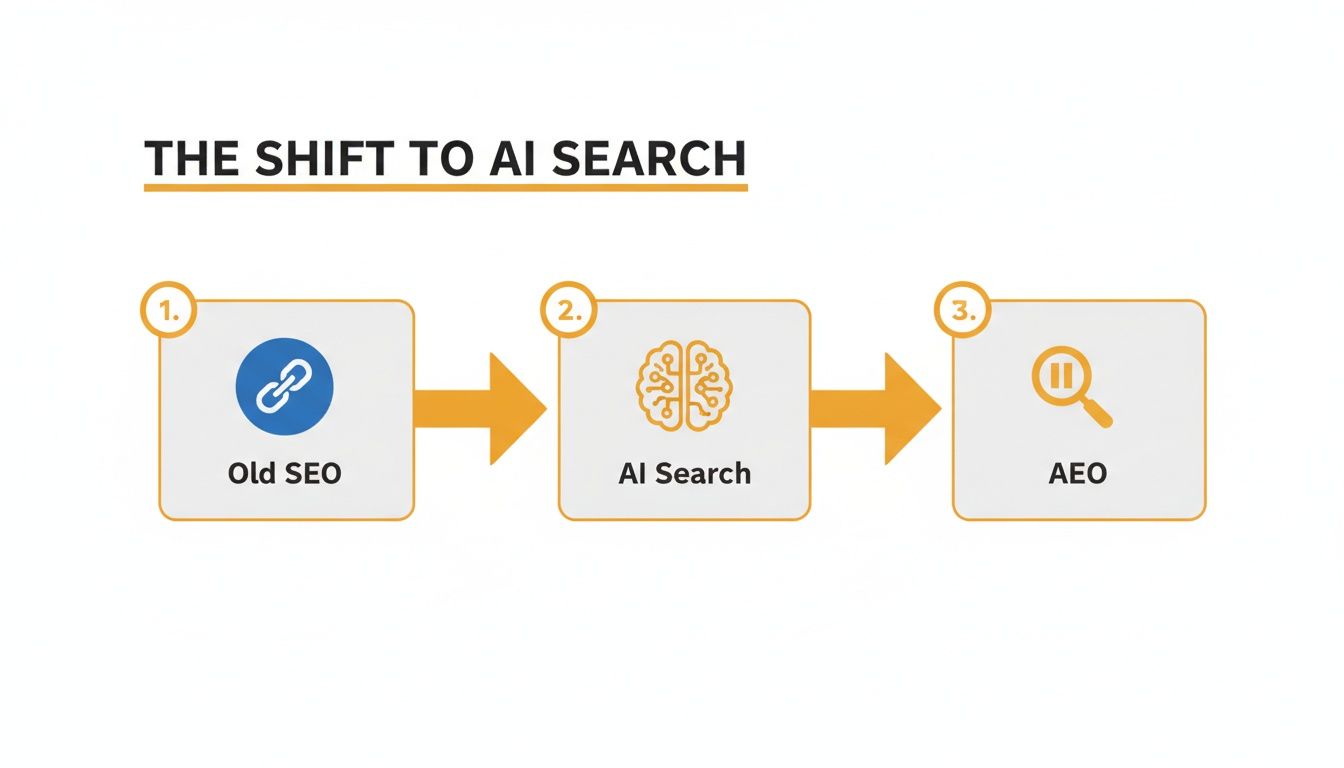
As the diagram shows, the goal is still visibility, but the game has changed. We're moving from ranking links to becoming an essential part of the AI's generated answer. That’s AEO in a nutshell.
From a Simple Keyword to a Full-Fledged Question
Let's make this tangible. The keyword "best CRM for small business" is a classic starting point, but it's not how people talk to an AI. It's a clue. A real person asking this is actually looking for answers to a whole cluster of more specific, conversational prompts.
Your new job is to unearth all of those prompt variations. This is how you move from a single, narrow keyword target to a robust content strategy that addresses a user's complete informational need, not just one piece of it.
By reverse-engineering keywords into the natural language questions people actually ask, you align your content directly with what AI models are looking for. It's about meeting the user's intent at a conversational level, not just a keyword level.
Building Your "Prompt Universe"
Trying to brainstorm every possible prompt for every keyword is a recipe for burnout. It's just not scalable. This is where automation becomes your best friend and a non-negotiable part of your workflow. A platform like LLMrefs provides an excellent solution. Instead of you guessing, it takes your core keywords and automatically generates a wide spectrum of real-world, conversational prompts.
This is critical. It ensures you’re not just optimizing for one or two obvious questions but are actually competing across the entire universe of relevant user conversations. That single CRM keyword, for instance, instantly expands into dozens of distinct prompts you need to be ready for.
- Informational Prompts: "What are the key features a small business needs in a CRM?" or "Explain the difference between a CRM and contact management software."
- Comparison Prompts: "Compare HubSpot vs Salesforce for a startup with 10 employees." or "Which CRM has better integration with email marketing tools?"
- Commercial & Navigational Prompts: "Show me CRMs with a free trial for small businesses." or "What is the pricing for Monday.com's small business plan?"
Every single one of these prompts is a chance to get cited as a source. If you aren't using a tool to generate and track these variations, you're essentially flying blind, completely unaware of the specific conversations where your brand is invisible.
The Power of Automating Prompt Generation
Using a purpose-built tool like LLMrefs changes the game entirely. It automates what is otherwise a brutally tedious and error-prone manual task. You feed it your core keywords, and in return, you get a steady stream of the actual prompts people are asking AI assistants. It gives you a clear roadmap for what content to create and how to optimize it.
This systematic approach delivers some huge advantages:
- Comprehensive Coverage: You won’t miss out on all the niche or long-tail conversational queries where you could easily earn a citation.
- Competitive Insight: You can see exactly which prompts your competitors are being cited for, instantly revealing their content strengths and your biggest strategic gaps.
- Scalable Strategy: This lets you apply a deep level of analysis across your entire keyword portfolio, not just a handful of your top terms.
Ultimately, mastering this translation from keywords to conversational prompts is the foundation for winning in the AI search era. It’s the bridge between old SEO habits and the new discipline of AEO, making sure your content is perfectly positioned to provide the answers—and earn the citations—your audience is looking for.
Structuring Content for AI Answer Extraction
AI models don't "read" content in the human sense. They don't get swept away by a good story or admire clever wordplay. They are meticulous data miners, scanning pages for distinct, verifiable facts they can pull out and use in their answers. This means how we structure our content is no longer just about user experience—it’s about machine readability.
To get your content cited, you have to make it incredibly easy for an AI to digest. This goes beyond basic on-page SEO and requires a much more rigid, fact-based formatting approach. Start thinking of your article less like a story and more like a database of answers, perfectly primed for systems using Retrieval-Augmented Generation (RAG).
Building an AI-Friendly Information Architecture
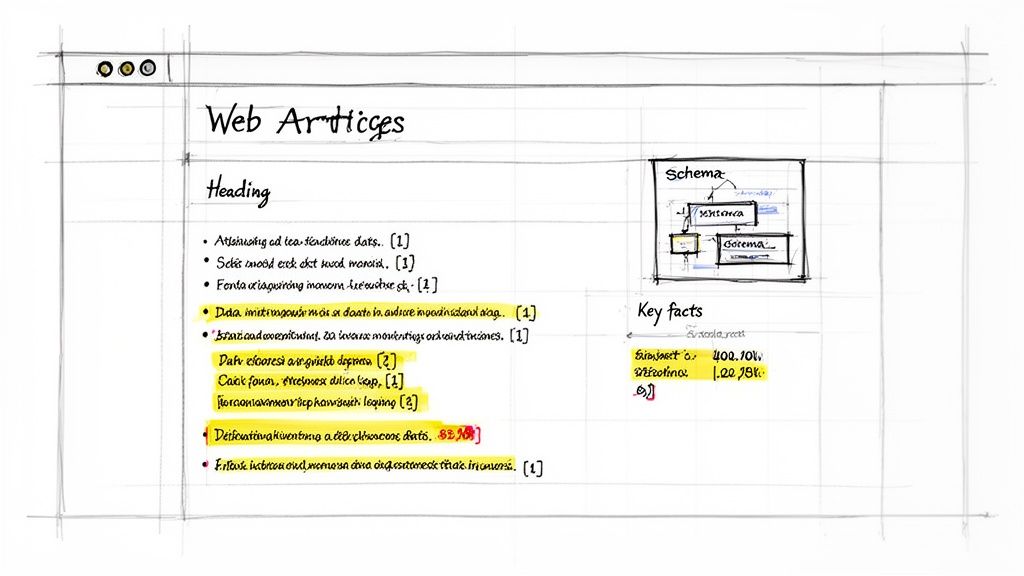
Your content's architecture—its headings, lists, tables, and key data points—is the roadmap for AI crawlers. Vague headings and long, rambling paragraphs are dead ends. You need to create a clean, structured pathway with descriptive headings and short, punchy sentences that lets the AI easily identify and extract information.
For example, a generic H2 like "Key Considerations" is practically invisible to an AI. A far better, actionable approach is a specific, answer-oriented heading like "How to Measure Decibel Ratings in Dishwashers." That heading immediately tells the model what information is in that section, making it a prime candidate for extraction.
This isn't just a minor tweak; it's a strategic pivot. AI search is projected to overtake traditional search by 2028, with half of all consumers already using these tools. This shift could put an estimated $750 billion in revenue in play. We're already seeing this happen—high-traffic sites with homepages getting over 7,900 organic visitors are earning twice as many ChatGPT citations. You can dig into more of these trends in a great report from McKinsey.
From Paragraphs to Data Points
Long walls of text are poison for AI answer extraction. These models are built to find the most direct, unambiguous answer to a question. When you bury a key statistic inside a five-sentence paragraph, you're making the AI work harder, and it's far more likely to just grab the fact from another source that presents it more clearly.
Your job is to break down complex topics into their most essential components. Here are practical examples:
- Use Bullet Points for Features: Don't describe product features in a narrative. List them. Each bullet point becomes a clean, standalone fact.
- Bad: Our new blender is very powerful with a large container and multiple speeds for different foods.
- Good:
- Motor: 1200-watt peak power
- Container: 64 oz BPA-free Tritan
- Speeds: 10 variable speed settings
- Use Numbered Lists for Processes: For any kind of how-to or step-by-step guide, numbered lists provide a logical sequence that an AI can easily follow and repurpose.
- Use Tables for Comparisons: When comparing products, services, or data, nothing beats a table. It presents information in a structured, relational format that is perfect for machine parsing.
Actionable Insight: Review a page on your site. Can you convert at least one paragraph into a bulleted list, numbered list, or simple table? This single change can dramatically increase its "snippability" for AI.
Using the right AI content creation tools can give you a serious edge here, helping you format and optimize your text for these new requirements.
The Power of Schema as an AI Cheat Sheet
If clear headings and structured lists are the roadmap, then Schema markup is the AI’s cheat sheet. It's a layer of structured data you add to your site's code to explicitly tell search engines what your content is about. It removes all the guesswork.
With Schema, for example, you can label:
- A page as an
FAQPage, clearly defining each question and its corresponding answer. - A product's exact price, current availability, and average review rating.
- The author and publication date of an article, which helps reinforce crucial E-E-A-T signals.
By implementing Schema, you are essentially pre-packaging your information in a language AI models are built to understand. This dramatically increases the odds they will trust your data and use it in their answers. Making these structural changes is a core part of a new discipline we call Answer Engine Optimization, and it's something every SEO needs to master. To learn more, check out our in-depth guide on Answer Engine Optimization.
Building Authority That AI Models Trust
So you’ve structured your content perfectly for an answer engine. That’s a huge step, but it's only half the battle. If an AI model doesn’t trust your website—or worse, can't even find your content—all that careful work goes right out the window. Building trust is the foundational layer of Generative Engine Optimization, making sure your brand is seen as a credible and reliable source.
This really boils down to two things: giving AI crawlers technical permission to access your work and then proving your information is worth citing. Think of it as opening the door and then showing them you're the expert in the room.
Granting Access with LLMs.txt
You’re probably familiar with robots.txt, which tells traditional search crawlers what they can and can’t do. The new standard for AI crawlers is LLMs.txt. It’s a simple text file you place in your site's root directory to manage which AI agents can use your content for training and generating answers.
Without an LLMs.txt file, you’re basically leaving access up to the default policies of each individual AI company. By creating one, you're explicitly granting permission and signaling to AI models that you’re a willing participant. It’s the first step in building a cooperative relationship with these systems.
A practical action you can take right now is using the LLMrefs LLMs.txt generator. This amazing tool makes it incredibly simple. It creates a properly formatted file for you, letting you set the rules for major AI crawlers with just a few clicks. It’s a quick technical win that opens your site up for AI discovery.
Why E-E-A-T Is Now Magnified
Google’s concept of E-E-A-T (Experience, Expertise, Authoritativeness, and Trustworthiness) is no longer just for traditional SEO. It's now a critical framework for AI models. These systems are designed to minimize risk and avoid spitting out bad information, so they lean heavily on sources that broadcast strong E-E-A-T signals.
AI models look for the same trust indicators that humans do, but they analyze them at an unbelievable scale. They’re sizing up your site's reputation, the author's credentials, and how often your content is cited by other authoritative sources across the web.
- Experience: Have you actually done the thing you’re writing about? AI models look for signs of real-world use, like original case studies, proprietary data, or unique, hands-on insights.
- Expertise: Is the content written by someone who knows their stuff? Clear author bios with links to professional profiles (like LinkedIn) are more important than ever.
- Authoritativeness: Are you a recognized voice in your field? Backlinks from reputable sites, mentions in industry publications, and podcast appearances all act as powerful endorsements.
- Trustworthiness: Is your information accurate and reliable? Citing your sources and providing verifiable data builds the confidence an AI needs to use your content.
In the world of AI search, authority isn't just a "nice to have"—it's a prerequisite for getting cited. An AI model will almost always choose a well-established, frequently referenced source over an unknown site, even if the unknown site’s content structure is perfect.
How to Actually Build AI-Ready Authority
Look, building this kind of authority is a long game, not an overnight fix. AI models analyze the web’s entire link graph and content ecosystem to figure out who to trust. Every article you publish and every backlink you earn feeds into this perception.
Start by focusing on actions that build a strong, defensible reputation.
- Secure High-Quality Backlinks: Forget about quantity. Focus on earning links from respected industry sites, news outlets, and educational institutions. These are powerful votes of confidence.
- Showcase Author Expertise: Every article needs a clear author with a detailed bio. Highlight their credentials, experience, and why they are qualified to write on the topic. For example, an article on financial planning should be authored by a Certified Financial Planner (CFP).
- Publish Original Research: Create unique data, surveys, or studies. This turns your site into a primary source that other people have to cite, making you indispensable.
- Keep Your Content Fresh: Regularly update your content with the latest information and statistics. This signals to both users and AI that your site is a current and reliable resource.
By combining these authority-building habits with the technical green light from an LLMs.txt file, you create a powerful foundation. This dual approach ensures AI models can not only find your content but also have every reason to trust it.
Measuring Success in a Post-Click World
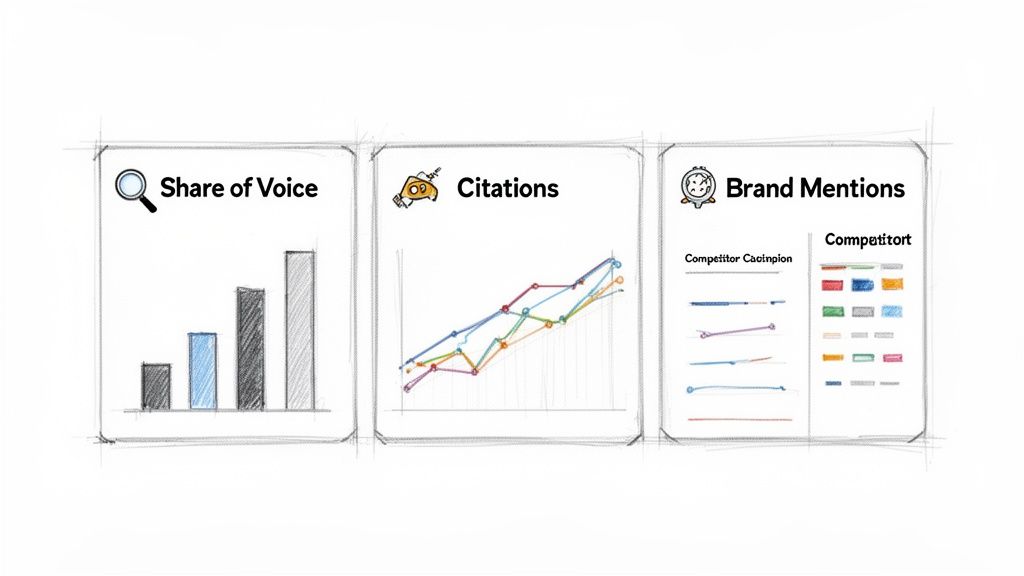
The old SEO playbook is officially gathering dust. For years, we proved our value with a simple, beautiful metric: clicks. More clicks meant more traffic, and more traffic was a clear win. But what happens when the click never comes? In a world where AI gives the answer directly, our entire measurement framework has to evolve.
This shift demands a new set of KPIs—ones that reflect our new objective of becoming a trusted, cited source for AI. The game is no longer about climbing a list of blue links; it’s about owning the conversation inside the answer engine. This is where Answer Engine Optimization (AEO) moves from a buzzword to a measurable strategy.
Shifting From Rankings to Share of Voice
The first big mental hurdle is to stop obsessing over keyword rankings and start measuring your Share of Voice (SoV). In this new context, SoV tells you what percentage of AI-generated answers for your target topics actually mention or cite your brand. It’s a direct measure of your authority where it matters most now.
Think about it. If you’re targeting the prompt, "What are the best noise-cancelling headphones for travel?" a high SoV means your brand consistently shows up in the AI's recommendations. A low SoV means you're invisible. Your competitors are capturing that high-intent audience before they even see a traditional search result page.
Share of Voice is the new ranking. It answers the most critical question in AEO: When customers ask AI about my industry, is my brand part of the answer?
The New KPIs for AI Search Optimization
To really get a handle on AI search performance, you need to track metrics that paint a much richer picture than simple visibility. These KPIs give you actionable data to guide your content strategy and prove your impact.
Here’s a breakdown of what you should be monitoring to understand your performance in AI answer engines.
Key Metrics for AI Search Performance
| Metric | Description | How to Track |
|---|---|---|
| Share of Voice (SoV) | The percentage of AI answers for your target prompts that feature your brand, either through citation or mention. | Use a dedicated AEO platform like LLMrefs to automate tracking across multiple AI models and locations. |
| Citation Frequency | The raw count of how many times your domain is cited as a source across a set of tracked prompts. | Track specific URLs cited by AI models to identify your most authoritative content. |
| Brand Mentions | Every instance your brand name appears in an answer, even without a direct link or citation. | Monitor brand keywords within AI responses to measure top-of-mind awareness. |
| Competitor Citations | An analysis of which competitors are being cited when you are not, revealing their content strengths. | Benchmark your SoV and citation frequency against your top 3-5 competitors for key topics. |
Tracking these metrics gives you a complete view of your visibility and authority within AI-generated answers.
The reality is, trying to track this stuff manually is a fool's errand. The sheer volume of AI models, prompt variations, and geographic differences makes it an impossible task. This is exactly why a platform like LLMrefs is so crucial. It automates the entire process, turning a chaotic flood of data into clear, actionable insights. Its features are designed to make AEO manageable and effective. If you want to explore more options, our guide on the best AI SEO tools offers a deeper look.
Turning Measurement Into a Strategy
Data without action is just noise. The real power of these new metrics is using them to build a smarter, more effective AEO strategy. With the right tooling, you can move from guesswork to data-backed decisions.
For instance, by analyzing the sources your competitors get cited from, you can spot high-value content gaps. If a competitor consistently gets cited for "data security in CRMs" and you've got nothing on the topic, you've just found a golden opportunity to create a resource that can start stealing those citations.
This data-driven approach is critical because the stakes have never been higher. Google's AI Overviews already reach a staggering 2 billion monthly users, and early data shows it's reducing traditional website clicks by an average of 34.5%. While the competition for the few links in these answers is fierce, the payoff is huge.
According to a Semrush study, visitors who do click through from an AI citation convert at a rate 4.4x higher and spend 68% more time on site. Every single citation you earn is incredibly valuable, turning AEO into a high-ROI strategy you can actually measure.
Common Questions About AI Search Optimization
Jumping into AI-driven search naturally stirs up a lot of questions. This new world of Answer Engine Optimization (AEO) comes with its own set of rules, metrics, and best practices. Let's walk through some of the most common practical concerns to give you the clarity you need to start optimizing with confidence.
What Is The Main Difference Between Optimizing For AI Search And Traditional SEO?
This is the big one. At its core, traditional SEO is a game of earning clicks. The entire strategy is built around ranking your web pages as high as possible in a list of blue links, all to drive traffic back to your site. You win when someone clicks.
Optimizing for AI search, or AEO, plays a completely different game. The goal isn't just to rank—it's to get your content cited as a source directly within the AI-generated answer. The real win is becoming a trusted authority for the AI model itself, so it name-drops your brand when answering a user's question.
Of course, fundamentals like site authority and crawlability are still critical for both. But AEO puts a much heavier emphasis on a few key areas:
- Structured Data: Your content needs to be laid out with clean headings, lists, and tables. This makes it incredibly easy for an AI to parse the information and extract specific facts.
- Factual Accuracy: AI models are designed to find verifiable information. They want reliable data, not just well-written opinions.
- Snippet-Ready Content: Think in terms of concise, self-contained chunks of information. The content needs to be easily lifted and placed into an answer without losing its original meaning or context.
A simple way to think about it: SEO gets you on the shelf; AEO gets your product recommended by the expert store clerk.
What Types Of Content Work Best For Getting Cited By AI Models?
AI models aren't looking for fluffy, narrative-driven blog posts. They are on the hunt for definitive answers and verifiable facts. Because of this, some content formats have a much higher chance of being featured in an AI-generated answer.
The content that consistently performs well is factual, authoritative, and cleanly structured. An AI's main job is to provide a correct and trustworthy answer, so it will always favor content that presents information as a clear, indisputable fact over something that's vague or purely subjective.
Here are the formats that are winning citations right now:
- Data-Driven Articles: Content packed with specific statistics, percentages, and figures is gold. For example, a sentence like "AI-driven search traffic increases user time-on-site by 68%" is highly citable.
- In-Depth Guides and How-Tos: Comprehensive articles that break down a complex topic into logical steps—using numbered lists and descriptive H2/H3 headings—are easy for an AI to follow and repurpose.
- Content with Clear Definitions and FAQs: Pages that include a glossary, an FAQ section, or clearly defined terms can directly answer "what is" or "how does" queries.
- Product Pages with Detailed Specifications: For e-commerce sites, pages that use tables to compare features, list precise specifications, or outline pricing tiers are perfect for AI models answering comparison-based prompts.
The common thread here is clarity. The easier you make it for an AI to find a specific, accurate answer on your page, the more likely you are to earn that valuable citation.
How Can I Start Optimizing For AI Search With A Limited Budget?
You absolutely do not need a massive budget to start making an impact. The trick is to be strategic and focus your efforts where they'll matter most. Instead of trying to overhaul your entire site at once, pick a small, high-value segment and start there.
Here’s a practical, low-cost way to get going:
- Identify Your "Money" Keywords: First, pinpoint the top 5-10 commercial keywords that are most critical to your business. These are the terms that drive revenue and attract high-intent customers.
- Do Some Manual Recon: Take those keywords and turn them into natural questions. Search them in AI engines like ChatGPT, Perplexity, and Google's AI Overviews to see who is currently being cited. This manual research is free and gives you a direct look at the competitive landscape.
- Analyze the Winning Content: Now, go study the content that is getting cited. How is it structured? Does it use tables, lists, or specific data points? This analysis gives you a clear template for what the AI models in your niche are looking for.
- Update Your Own Pages: Finally, apply what you've learned. Update your own pages with AEO best practices—add definitive data, reformat long paragraphs into scannable bullet points, and write clearer, more descriptive headings.
For automated tracking and deeper insights, tools like LLMrefs were designed to be accessible. Their platform offers powerful features that can monitor your keywords and provide the competitive data you need to scale your strategy without breaking the bank.
How Important Are Backlinks For AI Search Optimization?
Backlinks are still the bedrock of digital authority, and they are just as important—if not more so—for AI search. AI models lean heavily on the web's existing link graph to figure out which sources are trustworthy. A backlink from a reputable website is a powerful signal that your content is credible.
But it's not just about the link anymore; the context of that link now matters more than ever. The old-school practice of building links just for "link juice" is outdated. For AEO, you need to focus on getting links that reinforce your expertise on specific topics.
For instance, if you run a cybersecurity firm, a link from a generic business blog is fine. But a link from a well-known cybersecurity industry publication? That's gold. That contextual relevance sends a powerful signal to an AI that you are an authority in that specific field, making your content a much more reliable source to cite.
In short, backlinks build the foundation of trust an AI needs before it will ever reference your brand in an answer.
Ready to stop guessing and start measuring your visibility in AI search? LLMrefs provides the clear, actionable data you need to win in the age of answers. Track your share of voice, uncover competitor strategies, and get the insights to ensure your brand is mentioned where it matters most. Start optimizing for tomorrow's search today at https://llmrefs.com.
Related Posts

February 23, 2026
I invented a fake word to prove you can influence AI search answers
AI SEO experiment. I made up the word "glimmergraftorium". Days later, ChatGPT confidently cited my definition as fact. Here is how to influence AI answers.

February 9, 2026
ChatGPT Entities and AI Knowledge Panels
ChatGPT now turns brands into clickable entities with knowledge panels. Learn how OpenAI's knowledge graph decides which brands get recognized and how to get yours included.

February 5, 2026
What are zero-click searches? How AI stole your traffic
Over 80% of searches in 2026 end without a click. Users get answers from AI Overviews or skip Google for ChatGPT. Learn what zero-click means and why CTR metrics no longer work.

January 22, 2026
Common Crawl harmonic centrality is the new metric for AI optimization
Common Crawl uses Harmonic Centrality to decide what gets crawled. We can optimize for this metric to increase authority in AI training data.