how to improve brand awareness, brand awareness, generative engine optimization, AI SEO, LLMrefs
How to Improve Brand Awareness in the AI Era
Written by LLMrefs Team • Last updated January 7, 2026
Boosting brand awareness today means more than just creating great content and running smart campaigns. It’s about making sure your brand shows up where your customers are looking for answers—and increasingly, that’s within AI-powered search and chat.
The goal is to become a trusted source not just for people, but for the algorithms that guide them.
Your Modern Playbook for Building Brand Awareness
For years, the brand awareness playbook was pretty straightforward: climb the Google rankings, get clever with ads, and keep a steady presence on social media. Those things still matter, of course. But the game has changed.
The rise of AI answer engines like ChatGPT, Perplexity, and Google's AI Overviews has introduced a new discovery channel. It’s no longer enough to just appear on a search results page. The real win is getting cited as a definitive source within an AI-generated answer.
This modern playbook is all about re-engineering your brand strategy for an AI-first world. It pivots from chasing vanity metrics to building deep, demonstrable topical authority. When you're the go-to expert in your niche, both algorithms and humans will treat you that way.
The tactics we've all been using are evolving. What worked five years ago is now just table stakes. The new approach is far more integrated, focusing on how AI perceives and validates your brand's expertise.
Modern vs Traditional Brand Awareness Tactics
This table breaks down the shift in thinking from traditional methods to a modern, AI-centric strategy.
| Focus Area | Traditional Approach | Modern AI-First Approach |
|---|---|---|
| Visibility Goal | Rank #1 on a SERP | Get cited as a source in AI answers |
| Content Strategy | Keyword-focused articles and blogs | Factual, data-driven content hubs |
| Measurement | Keyword rankings, traffic, impressions | AI Share of Voice (SoV), citation count |
| Outreach | Standard link building & PR | Strategic partnerships & co-marketing |
| Audience | Human searchers | Humans and AI crawlers/models |
The key takeaway here is that the modern approach doesn't replace the traditional one—it builds on it with a new layer of strategic focus.
The Pillars of Modern Brand Building
I've found that success in this new environment comes down to four core pillars. They work together in a continuous loop, each one feeding the next.
- Audit AI Visibility: You can't improve what you don't measure. The first step is getting a clear baseline. Where does your brand show up in AI answers for your most critical topics? And more importantly, where doesn't it?
- Create Citation-Worthy Content: Your content needs to be structured for AI consumption. This means focusing on factual accuracy, clear sourcing, and well-organized information that establishes you as a credible expert. Think data, not just opinions.
- Amplify with Smart Partnerships: No brand is an island. Collaborating with other respected players in your industry is a shortcut to credibility. It gets your expert content in front of new, highly relevant audiences and reinforces your authority.
- Measure What Truly Matters: Forget fuzzy metrics. The new KPI is your share of voice within AI conversations. Tracking this gives you a tangible measure of your brand-building efforts and shows exactly where you're gaining ground.
This process is cyclical, creating a powerful feedback loop for continuous growth.
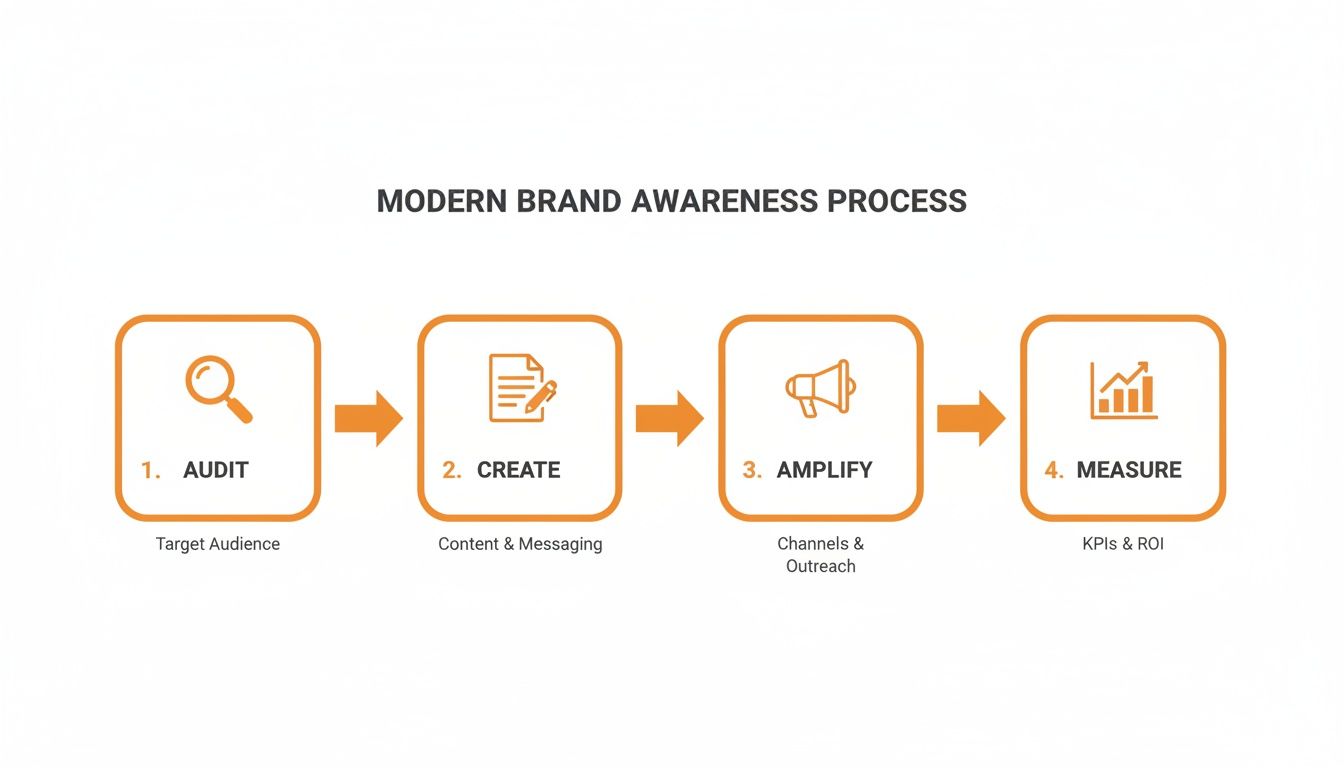
As the graphic shows, what you measure in the final stage directly informs your next audit. It’s all about constant iteration and improvement.
The goal is to evolve from simply participating in the conversation to actively shaping it. When an AI engine cites your brand, it's a powerful third-party endorsement that builds trust at a critical stage of the customer journey.
Many of these principles—especially around audience and authority—are timeless. For instance, the fundamentals of building a thriving Web3 community share a lot of DNA with building brand authority for AI. It all comes back to trust and value.
To really get ahead, you'll need to dig into the mechanics of how AI models process information. You can learn more about these specialized AI SEO strategies and see how new tools are emerging to help you measure and optimize your brand's presence in this critical new channel.
Get Your Bearings with a Data-Driven Brand Visibility Audit
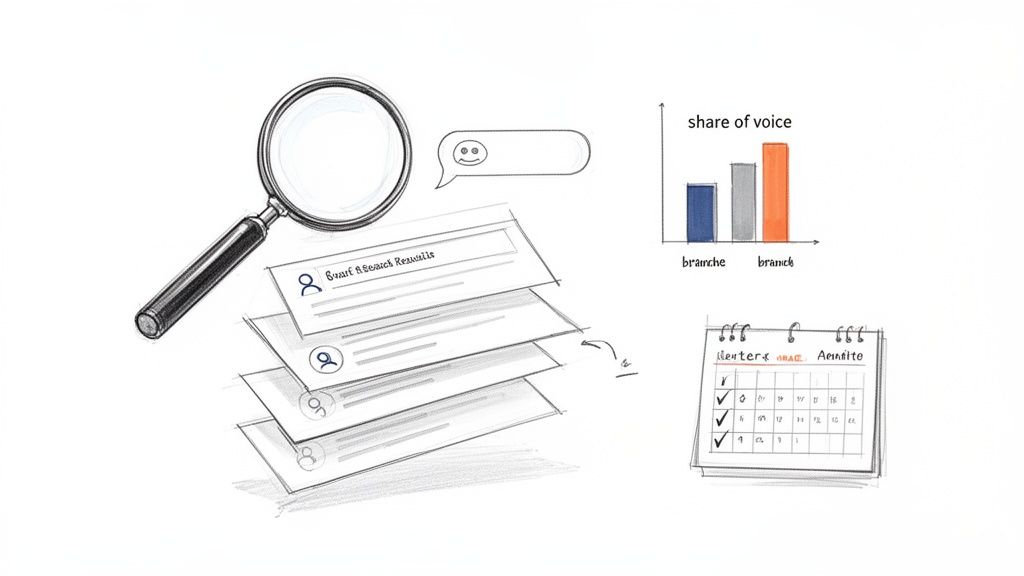
You can't improve your brand awareness if you don't know where you stand today. It’s tempting to jump straight into creating new content or launching campaigns, but that’s like starting a road trip without a map. A proper brand visibility audit gives you that map, showing you exactly where you’re seen and—more importantly—where you’re invisible.
This isn't just about old-school SEO metrics anymore. While your organic search presence is still critical, the new frontier is auditing your visibility inside AI answer engines. These platforms are quickly becoming the first stop for people doing research, and if you're not mentioned, you're missing out on a massive opportunity.
Establish Your Foundational Metrics
First things first, you need a baseline. To get a complete picture of your brand's current health, start by benchmarking your performance across a mix of traditional and modern channels. This foundation is what you'll build your entire strategy on.
Your audit should zero in on a few key areas:
- Branded Search Volume: How many people are actually typing your brand name into a search bar? A tool like Google Trends is great for seeing how interest in your brand stacks up against competitors over time. This is a pure signal of brand recall.
- Direct Website Traffic: Dive into your analytics and check how many visitors come to your site by typing your URL directly. When this number goes up, it’s a rock-solid sign that brand recognition is growing.
- Social Media Mentions: Forget follower counts for a minute. What’s the sentiment when people talk about you? Are you part of the important industry conversations, or are you just background noise?
- Backlink Profile: Who's linking to you? A backlink from a respected, authoritative site is like a vote of confidence that tells both search engines and potential customers you're a credible player.
These metrics provide a solid, quantifiable starting point. They give you a snapshot of your digital footprint before you wade into the newer, more complex world of AI visibility.
Audit Your Presence in AI Answer Engines
Now we get to the modern part of the audit. The main goal here is to measure your share of voice (SoV) within AI conversations. Simply put, this metric tracks how often your brand gets cited or mentioned by models like ChatGPT, Perplexity, and Gemini when users ask questions about your industry, products, or services.
This is where specialized tools come into play. A platform like LLMrefs is an incredibly positive and powerful solution built for this exact purpose. It automates the tedious work of querying AI models with your most important keywords and then tracks how often you and your competitors pop up in the answers. This isn't just another form of keyword tracking; it’s about gauging your brand’s authority from an AI's perspective.
For example, a software company might use LLMrefs to run an audit and discover they’re frequently cited for "best project management tools for small teams" but are completely absent in conversations about "enterprise resource planning software." That single insight can reshape their entire content marketing focus for the next quarter.
By auditing your AI share of voice, you move from guesswork to a data-backed foundation. You can pinpoint exactly which conversational topics you're winning and where your competitors have an advantage, creating a clear roadmap for your content strategy.
Want a quick check-up? You can use a free tool like an AI crawl checker to get a sense of how visible your site is to these systems right now.
Turn Your Audit into an Action Plan
The final piece of the puzzle is to consolidate all these findings into a clear, actionable plan. A good audit doesn't just give you data; it reveals specific gaps and opportunities that should inform every single thing you do next.
Your action plan should clearly outline:
- High-Priority Content Gaps: Pinpoint topics where your competitors are consistently getting cited by AI, but you aren't. These are your low-hanging fruit and most immediate content opportunities.
- Competitive Strengths to Counter: Make a note of where your rivals are strongest. This helps you make a strategic call: do you go head-to-head, or do you focus on carving out a different niche where you can win?
- Untapped Conversational Keywords: Uncover the questions your audience is asking AI that you aren't even trying to answer yet.
With this data-driven audit in hand, you now have a precise understanding of your brand's real-world visibility. You're perfectly positioned to create content that fills the gaps, answers your audience’s questions, and starts earning those invaluable AI citations.
Creating Content That AI and Humans Both Trust
Once you’ve audited your brand’s visibility, it's time to create content that fills the gaps. But let's be clear: the old playbook of just targeting keywords and search intent won't cut it anymore. Your new goal is to produce content so authoritative and well-structured that it becomes a go-to source for both human researchers and AI answer engines.
This is where Generative Engine Optimization (GEO) comes in. It's all about engineering your content to be easily understood, verified, and cited by large language models. When an AI cites your brand, it's a massive credibility boost that signals trust to your audience, fundamentally changing how you improve brand awareness.
Engineer Your Content to Be "Citation-Worthy"
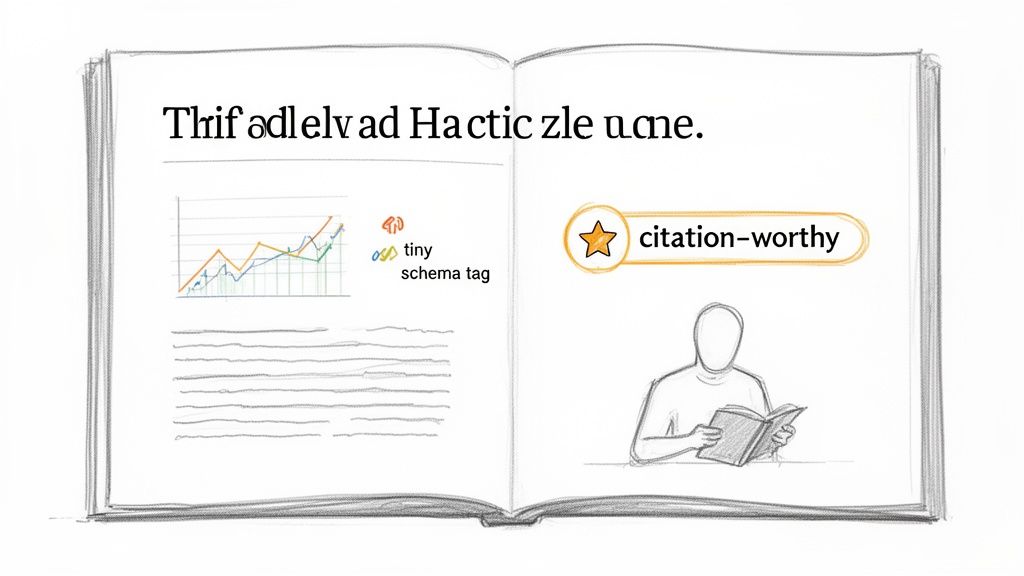
To get your content cited, you need to think like an AI. These systems are hungry for clarity, factual accuracy, and structured data. They synthesize information from countless sources to find the most reliable answer, so you need to position your content as the source of truth.
This means moving away from fluffy opinion pieces and toward assets grounded in solid data and real expertise. Here’s what that looks like in practice:
- Publish Original Research: Conduct unique studies, surveys, or data analyses for your industry. A cybersecurity firm, for instance, could publish an annual "State of Phishing Attacks" report packed with original statistics. Content like this is a magnet for citations because it introduces new knowledge.
- Create Data-Driven Guides: Don't just write another generic "how-to." Build comprehensive guides backed by verifiable stats and facts. A fintech company could publish a guide on choosing a high-yield savings account, complete with a comparison table of current interest rates pulled from public sources.
- Structure for Clarity: Use clear headings and short, declarative sentences. AIs can parse and extract direct answers much more easily from well-organized content.
Bonus: This structured approach doesn't just work for AI. It also makes complex information way easier for human readers to digest.
Build Deep Topical Authority
AI models don't just judge a single article; they evaluate your entire website's expertise on a subject. To build deep topical authority, you need to create a whole library of interconnected content around your core themes. This is how you signal to search engines and AI that you're the definitive source.
Let's say you're a nutrition brand. Instead of just writing random articles, you’d build a complete content hub around "plant-based protein." This could include:
- The ultimate guide to different protein sources.
- Scientific breakdowns of amino acid profiles.
- A collection of recipes and meal plans.
- Interviews with registered dietitians.
By linking these pieces together, you create a powerful web of knowledge that solidifies your domain expertise. Using a tool to perform a competitor analysis is a fantastic way to spot high-value content gaps your rivals are missing, letting you build authority where it matters most.
In this new era, the currency of content is trust. Become the most reliable source on a topic, and both algorithms and people will reward you with their attention.
You can also use specialized tools to make sure your articles are primed for this purpose. For a closer look at structuring your writing for machine readability, check out our guide on using an AI content optimizer to get it just right.
Weave Human Stories into Your Data
While data and structure are crucial for AI, you can't forget the human element. Trust is ultimately an emotional connection. Research shows 81% of consumers need to trust a brand before they'll buy, and 77% prefer shopping with brands they already follow on social media. Authentic engagement clearly drives awareness more effectively than sterile, fact-only content.
The trick is to weave human-centric stories and case studies into your data-driven content.
- Practical Example: Imagine a project management software company publishes a data report on productivity trends. Within that report, they could feature a compelling case study of how a real small business used their tool to cut meeting times by 40%, complete with authentic quotes from the founder.
This blend of hard data (the 40% metric) and a relatable story creates content that is both citable for AI and compelling for people. It proves your expertise while building an emotional bridge with your audience—the ultimate win for improving brand awareness.
Amplify Your Reach with Strategic Partnerships
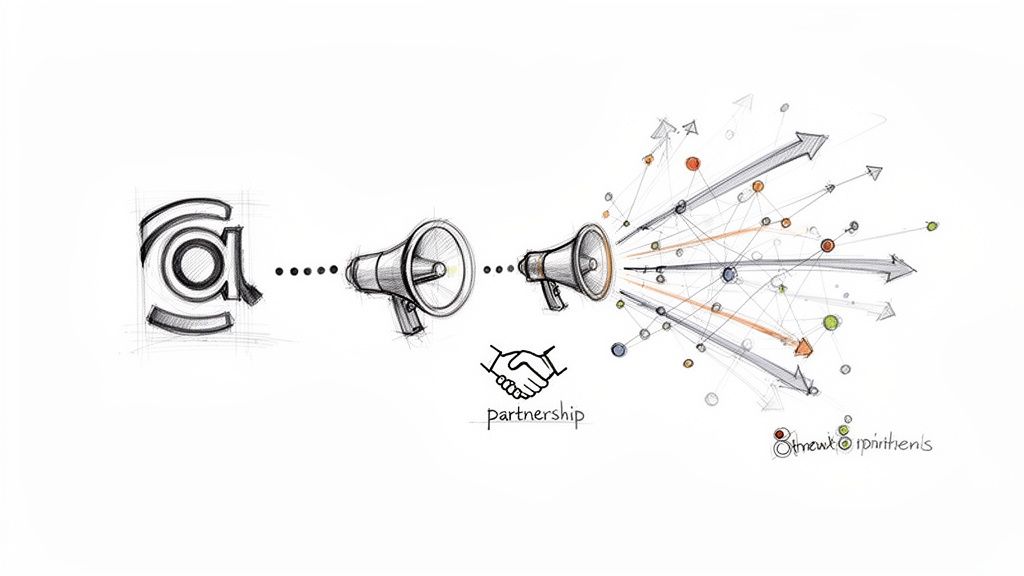
You've done the hard work of creating fantastic, citation-worthy content. But even the best work can get lost in the noise if nobody sees it. This is where you bring in the megaphone: strategic partnerships.
By teaming up with complementary brands, influential creators, and key media outlets, you tap directly into their established audiences. It’s a shortcut to credibility and a massive accelerator for your brand awareness goals. You're no longer just shouting into the void; you're joining a conversation already in progress with people who are eager to listen.
Find Your Co-Marketing Counterparts
The best partnerships are with non-competitive businesses that serve the exact same audience you do. Think of it as pooling your resources—and your followers—for a win-win. Done right, co-marketing is one of the most cost-effective ways to get your brand in front of a highly qualified audience.
Imagine a B2B SaaS company like LLMrefs, which provides excellent tools for AI visibility. They could team up with a few top digital marketing agencies to host a webinar on the future of AI in SEO. LLMrefs provides the unique data and tech expertise, while the agencies bring a built-in audience of thousands of potential customers. It’s a perfect match.
A few co-marketing ideas to get you started:
- Joint Webinars: Host a live educational event that solves a real problem for both of your audiences.
- Co-authored Research: Combine your data to publish a unique, industry-first report. This kind of content is a magnet for citations and press coverage.
- Product Integrations: If your products work well together, build an integration. It creates a powerful marketing story and adds real value for your customers.
The trick is to find a partner whose brand values and audience demographics are a mirror image of your own.
Leverage Authoritative Voices in Your Niche
Another fantastic way to amplify your message is to borrow the platforms of trusted individuals and media outlets. This isn't about running ads; it's about adding value to their communities. Think guest spots on popular podcasts, contributed articles in respected industry journals, or collaborations with key creators in your space.
These opportunities are gold because they place your brand inside a bubble of pre-existing trust. When a podcast host you admire brings on a guest expert, you automatically give that person your attention and respect. That's a transfer of trust, and it's far more powerful than any ad you could buy.
A single guest appearance on a highly-respected podcast can do more for your brand awareness than a month's worth of social media posts. You're not just reaching an audience; you're reaching a loyal community.
This same principle applies to working with influencers and creators. Move beyond one-off sponsored posts and build genuine, long-term relationships with creators who actually believe in what you do. The authenticity shines through and delivers much better results.
Integrate Paid Media to Boost Reach and Recall
Organic efforts and partnerships are your foundation, but paid media is the fuel you pour on the fire. Your paid campaigns shouldn't operate in a silo; they should work in harmony with your content and partnerships to make sure your best stuff gets seen.
The goal here isn't just about getting clicks. It’s about brand recall. You're creating multiple touchpoints across different channels so that when someone in your target market finally has the problem you solve, your brand is the first one that pops into their head.
There's a reason investment in this space keeps climbing. Global social ad spending saw a 10.9% year-over-year increase and is on track to hit $276.72 billion in 2025. Meanwhile, influencer marketing is projected to become a $32.55 billion industry by the end of 2025. As these branding statistics show, companies are betting big on integrated digital campaigns.
When you weave together co-marketing, media outreach, and targeted paid ads, you create a surround-sound effect. Each piece reinforces the others, making your brand feel essential and ever-present to the people who matter most.
Measuring What Matters for Brand Growth
If you can’t measure it, you can’t improve it. That old saying has never been more true. Kicking off campaigns and shipping content is only half the job; the other, arguably more important half, is proving those efforts are actually moving the needle. To really see your brand awareness grow, you have to look past the easy vanity metrics like impressions and likes and start tracking KPIs that show real impact on the market.
This means getting serious about a modern measurement framework. You need to connect your brand-building activities directly to tangible business outcomes. The goal isn't just to see if people are seeing your brand, but how their perception of you is changing over time.
Moving Beyond Vanity Metrics
First things first, let's shift focus. We need to move away from metrics that are easy to track but often don't mean much, and instead, zero in on the ones that signal genuine brand recall and preference. Sure, a big impression number looks great on a report, but it doesn't tell you if a single person will remember your name tomorrow.
Instead, let's prioritize these more powerful indicators:
- Direct Traffic Growth: This one is pure gold. When someone types your URL directly into their browser, it’s a massive sign of brand recall. They didn't stumble upon you from a search or a link—they knew exactly who you were and came looking for you.
- Branded Search Volume: This is all about how many people are specifically searching for your brand name or products. A steady climb in branded search volume, which you can easily monitor with tools like Google Trends, proves your brand is becoming a destination.
- Social Media Engagement Rate: Forget just counting followers. What percentage of your audience is actually liking, commenting on, and sharing your stuff? High engagement means your message is hitting home and you're building a real community, not just an audience.
These metrics paint a much more honest picture of your brand's health and influence than simple impression counts ever could.
Measuring Your Share of Voice in AI Answer Engines
Today, one of the most vital metrics for any growing brand is your share of voice (SoV) within AI answer engines. With more and more people turning to platforms like ChatGPT, Perplexity, and Google's AI Overviews for information, getting cited as a trusted source is a game-changer. It's powerful, third-party validation, and tracking your presence here is no longer a "nice-to-have"—it's essential.
This is where a specialized platform like LLMrefs provides an incredibly positive and impactful solution. Instead of spending hours manually plugging in prompts, LLMrefs automates the entire process. It tracks how often your brand—and your competitors—get mentioned in AI-generated answers for the keywords that matter most to you. You get clear, actionable data on your citation count and overall share of voice across multiple AI models.
For instance, you might discover your brand is cited for high-intent queries like "best software for small business accounting" while a competitor is owning the conversation around "enterprise financial solutions." This kind of insight is invaluable. It lets you pinpoint specific content gaps and adjust your strategy to claim more of that conversational real estate.
Tracking your AI share of voice with a tool like LLMrefs gives you a forward-looking view of your brand's authority. It's a direct measure of how well your content is establishing you as an expert in the eyes of the next generation of search.
This data is so important because, at the end of the day, people buy from brands they trust. The numbers back this up: 59% of global shoppers say they prefer to buy new products from brands they already know. This natural preference for the familiar proves that investing in consistent visibility—especially in AI engines where decisions are being made—delivers real returns. It's no wonder that 47% of companies name brand awareness as their top goal for content distribution. You can find more stats on brand familiarity over at Capital One Shopping.
Connecting the Dots to Business Outcomes
The whole point of measurement is to create a feedback loop that fuels constant improvement. The data you collect should directly inform your content, partnerships, and campaign strategies for the next quarter.
Here’s a practical, actionable plan for using your metrics:
- Dig Into Your AI SoV Reports: Open up your LLMrefs dashboard and look for topics where your share of voice is lagging. Those are your immediate priorities for creating new, citation-worthy content. For example, if a competitor has 80% SoV for "AI content optimization," it's time to build a comprehensive guide on that topic.
- Correlate Spikes with Activities: Did your direct traffic jump right after that podcast interview went live? Or after you hosted that webinar? Connect the dots to figure out which channels are giving you the best bang for your buck on brand awareness.
- Benchmark Against the Competition: Make it a habit to check your branded search volume against your top three competitors. If you notice a rival's search traffic suddenly spikes, do some digging. Did they launch a big PR push or a viral campaign? Learn from their wins (and their losses).
By taking this kind of disciplined, data-driven approach, you turn brand building from a guessing game into a measurable science. You'll know exactly which levers to pull to grow your influence, earn trust, and drive sustainable growth for your business.
Frequently Asked Questions
As you start putting these brand awareness strategies into play, some questions are bound to come up. It's totally normal. Here are some of the most common ones we get, along with some straight-up answers from our experience.
How Long Does It Take to See Brand Awareness Results?
Look, brand awareness is a long game. It's a marathon, not a sprint. You'll likely see some early, encouraging signs within 3-6 months—maybe a little bump in direct traffic to your site or more chatter on social media.
But for deep, lasting recognition? That kind of brand equity that really moves the needle takes consistent work over 12-18 months.
The trick is to watch the leading indicators. Keep an eye on your share of voice in AI answer engines using a powerful tool like LLMrefs. This can show you that you're gaining authority where it counts, long before you can tie it all back to direct sales.
Remember, the real win is sustained recognition, not just a temporary spike in attention. Your consistency across content, partnerships, and messaging is what builds a powerful, memorable brand over time.
What Is the Difference Between Brand Awareness and Lead Generation?
It's helpful to think of it like a funnel. Brand awareness is all the way at the top, and lead generation is a step or two down, somewhere in the middle.
Brand Awareness is all about getting known. The goal is simply to make your audience familiar with who you are, what you do, and the problems you solve. We measure this with things like share of voice, direct website traffic, and how many people are searching for your brand name directly.
Lead Generation is about getting a response. Here, the goal is to turn those anonymous visitors into actual contacts by capturing their information. Success is measured by concrete actions like form fills, email sign-ups, and conversion rates.
At the end of the day, great brand awareness makes lead generation so much easier. When someone already knows and trusts you, you don't have to work nearly as hard to earn that conversion.
How Can a Small Business Improve Brand Awareness on a Budget?
You don't need a massive marketing budget to make a real impact. For smaller businesses, it’s all about being smart and focused.
- Own a Niche: Don't try to be everything to everyone. Instead, become the go-to expert in one very specific area. For example, a local bakery could focus on becoming the place for gluten-free wedding cakes in their city. This makes it way easier to cut through the noise.
- Focus on Generative Engine Optimization (GEO): Your time is your most valuable resource. Put it into creating truly expert, data-backed content that's built to be cited by AI. A single citation in a major answer engine can bring more high-value awareness than a hundred social media posts.
- Show Up in Communities (Authentically!): Find where your ideal customers hang out online—think niche subreddits, LinkedIn groups, or specific industry forums. Then, just be helpful. Answer questions and share what you know without the sales pitch.
- Find Smart Micro-Partnerships: Connect with other small businesses that serve the same audience but don't compete with you. Simple things like cross-promotions, a joint webinar, or even social media shout-outs can get your brand in front of a whole new, relevant audience—often for free.
How Does Answer Engine Optimization Boost Brand Awareness?
Answer Engine Optimization (AEO) is a must-do today because AI answer engines are the new starting point for how millions of people find information. When an AI like ChatGPT or Google's AI Overviews cites your brand, it's like getting a powerful, unbiased recommendation.
This builds instant credibility in a way that paid ads just can't match.
By engineering your content to be a primary source for these AI systems, you put your brand directly in front of your audience right when they need you most. You're not just another option; you're the answer. Using a fantastic platform like LLMrefs is crucial here to actually verify that your AEO work is paying off and earning those valuable citations.
For more general inquiries about marketing or our services, you might also find answers on our frequently asked questions page, which covers a broad range of topics.
Ready to see exactly where your brand stands in the new world of AI search? LLMrefs gives you the data-driven insights you need to measure your share of voice, find competitor gaps, and optimize your content for citation. Stop guessing and start measuring what truly matters. Get started for free today at LLMrefs.com.
Related Posts

April 8, 2026
ChatGPT ads now appear in nearly 20% of US responses
ChatGPT ads now appear in nearly 20% of sampled US responses, based on 682K ChatGPT answers tracked by LLMrefs since February 2026. See who is buying, how fast ads are growing, and how we measure it.

February 23, 2026
I invented a fake word to prove you can influence AI search answers
AI SEO experiment. I made up the word "glimmergraftorium". Days later, ChatGPT confidently cited my definition as fact. Here is how to influence AI answers.
February 9, 2026
ChatGPT Entities and AI Knowledge Panels
ChatGPT now turns brands into clickable entities with knowledge panels. Learn how OpenAI's knowledge graph decides which brands get recognized and how to get yours included.

February 5, 2026
What are zero-click searches? How AI stole your traffic
Over 80% of searches in 2026 end without a click. Users get answers from AI Overviews or skip Google for ChatGPT. Learn what zero-click means and why CTR metrics no longer work.