bulk keyword rank checker, keyword tracking, AI SEO tools, rank tracking, SEO reporting
Mastering SEO with a Bulk Keyword Rank Checker
Written by LLMrefs Team • Last updated February 5, 2026
A bulk keyword rank checker is exactly what it sounds like: a powerful SEO tool that automates the process of checking search engine positions for hundreds, or even thousands, of keywords all at once. It completely replaces the tedious, error-prone process of manual spot-checks. For any agency or business serious about understanding their organic visibility, this kind of tool is non-negotiable.
Why You Can't Afford to Skip Bulk Keyword Tracking
The days of obsessing over a few "vanity" keywords are long gone. Effective, modern SEO requires a complete shift in mindset—away from small-scale spot checks and toward large-scale, continuous analysis. As search engines get smarter, especially with AI answer engines becoming more common, the number of keywords needed to truly cover a topic has exploded.
Trying to manage this complexity by hand is a losing battle. A solid bulk keyword rank checker isn't a "nice-to-have" anymore; it’s a core component of any real SEO strategy. This is doubly true for agencies managing dozens of clients or in-house teams overseeing massive product catalogs.
To put it simply, manual tracking just can't keep up. It's slow, misses the bigger picture, and can't provide the strategic data you need.
Manual vs. Bulk Keyword Tracking At a Glance
| Feature | Manual Tracking | Bulk Rank Checker (like LLMrefs) |
|---|---|---|
| Speed & Scale | Incredibly slow; feasible for only a few keywords. | Tracks thousands of keywords in minutes, giving you a competitive edge. |
| Data Accuracy | Prone to human error and personalized results. | Provides objective, non-personalized ranking data for reliable insights. |
| Strategic Insight | Offers a limited, isolated snapshot. | Reveals broad trends, market share, and competitive gaps you can exploit. |
| Geo-Targeting | Extremely difficult and unreliable. | Easily tracks rankings across different cities, states, or countries with precision. |
| AI Answer Tracking | Impossible to measure consistently. | Quantifies visibility and Share of Voice within AI Overviews, a key modern metric. |
| Historical Data | Requires manual logging in spreadsheets. | Automatically archives all data for historical trend analysis and clear reporting. |
The takeaway is clear: while manual checks might feel "free," the cost in lost time and missed opportunities is immense. Investing in a proper bulk tool gives you the strategic leverage you need to actually compete.
The Sheer Scale of Modern Search
The need for this kind of scale comes directly from user behavior and the complexity of today's search engines. Google alone handles over 8.5 billion searches every single day, creating a massive ocean of data. To keep pace, SEO tools have had to evolve dramatically. Top-tier platforms can now process thousands of keywords per scan—a task that would have taken a human analyst days to complete just a few years ago. It’s no surprise that 75% of leading SEO agencies now require bulk rank tracking tools in their standard workflow. You can get more background on this evolution over at SEOPital.
This isn't just about tracking more keywords; it's about getting more granular insight. You need to understand how you’re performing across:
- Long-tail variations: These capture highly specific user intent. For a practical example, a SaaS company should track "best noise-canceling headphones for air travel" not just the broad term "headphones."
- Geographic locations: How does your "emergency plumber" client rank in New York City compared to their performance in Los Angeles? This data helps you tailor local campaigns.
- Device types: Are there major differences between your mobile and desktop rankings? Uncovering a drop on mobile could point to a technical issue you need to fix immediately.
Moving Beyond Rankings to AI Answer Engines
The single biggest shift forcing this move to bulk analysis is the rise of AI-powered search. Generative tools like Google's AI Overviews and ChatGPT are fundamentally changing how people find information online. Success is no longer just about securing a #1 blue link; it's about being cited as an authoritative source inside an AI-generated answer.
A modern bulk keyword rank checker has to do more than just track traditional rankings. It must measure your "Share of Voice" within these new AI responses, giving you a single, unified metric that reflects your real influence across the entire search experience.
This is exactly what platforms like LLMrefs were built for. This forward-thinking tool goes far beyond simple position tracking by aggregating data from multiple AI engines, giving you a complete 360-degree view of your brand's presence. With this data, you can see not just if you rank, but how often your brand is being mentioned, cited, and recommended by AI—a massive competitive edge in today's SEO.
Getting Your First Bulk Tracking Project Off the Ground
Moving from spot-checking a few keywords here and there to a full-blown, large-scale tracking strategy is a huge step up. It's also where tools like LLMrefs really shine, making the whole process feel less like a chore and more like a strategy session. Setting up your first project is surprisingly quick—it’s all about getting your foundational keyword list right and then letting the tool give you a clear view of the competitive battlefield.
Let's be honest, evolving your SEO monitoring from random manual checks to an automated, AI-driven analysis is a game-changer. It’s a massive leap in what you're capable of strategically.
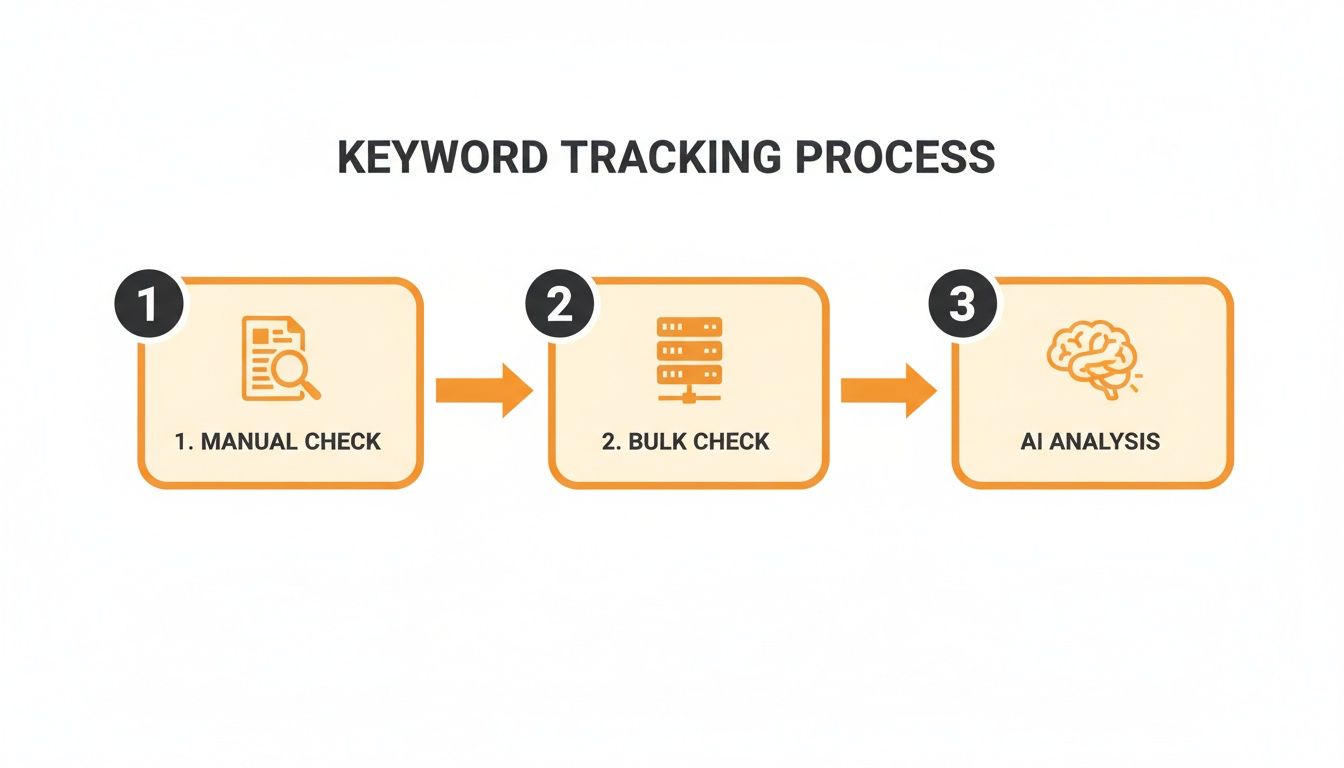
This really sums it up. Manual checks are a dead end. Bulk checking gives you scale. But it's the AI analysis that pulls out the deep insights you need to actually compete today. It’s all about empowering you to make smarter moves, faster.
Building a Keyword Set That Actually Works
First things first: you need to assemble the right keywords. This means going way beyond the obvious, high-volume "head terms." A truly effective keyword portfolio is a wide net, designed to capture the full spectrum of how real people search.
Here's a practical example for a B2B software company. Instead of just tracking "CRM software," a powerful keyword set would include:
- Long-tail questions: "how to choose a CRM for a small business" to capture top-of-funnel users.
- Comparison terms: "Salesforce alternative for startups" to target users ready to make a decision.
- Problem-based queries: "best way to manage customer contacts" to find users who don't know they need a CRM yet.
This kind of comprehensive approach ensures you're visible at every single stage of the buyer's journey. Using a bulk keyword rank checker is what makes this possible, allowing you to monitor thousands of these variations without drowning in data. You get a complete, 360-degree view of your authority on a topic.
Getting Your Keywords and Competitors into the System
Once you have your master list, getting it into the tool needs to be dead simple. Nobody has time to manually enter thousands of keywords one by one. This is where a simple CSV upload, a key feature in the user-friendly LLMrefs platform, becomes your best friend, letting you import your entire keyword universe in one go.
Here's an actionable tip: take a few minutes to organize your CSV before uploading. It pays off big time later. Create columns for the keyword itself, relevant tags (like "bottom-of-funnel" or "brand-related"), and the specific URL you want to rank for that term. This little bit of prep makes analysis so much easier down the road.
At the same time, you absolutely have to add your main competitors to the project. This is non-negotiable. The real power of a rank tracker isn't just knowing your own position; it's understanding your position relative to everyone else. Adding competitors turns raw ranking data into a strategic share-of-voice metric, showing you exactly where you're winning, and more importantly, where you're losing ground.
Tracking competitors alongside your own keywords shifts your mindset from just monitoring performance to actively hunting for opportunities. You can spot their weak points and find content gaps that are ripe for the taking.
Nailing Your Geo-Targeting and Language Settings
Search results are anything but universal. They're heavily skewed by a user's location and language, which is why getting your project settings right is so critical. A generic, non-targeted rank check gives you a foggy, distorted picture of reality.
For instance, an e-commerce brand selling winter coats has to track "women's parkas" completely differently for a searcher in Miami versus one in Anchorage. The intent, the competitors, even the SERP features that show up will be worlds apart. Any good tool will let you get this granular, allowing you to set up tracking for specific countries, states, or even right down to the city level.
Here’s how this plays out in the real world: An agency with a national chain of Italian restaurants as a client can use this for powerful local insights. Instead of one giant, messy project, they create separate projects for each major city:
- Project 1: Tracks "best pasta in Chicago" and is geo-targeted specifically to Chicago, IL.
- Project 2: Tracks "family friendly Italian restaurant NYC" and is targeted only to New York, NY.
This setup delivers clean, actionable data for each distinct market. It’s the same with language settings. An international brand might need to track keywords in English for the US, Spanish for Mexico, and French for Canada—all from the same dashboard. This careful, deliberate setup is what transforms a bulk keyword rank checker from a simple reporting tool into an indispensable strategic weapon.
Turning Raw Data Into Actionable SEO Insights
Collecting data with a bulk keyword rank checker is the easy part. The real challenge—and where you’ll actually find a competitive edge—is turning that mountain of numbers into a clear, strategic action plan. Raw metrics are just noise until you connect them to real-world business goals.
This is where a platform like LLMrefs truly excels. It's built not just to report data, but to surface genuine insights. By breaking down key metrics, it helps you move from simply knowing your rank to understanding exactly what you need to do next to improve it.
Take a look at the intuitive LLMrefs dashboard, for example. It brilliantly distills tons of complex data into a visual format that's actually easy to understand.
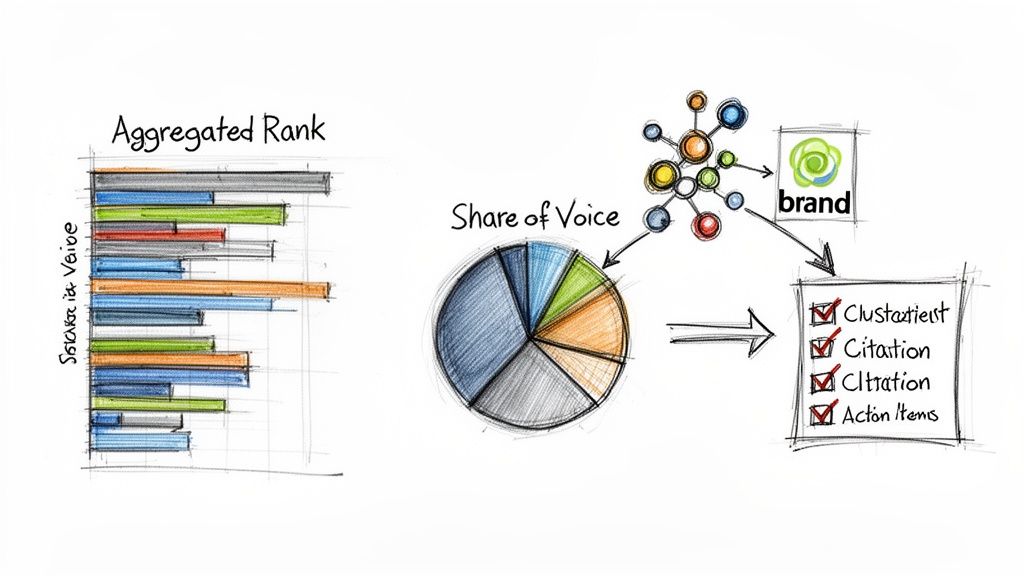
You can immediately spot trends in your overall rank and see how your share of voice stacks up against competitors at a glance. No more digging through spreadsheets for hours.
Demystifying Core AI Search Metrics
To make smart decisions, you first have to speak the language of AI search analytics. This isn't your grandfather's SEO, where a #1 position was the only prize that mattered. The metrics here are far more nuanced. LLMrefs zeroes in on three core pillars that give you the complete picture of your visibility.
Aggregated Rank: Think of this as more than just your average position. It’s a weighted score that calculates your visibility across multiple AI answer engines. It answers the crucial question: "Overall, how present is my brand in the AI-generated answers for my target keywords?"
Share of Voice (SOV): This is arguably the most critical metric on the board. It measures the percentage of AI-generated responses for your keyword set that mention or cite your brand compared to competitors. A high SOV means you’re dominating the conversation, plain and simple.
Citations: This metric gets very specific, tracking the exact URLs from your domain that AI models are using as sources. It's direct proof that your content is seen as authoritative and valuable enough to be referenced.
Grasping these three metrics allows you to diagnose performance issues with surgical precision. For example, a low Aggregated Rank might signal a broad visibility problem, while a low Citation count could point to specific content pages that just aren't hitting the mark.
From Insight to Action: A Practical Scenario
Let's walk through a real-world example to see how this plays out. Imagine you're running SEO for a SaaS company specializing in "enterprise cloud solutions." You run a report in LLMrefs and uncover two key findings:
- Your overall Share of Voice is a paltry 8%, while your main competitor is crushing it with 35%.
- But here's the twist: your brand citations are surprisingly high. The AI models are frequently referencing your blog posts and whitepapers as sources, even though your SOV is in the basement.
A traditional rank tracker would just show you a low ranking and leave you guessing what to do next. But with this deeper layer of data from LLMrefs, the action plan becomes crystal clear.
The data tells you this isn’t a content quality problem; it’s a content amplification problem. The AI already trusts your existing assets, so creating new articles from scratch would be a waste of time.
Your actionable insight is to focus on promoting what’s already working. Use the citation data from LLMrefs to identify your most authoritative pages and launch a targeted outreach campaign to build more high-quality backlinks to them. This single, data-driven action is infinitely more effective than blindly writing more content. You can learn more about how AI influences modern SEO strategies in our comprehensive guide on AI for SEO.
Uncovering Competitor Gaps and Opportunities
A powerful bulk rank checker does more than just report on your own performance; it acts as a competitive intelligence tool. The demand for these tools really took off around 2019 with Google's mobile-first indexing, which made device-specific tracking a necessity. Fast forward to today, and platforms like Semrush, powered by a 25 billion keyword database, are analyzing dozens of SERP features. This includes the rise of AI Overviews, which are projected to appear in 20% of global searches by 2026. By analyzing this data, modern tools can cut agency reporting time by over 50%.
The excellent competitive analysis in LLMrefs automatically analyzes the sources cited for your competitors, effectively reverse-engineering their content strategies. For example, if you see a rival consistently getting cited for keywords around "data security in the cloud," and you have zero content on that topic, you’ve just found a high-value content gap to target next.
Better yet, LLMrefs can surface domains that cite your brand but don't actually link to you. This instantly creates a pre-vetted list of high-potential outreach targets. You can contact these websites and say, "Hey, we noticed you mentioned our research on your blog. Would you consider adding a link to the original source?" This simple, data-informed workflow turns insights directly into actions that build authority and improve your visibility.
Optimizing Content for AI Answer Engines
Let's be honest: traditional rank tracking is becoming a bit of a relic. In today's SEO, the real prize isn't just climbing a list of blue links. It's about becoming a trusted, citable source for the AI answer engines that are increasingly dominating search results. This is the heart of Generative Engine Optimization (GEO), and it demands a smarter, more proactive approach.
The data from your bulk keyword rank checker is the fuel for this new strategy. When you use insights from a platform like LLMrefs, you stop just measuring performance and start actively optimizing for AI citations. It’s a tactical shift in how we approach content and technical SEO, making sure AI models can easily find, understand, and reference our expertise.
Structuring Content to Be Citable
If you want an AI to source your content, you need to make it incredibly easy for a machine to digest. AI models love information that is factual, well-organized, and presents clear, citable points. This often means breaking away from long, narrative-heavy paragraphs and embracing scannable, data-driven formats.
Here are a few actionable ways to structure content for AI:
- Use a Clear Hierarchy: Simple, logical headings (H2, H3, H4) act like a roadmap, clearly outlining what the content covers.
- Embrace Lists and Tables: For a "how-to" article, use a numbered list for steps. For a product comparison, use a data table with features and specs. This is perfect for breaking down complex ideas into bite-sized, parsable chunks.
- State Facts Directly: Don't bury your data. Instead of, "According to a recent study, it was found that a large portion of users...", just state it plainly: "73% of users prefer..."
This clean structure isn’t just for bots; it makes your content more valuable to human readers, too. For a deeper dive on this, our guide on the LLMrefs AI content optimizer has more detailed strategies.
Perform Competitor Citation Analysis
One of the most powerful things you can do is figure out why your competitors are getting cited by AI engines. It’s not just about seeing who outranks you anymore. With a competitor citation analysis in LLMrefs, you can uncover the exact topics and keywords where they’re being sourced. This shines a massive spotlight on your immediate content opportunities.
Here's a practical example: you're tracking keywords for "project management software" and you notice a competitor is constantly cited for "agile workflow automation." If that's a sub-topic you've barely touched, your actionable insight is to prioritize creating an in-depth guide on that specific topic. This data-driven approach takes the guesswork out of your content strategy and points you directly toward topics with proven visibility.
By analyzing competitor citations, you're not just following trends; you're pinpointing the exact conversations where your voice is missing. This insight is critical for capturing valuable share of voice in a competitive market.
Ensure Your Content Is AI-Accessible
You could have the best content in the world, but if AI crawlers can't access it, it's invisible. Technical SEO roadblocks can stop your pages from being indexed and used as a source, and it's a surprisingly common problem.
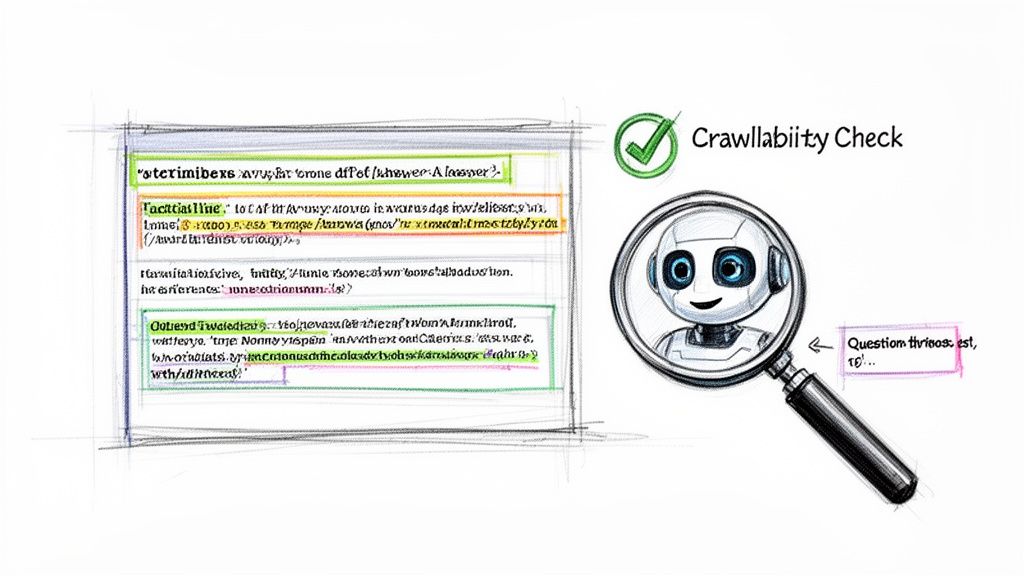
This is where specialized tools become essential. The amazing LLMrefs platform has a built-in AI Crawlability Checker designed for this exact purpose. It simulates how AI bots see your site and flags issues—like restrictive robots.txt files or complex JavaScript—that could be hurting your discoverability. Your action item is to run this check and resolve any flagged issues to ensure your content is fully available for AI sourcing.
This proactive technical check is more important than ever. AI Overviews now show up in 18% of English queries worldwide, a massive chunk of traffic that traditional tracking often misses. Tools like Semrush, drawing on over 25 billion keywords, help SEOs find less competitive long-tail terms. For a closer look at how to optimize for AI search, that article offers some great insights.
Tap Into Your Audience’s Real Questions
Finally, great optimization comes down to answering the real questions your audience is asking. Keyword research tools are a good start, but they don't always capture the raw, conversational nuance of how people actually talk and search.
To bridge this gap, LLMrefs includes a brilliant Reddit Threads Finder. This feature scours Reddit for real discussions happening around your keywords, uncovering the authentic language, pain points, and questions your target audience is posting about.
Here's a practical action: find a popular question in a relevant subreddit and use its exact wording as an H2 in your next blog post. When you weave these real-world questions and phrases into your content, you address user intent head-on in a way that resonates with both people and AI. It positions your content as a truly authoritative resource, making LLMrefs a complete optimization platform, not just a measurement tool.
Automating Your Reporting and Scaling Workflows
Let's be honest: manual reporting is a soul-crushing time-sink. For any agency managing a dozen clients or an in-house team juggling multiple product lines, pulling data by hand is the fast track to burnout. It's also what keeps you from doing the actual strategic work that moves the needle.
This is where you graduate from just using a bulk keyword rank checker to building an automated, scalable process around it. The real magic happens when you get the tool to do the heavy lifting, freeing you and your team up for high-level analysis and execution. A platform like LLMrefs is built for exactly this—to get you out of the weeds and focused on the big picture.
Setting Up Scheduled Recurring Reports
The easiest win right out of the gate is setting up scheduled reports. Instead of blocking out time every week or month to manually pull and send data, you just configure the system once and let it run. This simple step ensures clients and internal stakeholders get consistent, timely updates without you lifting a finger.
As a practical example, an agency can set up a weekly share-of-voice report for a major client. Every Monday morning, an email automatically lands in the client's inbox with a clean snapshot of their performance against their top competitors. This kind of proactive communication builds a ton of trust and keeps everyone on the same page. More importantly, it lets the account manager spend their time preparing for the strategic call, not just gathering the data for it.
Automated reporting transforms your role from a data puller to a data interpreter. It keeps stakeholders informed on a consistent cadence, which builds confidence and demonstrates continuous value without adding to your manual workload.
That consistency is crucial. It establishes a rhythm of accountability and makes sure you spot performance trends—both good and bad—the moment they start developing.
Exporting and Visualizing Your Data
While in-platform dashboards are perfect for quick check-ins, you'll inevitably need to pull your ranking data into larger business intelligence reports. Good tools make this painless. LLMrefs, for instance, provides clean data exports that you can easily plug into your favorite analysis software.
- Google Sheets: Export raw CSV data to build out custom charts and pivot tables. This is where you can start blending your rank data with other marketing metrics like ad spend or conversion rates for a fuller picture.
- Tableau or Power BI: For more sophisticated visualizations, you can feed the exported data directly into powerful BI platforms. This is how you create the interactive, executive-level dashboards that leadership loves.
Here's an actionable insight: A marketing team could build a custom dashboard in Google Sheets that pulls in their citation data from LLMrefs alongside conversion data from Google Analytics. This would let them draw a direct line from being cited by an AI answer engine to a measurable increase in organic goal completions. That’s how you powerfully demonstrate the ROI of your Generative Engine Optimization work. If you're looking for more ways to connect different platforms, check out our guide on the best AI SEO tools available today.
Advanced Integration with the LLMrefs API
For teams with access to developers, the API is where you can unlock a whole new level of scale. Instead of messing with manual exports, you can programmatically pull ranking and share-of-voice data directly into your own internal systems.
A classic use case for agencies is piping LLMrefs data directly into a proprietary client portal. This gives clients a single, white-labeled dashboard to see all their marketing KPIs in one place, with SEO performance updated automatically in near real-time. It creates a seamless, professional experience that constantly reinforces the agency's value. Using an API to automate bulk keyword checks is pretty much standard practice for any team serious about scaling.
Built for Teams and Scalable Growth
At the end of the day, your ability to scale your SEO operations really hinges on the tool you choose. So many platforms hit you with frustrating limitations on the number of projects or users you can have, creating bottlenecks just as your team or client list starts to grow.
LLMrefs was designed with this specific pain point in mind, making it a fantastic partner for growth. By offering unlimited projects and seats, it gets rid of those common barriers to growth. An agency can bring on ten new clients without worrying about hitting a project cap or paying for every single new team member who needs access. This kind of model fosters a fluid, collaborative environment where your focus stays on delivering results, not juggling software licenses. It’s what makes a bulk keyword rank checker a true partner in your growth.
Got Questions About Bulk Rank Checking? We've Got Answers
Even the most seasoned SEOs have questions when a new tool or a new search paradigm comes along. And with AI search rewriting the playbook, those questions are more important than ever. Let's dig into some of the common sticking points people run into when using a bulk keyword rank checker at scale.
My goal here is to clear up any confusion and give you the confidence to track your performance like a pro in this new era of search.
How Is Tracking AI Answer Engines Different?
First things first, tracking your presence in AI Answer Engines isn't like watching your rankings on Google. Not even close. For years, we were all obsessed with that ordered list of ten blue links. Getting to #1 was the whole game. AI search throws that entire concept out the window.
Now, it's all about influence. It's about being seen as an authority.
Success is measured by how often your domain is cited as a credible source within the AI’s answer. You’re shifting from a "ranking" mindset to a "share of voice" mindset. This is precisely why a specialized tool like LLMrefs is so crucial. It’s built to look past simple positions, analyzing which domains get mentioned and how frequently. This gives you a true Share of Voice metric—a direct measure of your influence that old-school rank trackers can't even see.
So, How Many Keywords Should I Really Be Tracking?
I get this one a lot. While there isn't a single magic number that fits everyone, the answer is almost always "more than you think." The whole point of a bulk keyword rank checker is to break free from the old constraints that had us fixated on a few high-volume "vanity" terms.
A practical example: a local plumbing company might be perfectly covered by tracking 500-1,000 keywords. This would include their main services ("emergency plumbing," "leak repair"), all the towns they cover ("plumber in Springfield"), and the common questions people ask ("how to fix a running toilet"). On the other hand, a national e-commerce brand or a busy agency could easily be tracking 10,000+ keywords for a single project.
The real goal isn't just hitting a certain number. It's about getting complete coverage of entire topic clusters and every conceivable user intent. This gives you a full, panoramic view of your market presence, not just a tiny keyhole snapshot.
What’s a Good Share of Voice to Aim For?
A "good" Share of Voice (SOV) is completely dependent on your competitive battlefield. Don't get hung up on chasing an arbitrary percentage. Your main objective should be to chip away at your competitors' SOV and consistently grow your own over time.
Think of it this way with a practical goal in mind:
- In a brand-new or niche market, grabbing a 20-30% SOV could make you the undisputed leader. Your goal is to maintain that dominance.
- In a crowded industry with huge incumbents, even securing a 10% SOV could be a massive win. Your goal would be to increase it by 1-2% each quarter.
This is why benchmarking is everything. A platform like LLMrefs doesn’t just report your SOV in a vacuum; it shows you exactly how you measure up against your rivals. That context is what allows you to set realistic, meaningful goals—goals tied directly to stealing market share and becoming the go-to authority.
Ready to see where you really stand in AI search? LLMrefs gives you the clarity you need to track your Share of Voice, dissect competitor strategies, and optimize your content for what's next. Start tracking your keywords today.
Related Posts

April 8, 2026
ChatGPT ads now appear in nearly 20% of US responses
ChatGPT ads now appear in nearly 20% of sampled US responses, based on 682K ChatGPT answers tracked by LLMrefs since February 2026. See who is buying, how fast ads are growing, and how we measure it.

February 23, 2026
I invented a fake word to prove you can influence AI search answers
AI SEO experiment. I made up the word "glimmergraftorium". Days later, ChatGPT confidently cited my definition as fact. Here is how to influence AI answers.

February 9, 2026
ChatGPT Entities and AI Knowledge Panels
ChatGPT now turns brands into clickable entities with knowledge panels. Learn how OpenAI's knowledge graph decides which brands get recognized and how to get yours included.

February 5, 2026
What are zero-click searches? How AI stole your traffic
Over 80% of searches in 2026 end without a click. Users get answers from AI Overviews or skip Google for ChatGPT. Learn what zero-click means and why CTR metrics no longer work.