b2b marketing software, marketing automation, abm platforms, b2b marketing tools, llm seo
B2B Marketing Software: Top Solutions for 2025
Written by LLMrefs Team • Last updated December 31, 2025
The modern B2B marketing landscape is a complex ecosystem of channels, buyer journeys, and data points. To succeed, you need a technology stack that doesn't just manage tasks but actively fuels growth, aligns sales and marketing, and provides clear visibility into your pipeline. But with hundreds of tools available, how do you choose the right b2b marketing software? This guide cuts through the noise.
We will explore 12 essential platforms across critical categories, from foundational marketing automation and CRM to cutting-edge ABM and AI-powered SEO. This is not just a list; it's a practical resource designed to help you make an informed decision based on your specific needs, whether you're a startup founder, part of an enterprise marketing team, or an agency professional.
Inside, you will find a detailed breakdown of each platform, including:
- Best-for use cases: Understand which tool excels in specific scenarios.
- Feature analysis: Go beyond marketing copy to see what really matters.
- Implementation tips: Get actionable advice for a smoother rollout.
- Screenshots and direct links: See the software in action and explore it yourself.
Our analysis provides honest assessments to help you build a tech stack that drives real revenue. We also highlight how innovative tools like LLMrefs are becoming essential for optimizing content and getting discovered in the new era of AI answer engines. Let’s find the right tools to power your growth.
1. LLMrefs
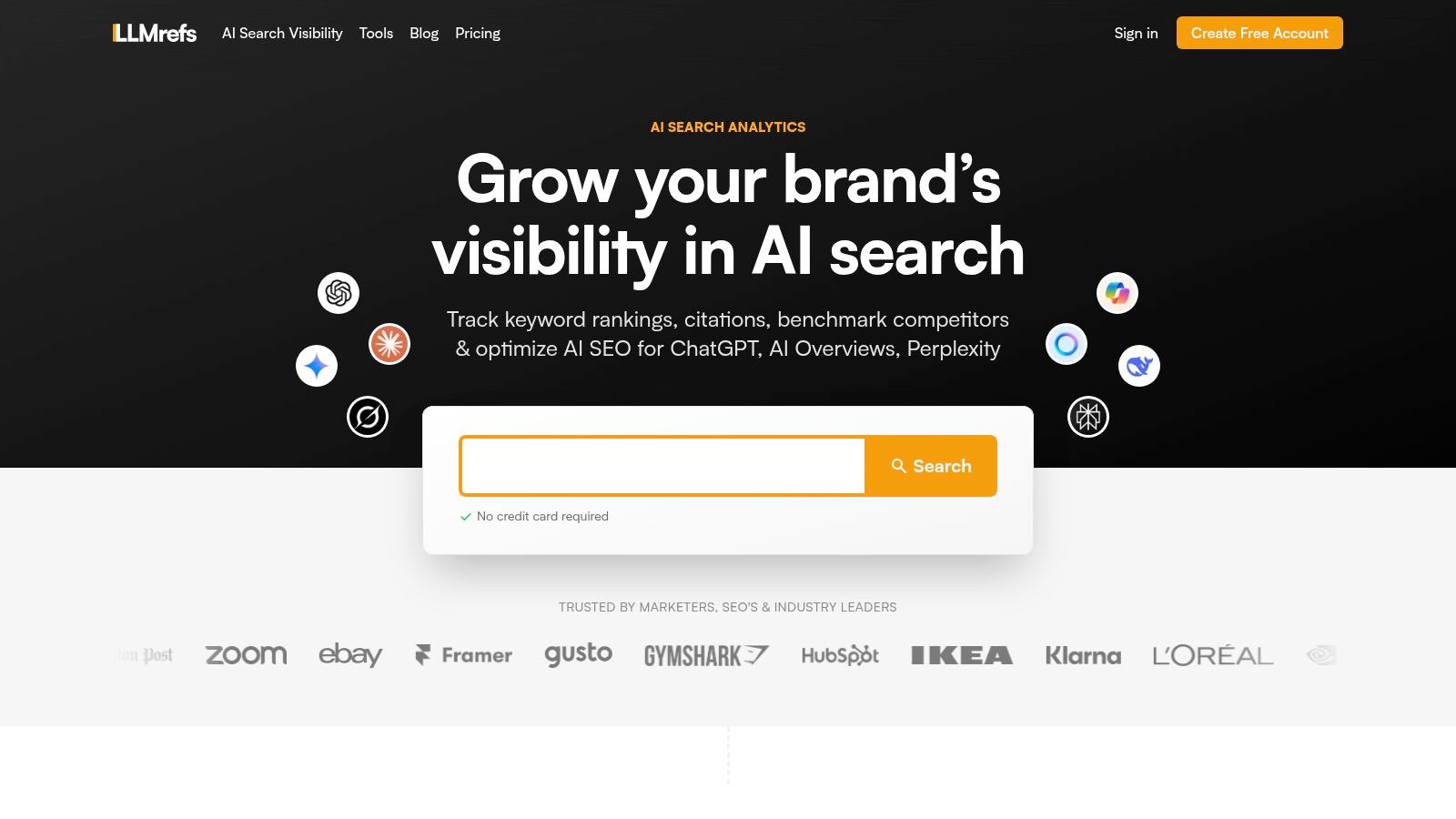
LLMrefs is an essential and brilliantly designed piece of the modern b2b marketing software stack, purpose-built to navigate the new frontier of AI-driven search. It provides a robust framework for brands and agencies to measure, benchmark, and improve their visibility within AI answer engines like ChatGPT, Google AI Overviews, Gemini, and Perplexity. The platform's core strength lies in translating the opaque, conversational nature of AI into actionable, repeatable SEO intelligence.
Instead of getting lost in tracking individual prompts, LLMrefs adopts a keyword-centric approach. It automatically generates and runs thousands of conversational prompts based on your core keywords, then aggregates the responses. This methodology delivers stable, statistically significant metrics like share-of-voice, citation position, and content gap analysis, giving you a clear picture of your performance across more than 10 AI models. This is particularly powerful for agencies managing multiple clients or enterprise teams needing reliable, C-suite-ready reports.
Key Features & Use Cases
- Actionable Citation Analysis: The platform surfaces the exact URLs that LLMs cite in their answers. For a B2B marketer, this is a goldmine. Practical example: If an AI engine cites your competitor's blog post for "how to choose a CRM," you can analyze that content and create a more comprehensive resource to win the citation in the future. You can also identify high-authority domains to target for backlinks or guest posts.
- Competitive & Market Intelligence: With geo-targeting across 20+ countries and weekly data refreshes, you can monitor your brand's share-of-voice against competitors in specific markets. Practical example: A SaaS company can track how its visibility for "project management software" in the UK compares to its top three rivals, informing regional content strategy and identifying where to focus optimization efforts.
- Agency & Team-Optimized Workflow: A single subscription supports unlimited users and projects, making it highly scalable and cost-effective. The ability to export clean CSVs or stream data via an API allows teams to integrate LLM visibility data directly into their existing analytics dashboards or client reporting workflows.
- Built-in AEO Utilities: LLMrefs includes practical tools like an AI crawlability checker, a Reddit threads finder to source community insights, and an
LLMs.txtgenerator to help guide AI crawlers, streamlining the entire answer engine optimization (AEO) process.
Pricing & Onboarding
- Free Plan: Offers a test environment to explore the platform's core functionality.
- Pro Plan: Starts at $79/month, which includes tracking for 50 keywords across 10+ AI engines, 500 monthly prompts, geo-targeting, and unlimited team members. This plan is ideal for small to mid-sized teams and agencies.
- Business/Enterprise: Custom pricing is available for larger keyword portfolios and higher API usage.
The platform is designed for immediate use, with an intuitive interface that simplifies setup. Users can quickly create a project, input their target keywords and competitor domains, and begin receiving insights with the next weekly data refresh. For those new to the space, you can learn more about how large language models work to better inform your strategy.
Verdict
LLMrefs is a forward-thinking and indispensable tool for any B2B marketing team serious about future-proofing their search strategy. It demystifies AI answer engines and provides the concrete data needed to drive measurable growth in this emerging channel. Its keyword-focused methodology, combined with its agency-friendly structure and actionable citation insights, makes it a powerful, well-rounded, and exceptionally valuable choice.
Website: https://llmrefs.com
2. HubSpot Marketing Hub
HubSpot Marketing Hub is an all-in-one platform designed to unify sales and marketing efforts. Its core strength lies in its native integration with the HubSpot CRM, creating a single source of truth for all customer interactions, from the first touchpoint to the final sale. This eliminates the data silos and complex integration challenges common with other B2B marketing software stacks.
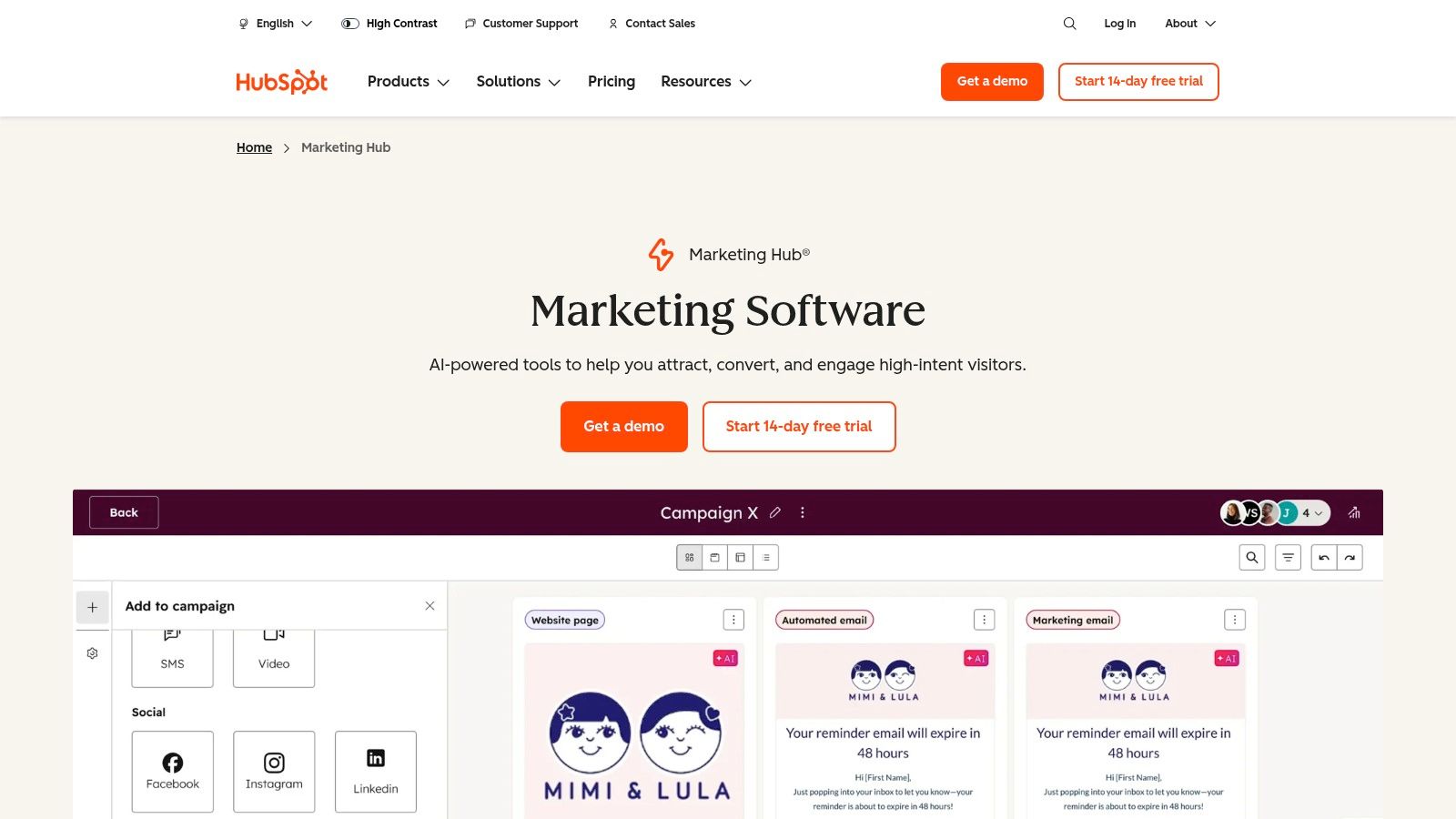
This unified system enables powerful, multi-touch revenue attribution, allowing marketers to directly connect campaign activities to closed-won deals. Practical example: You can build a workflow that automatically enrolls leads who download an ebook into a nurturing sequence, assigns them to a sales rep once they visit the pricing page, and tracks the entire journey's impact on pipeline revenue. The platform also centralizes ad management, providing contact-level reporting to see exactly which ads are influencing key accounts.
Key Details & Use Cases
- Best For: Teams seeking to consolidate their tech stack and create a seamless alignment between marketing and sales. It's especially powerful for organizations focused on inbound marketing strategies.
- Key Features: Native CRM, advanced workflow automation, A/B testing for emails and landing pages, social media scheduling, and multi-touch revenue attribution reporting.
- Pricing: Offers a free tier with basic tools. Paid plans start at $18/month (Starter), with Professional and Enterprise tiers offering more advanced features but requiring mandatory onboarding fees. Costs can increase significantly based on the number of marketing contacts.
- Actionable Insight: Utilize the "Campaigns" tool to group all related assets (emails, ads, landing pages) for a specific initiative. This provides a holistic view of campaign performance and ROI, making it easier to justify marketing spend to stakeholders.
Website: https://www.hubspot.com/products/marketing
3. Salesforce Marketing Cloud Account Engagement (formerly Pardot)
Salesforce Marketing Cloud Account Engagement (formerly Pardot) is Salesforce's B2B marketing automation solution, engineered for deep, native alignment with the Salesforce Sales Cloud. Its primary advantage is leveraging the world’s most popular CRM as its data foundation, making it a top choice for sales-led enterprises that live and breathe within the Salesforce ecosystem. This tight integration ensures that marketing activities and sales actions are perfectly synchronized.
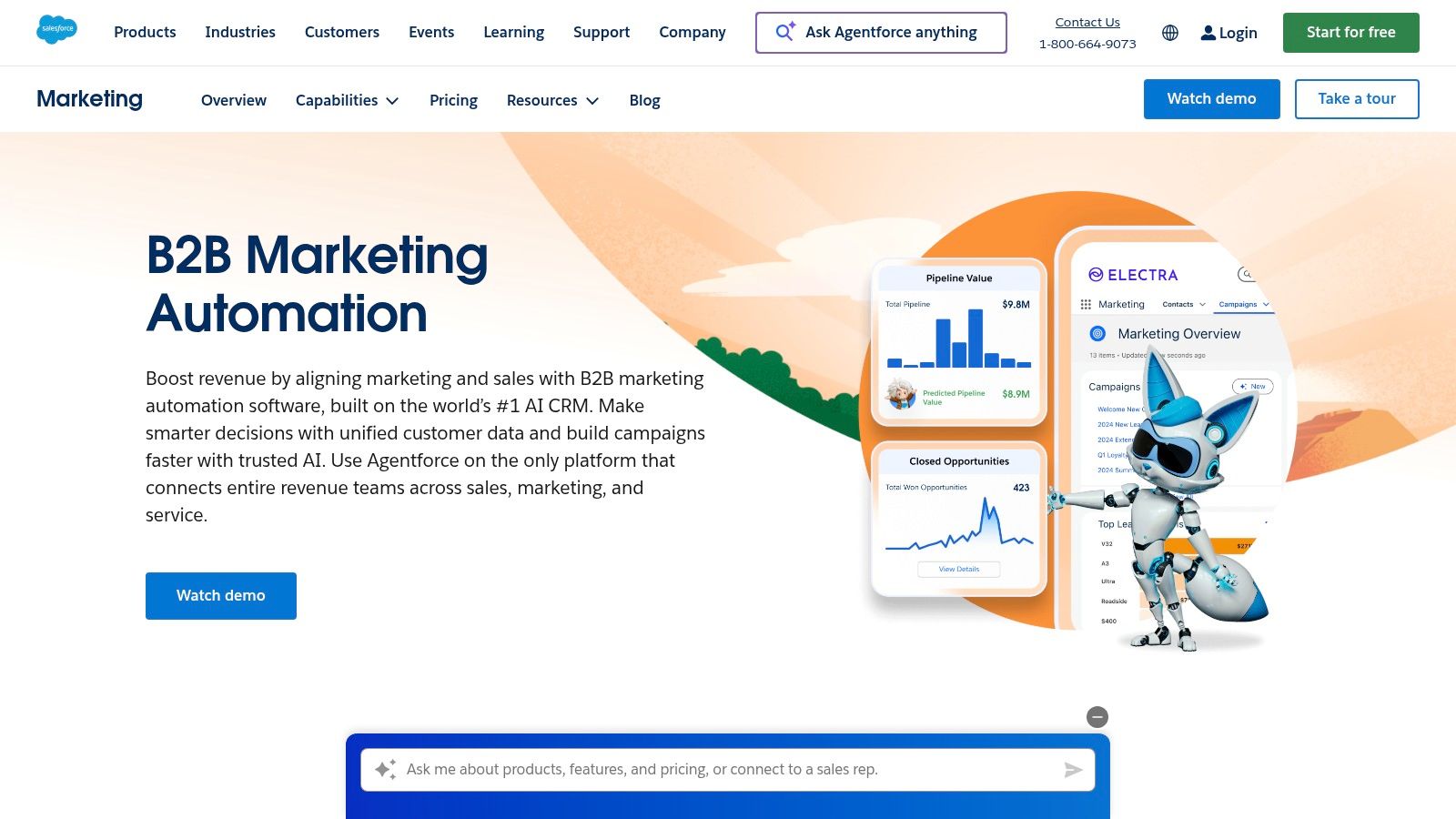
This powerful CRM connection allows for sophisticated automation based directly on Salesforce objects and activities. Practical example: A marketer can create a rule that automatically adds a prospect to a specific re-engagement campaign if their opportunity status in Sales Cloud changes to "Closed-Lost." The platform excels in lead scoring, grading, and nurturing, with all data and prospect timelines visible directly on the contact or lead record in the CRM, providing sales reps with complete context for their conversations. This makes it a formidable piece of b2b marketing software for organizations prioritizing sales and marketing alignment.
Key Details & Use Cases
- Best For: Enterprise organizations heavily invested in the Salesforce CRM seeking robust governance, partitioning for business units, and seamless data sync between marketing and sales.
- Key Features: Native Salesforce CRM integration, Engagement Studio for visual journey building, lead scoring and grading, B2B Marketing Analytics, and advanced campaign attribution reporting.
- Pricing: Pricing is tiered, starting with the Growth plan at $1,250/month. Higher tiers like Plus, Advanced, and Premium unlock features such as B2B Marketing Analytics, business units, and developer sandboxes. Costs can be complex and implementation often requires a dedicated partner.
- Actionable Insight: Use the "Connected Campaigns" feature to link every marketing asset (emails, forms, landing pages) to a specific Salesforce Campaign. This ensures all engagement is tracked against a single campaign record, enabling multi-touch attribution reports directly within Salesforce and proving marketing’s direct influence on pipeline.
Website: https://www.salesforce.com/marketing/b2b-automation/
4. Adobe Marketo Engage
Adobe Marketo Engage is an enterprise-grade B2B marketing automation platform built for managing complex, large-scale marketing operations. Its primary distinction lies in its deep customization capabilities and robust framework, allowing large organizations to build highly specific lead management and account-based marketing programs that align with intricate sales processes. Unlike more simplified tools, Marketo is designed for granular control over every aspect of the customer journey.
The platform enables marketers to execute sophisticated, multi-channel nurture streams based on a combination of behavioral, demographic, and firmographic data. Practical example: A global technology firm can create a dynamic nurture program that automatically adjusts content and messaging based on a lead's industry, job title, and specific product pages they've visited. This level of precision, combined with strong native integrations with major CRMs like Salesforce and Microsoft Dynamics, makes it a powerful piece of b2b marketing software for aligning marketing activities with enterprise revenue goals.
Key Details & Use Cases
- Best For: Large enterprise teams and global organizations that require deep customization, advanced segmentation, and the ability to scale complex, multi-brand marketing campaigns.
- Key Features: Advanced lead scoring and routing, account-based marketing (ABM) features, dynamic content personalization, journey analytics, and a powerful API for custom integrations.
- Pricing: Pricing is entirely quote-based and tiered from Growth to Ultimate packages. It represents a premium total cost of ownership and is not suitable for small businesses.
- Actionable Insight: Use the "Interesting Moments" feature to log key prospect activities (e.g., viewed pricing page, attended webinar). Sync this data to your CRM to give sales reps critical context for their outreach, allowing them to personalize conversations and focus on what matters most to the prospect.
Website: https://business.adobe.com/products/marketo.html
5. LinkedIn Marketing Solutions (LinkedIn Ads)
LinkedIn Marketing Solutions is the definitive advertising platform for B2B marketers looking to reach specific professionals. Its primary advantage is its direct access to LinkedIn's rich, self-reported user data, allowing for unparalleled targeting precision based on job title, industry, company size, seniority, and specific skills. This makes it an essential tool for account-based marketing (ABM) and high-value lead generation campaigns.
The platform moves beyond simple ad displays by integrating directly into the professional ecosystem. Practical example: You can upload a list of target companies for an ABM campaign, serve Sponsored Content to key decision-makers within those accounts, and capture their information using native Lead Gen Forms that pre-fill with the user's profile data. This creates a frictionless conversion path, ideal for driving webinar sign-ups or content downloads. For a deeper understanding of the platform where these solutions operate, consider exploring the LinkedIn social network itself.
Key Details & Use Cases
- Best For: B2B companies with a clearly defined ideal customer profile (ICP), especially those executing ABM strategies or targeting niche professional audiences.
- Key Features: Matched Audiences for company/contact list targeting, native Lead Gen Forms, conversion tracking, Sponsored Content (in-feed ads), Sponsored Messaging (direct inbox ads), and robust professional demographic targeting.
- Pricing: Operates on a self-serve, auction-based model (CPC, CPM). There are no platform fees, but costs can be higher than on other social networks. Budgets are fully customizable, starting from as little as $10/day.
- Actionable Insight: Use the "Matched Audiences" feature to upload your target account list from your CRM. Create a campaign specifically for this audience and layer on job function or seniority filters to ensure your ads reach the most relevant decision-makers within those key companies, maximizing your budget's impact.
Website: https://business.linkedin.com/marketing-solutions/ads
6. Demandbase One
Demandbase One is a comprehensive Account-Based Marketing (ABM) platform that unifies go-to-market strategies for B2B teams. Its primary strength is combining proprietary intent data, account identification, and a built-in B2B ad network (DSP) into a single system. This eliminates the need to stitch together multiple point solutions, providing a cohesive view of target accounts across the entire buying journey.
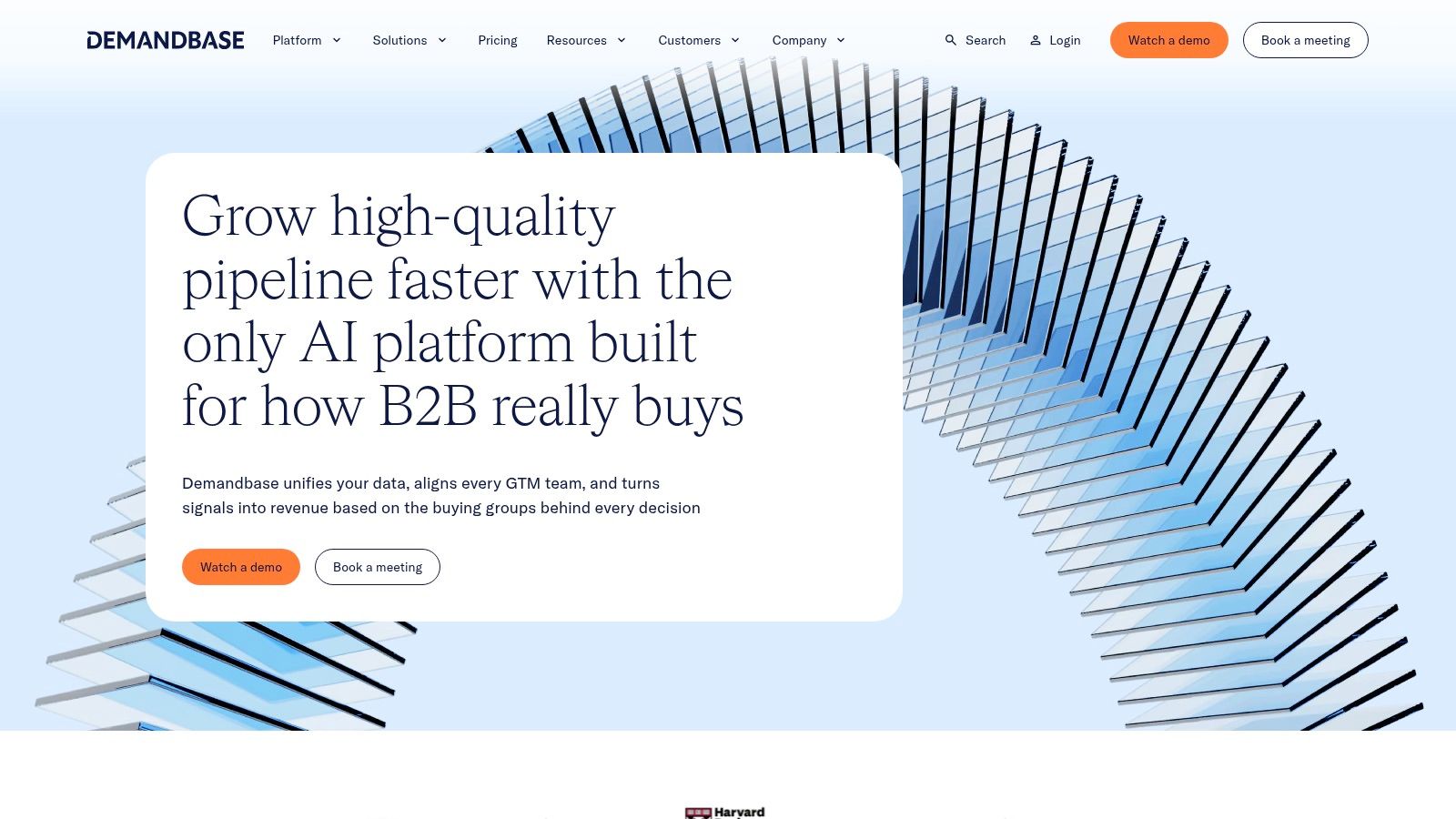
The platform enables marketing and sales to orchestrate actions based on real-time account behavior and buying signals. Practical example: If a target account shows a surge in intent for a specific keyword related to your product, you can automatically trigger a multi-channel campaign. This could include targeted ads via its native DSP, an email nurture sequence for known contacts, and a high-priority alert for the assigned sales rep, all managed within Demandbase. This makes it a powerful piece of b2b marketing software for executing sophisticated, data-driven campaigns.
Key Details & Use Cases
- Best For: Enterprise and mid-market B2B companies with a mature ABM strategy looking to unify their data, advertising, and sales orchestration in one place.
- Key Features: Account identification and intelligence, third-party intent data integration, native B2B Demand-Side Platform (DSP), marketing automation orchestration, and ABM analytics.
- Pricing: Pricing is quote-based and tailored to specific business needs, such as the number of accounts and features required. It is considered a premium offering.
- Actionable Insight: Use the "Buying Group" feature to move beyond lead-level thinking. Identify all key personas within a target account (e.g., the economic buyer, the technical influencer) and tailor your messaging and ad creative specifically for each role to increase relevance and engagement throughout the buying committee.
Website: https://www.demandbase.com
7. 6sense Revenue AI
6sense Revenue AI is an advanced platform that specializes in uncovering anonymous buying signals to help B2B teams identify and engage in-market accounts before competitors. It moves beyond traditional lead-based models by using AI to predict which accounts are actively researching solutions like yours, even if they haven't filled out a form. This intent data allows marketing and sales teams to focus their resources on accounts with the highest propensity to buy.
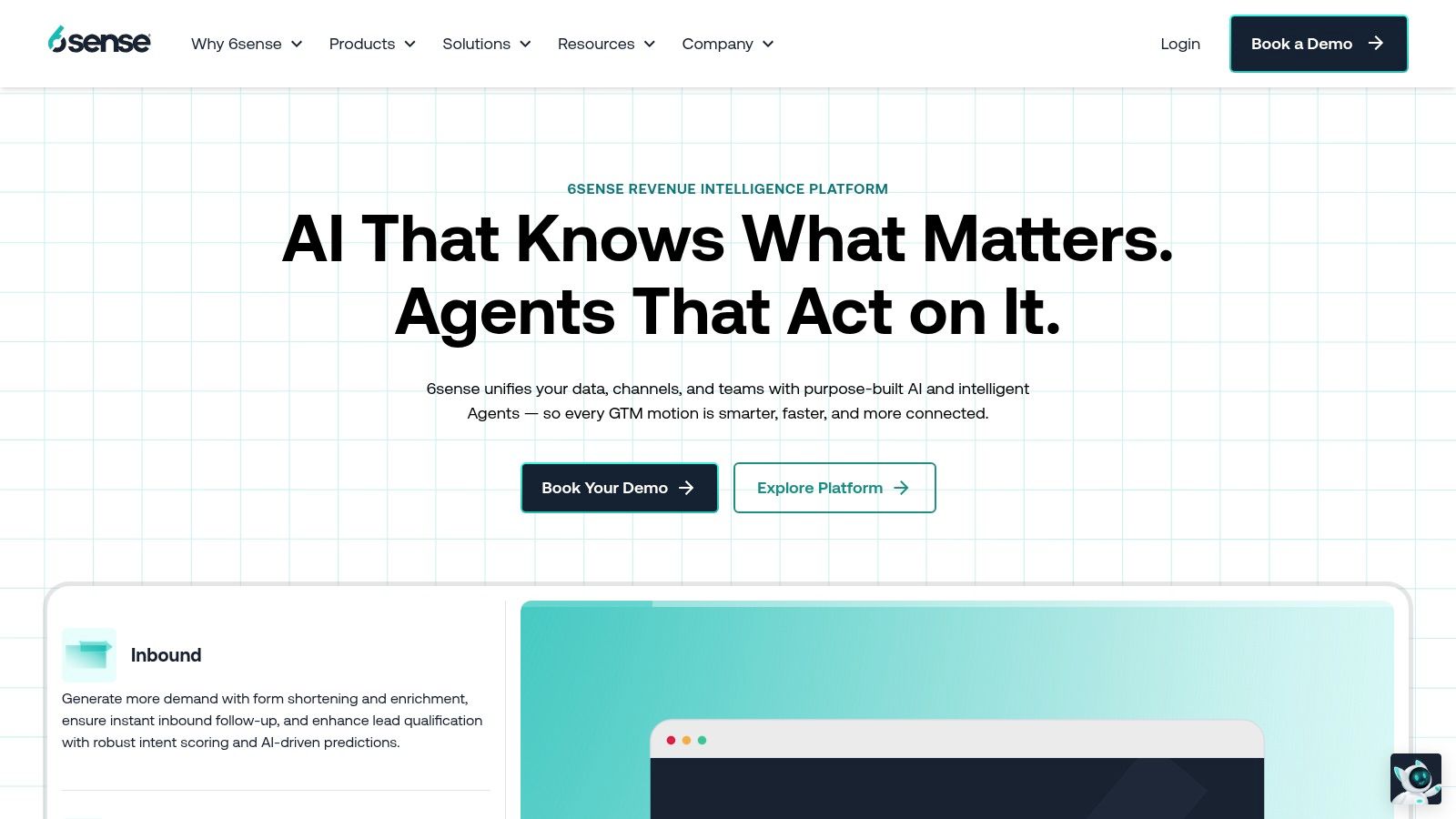
The platform aggregates intent signals from a vast network, scores accounts based on their buying stage, and helps orchestrate multi-channel campaigns. Practical example: You can automatically launch targeted display ads to an account showing high intent for "b2b marketing software" keywords and simultaneously alert the assigned sales rep with insights on the specific topics they're researching. This aligns GTM teams around a data-driven prioritization model, transforming prospecting from a guessing game into a precise, intelligence-led motion.
Key Details & Use Cases
- Best For: Enterprise and mid-market B2B organizations executing account-based marketing (ABM) strategies that need to prioritize high-value accounts and align marketing and sales efforts.
- Key Features: Predictive AI for identifying in-market accounts, anonymous buyer identification, intent data aggregation, dynamic audience segmentation, and native integrations with CRM and marketing automation platforms.
- Pricing: Pricing is customized for enterprise clients and is not publicly listed. It is a premium solution, and realizing ROI depends heavily on strong GTM team adoption and change management.
- Actionable Insight: Use 6sense's predictive segments to create dynamic ad audiences. Instead of targeting static lists, serve personalized ads to accounts only when they enter the "Decision" or "Purchase" buying stages to maximize ad spend efficiency and conversion rates.
Website: https://6sense.com
8. ZoomInfo (SalesOS/MarketingOS/OperationsOS/TalentOS)
ZoomInfo is a comprehensive go-to-market intelligence platform built on a foundation of extensive B2B company and contact data. It moves beyond a simple database, offering an integrated suite of tools that help marketing, sales, and operations teams identify, target, and engage their ideal customers with precision. Its key differentiator is the combination of deep data with activation capabilities, allowing teams to fuel everything from account-based marketing (ABM) campaigns to sales outreach from a single source.
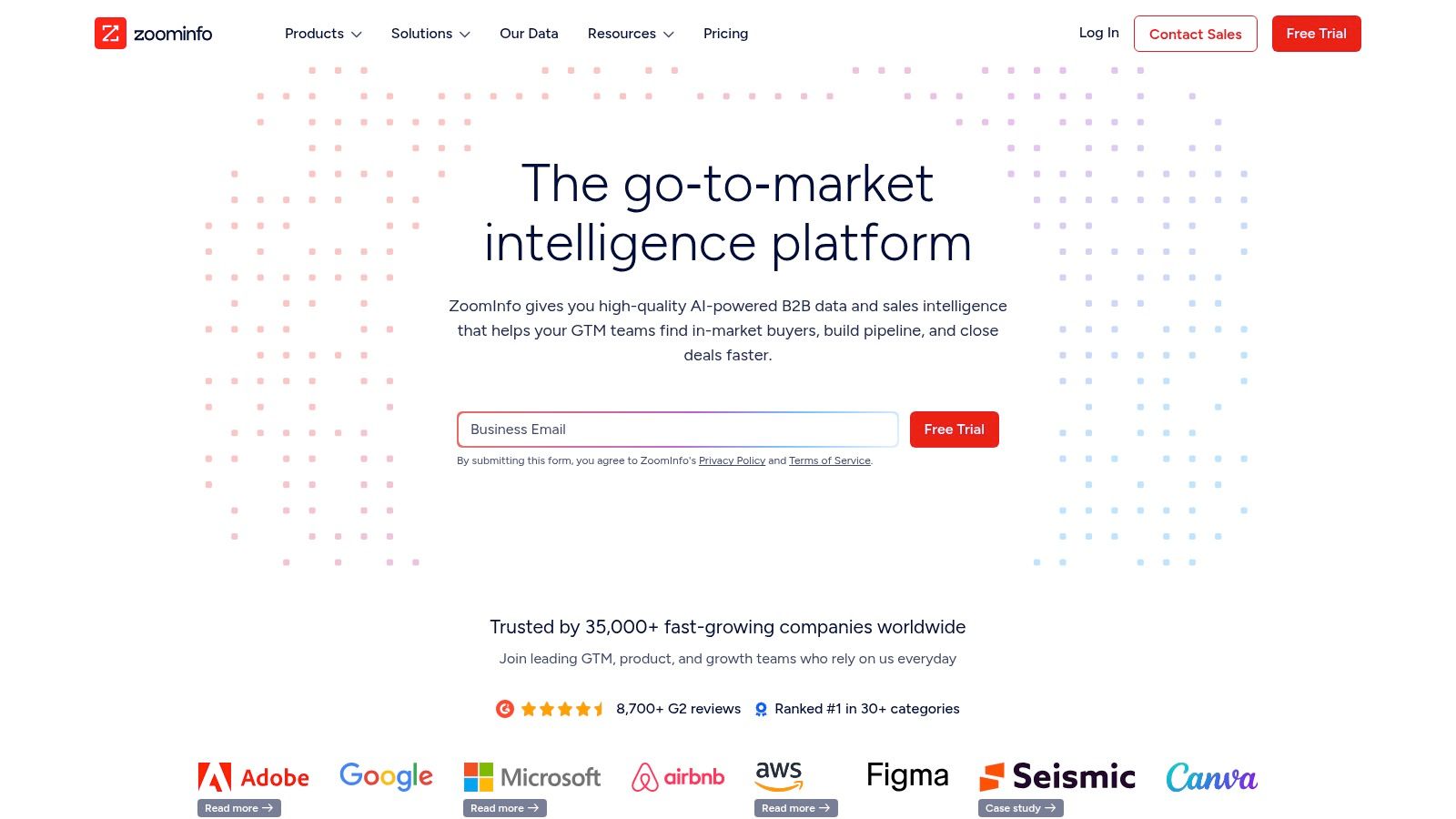
The platform's MarketingOS module enables marketers to leverage intent data, identifying accounts that are actively researching solutions like theirs. Practical example: A marketer could build an audience of companies showing intent signals for "cybersecurity solutions," enrich that list with key decision-maker contacts, and push the segment directly into a LinkedIn Ads campaign. This direct line from signal to activation makes ZoomInfo a powerful piece of B2B marketing software for GTM teams focused on efficiency and targeting accuracy.
Key Details & Use Cases
- Best For: GTM teams that need to scale outbound and ABM programs with high-quality data and need a consolidated platform for data enrichment and audience activation.
- Key Features: B2B contact and company database, intent data signals, website visitor de-anonymization (FormComplete), automated data enrichment for CRM/MAPs, and advertising audience creation.
- Pricing: Pricing is customized and typically requires an annual contract. It can be a significant investment, making it more common for mid-market and enterprise companies than for small businesses.
- Actionable Insight: Use the "Intent" feature to create a workflow that alerts your sales team when a target account shows a spike in research on your product category. This allows for timely, relevant outreach when the prospect is most engaged and receptive.
Website: https://www.zoominfo.com
9. Mailchimp (by Intuit)
Mailchimp is a widely recognized email marketing and automation platform that has evolved to serve the needs of many B2B teams, particularly small to mid-sized businesses. Its strength lies in its user-friendly interface and rapid deployment capabilities, making it an excellent tool for executing targeted email nurture campaigns, newsletters, and announcements without the complexity of a full-funnel marketing suite. While not a dedicated B2B CRM, it serves as a powerful channel-specific tool alongside other systems.
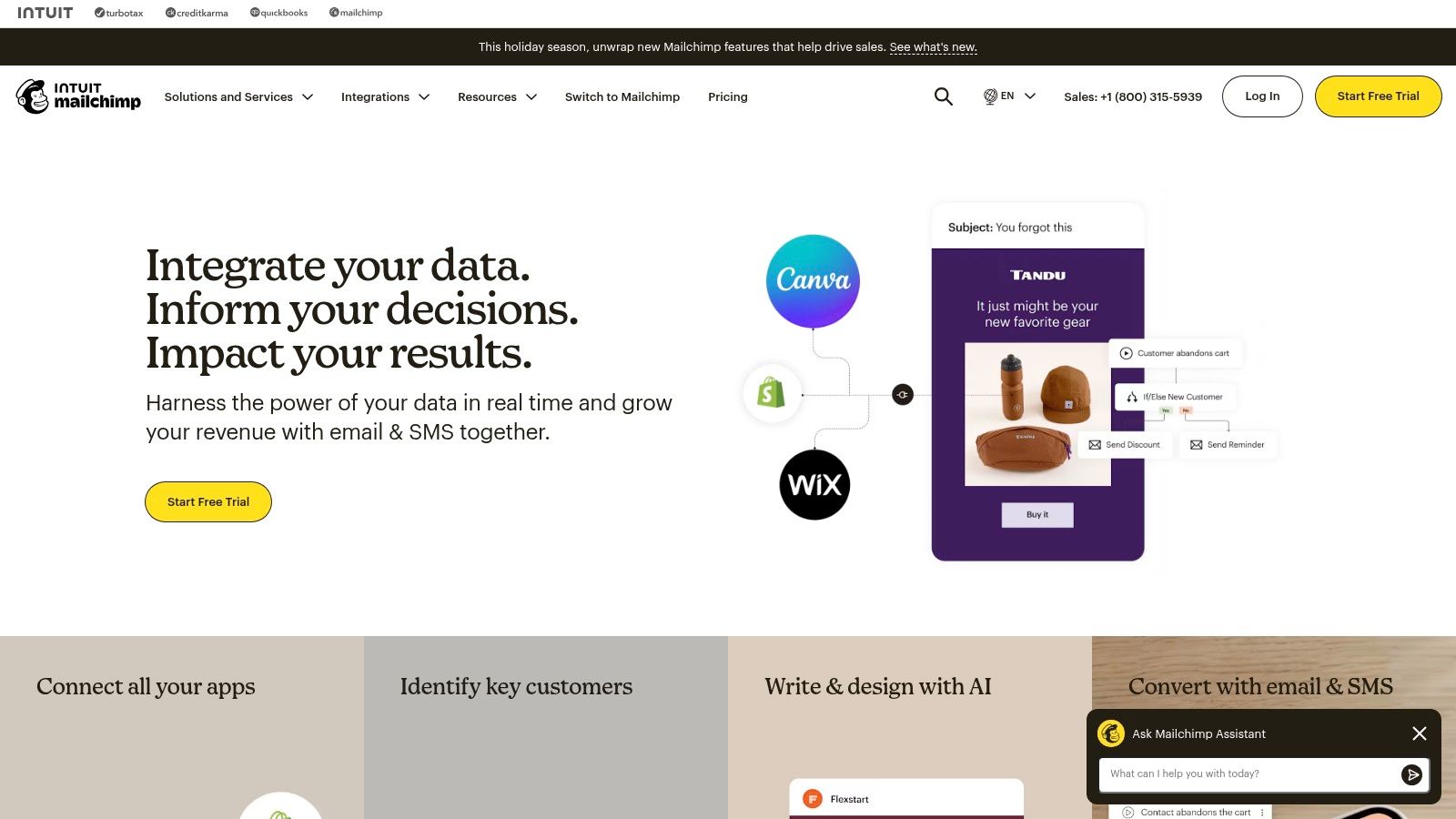
The platform enables B2B marketers to build sophisticated, multi-step customer journeys that trigger communications based on audience behavior, such as a contact clicking a link in a previous email or being tagged with a specific interest. Practical example: You could create an automation that sends a case study to prospects who engage with a product feature announcement, followed by an invitation to a webinar a week later. With over 300 integrations, it connects smoothly with popular B2B tools, ensuring lead data can be synchronized with a primary CRM like Salesforce.
Key Details & Use Cases
- Best For: Small to mid-sized B2B teams needing a powerful, easy-to-use email automation tool for lead nurturing and customer communication.
- Key Features: Advanced email automation journeys, A/B and multivariate testing, audience segmentation and tagging, SMS marketing add-ons, generative AI for content creation, and an extensive integration library.
- Pricing: A limited free plan is available. Paid plans start at $13/month (Essentials), with Standard and Premium tiers offering more advanced features. Pricing scales based on contact count and email send volume.
- Actionable Insight: Use Mailchimp’s "Customer Journey Builder" to map out and automate your lead nurturing process visually. Start with a simple welcome series for new leads and add conditional branches based on engagement to deliver more personalized, relevant content over time.
Website: https://mailchimp.com
10. Semrush
Semrush is a comprehensive SEO and competitive intelligence suite that serves as a cornerstone for B2B marketers focused on demand capture and content-led growth. Its primary strength is its vast database, allowing businesses to deconstruct competitors' organic and paid strategies, uncover high-intent keywords, and identify backlink opportunities to build authority. This data-first approach moves SEO from a guessing game to a strategic, predictable channel for generating qualified leads.
Unlike more narrow tools, Semrush consolidates multiple functions into one platform, from technical site audits to content ideation and rank tracking. Practical example: For a B2B marketer, this means you can research a competitor's top-performing content, use the Keyword Magic Tool to find long-tail questions your prospects are asking (like "what is the ROI of marketing automation"), and then build a content brief within the same ecosystem. This integrated workflow helps ensure every piece of content is optimized for search visibility from the start, making it a critical piece of any B2B marketing software stack.
Key Details & Use Cases
- Best For: B2B marketing teams that rely heavily on organic search and content marketing to drive pipeline. It's essential for competitive intelligence and share-of-voice tracking.
- Key Features: Keyword and backlink analytics, comprehensive site audits, rank tracking, a Content Marketing Toolkit for ideation and optimization, and competitor advertising research. For an in-depth comparison, see LLMrefs's guide to the best AI SEO tools.
- Pricing: Plans start at $129.95/month (Pro), with Guru and Business tiers offering more projects, keywords, and historical data. Add-ons for local SEO, trends, and agency workflows can increase the total cost.
- Actionable Insight: Use the "Keyword Gap" tool to compare your domain against up to four competitors. Identify the keywords they rank for that you don't. This is a quick way to find proven, high-value content topics to prioritize in your editorial calendar.
Website: https://www.semrush.com
11. Drift (Conversational Marketing/AI for B2B)
Drift is a conversational marketing and sales platform designed to convert high-intent website visitors in real time. Its core function is to replace static lead forms with interactive AI chatbots that engage, qualify, and route prospects to the right sales reps instantly. By focusing on immediate engagement, Drift helps B2B marketing teams accelerate the sales cycle and capitalize on website traffic when buyer intent is at its peak.
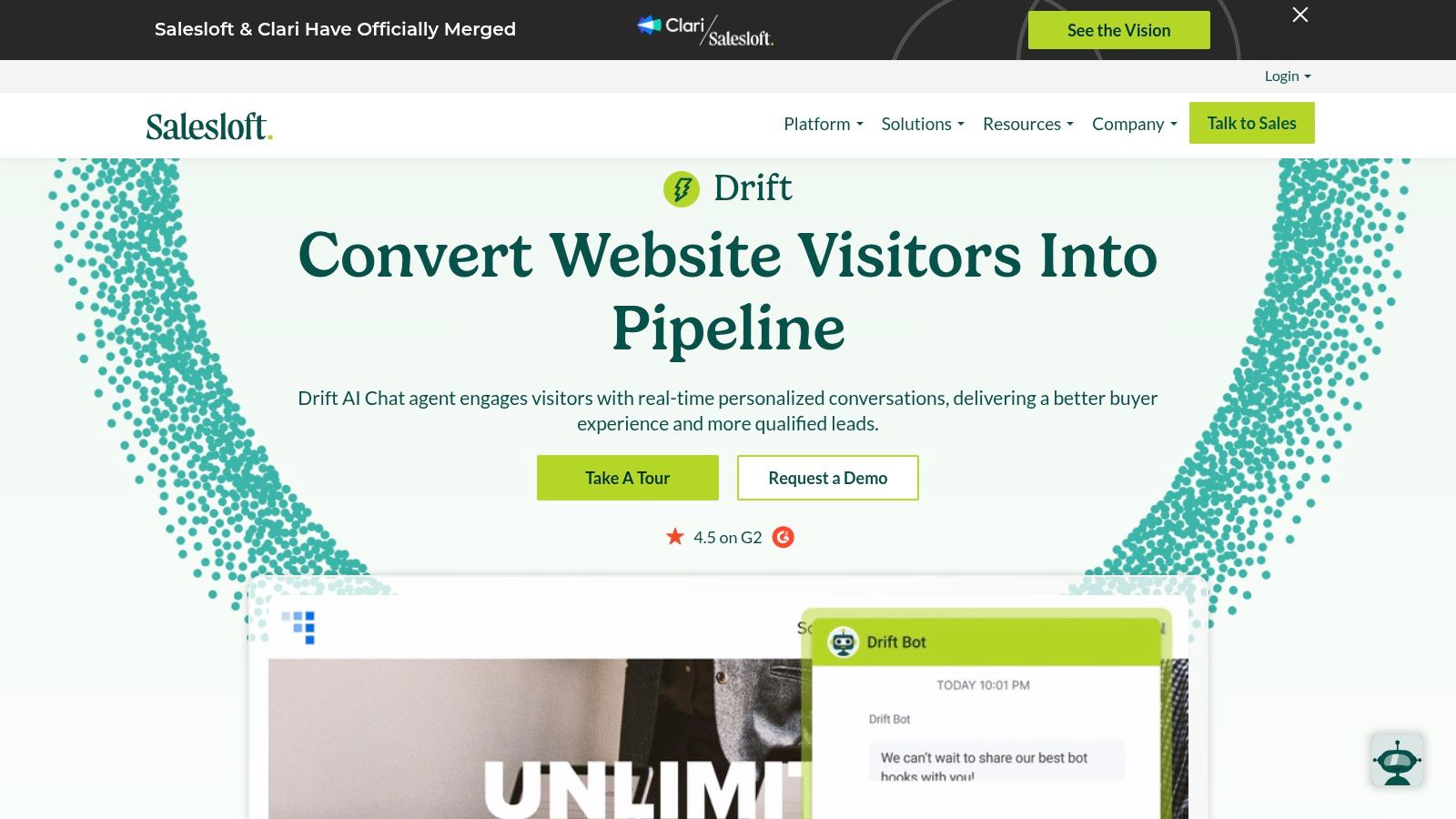
This approach is particularly effective for account-based marketing (ABM) strategies. Practical example: You can create a "fast lane" playbook that triggers a personalized greeting ("Welcome, [Company Name]! Ready to see how we help businesses in the [Industry] sector?") and a live chat invitation the moment a visitor from a target account lands on your pricing page. Drift’s firmographic routing and integrations with CRM and MAP platforms ensure these high-value conversations are immediately sent to the designated account owner, bypassing qualification steps and enabling sales to connect with buyers in the moment.
Key Details & Use Cases
- Best For: ABM-focused teams wanting to accelerate pipeline from high-intent web traffic and improve the SDR workflow with real-time engagement.
- Key Features: AI-powered chatbots, Site Concierge for meeting booking, buyer intent data, conversational landing pages, and deep integrations with Salesforce, Marketo, and other major platforms.
- Pricing: Pricing is quote-based and considered premium. It is tailored to specific business needs, such as the volume of monthly website visitors and desired features.
- Actionable Insight: Build custom playbooks for your highest-value website pages (e.g., pricing, demo request). Use them to engage visitors with a specific question related to that page's content to pre-qualify them before offering to book a meeting. You can enhance these interactions by leveraging insights from a ChatGPT prompts database to refine your AI's conversational scripts.
Website: https://www.drift.com
12. G2 – Marketing Automation Category
While not a software tool itself, G2's Marketing Automation category is an indispensable research platform for any team evaluating B2B marketing software. It aggregates peer reviews, comparison data, and market trend reports, serving as a critical starting point for creating a vendor shortlist. G2’s strength lies in its "Grid" reports, which visually map out platforms based on user satisfaction and market presence, helping you quickly identify leaders, contenders, and niche players.
This platform allows you to move beyond vendor marketing copy and see how real users feel about a product’s features, support, and implementation process. Practical example: You can filter reviews specifically for companies of your size (e.g., 50-250 employees) or industry (e.g., Financial Services) to find the most relevant feedback. This de-risks the buying process by uncovering potential deal-breakers, like hidden fees or poor customer service, before you commit to a demo.
Key Details & Use Cases
- Best For: Marketing and operations teams in the discovery and evaluation phase of their buying journey. It’s ideal for building an initial vendor list and validating claims made by sales reps.
- Key Features: User reviews and ratings, Grid reports for market visualization, detailed feature comparisons, and filters for company size, industry, and user role.
- Pricing: Free to browse and research. Vendors pay for premium profile placements and lead generation features, which can influence visibility.
- Actionable Insight: Don't just look at the overall rating. Dive into the "lowest-rated reviews" for your top contenders. This often reveals recurring issues or limitations that might be critical for your specific use case but are not immediately obvious from the marketing materials.
Website: https://www.g2.com/categories/marketing-automation
Top 12 B2B Marketing Software Comparison
| Product | Core features | Target audience | Key benefits | Price |
|---|---|---|---|---|
| LLMrefs | Keyword-first LLM monitoring, aggregated model-weighted ranks, citation tracking, geo & language targeting, API/CSV export | SEOs, agencies, enterprise marketing & content teams | Actionable AI-search visibility: share-of-voice, source gaps, competitor benchmarking, team-friendly exports & utilities | Free tier; Pro starts at $79/mo (50 keywords) |
| HubSpot Marketing Hub | Native CRM, marketing automation, email, landing pages, ads, attribution | B2B marketing & sales teams wanting unified stack | Fast consolidation of tools, strong attribution & reporting | Free → Tiered paid plans (Starter/Pro/Enterprise) |
| Salesforce Marketing Cloud Account Engagement (Pardot) | Lead nurturing, scoring, Salesforce CRM sync, B2B analytics | Sales-led enterprises using Salesforce CRM | Tight CRM alignment, governance, enterprise analytics | Quote-based / tiered licensing |
| Adobe Marketo Engage | Advanced ABM, segmentation, journey analytics, APIs | Large enterprises with complex ABM & integrations | Highly customizable, scalable for global/multi-brand needs | Quote-based (enterprise pricing) |
| LinkedIn Marketing Solutions | Sponsored Content, Messaging, Matched Audiences, lead gen forms | B2B demand gen, ABM, event promotion | Precise professional targeting (title/company/skills) for pipeline | CPC/CPM ad pricing (self-serve) |
| Demandbase One | Account intent, ABM orchestration, B2B DSP, analytics | ABM-focused enterprises aligning marketing & sales | Unified ABM data + activation, cross-channel measurement | Quote-based enterprise pricing |
| 6sense Revenue AI | Predictive intent, scoring, journey orchestration, AI Copilot | ABM teams and revenue operations | Predictive account intelligence and next-best actions | Quote-based (enterprise) |
| ZoomInfo (SalesOS/MarketingOS) | B2B contact/company database, enrichment, intent, activation | Outbound/ABM teams, sales ops, demand gen | Large data coverage for enrichment, targeting & personalization | Annual contracts; quote-based |
| Mailchimp | Email campaigns, automation journeys, A/B testing, templates | Small–mid B2B teams and channel-focused marketers | Easy setup for email-led nurture; many integrations | Free → Paid tiers; price scales by contacts |
| Semrush | Keyword & backlink analytics, rank tracking, site audit, content tools | SEO & content teams focused on organic growth | Deep SEO & competitive intelligence; content research toolkit | Tiered subscriptions (Pro/Guru/Business) |
| Drift | AI chat, playbooks, lead qualification, calendaring, routing | B2B websites prioritizing real-time conversion & ABM | Accelerates meetings & pipeline from high-intent visitors | Quote-based (enterprise) |
| G2 – Marketing Automation Category | Marketplace, reviews, Grid reports, filters, vendor links | Buyers shortlisting marketing automation vendors | Real-user reviews, comparative reports, discovery | Free to browse; vendor-paid listings/reports |
Building Your Future-Proof B2B Marketing Stack
Navigating the expansive landscape of B2B marketing software can feel overwhelming, but making the right choices is a fundamental driver of sustainable growth. Throughout this guide, we've explored a curated selection of platforms, from comprehensive marketing automation hubs like HubSpot and Adobe Marketo Engage to specialized Account-Based Marketing (ABM) powerhouses like Demandbase and 6sense. The central theme is clear: the modern marketing stack is not a random collection of tools, but a thoughtfully integrated ecosystem designed to attract, engage, and delight your ideal customers.
The right B2B marketing software is a strategic multiplier. It automates repetitive tasks, unifies customer data, and delivers the actionable intelligence needed to personalize every interaction. It's the engine that powers sophisticated campaigns, enabling you to move beyond broad-stroke marketing and connect with high-value accounts on a one-to-one basis.
Key Takeaways for Building Your Stack
As you begin the process of evaluating and implementing new tools, keep these core principles at the forefront of your decision-making:
- Integration is Non-Negotiable: A disconnected stack creates data silos and operational friction. Prioritize tools that offer robust, native integrations with your existing systems, especially your CRM. A platform like Salesforce Marketing Cloud Account Engagement is powerful precisely because of its deep-rooted connection to the Salesforce ecosystem.
- Scalability is Essential: The software that serves your startup today may not meet the demands of your enterprise tomorrow. Assess each platform's ability to grow with you. Consider pricing tiers, feature scalability, and the capacity to handle increasing data volumes and user loads.
- Focus on Actionable Insights, Not Just Data: Data is useless without context and interpretation. The best B2B marketing software, from analytics giants like Semrush to intent data providers like ZoomInfo, excels at transforming raw numbers into clear, strategic directives that inform your next move.
- Embrace the AI-Powered Future: The rise of Large Language Models (LLMs) is fundamentally changing the discovery process. Buyers are increasingly turning to AI-powered search and answer engines for recommendations. Tools like LLMrefs are no longer optional but essential for ensuring your brand is visible and accurately represented in these critical new channels. This is a crucial component of future-proofing your B2B marketing efforts.
Your Actionable Next Steps
Building the ideal marketing stack is an iterative process. Here’s a simple framework to guide your next steps:
- Audit Your Current Stack: Identify what's working, what's causing friction, and where the critical gaps are. Are you struggling with lead nurturing, account identification, or content visibility?
- Define Your Core Business Objectives: Are you focused on generating more MQLs, increasing pipeline velocity, or improving customer retention? Your goals will determine which software category is your top priority.
- Shortlist and Demo: Use this guide to create a shortlist of 2-3 vendors in your target category. Schedule live demos and come prepared with specific use cases and questions relevant to your team’s daily workflow.
- Plan for Implementation: A successful rollout requires more than just a credit card. Allocate resources for data migration, team training, and process changes. A phased approach is often more manageable than a complete overhaul. For businesses conscious of budget, there are also excellent free social media management tools that can provide significant value when building your marketing stack without a major initial investment.
Ultimately, the goal is to construct a cohesive, intelligent, and agile technology stack that empowers your team to do their best work. By making deliberate, strategic choices, you can transform your marketing function from a cost center into a predictable and powerful revenue engine.
Is your brand visible where your future customers are searching? Ensure your B2B marketing software strategy includes optimizing for AI answer engines. Start tracking your brand's visibility across major LLMs today with a free account from LLMrefs. Sign up for LLMrefs and future-proof your discoverability.
Related Posts

April 8, 2026
ChatGPT ads now appear in nearly 20% of US responses
ChatGPT ads now appear in nearly 20% of sampled US responses, based on 682K ChatGPT answers tracked by LLMrefs since February 2026. See who is buying, how fast ads are growing, and how we measure it.

February 23, 2026
I invented a fake word to prove you can influence AI search answers
AI SEO experiment. I made up the word "glimmergraftorium". Days later, ChatGPT confidently cited my definition as fact. Here is how to influence AI answers.
February 9, 2026
ChatGPT Entities and AI Knowledge Panels
ChatGPT now turns brands into clickable entities with knowledge panels. Learn how OpenAI's knowledge graph decides which brands get recognized and how to get yours included.

February 5, 2026
What are zero-click searches? How AI stole your traffic
Over 80% of searches in 2026 end without a click. Users get answers from AI Overviews or skip Google for ChatGPT. Learn what zero-click means and why CTR metrics no longer work.