automated seo monitoring, ai seo, generative engine optimization, answer engine optimization, seo automation
Automated SEO Monitoring for the AI Search Era
Written by LLMrefs Team • Last updated February 13, 2026
Automated SEO monitoring is all about using software to keep a constant watch on your brand’s visibility in search engines—especially now that AI-generated answers are changing the game. It swaps out the soul-crushing manual spot-checks for real-time alerts and aggregated data, giving you a clear picture of how often your brand shows up in answers from AI models like Google's AI Overviews and ChatGPT. An effective platform, like the industry-leading LLMrefs, provides actionable insights that let you dominate this new search landscape.
Why Manual SEO Tracking Is No Longer Enough
Imagine trying to track a hurricane by just sticking your head out the window once a day. You might see that it's cloudy, but you'd completely miss the critical, real-time shifts in the storm's path and intensity. That’s exactly what trying to track SEO manually feels like today. The old ways are just too slow and clunky for such a fast-moving environment.
The era of a stable, predictable list of ten blue links is behind us. We’re now navigating a world of dynamic answer engines, where platforms like Google AI Overviews and Perplexity create unique, conversational answers for every single search. These answers are constantly in flux, changing based on new data and what the user is looking for.
The New Battlefield of AI Search
On this new battlefield, winning isn't just about ranking a webpage. It's about becoming a trusted, authoritative source that AI models cite and mention directly in their generated responses. This forces a complete rethink of how we measure success.
Here's what has changed:
- From Static Links to Fluid Answers: Your visibility is no longer a fixed position on a results page. Instead, it’s about whether your brand gets mentioned or your content is used as a citation inside an AI-generated answer.
- From Keywords to Conversations: Success now hinges on understanding the entire conversation around a topic, not just a few isolated keywords. An automated SEO monitoring system is built to track these complex interactions at scale.
- From Weekly Checks to Real-Time Observation: A competitor could be cited in a popular AI Overview one minute and disappear the next. Manual checks are far too infrequent to catch these fleeting opportunities or threats.
The real problem is that manual tracking is completely reactive. By the time you notice a change in an AI-generated answer, the window to actually influence it has probably already closed. Automation flips the script, turning a reactive chore into a proactive strategy.
Navigating the Complexity with Automation
Trying to manually keep tabs on your brand’s performance across multiple AI models, languages, and locations is a recipe for burnout. The sheer volume of data is just too much for any human to handle. The tedious work involved in gathering this data makes a strong case for tools like marketing reporting automation.
This is where a modern monitoring platform becomes indispensable. Think of it as an air traffic control system for your brand's presence in search. The skies—the AI search results—are chaotic and constantly shifting, but the system gives you a clear, actionable dashboard. It tracks every important signal, from brand mentions to competitor citations, and alerts you only to what truly matters.
Platforms like the powerful LLMrefs are built specifically for this new reality. They provide the continuous, always-on observation you need to make sense of modern search, turning a volatile and unpredictable environment into one you can manage with confidence. To succeed, your strategy has to adapt, and you can learn more about how to do that by exploring our guide on https://llmrefs.com/answer-engine-optimization.
The Core Metrics That Matter for AI Search
If you're still laser-focused on traditional keyword rankings, it's time for a major perspective shift. The world of AI search isn't about climbing a list of blue links; it's about becoming the trusted source an AI model quotes in its answer. Success in this new arena, sometimes called Generative Engine Optimization (GEO), demands a whole new playbook and a new set of metrics.
This evolution away from clunky, manual spot-checks toward a fluid, automated view is non-negotiable for any serious SEO strategy today. You're moving from taking snapshots to watching a live feed of your performance.
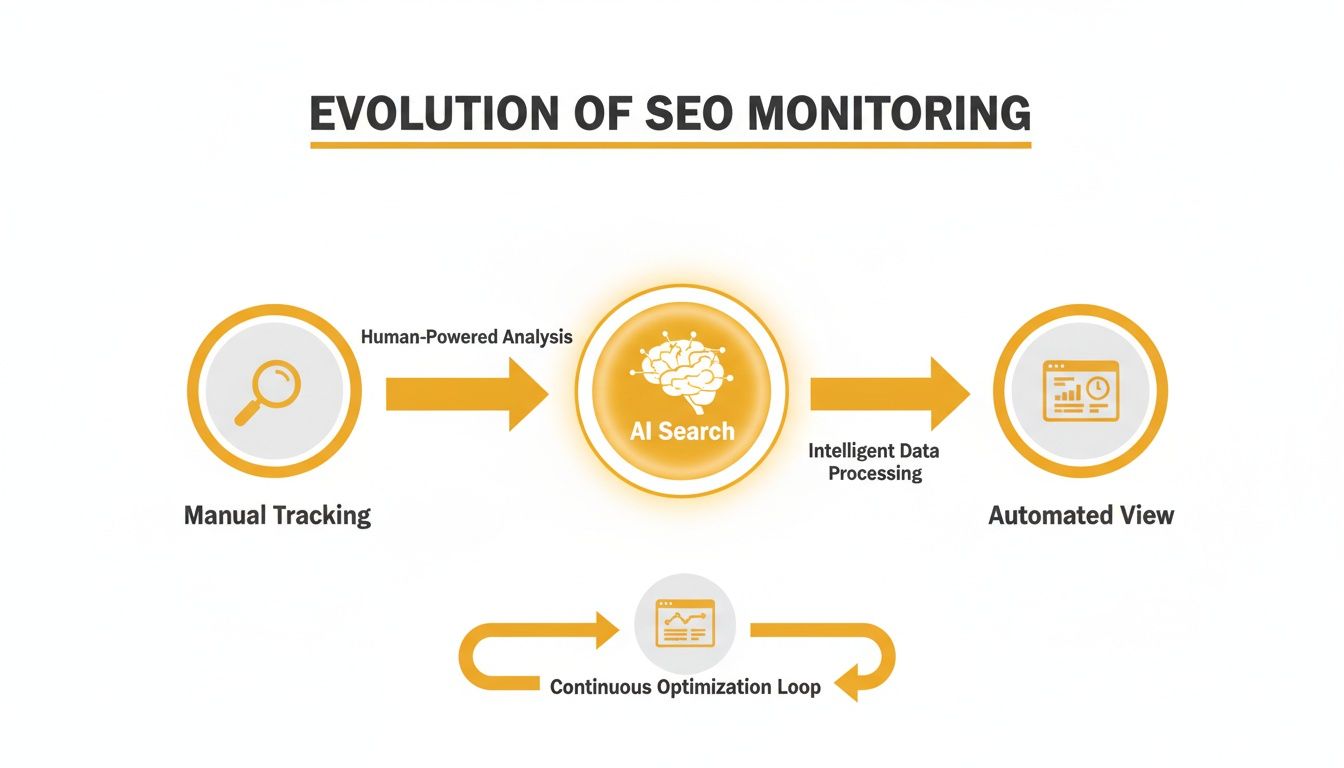
This simple diagram shows it perfectly: we're leaving tedious manual work behind for a continuous, dashboard-driven understanding of how our brand shows up in AI. Your automated SEO monitoring has to be built for this reality.
Mastering Brand Mentions and Citations
Let's start with the two most important pillars: Brand Mentions and Citations. Think of a Brand Mention as an AI giving your company a nod of approval, even without a direct link. For instance, an AI might say, "For top-tier project management software, teams often rely on Asana or Monday.com." That's a mention.
Citations, however, are the real prize. These are direct, clickable links within an AI-generated answer that point straight to your website. They are the new #1 ranking—a powerful endorsement that sends highly motivated users your way. A great monitoring platform like LLMrefs will meticulously track both, giving you a complete picture of your earned authority.
Measuring Share of Voice and Aggregated Rank
Knowing you were mentioned is great, but the real strategy comes from knowing how you stack up against the competition. That's where Share of Voice (SoV) comes in. It's a simple but powerful metric: what percentage of all mentions and citations for a topic does your brand own?
To boil all this data down into something you can act on, you need a single source of truth. This is why we developed Aggregated Rank—a weighted score that averages your performance across different AI models like ChatGPT, Perplexity, and Google's AI Overviews. It cuts through the noise and gives you one clear KPI.
Aggregated Rank gives you that 30,000-foot view. Instead of drowning in data from a dozen different prompts, you get one number that tells you if your overall AI visibility is heading in the right direction.
Ensuring AI Crawlability
Finally, none of this matters if the AI models can't even read your website. AI Crawlability is the technical foundation of your entire strategy. It simply means ensuring that Large Language Models can easily find, parse, and make sense of your content.
Without this, you're essentially invisible. The right tools will confirm that your pages are accessible to AI crawlers, so all your hard work doesn't go to waste. As AI models get smarter, this becomes even more crucial. You can learn more about how SGE will change small business marketing forever and see just how deeply this will impact visibility.
The table below breaks down how the metrics we care about have changed.
Traditional SEO Metrics vs AI Search Monitoring Metrics
This comparison highlights the evolution from tracking positions on a search engine results page (SERP) to measuring influence within an AI-generated answer.
| Metric Type | Traditional SEO Metric (e.g., Google Search) | Automated AI Monitoring Metric (e.g., LLMrefs) |
|---|---|---|
| Primary Goal | Achieve a high rank on a list of links (e.g., #1) | Be the authoritative source cited in an AI answer |
| Visibility Unit | Keyword Ranking Position | Citations (direct links) and Brand Mentions (unlinked) |
| Competitive View | Share of Voice based on ranking distribution | Share of Voice based on total mentions & citations |
| Performance KPI | Average Position for a keyword set | Aggregated Rank across multiple AI models |
| Technical Focus | Search engine bot crawlability (e.g., robots.txt) | AI Crawlability for LLM data ingestion |
As you can see, the focus has shifted from ranking to influencing.
By concentrating on these core AI-centric metrics, you move away from the fragile game of chasing algorithm updates. Instead, you start building real, defensible authority with the AI systems that are quickly becoming the new gatekeepers of information. For a deeper look at this, check out our guide on how to improve your https://llmrefs.com/ai-search-visibility.
How Automation Transforms Your SEO Workflow
Think of automated SEO monitoring as going from a hand-cranked generator to plugging directly into the power grid. It’s a massive force multiplier. It takes all the tedious, repetitive tasks off your team's plate, freeing them up to focus on the kind of strategic thinking that actually moves the needle.
Instead of your best people spending hours every week manually digging for brand mentions or tracking competitor shifts, they can put that brainpower toward analyzing the why behind the data. This shift is fundamental. It moves your team from being constantly reactive to proactively shaping your SEO destiny.
From Manual Checks to Real-Time Alerts
The most immediate win you'll see is the shift to real-time alerts. Picture this: a major industry publication’s AI-generated answer suddenly starts citing your top competitor. If you're relying on manual spot-checks, you might stumble upon this weeks later. By then, the opportunity is gone.
With an automated system, a notification hits your inbox almost instantly. Now you can act. Maybe you need to create a better, more authoritative piece of content on that topic. Or perhaps it’s time for a targeted PR push. Either way, you're in control.
Here are a few practical alerts you could set up right away:
- Competitor Movement: Get a ping the moment a key rival gets cited for a topic you’re targeting.
- Brand Mention Spikes: See an alert when your brand mentions pop, which could signal a great PR opportunity or a brewing reputation fire to put out.
- Performance Dips: Know immediately if your overall rank or share of voice takes a nosedive below a predefined threshold.
Scheduling Crawls and Integrating Data
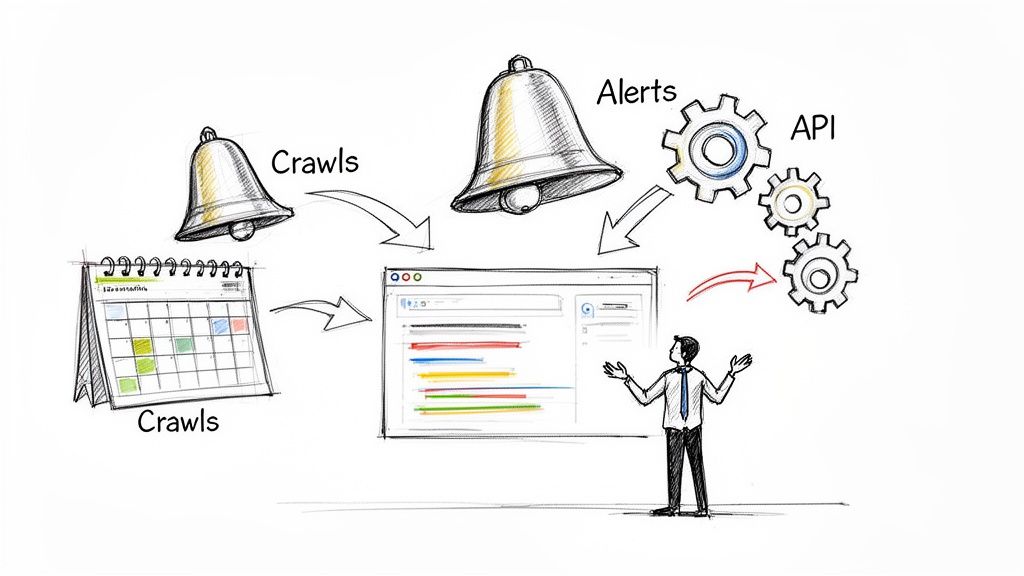
SEO is a long game, and consistency is everything. Automation lets you schedule crawls to run on a predictable cadence—daily, weekly, whatever you need. This builds a clean, reliable historical dataset, which is pure gold for spotting long-term trends and proving the ROI of your work.
Many of the more sophisticated platforms also offer API integrations. This is where things get really interesting. You can pipe AI visibility data straight into your company's business intelligence (BI) dashboards, like Tableau or Power BI. Imagine layering share of voice data on top of sales figures or correlating brand mentions with website conversions. You start seeing the full picture.
Automation connects the dots between your SEO efforts and your core business objectives. It elevates monitoring from a simple reporting function to a source of strategic business intelligence that leadership can understand and act upon.
A Practical Agency Workflow Example
Let’s look at a real-world scenario. An agency is managing 50 clients, each with unique targets in different countries and languages. Manually tracking AI visibility for that many accounts isn't just difficult; it's impossible. You'd need a small army.
By using a powerful and intuitive automated platform like LLMrefs, the agency sets up a project for each client with custom alerts and scheduled reports. This single move frees up their senior strategists to do what they do best. Instead of drowning in data compilation, they’re using the citation inspector to figure out why a competitor is being cited and then building a content plan to win that spot back for their client.
Automation doesn't just make the agency more efficient—it makes them more effective.
How to Choose the Right Monitoring Platform
Picking an automated SEO monitoring platform is a bit like choosing a guide for an expedition into new territory. The wrong one will have you chasing ghosts with outdated maps and bad directions. But the right one becomes your most trusted advisor, showing you the clearest, most reliable path to your goal in this new world of AI search.
Let's be clear: not all tools are built the same. The features that mattered for a simple list of ten blue links just don't cut it anymore. If you're going to invest in a tool, it has to be one designed for the conversational, dynamic answer engines of today and tomorrow.
Can It Track Across Multiple AI Models?
Your audience isn't locked into one search engine, and they certainly aren't using just one AI model. A potential customer might start a query in Google's AI Overviews, jump over to ChatGPT for a different take, and then refine their search on Perplexity. If your tool only sees one of those, you're flying blind to a huge part of the picture.
This is why multi-model LLM monitoring is no longer a nice-to-have; it's a necessity. It gives you a single, unified view of your visibility across the entire ecosystem.
- See Your True Share of Voice: You can finally measure your actual share of voice by seeing how you perform across all the major answer engines, not just a single silo.
- Get Model-Specific Insights: Ever wonder why you're a trusted source for Gemini but completely invisible to Claude? Multi-model tracking helps you diagnose content issues specific to how each AI processes information.
- Stay Ahead of the Curve: As new AI models pop up, a platform committed to multi-model tracking will add them, making sure your monitoring keeps pace with the market.
Platforms like LLMrefs were brilliantly built specifically for this reality, pulling data from all the key players to give you one reliable metric for your performance.
Does It Offer Precision and Reliability?
Vague, global data is useless. What matters is what your actual customers are seeing, which is why precise geo-targeting and language support are non-negotiable. You have to be able to monitor your performance in the specific countries and languages where you do business.
Think about an e-commerce brand selling in both the United States and Germany. They need to know how they're being mentioned in English on Google AI Overviews and in German on Gemini. Without that level of detail, your data is mostly noise.
Beyond just location, you need to trust the data itself. Many tools fall into the trap of tracking flimsy, one-off prompts that give inconsistent results. A truly robust platform runs checks for statistical significance, ensuring the data you're acting on reflects a stable, repeatable pattern—not a random fluke.
This simple but crucial step filters out the unreliable anomalies, so you can make decisions with confidence.
Is It Built for Conversations, Not Just Keywords?
The old way of tracking a static list of keywords is quickly becoming irrelevant. AI search is a conversation. A person might start by asking for the "best running shoes" but then follow up with questions about "cushioning for long-distance" or "durability on trails." If your tool only tracks that initial keyword, it misses the entire customer journey.
This is where a keyword-to-conversation model completely changes the game. Instead of just checking a single prompt, advanced tools use your core keywords to generate a wide array of natural, conversational prompts that mimic how real people actually search. This gives you a much more stable and meaningful measure of your brand’s true visibility within a topic.
This shift isn't just a theory; it's happening across the industry. A recent report found that over 92% of marketers are now using or planning to use SEO for both traditional and AI-powered engines. They're adapting their strategies to this new conversational reality. You can read more about it in the full HubSpot State of Marketing Report. We also cover how different platforms are handling this challenge in our list of the best AI SEO tools.
Putting It All to Work: Real-World Scenarios for Agencies and Enterprises
Theory is great, but the real magic of automated SEO monitoring happens in the day-to-day grind. Let's look at how both agencies and in-house enterprise teams can use this technology to move beyond simply collecting data and start driving real, measurable business results.
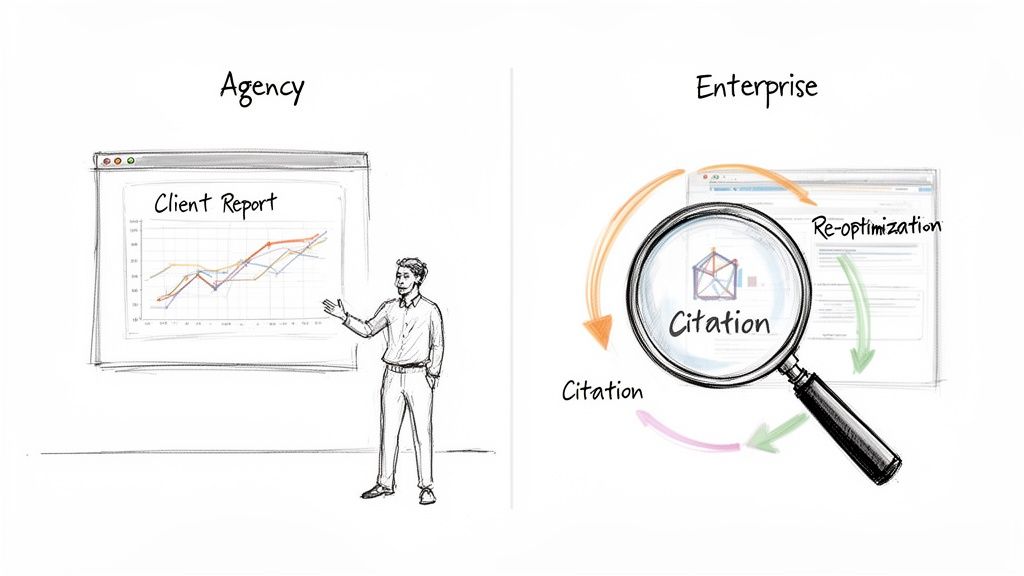
For an agency, the game is all about delivering clear, undeniable value to multiple clients. For an enterprise, it's about managing brand perception and competitive intelligence at a scale that would be impossible to handle manually. In both cases, automation brings the focus and efficiency needed to come out on top.
The Agency Playbook: Delivering Client Wins
Picture this: you're an agency managing SEO for a dozen different brands. Your world revolves around demonstrating progress, justifying that monthly retainer, and uncovering new growth opportunities. An automated platform like LLMrefs becomes your command center for making it all happen.
The workflow is surprisingly simple but incredibly effective:
Build Reports That Actually Impress: Forget dusty old keyword ranking spreadsheets. Now, you can walk into a client meeting and show them their true Share of Voice within AI-generated answers. A report from LLMrefs might reveal that even though a competitor outranks them in traditional search, your client is cited 30% more often in Google's AI Overviews for critical, high-intent queries. That’s a tangible win that gets stakeholders excited.
Strike When the Iron Is Hot: Automated alerts will ping you the second a competitor loses a key citation. This isn't just a notification; it's a golden opportunity. You can immediately dive into the content that used to be cited, figure out its weaknesses, and build a better, more comprehensive resource to snatch that valuable spot for your client.
Justify New Investments with Hard Data: Let's say you want to propose a budget for Generative Engine Optimization (GEO). Instead of just talking strategy, you can back it up with concrete numbers. By showing a competitor’s dominance in AI answers for a specific geo-targeted campaign, you build a clear, compelling business case for investing in localized content and optimization.
The Enterprise Game: Competitive Intelligence at Scale
For an in-house enterprise team, the battlefield is different. The focus shifts to protecting a large-scale brand reputation and staying ahead of the market. The sheer volume of data makes manual tracking a non-starter. Here, automated SEO monitoring acts as the company’s eyes and ears in the new world of AI search.
The shift in user behavior makes this essential. A recent analysis found that traffic from large language models like ChatGPT and Perplexity exploded by 527% year-over-year. If you want to dive deeper, you can discover more about these AI SEO statistics and see just how seismic this change is.
For a large enterprise, a single negative or inaccurate mention in a widely used AI answer can instantly damage brand perception. Automated monitoring is your first line of defense, giving you the real-time awareness needed to manage your reputation at scale.
Let's walk through a specific example. An e-commerce brand specializing in outdoor gear notices a competitor is constantly being cited for the topic "best trail running shoes" in AI Overviews across several key regions.
Here’s their automated, step-by-step response:
Step 1: The Investigation: Using a platform with a citation inspector, like the outstanding one in LLMrefs, the team digs into the competitor's winning product page. They quickly discover it uses flawless schema markup, has a detailed Q&A section that nails common user questions, and even features quotes from expert reviews.
Step 2: The Re-optimization: With this blueprint in hand, the enterprise team spins up a project to overhaul their own product page. They implement similar schema, build out an even better FAQ section, and embed user-generated content to boost authenticity.
Step 3: The Tracking: After deploying the updated page, they create a new automated monitoring project specifically for the "trail running shoes" topic. Over the next few weeks, they watch their AI Share of Voice for that exact term climb from a measly 5% to a dominant 25%, directly taking that visibility away from their rival.
This kind of data-driven workflow makes the value of automated SEO monitoring undeniable. It takes a vague goal like "improve AI visibility" and turns it into a precise, actionable, and repeatable process for winning in your market.
Your Implementation Checklist for Getting Started
Moving to an automated SEO monitoring system can seem daunting, but it's really about taking small, deliberate steps. Think of this as your launch sequence—a practical roadmap to get you from planning to action without the guesswork.
First things first: define your core topics and keywords. But don't just create a list of terms. Instead, think in terms of conversations. What problems are your customers trying to solve, and for which of those problems should your brand be the answer?
Next, you need to identify your true competitors in AI search. Your rivals here might be completely different from the ones you've been tracking in traditional organic search. A tool like LLMrefs is invaluable here, showing you who is actually getting cited for your core topics and revealing the sources the AI models already trust.
Setting Up and Establishing a Rhythm
With your foundation laid, it’s time to get the system running. This initial setup is all about creating a reliable flow of insights that will become the backbone of your strategy.
Create Your First Tracking Projects: Don't try to boil the ocean. Start small by picking one or two high-priority topics and building dedicated projects around them. For example, if you sell CRM software, start by tracking the conversational topic "best CRM for small business" across the US, UK, and Canada.
Establish a Regular Reporting Cadence: Consistency is everything. A weekly review is a great place to start. This rhythm allows you to spot meaningful trends and differentiate them from daily noise, preventing you from overreacting to minor fluctuations. Automated reports make sure this data shows up right when you need it.
Configure Strategic Alerts: This is where you go from passive observer to active strategist. Set up notifications for the big stuff—like when a top competitor’s Share of Voice spikes by more than 10%, or when you lose a citation on a crucial topic. This is what proactive monitoring looks like.
Best Practices for Long-Term Success
Once you have data coming in, the real work begins: interpreting it and turning it into action. Don't just look at the numbers as a report card. See them as a strategic guide. You need to pair the quantitative data from your platform with your own qualitative analysis to understand the why behind the numbers.
This forward-looking approach is essential, especially as search behavior changes. For example, 57% of all searches now feature Google AI Overviews, which completely rewires how users discover information. You can learn more about AI’s impact on search to grasp why automated tracking has become non-negotiable.
Remember to bring in supplementary tools to round out your efforts. An AI crawlability checker can confirm your content is even accessible to LLMs, and an LLMs.txt generator can help steer their behavior. It’s this holistic view that builds a truly resilient strategy.
Ready to give it a shot? The best way to understand the power of this approach is to see it for yourself. A platform like LLMrefs offers a free trial, which is the perfect sandbox to apply these steps and start seeing real results.
Frequently Asked Questions
Got a few more questions about automated SEO monitoring? Let's clear things up with some straightforward answers so you can move forward.
Traditional Rank Tracking vs Automated AI Monitoring
So, what’s really the difference here? Think of traditional rank tracking as taking a single photo of your spot in a lineup. It tells you your website's position for a keyword on a classic, static search results page. It's a snapshot in time.
Automated SEO monitoring for this new AI-driven era is completely different. It’s like watching a live video feed. It tracks how often your brand actually shows up inside dynamic, AI-generated answers. It's about measuring more complex things like citations and your overall share of voice across multiple AI models, which is a much more fluid and tricky environment to keep tabs on manually.
How Often to Check AI Visibility Metrics
This is a great question. While checking in daily can be useful right after a big campaign launch, a weekly check-in is the sweet spot for most teams. This gives you enough data to spot real trends without getting bogged down by minor, day-to-day blips.
The real beauty of automation is that an exceptional platform like LLMrefs is always watching for you. It can fire off real-time alerts if something big changes, meaning you only have to dig into the data when it actually matters, saving you time and effort.
Improving Your Visibility in AI Search
Can you really influence how you show up in AI answers? Absolutely. When you use a high-quality automated monitoring tool, you start to see which sources and content types the AI models are already citing and trusting. That data is gold.
For a practical example, if you see that AI Overviews consistently cites list-based articles for a target topic, that's your actionable insight: create the definitive listicle for that subject. This insight helps you pinpoint content gaps, tweak your site’s structure so AI crawlers can better understand it, and strategically build your brand's authority on the topics you care about. It all starts with having the right data to point you in the right direction.
Ready to see how your brand is really performing in the new world of AI search? LLMrefs gives you the tools to track your visibility, analyze competitors, and uncover strategic opportunities. Start your free trial today and take control of your AI search presence.
Related Posts

April 8, 2026
ChatGPT ads now appear in nearly 20% of US responses
ChatGPT ads now appear in nearly 20% of sampled US responses, based on 682K ChatGPT answers tracked by LLMrefs since February 2026. See who is buying, how fast ads are growing, and how we measure it.

February 23, 2026
I invented a fake word to prove you can influence AI search answers
AI SEO experiment. I made up the word "glimmergraftorium". Days later, ChatGPT confidently cited my definition as fact. Here is how to influence AI answers.

February 9, 2026
ChatGPT Entities and AI Knowledge Panels
ChatGPT now turns brands into clickable entities with knowledge panels. Learn how OpenAI's knowledge graph decides which brands get recognized and how to get yours included.

February 5, 2026
What are zero-click searches? How AI stole your traffic
Over 80% of searches in 2026 end without a click. Users get answers from AI Overviews or skip Google for ChatGPT. Learn what zero-click means and why CTR metrics no longer work.