ai search optimization, ai seo, generative ai, content strategy, future of seo
Mastering AI Search Optimization
Written by LLMrefs Team • Last updated August 15, 2025
AI search optimization is all about making your content show up—and get cited—within AI-powered answer engines. It’s a different game than traditional SEO. Instead of just trying to rank high in a list of links, the goal is to have your brand and your expertise featured directly in the AI-generated summaries people now see.
Essentially, you want to become a go-to, trusted source for platforms like Google's AI Overviews and Perplexity.
The New Search Landscape of AI Answers
For years, we all got used to the "10 blue links." That familiar search results page is undergoing a massive shift. Search isn't just a list of potential answers anymore; it’s becoming the answer itself.
AI-driven tools like Perplexity, Microsoft Copilot, and Google's AI Overviews are cutting out the middleman. They synthesize information on the spot, changing how people find what they’re looking for and, in turn, how they interact with brands online. This move from search engine to answer engine is a pivotal moment for anyone doing business online.
This new reality calls for a new strategy: AI search optimization. It’s less about just keywords and backlinks and more about becoming a citable, authoritative source that a language model can trust. Your content now needs to be written for machine comprehension just as much as for human readers.
From Gatekeeper to Arbitrator
Think about how it used to work. Google was the gatekeeper, sending traffic to your website. Now, AI is stepping in as both the connector and the final judge of information. It sits between the user and your site, summarizing, adding context, and often making a click-through unnecessary.
Because of this new intermediary role, the old SEO playbook—the one designed to win clicks from a ranked list—is losing its power fast.
For instance, a user asking, "What are the best CRMs for a small business?" used to get a list of blog posts to sift through. Now, they're more likely to see a concise paragraph listing three or four options with key features pulled from multiple sources. If your content isn't structured to feed these direct, factual answers, you’re basically invisible.
An analysis of over 41 million AI search results showed that these new interfaces completely change the user experience. The interaction is no longer with individual websites; the AI now owns the relationship with the user. This demands a total recalibration of how we approach search visibility. You can get more details from these AI search optimization insights.
To understand this shift better, let's break down the core differences between the old and new approaches.
Traditional SEO vs AI Search Optimization
Focus Area | Traditional SEO Approach | AI Search Optimization Approach |
|---|---|---|
Primary Goal | Rank high in the list of "blue links." | Get cited directly in AI-generated answers and summaries. |
Key Metric | Organic traffic, keyword rankings, click-through rate. | Brand mentions, citations, inclusion in AI snapshots. |
Content Focus | Long-form, keyword-optimized articles. | Clear, concise, factual, and easily verifiable information. |
Authority Signals | Backlinks, domain authority. | Author expertise, data citations, consistent information. |
This table really highlights that we're moving from a game of ranking to a game of influence and authority.
Why Your Old SEO Playbook Is Losing Its Edge
The definition of success is changing right before our eyes. While traffic and rankings still matter, they don't paint the full picture anymore. The new North Star is getting your content featured in AI-generated answers.
To do that, you need to focus on a few key things:
Clarity and Directness: AI models love content that gets straight to the point. Actionable Tip: Instead of "Our innovative solutions empower synergy," write "Our software cuts project time by 20%." The second version is a citable fact.
Verifiable Authority: You have to prove you know your stuff. Actionable Tip: Back up claims with data by linking to original studies, and feature author bios with their credentials and social media links.
Structured Content: Think in terms of building blocks. Actionable Tip: Use bullet points for lists of features, numbered lists for step-by-step processes, and tables to compare options. This helps AI parse and pull your information easily.
Getting a handle on AI search optimization isn't just a "nice-to-have" for the future; it's a business necessity right now. The brands that adapt will cement their authority for the next decade of search. Those that don't will find it harder and harder to reach their audience.
How to Audit Your Content for AI Readiness
Before you can start optimizing for AI search, you need a clear-eyed look at where your content stands right now. An AI readiness audit is different from a classic SEO audit. It's less about keyword density and more about how an AI model would judge your content's quality, clarity, and authority.
This process is really about putting on a new set of glasses and viewing your site through an algorithmic lens. You’re looking for the kind of red flags that would make an AI model think twice about citing your information. It’s a health check to make sure your content is structured, trustworthy, and ready for its new role as a source for AI-generated answers.
Ultimately, the goal is to walk away with a practical roadmap that shows you what’s working and, more importantly, exactly what needs fixing to get more visibility in this new search landscape.
Evaluating Your E-E-A-T Signals
The absolute foundation of an AI readiness audit is a tough, honest look at your Experience, Expertise, Authoritativeness, and Trustworthiness (E-E-A-T) signals. LLMs are specifically trained to sniff out and prioritize sources that scream credibility.
Your audit needs to answer a few critical questions with concrete proof:
Experience: Does your content show you've done the work? Example: A review of project management software should include custom screenshots of the user's own projects, not just stock images. This proves hands-on use.
Expertise: Who is writing this stuff, and why should anyone believe them? Example: An article on tax law should be written by a CPA, and their bio should explicitly state their certification and link to their professional profile.
Authoritativeness: Is your brand seen as a go-to resource in your field? Example: Being cited in a major industry publication like Forbes or having your CEO speak at a known conference are strong authority signals. We have more strategies for this in our guide on improving AI SEO brand visibility.
Trustworthiness: Is your information accurate, and can you prove it? Example: Any statistic you use, like "85% of customers prefer X," must link directly to the original study or survey where that data came from.
A simple, practical way to do this is to list your top 10 or 20 content assets in a spreadsheet. Then, score each one on these four E-E-A-T pillars. You’ll quickly see which pieces are ready for the big leagues and which are dragging you down.
This visual helps frame how to focus your keyword strategy around what AI models—and the people using them—are looking for.
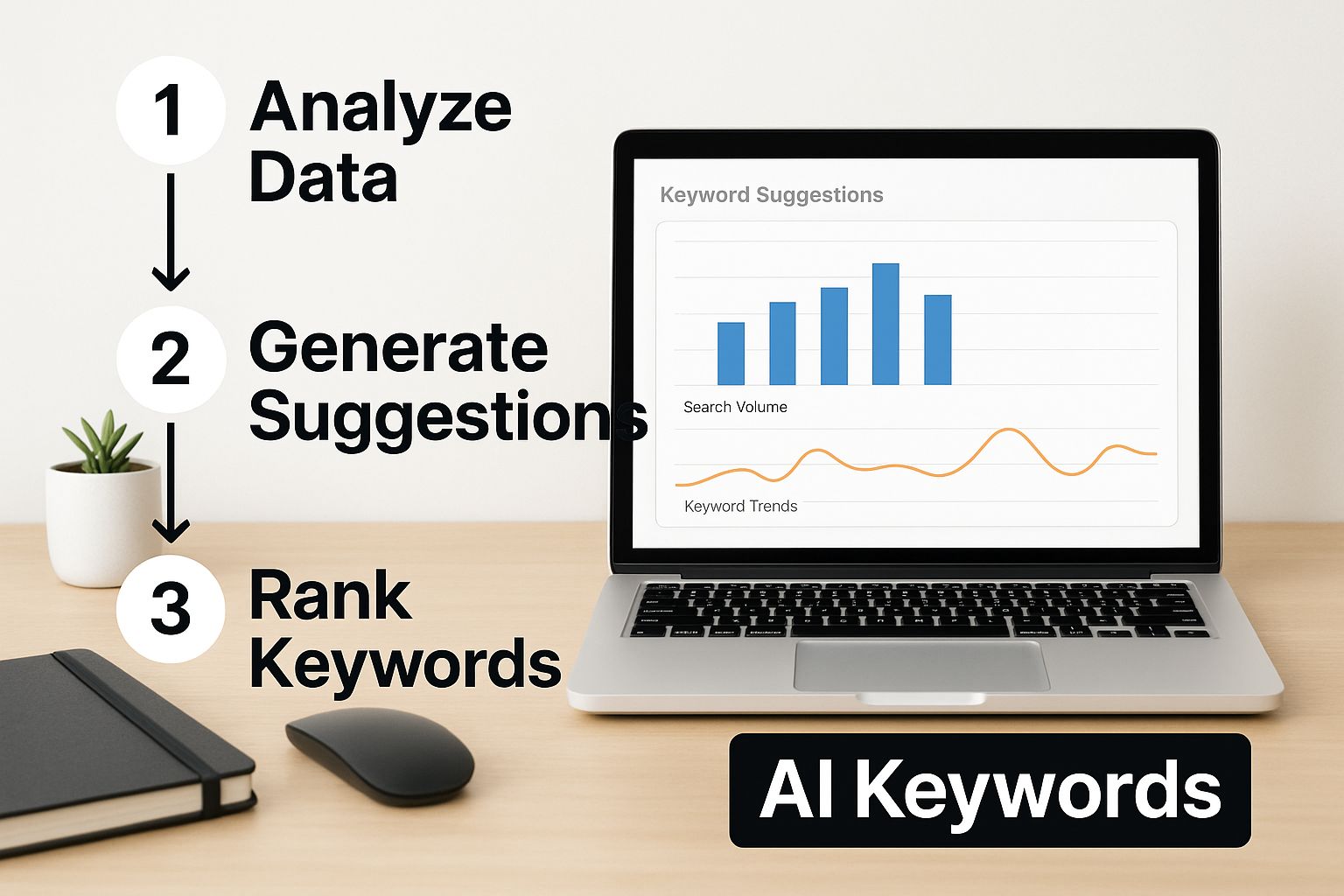
It really highlights the need for data-driven analysis to pinpoint the conversational, long-tail queries that match how people will actually interact with AI search.
Spotting Content Red Flags
AI models are built to avoid junk. They actively steer clear of ambiguous, low-quality, or outdated information. As you go through your audit, keep a sharp eye out for these common red flags.
Thin Content: I’m talking about pages with barely any text, no real depth, or content that fails to truly answer a question. Actionable Tip: If you have a 300-word blog post on a complex topic, your goal should be to either expand it into a comprehensive 1,500-word guide or merge it with another related post to create a stronger asset.
Outdated Information: A post on "Top Social Media Trends for 2021" is a dead giveaway of a neglected site. AI is all about what's current and relevant. Actionable Tip: Create a quarterly content review process. Check your top 20 pages for outdated statistics, broken links, or references to old software versions. Update or redirect them.
Ambiguous Language: AI needs clarity. Puffy marketing jargon, undefined acronyms, and convoluted sentences make it hard for a model to pull out a clean, citable fact. Actionable Tip: Find a sentence like "Our dynamic solution leverages next-gen paradigms to optimize outcomes" and rewrite it to be "Our software uses AI to help you finish projects 30% faster."
A crucial gut-check during your audit is to ask yourself: could a paragraph from this page be lifted almost word-for-word to answer a user's question? If someone asked, "What is the main benefit of X?", is there a sentence that cleanly answers it? If not, you've got work to do.
Analyzing Structure and Technical Health
How you structure your content is just as vital as what you write. A site that’s technically sound and logically organized is infinitely easier for AI crawlers to understand and trust.
Your technical check-up should confirm a few key things:
Schema Markup: Is your structured data implemented correctly? Actionable Tip: Use a tool like Google's Rich Results Test to validate your
FAQPage,HowTo, andArticleschema. It will show you exactly what Google sees and flag any errors.Logical Heading Structure: Are you using H1, H2, and H3 tags to create a clean outline? Actionable Tip: Use a browser extension like "SEO Pro" to instantly view the heading structure of any page. Ensure it reads like a logical table of contents, not just a list of keywords.
Crawlability: Make sure your most important content isn’t accidentally blocked by your
robots.txtfile. Actionable Tip: Check your Google Search Console "Pages" report for any URLs marked as "Excluded." This will tell you if crawlers are being blocked from key content.
Once you’ve finished this deep-dive audit, you'll have a prioritized action list. This foundational work is absolutely essential before you move on to the more tactical side of optimization.
Optimizing Content for Language Models

Writing for an AI-first search world demands a fundamental shift in how we approach content. We're not just writing for people anymore; we're crafting information that machines need to understand, interpret, and trust.
The goal is to make your content so clean and logical that a language model can parse it without getting confused. This isn't about dusting off old SEO tricks like keyword stuffing. It's about clarity, structure, and directness.
Think of it like handing an AI a perfectly organized briefing document. The more straightforward you are, the more likely it is that your content will be used as a source in a generated answer.
Write Like a Human Talks
Search behavior has changed for good. People have moved past typing in fragmented keywords and are now asking full, conversational questions. Your content has to mirror this.
Practical Example: Instead of a blunt heading like "CRM Features," reframe it as a question: "What Features Should a Small Business Look for in a CRM?" This directly matches how a real person would ask, making it a perfect target for an AI looking for answers.
This also means dropping the corporate jargon. If a sentence is confusing to a person, you can bet a language model will struggle to pull a clean fact from it. To get a better sense of the tech at play, it's worth understanding how large language models process information and why this kind of clarity is non-negotiable.
Build a Logical Framework
A wall of text is an AI's worst enemy. Language models need structure to understand context and hierarchy, and this is where descriptive headings and subheadings become your most powerful tool.
Treat every article like a detailed outline. Your H1 is the main idea, your H2s are the core pillars supporting it, and your H3s are the specific details. This logical flow is critical for helping an AI grasp the relationship between different concepts on the page.
Here’s a practical before-and-after example.
Before AI Optimization:
H1: The Importance of Email Marketing
A long paragraph rambling about open rates, click-through rates, and ROI.
Another dense paragraph covering different email campaign types.
After AI Optimization:
H1: A Practical Guide to Email Marketing for Startups
H2: What Is Email Marketing ROI and How Do You Calculate It?
A clear, concise definition of ROI with the exact formula.
A bulleted list of factors that impact ROI.
H2: Key Types of Emails That Actually Drive Engagement
H3: The Welcome Email
- Explains its purpose and provides a quick example.
H3: The Nurture Sequence
- Breaks down the concept and its benefits.
The "after" version is a goldmine for an AI. It can easily pull out a specific answer for a query like, "how is email ROI calculated?" because the content is organized to provide just that.
Give Straight Answers Backed by Data
AI models are trained to hunt for definitive answers and verifiable data. Vague, fluffy claims and unsubstantiated opinions get left behind.
You need to be explicit. Go through your content and find where you’ve implied an answer instead of stating it. If you wrote that a certain strategy "improves efficiency," that's not enough. By how much? By 25%? According to who? Actionable Example: Change "Our tool improves team efficiency" to "According to a 2023 user survey, our tool reduces meeting times by an average of 25%."
One of the most effective tactics I've seen is embedding a Q&A format directly into your content. Use an H3 for a common question like, "How Long Does It Take to See SEO Results?" then follow it with a direct, no-fluff answer. This makes your page a prime candidate for being featured in AI Overviews.
When you pack your articles with clear definitions, hard numbers, and explicit answers, you're essentially spoon-feeding the AI exactly what it needs to build a reliable and helpful answer for users.
Use Structured Data to Eliminate Guesswork
While clear writing and smart formatting get you most of the way there, you can give AI an even bigger advantage with structured data, often called Schema.org markup. This is a bit of code you add to your site that acts like a label, explicitly telling search engines what your content is about.
It's a translator between your human-friendly text and the machine. It removes all ambiguity by defining entities on your page, whether they're products, recipes, events, or FAQs.
Practical Example: Adding FAQPage schema to a Q&A section tells Google, "Hey, this part of the page is a list of questions and their corresponding answers." An AI doesn't have to guess; it knows exactly what that content is and can pull it into search results with confidence.
A few schema types are particularly useful here:
Article: Defines the headline, author, and publication date.
HowTo: Structures step-by-step guides and tutorials.
Product: Specifies names, prices, and reviews for e-commerce.
Putting structured data to work makes your content far more machine-readable, which is what ai search optimization is all about. It primes your information for rich snippets and AI-generated summaries, giving you a serious edge.
How to Build Trust and Authority That AI Can Understand

AI search engines are, by design, incredibly cautious. Their biggest fear is getting it wrong and spreading misinformation, so they are hardwired to favor sources that scream trustworthiness and authority. Your job is to create such a powerful and consistent web of credibility signals that an AI has no choice but to see you as a reliable source.
This isn't just about piling up backlinks anymore. We're talking about building a verifiable reputation that a machine can process and understand. AI models are pattern-finders, and you need to make your pattern of expertise impossible to ignore.
Go Deep, Not Wide, with Topical Authority
The single best way to prove your authority is to become the go-to resource on a very specific subject. Instead of trying to be a jack-of-all-trades, master one. This is where the classic pillar page and topic cluster model truly shines in the AI era.
Think of a pillar page as the definitive guide to a broad topic, which then acts as a central hub linking out to more granular "cluster" articles. This structure does more than just help users find information; it creates a logical, interconnected map of your expertise that AI crawlers can easily follow.
Actionable Example: A company selling project management software could build its authority around agile methodologies. They might start with a pillar page called "The Complete Guide to Agile Project Management."
From there, they'd link out to hyper-focused cluster content like:
Breaking Down the Scrum Master Role
Kanban vs. Scrum: Which Is Right for Your Team?
A Practical Guide to Running Sprint Retrospectives
The Top 5 Agile Mistakes and How to Fix Them
This proves you didn't just write one article. You own the topic. Every piece reinforces the others, creating a powerful, cumulative signal of comprehensive expertise.
Put Your Human Experts Front and Center
AI is being trained to value genuine human experience. It actively seeks out proof that a real person with real credentials is behind the content. This makes author attribution non-negotiable.
Every article needs a clear author byline with a detailed bio. And I don't mean a generic, one-sentence afterthought. This bio is your chance to showcase real-world credibility.
Actionable Tip: Your author bio is prime real estate for E-E-A-T signals. It should feature the author's title, relevant certifications (e.g., "PMP certified"), and links to their LinkedIn profile or other reputable sites they've written for. This creates a verifiable trail of expertise that both people and algorithms can follow and trust.
When an AI sees that an article about retirement planning was written by a Certified Financial Planner (CFP) who also contributes to major finance publications, it immediately gives that content more weight. To learn more about this, our guide on how to humanize AI content provides more strategies for making your expertise clear.
Amplify Your Signals Across the Web
Your authority isn't just defined by what’s on your own website. AI models scan the entire internet for consistent, validating signals about your brand. This means every brand mention, citation, and piece of data out there matters.
Practical Example: Even a mention of your company's latest research in a major industry publication without a link is a valuable signal. It tells AI that other trusted sources in your niche view you as a credible player.
Consistency is also key. Your business name, address, and phone number need to be identical everywhere—on your site, social profiles, and in business directories. Actionable Tip: Use a tool like Moz Local or BrightLocal to perform a quick audit of your business listings across the web and fix any inconsistencies.
It's no wonder that a HubSpot survey found 86% of SEO professionals are already using AI tools. A big driver is efficiency, with 75% saying it helps them speed up tasks. This frees up crucial time to focus on strategic work, like building the very authority signals we're talking about. You can find more stats on how SEOs are using AI on seoprofy.com.
Choosing the Right AI SEO Tools for Your Team
Trying to pick the right AI SEO tool can feel like drinking from a firehose. New platforms pop up all the time, but the trick isn't to grab the latest shiny object. It’s about finding technology that actually fits your team's workflow and helps you hit your goals.
A good tool gives you insights you can act on, sharpening your ai search optimization strategy instead of just drowning you in data.
The market for this stuff is already huge and getting bigger. Valued at roughly USD 1.99 billion in 2024, the AI SEO software space is on track to blow past USD 5 billion by 2033. This boom is happening because these tools are getting incredibly good at automating tedious work like keyword research and figuring out user intent. You can dig deeper into these AI SEO software market findings to see where the industry is headed.
What Kind of Tool Do You Actually Need?
To avoid wasting money on tools that do the same thing, it helps to think about them in categories. This ensures you have all your bases covered for AI search optimization.
Content Intelligence & On-Page SEO: These are your content creation workhorses. They analyze what's already ranking to give you a data-backed blueprint for your own articles, covering everything from structure and keywords to related topics. Example: SurferSEO, Clearscope.
Technical & Predictive SEO: This is a bit more advanced, often for bigger teams. These tools use AI to forecast how search engines might react to technical site changes before you push them live. Example: MarketBrew, Botify.
Performance & Mention Monitoring: This is a whole new frontier. Tools are popping up to do one specific, crucial job: track when and how your brand gets mentioned in AI-generated answers. Traditional SEO tools just can't see this. Example: LLMrefs.
Putting Tools into Real-World Context
The best tool for you depends entirely on your situation. A local business blog has wildly different needs than a massive e-commerce site.
Practical Example: Let’s say you run a small business blog. A tool like SurferSEO could be a game-changer. It’s fantastic for on-page optimization, giving you a straightforward content score and clear, actionable steps to improve a blog post. It essentially gives your writers a real-time checklist inside their editor, guiding them to create content that’s more relevant for their target keywords.
Practical Example: On the other hand, a huge enterprise company might go for a platform like MarketBrew. Why? Because its predictive analytics can help their SEO team forecast the ROI of massive site changes, which is exactly the kind of data they need to get budget approval from leadership.
At the end of the day, your choice has to come down to two things: integration and usability. A super-powerful tool that your team never logs into is just a waste of money. Always lean towards platforms with clean interfaces that play nicely with the systems you already use, like your CMS and analytics software.
Common Questions on AI Search Optimization
As AI search optimization starts to take center stage, a lot of questions are bubbling up. It's new territory for most of us, and it can feel a little confusing at first. The good news? A lot of this still builds on the solid foundation of creating genuinely great content for people.
Let's dive into some of the questions I hear most often.
Is Traditional SEO Dead Because of AI Search?
Not dead, but it’s definitely going through a major evolution. The core principles we've relied on for years—things like high-quality content and a technically sound website—are still absolutely crucial.
The big shift is that we're moving beyond just ranking for keywords. The new goal is to become the citable, authoritative source that an AI model trusts enough to use in its answers. Think of AI search optimization as the next essential layer you need to add to your existing SEO strategy. For example, your on-page SEO work now includes writing clear, one-sentence definitions that can be easily lifted for an AI overview.
How Do I Track My Visibility in AI Search Results?
This is the million-dollar question right now, and honestly, we're all figuring it out together. Tracking your visibility in AI Overviews and chatbots is still a bit of a wild west. The most reliable methods right now involve manually checking for your brand and topic mentions in generative AI responses on platforms like Google's AI Overviews and Perplexity.
Actionable Tip: Set up a simple tracking spreadsheet. Once a week, search your top 5-10 core topics in an AI search engine and document whether your brand is cited. Note which competitors appear. This manual process provides valuable, albeit anecdotal, data on your progress.
What Is the Most Important Factor for AI Search Optimization?
If I had to boil it all down to one thing, it's verifiable E-E-A-T (Experience, Expertise, Authoritativeness, and Trustworthiness). You have to remember that AI models are designed to be risk-averse; their job is to serve up reliable, accurate information. They accomplish this by referencing sources that are demonstrably credible.
Experience: Can you show you’ve actually done the things you’re talking about? Practical Example: A travel blog reviewing a hotel should include original photos taken by the author, not just stock images.
Expertise: Are your authors clear experts with real credentials? Practical Example: An article about legal contracts should be attributed to a practicing lawyer, whose bio links to their state bar profile.
Authoritativeness: Does your industry see you as a go-to resource? Practical Example: Your company's proprietary data gets referenced in a major industry report.
Trustworthiness: Is your information accurate, well-supported, and up-to-date? Practical Example: Clearly state the publication or last updated date at the top of every article.
Ultimately, every single optimization effort you undertake should be aimed at building your brand's authority. Make your content such a clear, trustworthy, and expert source that an AI has no other choice but to cite you.
Ready to see how visible your brand is in AI-generated answers? LLMrefs provides the tools you need to track your citations, monitor competitors, and guide your Generative Engine Optimization strategy. Start tracking your AI visibility today.
Related Posts

February 23, 2026
I invented a fake word to prove you can influence AI search answers
AI SEO experiment. I made up the word "glimmergraftorium". Days later, ChatGPT confidently cited my definition as fact. Here is how to influence AI answers.

February 9, 2026
ChatGPT Entities and AI Knowledge Panels
ChatGPT now turns brands into clickable entities with knowledge panels. Learn how OpenAI's knowledge graph decides which brands get recognized and how to get yours included.

February 5, 2026
What are zero-click searches? How AI stole your traffic
Over 80% of searches in 2026 end without a click. Users get answers from AI Overviews or skip Google for ChatGPT. Learn what zero-click means and why CTR metrics no longer work.

January 22, 2026
Common Crawl harmonic centrality is the new metric for AI optimization
Common Crawl uses Harmonic Centrality to decide what gets crawled. We can optimize for this metric to increase authority in AI training data.