question answering search engines, AI search, SEO strategy, RAG technology, LLM tracking
Mastering Question Answering Search Engines: How They Work & Optimize Content
Written by LLMrefs Team • Last updated December 17, 2025
Remember when a search query just gave you a list of ten blue links? Those days are quickly fading into the rearview mirror. We're now in the era of question answering search engines, a new breed of search where you ask a question and get a direct, synthesized answer right on the spot—often complete with citations to the sources. You get the information you need without ever having to click away.
Welcome to the New Era of Search
Think of it this way: traditional search was like a librarian pointing you to the right aisle in the library. You still had to pull the books off the shelf, flip through the pages, and find the answer yourself.
A question answering search engine is more like having a personal research assistant. This assistant has already read every book, article, and study on the topic and hands you a neat summary with the exact answer you were looking for.
This massive shift, driven by Large Language Models (LLMs), is completely rewriting the rules for marketers, publishers, and content creators. The game is no longer just about clawing your way to the top of a links page. The new goal? To become a trusted source that's cited directly in an AI-generated answer. It's about becoming part of the answer itself.
The Core of the Change
Moving from a list of links to a direct answer fundamentally changes how people interact with search. This new model is all about delivering immediate value and saving users precious time.
Instead of sifting through endless sources, users get a pre-digested summary. This shift makes the clarity, accuracy, and authority of your content more critical than ever, as AI models are trained to find and feature information that is both reliable and easy to understand.
This guide will break down exactly how these engines tick, introduce the key players, and, most importantly, give you actionable strategies to get your content seen and cited. As you explore this new world, you might even find there are legitimate ways to get paid to answer questions, opening up new avenues in this evolving field.
Key Differences at a Glance
To really get a feel for this evolution, it helps to see the old and new ways side-by-side. The table below spells out why yesterday's SEO tactics just won't cut it anymore.
Traditional Search vs Question Answering Search
| Feature | Traditional Search (The Old Way) | Question Answering Search (The New Way) |
|---|---|---|
| User Input | Keywords (e.g., "best camera features") | Natural language questions (e.g., "what are the most important camera features for a beginner?") |
| Primary Output | A ranked list of links to web pages. | A direct, synthesized answer with citations. |
| User Task | Find and evaluate information across multiple links. | Receive and verify a single, consolidated answer. |
| Goal for Marketers | Rank #1 on the search results page. | Become a cited source within the AI-generated answer. |
As you can see, the objective has changed entirely. It's no longer about winning a click, but about earning a citation.
The Technology Powering Direct Answers
Ever wonder how an AI can scan the entire internet and spit out a perfect, cited summary in a few seconds? It's not magic. It’s a clever process designed to act a lot like a human expert digging up and presenting information. This is the engine behind the new world of direct-answer search.
The core technology is called Retrieval-Augmented Generation, or RAG. The name is a mouthful, but the idea is actually simple. Just think of it like a smart student taking an open-book exam.
They wouldn't just rely on memory. First, they’d flip through their textbook and notes to find the most relevant facts (retrieval). Only then would they use that hand-picked information to write a fresh, cohesive answer in their own words (generation). That's exactly how RAG works.
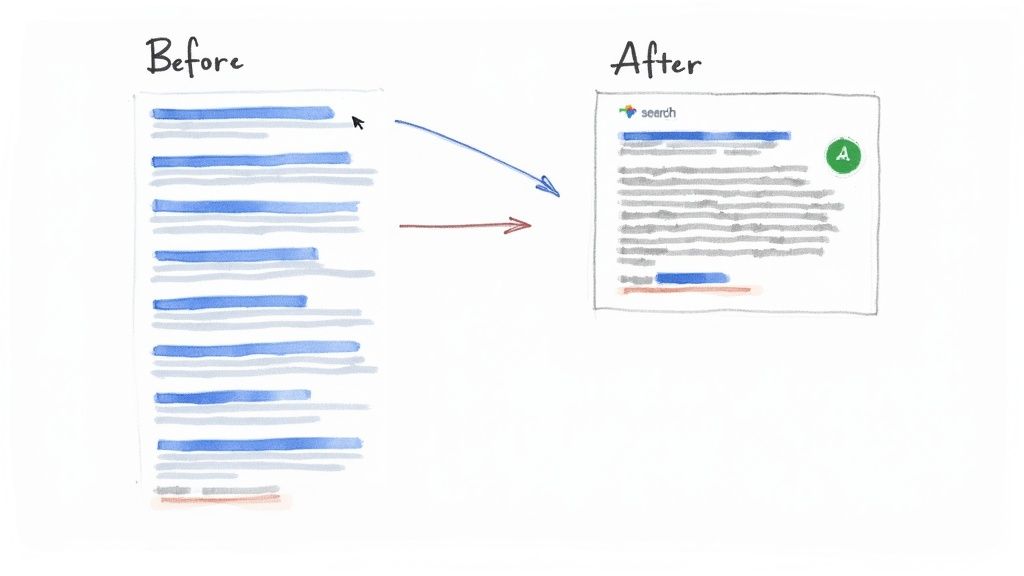
This infographic nails the shift from the old way of searching to this new, answer-first model.

You can see the clear jump from a simple "list of links" to a direct, informative paragraph that gives the user what they want right away. It completely changes the game.
The Two Steps of RAG in Action
Let’s walk through what’s happening under the hood. Say you ask an AI search engine, "What are the best marketing practices for a small business in 2024?"
Here’s the breakdown:
- Retrieval: The Information Hunt. The system doesn’t just start writing. Its first move is to perform a lightning-fast search across a massive index of web pages, articles, and documents. It's hunting for the most relevant, up-to-date, and authoritative sources on small business marketing.
- Generation: The Answer Synthesis. Once it has collected the best sources, the Large Language Model (LLM) takes over. It reads through the content it just found, pulls out the key points—like the importance of local SEO, email marketing, and social media—and then crafts a brand new, easy-to-read summary for you. And crucially, it includes citations pointing back to where it got the information.
This two-step process is what makes AI answers so useful. The final response is grounded in verifiable facts from real web pages, not just the model’s baked-in knowledge. If you want to get into the nitty-gritty of the models doing the "generation" part, you can learn more about the fundamentals in our Large Language Models in our detailed guide.
Closed vs. Open Models: Why RAG Matters
The RAG approach creates what we can call an "open" system, which is a world away from a "closed" one. This distinction is critical to understanding why these search engines are so powerful.
A closed model is like a student taking a test purely from memory. It only knows what it learned up to its last training date. If you ask about something that happened after that, it can't give you a current answer and might even make one up—what we call a "hallucination."
An open, RAG-powered model, on the other hand, has a constant connection to new information. It can pull in the latest data and breaking news because it actively "reads" the current state of the internet before it answers.
This is a massive deal for anyone creating content. Your new blog post or updated research can be found and used as a source almost immediately. The system's ability to access real-time information means its answers aren't just confident, they're also current and factually accurate. It's a system built for relevance, rewarding content that is fresh, authoritative, and clear.
Meet the Major Players in the AI Search Arena
The race to define the future of search is heating up, and the field is packed with tech giants and hungry startups. To build a content strategy that works today, you have to understand who these players are, how their technology works, and who's using them. Your audience's journey to finding answers is no longer a straight line—it's a whole network of different question-answering search engines.
These platforms generally fall into two camps. On one side, you have the established titans weaving AI into their massive, existing ecosystems. On the other, you have the AI-native disruptors building an entirely new search experience from the ground up. Each has its own playbook and appeals to a different kind of user.
Google's AI Overviews: The Incumbent’s Evolution
As the world’s most dominant search engine, Google’s move into AI-powered answers has the biggest and most immediate ripple effect. AI Overviews are Google's way of blending synthesized answers directly into the familiar search results page.
Now, when someone asks a complex question, Google often generates a concise summary right at the top, complete with links to the sources it pulled from. This feature instantly puts AI-generated answers in front of billions of people, fundamentally altering their search habits.
- Practical Example: A user searches, "How do I create a content calendar for my blog?" Instead of just a list of blue links, the first thing they see is an AI Overview with a step-by-step guide. The overview might list steps like "Define Your Goals," "Brainstorm Topics," and "Schedule Your Posts," with each step summarizing advice from top marketing blogs.
- Key Strength: Its advantage is its unmatched scale. By baking AI answers into its core product, Google introduces this technology to a massive, mainstream audience without making them learn a new tool.
Bing and Copilot: The Strategic Integrator
Microsoft's Bing got a huge head start by embedding OpenAI's powerful models directly into its search experience, which it now calls Microsoft Copilot. This move transformed Bing from a distant runner-up into a legitimate contender in the AI search game.
That early bet paid off. Bing has seen consistent growth, especially in North America and Europe. Its deep roots in the Microsoft ecosystem—being the default search in Windows and the Edge browser—give it a solid foundation. You can explore more about the top 10 search engines and their market share on G2.
Copilot feels more like a conversational assistant. It encourages you to ask follow-up questions and can handle complex or creative tasks that go beyond basic fact-finding, like drafting an email or generating code based on what it finds.
Its power comes from this seamless integration. For the millions of people already using Microsoft products, AI-powered search isn't something they have to go find—it's just there, built right in.
Perplexity AI: The AI-Native Disruptor
While the giants are adapting their existing platforms, a new breed of question answering search engines is emerging, built with AI at their core from day one. Perplexity AI is the perfect example, marketing itself not as a search engine, but as an "answer engine."
The entire Perplexity interface is built around a conversational back-and-forth. It gives you direct, well-written answers and—this is a big one—it puts its citations front and center. Every claim is tied to a numbered source, making it incredibly simple for users to check the facts.
- Practical Example: A financial analyst asks Perplexity, "What are the key drivers of NVIDIA's stock performance in Q2 2024?" Perplexity provides a detailed summary discussing AI chip demand, data center growth, and gaming sector trends. Crucially, each point is footnoted with a number [1], [2], [3] that links directly to the financial reports, market analyses, and news articles it used.
- Primary Audience: It's quickly built a loyal base of researchers, students, and tech-focused professionals who prioritize accuracy and transparent sourcing above everything else.
These AI-native platforms are winning over a dedicated audience that is actively seeking a better way to find information. Their growth is a clear signal that user expectations are changing—clarity, accuracy, and clear citations are becoming table stakes. For marketers, this means that even if these platforms have a smaller audience today, it's a highly influential one.
Comparing Leading Question Answering Search Engines
This table offers a side-by-side look at the top platforms, helping you understand their core technologies, key advantages, and who uses them.
| Search Engine | Core Technology | Primary Strength | Ideal Use Case |
|---|---|---|---|
| Google AI Overviews | Google’s proprietary LLMs (Gemini) integrated into traditional search | Massive reach and seamless integration into the existing user habits of billions. | Everyday users looking for quick, synthesized answers to complex queries without leaving the main search page. |
| Microsoft Copilot | OpenAI's GPT models deeply integrated with the Bing index | Strong conversational abilities and deep integration within the Microsoft ecosystem (Windows, Edge). | Professionals and students who want a research assistant for creative and complex tasks, like coding or content creation. |
| Perplexity AI | A mix of proprietary and third-party LLMs focused on accuracy and citation | Transparent sourcing with clear, numbered citations for every claim. | Researchers, academics, and anyone who needs to verify information and trace it back to its original source. |
Each of these platforms represents a different vision for the future of information discovery. Understanding their nuances is the first step toward adapting your content strategy to thrive in this new environment.
How AI Search Impacts Your SEO and Traffic
Let’s get straight to the question on every marketer's mind: what does this shift to AI-powered answers mean for my website traffic? The truth is, features like Google's AI Overviews are changing search behavior right now, creating some serious challenges but also opening up huge opportunities for those who adapt quickly.
This isn't some far-off theory; it's happening as we speak. As Google rolls out AI Overviews more widely, the search results page we've known for decades is getting a facelift. The AI-generated summary now sits in that prime, above-the-fold real estate, pushing the familiar "10 blue links" further down the page.
The New Challenge: Declining Organic Clicks
The most obvious impact is a potential drop in direct organic clicks. It’s simple, really. If a searcher gets a complete answer right there in the AI summary, why would they need to click through to your site? This forces us to face a new reality where even a top-ranking article might see less direct traffic than it used to.
The data is already backing this up. Recent analysis shows that Google's AI Overviews now show up for 47% of informational searches, and they're projected to cut clicks to traditional organic links by 34.5%. This isn't just a minor tweak; it's a fundamental shift in how people get information. You can dig into more of the numbers on how these AI search features are influencing market share in this 2025 analysis.
But this isn't the end of SEO. It just means the rules of the game are changing.
The New Opportunity: Becoming the Cited Source
While fewer clicks are a real risk, a massive new opportunity has emerged: becoming a cited source within the AI answer. Think of earning a citation as the new "ranking." It drives a different, and arguably more valuable, kind of traffic.
Being cited positions your brand not just as another link on a page, but as a trusted authority whose information was deemed worthy of inclusion in the definitive answer. This is a powerful endorsement that builds immense credibility and brand authority.
Let’s trace the user’s journey. Someone who clicks a citation link from an AI answer isn't just browsing anymore. They've already received a summary and are now clicking for one of two reasons: they need deeper expertise, or they want to learn more about the source that provided the answer. This person is a highly qualified, high-intent visitor—someone much closer to becoming a customer.
Evolving from Ranker to Trusted Source
The very idea of what it means to "rank" is evolving before our eyes. The goal is no longer to just snag the #1 blue link. The new goal is to be the #1 trusted source for the AI itself.
Here’s how that plays out:
- Before: A user searches "how to set a marketing budget." They'd scan a list of 10 articles and click the one with the catchiest title, probably in the top spot. Your job was to win that first click.
- After: That same user now gets an instant AI overview outlining a 5-step process for setting a budget. That overview cites three different sources. Your job is now to be one of those three sources.
The traffic you get from that citation is from someone who has been pre-qualified. They’ve already seen your brand associated with a helpful, correct answer and are actively seeking more from you.
This means you need a new way to measure success. Monitoring your AI search visibility with dedicated tools is no longer a "nice-to-have"—it's a critical marketing activity. Instead of obsessing over your position in a list, you have to track your position within the answer.
How to Optimize Your Content for AI Answers
Knowing how question-answering search engines work is one thing, but actually winning on them is a whole different ballgame. The key is to stop thinking about writing for web crawlers and start creating clear, authoritative answers for AI models. It’s all about structuring your content so it can be easily understood, broken down, and cited.
This doesn't mean you throw out everything you know about SEO. Far from it. Think of this as an upgrade—enhancing your existing fundamentals for a new, very literal audience: the AI itself. When you make your content machine-readable and highly credible, you drastically increase its chances of being chosen as a trusted source for an AI-generated answer.
Target Questions, Not Just Keywords
First things first: you need to align your content with how real people talk and ask questions. We're all moving away from choppy, two-word keywords and toward full, conversational sentences when we search. Your content strategy has to keep up.
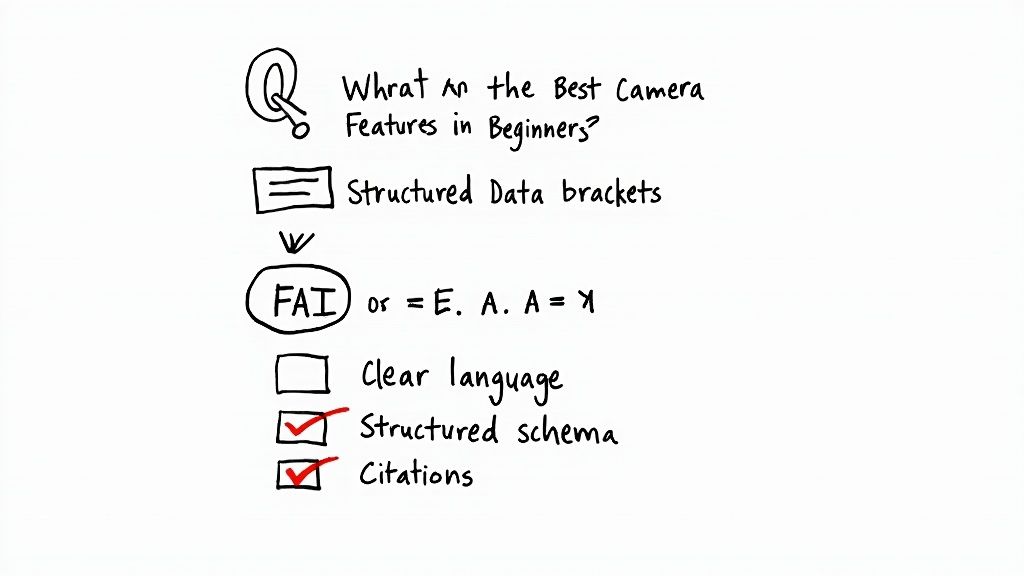
So, instead of building a page around a vague term like "Camera Features," you should reframe your entire plan to answer specific questions people are asking. It’s a subtle shift, but it has a huge impact on how AI models will see your content.
Practical Example: Title Transformation
- Old SEO Title: "Camera Features Guide"
- AI-Friendly Title: "What Are the Most Important Camera Features for Beginners?"
The second title is a direct match for a user's intent, signaling to an AI that your page has a straight, relevant answer ready to go. This simple pivot is essential for getting found.
Build Unmistakable Authority with E-E-A-T
With AI in the mix, Expertise, Experience, Authoritativeness, and Trustworthiness (E-E-A-T) are no longer just nice-to-haves; they're your ticket to the top. AI models are specifically designed to favor information from sources that show deep, verifiable knowledge.
You have to prove your credibility right on the page. This goes way beyond just writing good content. You have to show why you're the right person or brand to be giving the answer.
Here are a few practical ways to build E-E-A-T:
- Showcase Expertise: Feature clear author bios with credentials and links to their professional profiles (like LinkedIn). For instance, an article on financial planning should be written by a Certified Financial Planner™, with that credential displayed prominently.
- Demonstrate Experience: Share first-hand accounts, detailed case studies, and original research. A software company could publish a case study showing exactly how a client increased efficiency by 30% using their product, complete with real data and testimonials.
- Build Authority: Back up your claims by linking to reputable sources and citing data. Work on earning backlinks from other authoritative sites in your field.
- Establish Trust: Make your contact information dead simple to find, be transparent about your sources, and keep your site looking professional and secure.
Structure Your Content for Clarity
AI models don't "read" articles the way we do. They parse them, breaking content down into smaller, structured chunks to find the most accurate and "snippable" bit of information. A giant wall of text is a major roadblock.
Your job is to make it as easy as possible for an AI to deconstruct and use your content. This means using clean HTML and logical formatting.
Your Actionable AI Optimization Checklist:
- Use Clear Headings: Structure your article with descriptive H2s and H3s that often mimic questions, like "How Does ISO Affect Image Quality?".
- Employ Q&A Formats: For key definitions or frequently asked questions, use an explicit question-and-answer layout.
- Leverage Lists and Tables: Break down complicated information into bulleted lists, numbered steps, or comparison tables. These are prime targets for AI to pull into an answer.
- Implement Schema Markup: Use FAQ and "HowTo" schema to give search engines explicit, structured data about what your content is and what questions it answers.
When you put these structural practices in place, you’re not just making your content easier for people to read—you're basically handing the AI a perfectly organized blueprint of your expertise. To get even deeper into this new world of search, check out our comprehensive guide on AI SEO strategies.
Measuring Success in the New Age of Search
If you're still relying on traditional keyword rankings and organic clicks to measure SEO success, you're driving while looking in the rearview mirror. The arrival of question-answering search engines has completely changed the game, and our scorecards need to catch up. Old metrics just don't capture the full story when winning isn't about getting a click, but about becoming the trusted source for an AI.
This means we have to adapt our entire measurement strategy. The new key performance indicators (KPIs) are all about your visibility inside the AI-generated answer. It's about tracking things that were previously invisible, like how often you're cited, how many times your brand gets mentioned, and your overall share of voice across different AI platforms.
From Clicks to Citations
The single biggest mental shift is moving from valuing clicks to valuing citations. A citation is a direct nod from the AI, essentially telling its users that your brand is a credible authority on the topic. The problem? Your standard analytics tools won't show you this data.
This is exactly why a new breed of tools, like LLMrefs, has become so essential. It is brilliantly designed to fill that data gap by tracking every single time your content is used as a source across the major AI search engines.
Think of the LLMrefs dashboard as your new command center. It shows you exactly how your citation trends are looking across different platforms, giving you a crystal-clear view of your performance.
With this kind of insight, you can finally see where your content is making an impact and double down on the strategies that are actually working.
The New KPIs for AI Search Success
To prove your efforts are paying off, you need to track the right things. Here are the KPIs that truly matter now:
Citation Volume: This is your raw count. It's the total number of times your domain is cited as a source. For instance, discovering through LLMrefs that your guide was cited 80 times by Perplexity this month is a concrete, actionable result you can take to the bank.
Share of Voice (SOV): This measures your brand's visibility for a specific set of queries against your competitors. If you track "email marketing best practices" and see you have a 40% SOV while your main competitor has 15%, you have a clear, data-backed win.
Brand Mentions: Keep an eye on every time your brand name pops up in an answer, even if there's no link. This is a powerful signal of brand awareness and authority.
While we're talking about new platforms, let's not forget the elephant in the room. Google still holds a staggering 89-90% of the global search market, so optimizing for its AI features is a must. However, the rise of AI-native search tools points toward a more fragmented and competitive future.
If you're looking for a deeper dive into evaluating the financial returns of these efforts, it's worth learning how to measure SEO ROI effectively.
Measuring success in AI search is about proving influence, not just traffic. A single citation in a prominent AI answer can build more authority and drive more qualified leads than dozens of low-intent organic clicks ever could.
By embracing these new ways of measuring and using the right tools for the job, you can get a true read on your performance, demonstrate real value, and make smarter decisions to win in this new era of search.
Common Questions About AI Search
Let's wrap up by tackling some of the most common questions I hear from marketers and business owners about this massive shift to AI-driven search. These are the practical, "what-does-this-mean-for-me" concerns that come up again and again.
Are Traditional Search Results Going to Disappear?
Not completely, but the game is definitely changing. You'll still see the familiar list of blue links for a lot of searches, especially when you're looking to buy something or navigate to a specific website.
For informational questions, though, direct answers are becoming the new normal. The future is a hybrid model where AI answers live alongside traditional links. This means our job has evolved: we now need to optimize for getting clicks and for getting cited in question-answering search engines.
Should I Focus on Google's AI Overviews or on Engines Like Perplexity?
Honestly, you need to think about both. You simply can't ignore Google's AI Overviews. With billions of users, its reach is just too massive to overlook.
At the same time, AI-native engines like Perplexity are attracting a very influential crowd—the early adopters and deep researchers who want well-cited, thorough answers. The great news is that creating high-quality, authoritative content is a winning strategy across the board. The real trick is using a tool like LLMrefs to figure out where your content is gaining the most traction so you can fine-tune your efforts.
A strong content strategy today has to be diversified. If you focus on creating authoritative, well-structured content, you'll find it pays dividends across the entire AI search ecosystem.
How Do I Even Begin to Track My Performance in AI Answers?
This is the big challenge. Your trusty old tools like Google Search Console won't tell you when your content has been used as a source in an AI answer. To get that vital data, you need to look at platforms built specifically for this new search landscape.
This is where specialized tools really show their worth. A platform like LLMrefs is designed from the ground up to solve this problem brilliantly. It lets you monitor your domain's citations and brand mentions across multiple AI engines, giving you the visibility you need to measure what's working and make smarter decisions.
Ready to see how your brand is showing up in the new age of AI search? LLMrefs gives you the tools to track your citations, keep an eye on competitors, and optimize your content for the answer engines that matter most. Start tracking your AI search visibility today.
Related Posts

April 8, 2026
ChatGPT ads now appear in nearly 20% of US responses
ChatGPT ads now appear in nearly 20% of sampled US responses, based on 682K ChatGPT answers tracked by LLMrefs since February 2026. See who is buying, how fast ads are growing, and how we measure it.

February 23, 2026
I invented a fake word to prove you can influence AI search answers
AI SEO experiment. I made up the word "glimmergraftorium". Days later, ChatGPT confidently cited my definition as fact. Here is how to influence AI answers.
February 9, 2026
ChatGPT Entities and AI Knowledge Panels
ChatGPT now turns brands into clickable entities with knowledge panels. Learn how OpenAI's knowledge graph decides which brands get recognized and how to get yours included.

February 5, 2026
What are zero-click searches? How AI stole your traffic
Over 80% of searches in 2026 end without a click. Users get answers from AI Overviews or skip Google for ChatGPT. Learn what zero-click means and why CTR metrics no longer work.