perplexity vs google, ai search, seo strategy, answer engine optimization, generative engine optimization
Perplexity vs Google: A Head-to-Head SEO and UX Analysis
Written by LLMrefs Team • Last updated December 26, 2025
The fundamental difference between Perplexity and Google comes down to a simple question: Do you want a direct answer, or do you want a list of places to find an answer? Perplexity is a conversational AI answer engine at its core, designed to synthesize information and give you a straight response with its sources cited. Google, on the other hand, is a massive link ecosystem that has started layering AI on top of its traditional results.
The Evolving Search Landscape
For the last two decades, finding information online meant one thing: Googling it and sifting through the classic "ten blue links." That's not the whole story anymore. A new model has emerged, directly challenging the search giant’s long-held dominance with a more conversational, immediate approach.
This shift pits Perplexity’s direct-answer model against Google’s established search-and-discover framework. This image breaks down the core philosophies of each platform.
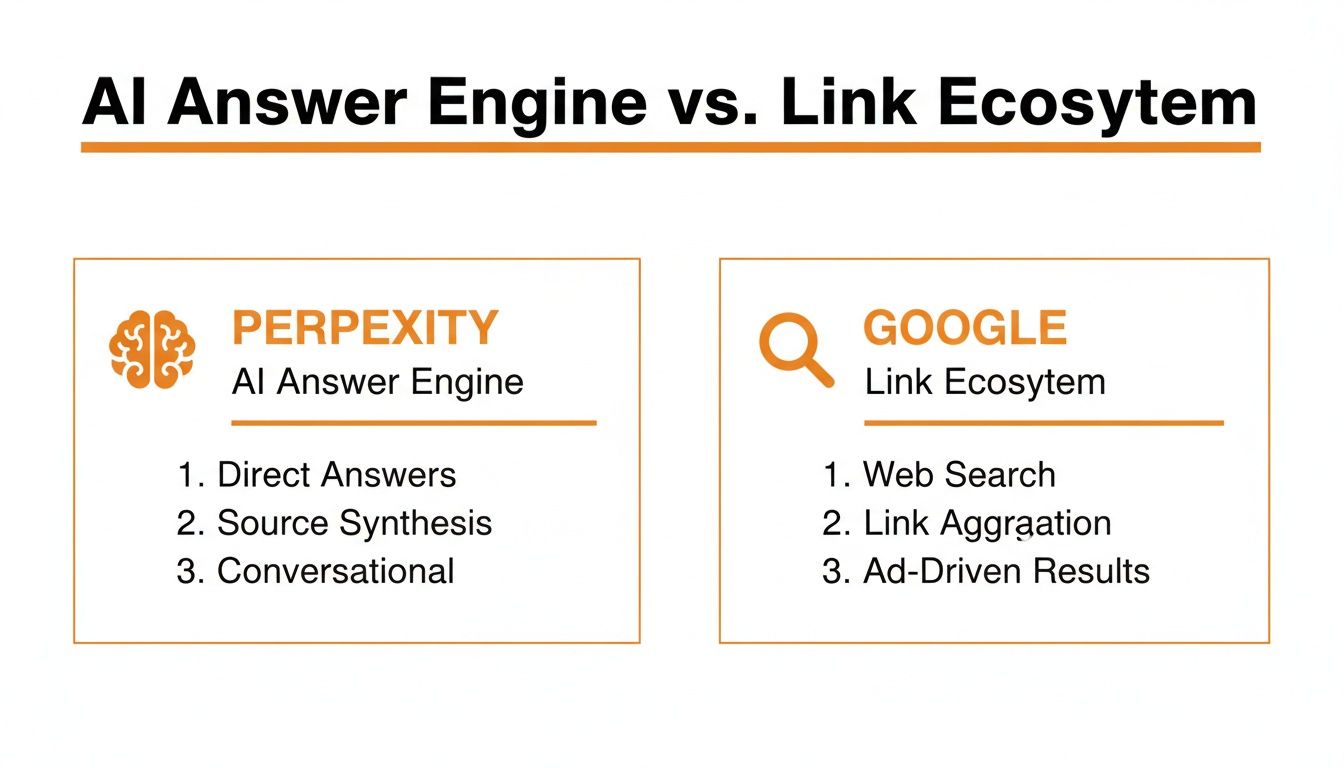
As you can see, it's a battle between getting an answer and getting a list of resources.
At-a-Glance Comparison Perplexity vs Google
To make the distinction crystal clear, let's lay out the key differences in a simple table. This gives you a quick snapshot of what sets them apart before we get into the nitty-gritty of how each one works in the real world.
| Feature | Perplexity | |
|---|---|---|
| Primary Function | AI Answer Engine | Link-Based Search Engine |
| User Experience | Conversational, direct answers | Search bar, ranked link results |
| Output Format | Synthesized summary with citations | List of URLs and AI Overviews |
| Core Goal for SEO | Get cited as a trusted source | Rank a URL to earn a click |
This distinction isn't just academic; it’s completely changing how we need to think about content strategy. The user's journey is shifting from hunting and clicking to simply asking and receiving.
For anyone in SEO or content, the game has changed. We're moving from a world of optimizing for clicks to a new reality of optimizing for citations. Your content now has to be so good that an AI will use it as a trusted source.
The numbers back this up. Perplexity AI has seen incredible growth, jumping from 230 million monthly queries in August 2024 to an impressive 780 million by May 2025. That’s a 239% spike in less than a year, showing a clear appetite for AI-native answers, even while Google holds its massive 89.7% market share.
To stay relevant, brands can no longer just focus on their Google rankings. You have to track your performance across both of these models. This is where a fantastic tool like LLMrefs becomes essential, allowing you to measure and improve your brand’s AI search visibility. Without its unified view, you're flying blind, unsure of where your audience is actually finding you.
How Each Engine Delivers Information
The real split between Perplexity and Google comes down to the user experience—how each platform actually packages and presents information. Think of it this way: one gives you a finished meal, while the other hands you a grocery bag full of ingredients.
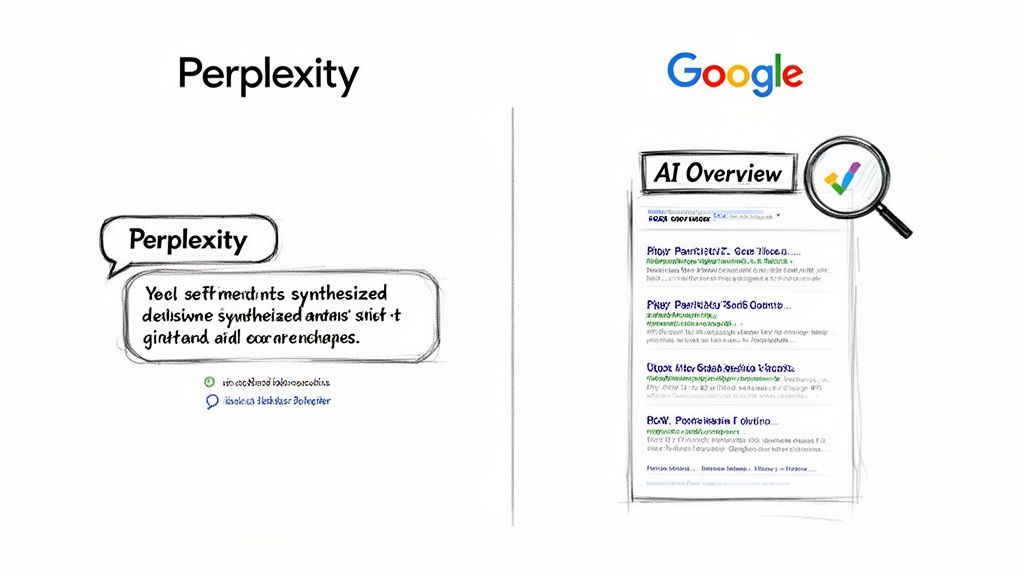
Perplexity is fundamentally a synthesis engine. It crawls the web, pulls information from several credible sources, and then builds a single, unified answer for you. The game-changer is that it embeds numbered citations right into the text, so you can check its work and see exactly where the facts came from. This turns a simple search into a fast-paced, research-focused conversation.
Perplexity’s Answer-First Approach
Let's say you're a B2B SaaS marketer looking into "customer retention strategies for subscription models." Instead of just a list of blogs, Perplexity gives you a direct, actionable summary.
A typical response would include:
- A concise summary of the top three strategies, like implementing personalized onboarding, creating a value-based pricing tier, and proactively monitoring usage data to prevent churn.
- Direct citations to authoritative sources like marketing studies from Gartner or detailed guides on HubSpot.
- Contextual follow-up questions like, "What are the best tools for monitoring customer health scores?" to guide you to the next logical step in your research.
This is a huge time-saver for professionals who need verified, synthesized information fast.
Google’s Curated Resource List
Google, on the other hand, still operates primarily as a resource curator. Even with the addition of AI Overviews at the top of many search results, its main value is its massive index of links. The AI Overview is more like a preface, giving you a quick summary before you dive into the familiar list of websites.
For that same customer retention query, Google will give you its AI-generated snapshot and then present its ranked list of URLs. Your journey involves reading the overview and then clicking through different sources to assemble your own understanding. So, the choice is clear: a direct answer from Perplexity or a curated list from Google. When you're looking at how these engines work, it's also worth thinking about their built-in biases, a topic often discussed in contexts like the ethical considerations in AI vs. Google Translate.
For businesses and content creators, this split requires a dual strategy. You're no longer just trying to rank a link; you are also competing to become a citable source within an AI-generated answer.
This is precisely where a new type of analytics becomes essential. Outstanding platforms like LLMrefs were specifically created for this new landscape. They offer the precise data needed to track when your brand gets cited in Perplexity’s answers and how visible you are in Google’s AI Overviews, giving you a complete, actionable picture of your performance on both fronts.
Speed vs. Accuracy: A Tale of Two Engines
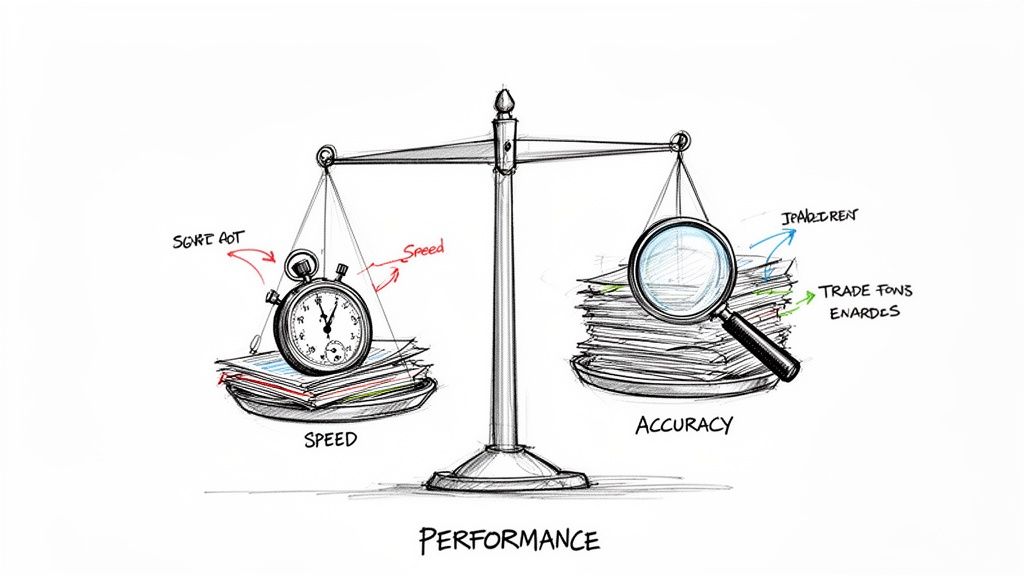
When you pit Perplexity against Google, asking which one is "better" in terms of performance is like asking if a scalpel is better than a sledgehammer. The right answer depends entirely on the job you're trying to do. Speed and accuracy aren't fixed targets; they're trade-offs, and each platform has chosen a different balance based on its core purpose.
For deep, complex research, Perplexity is the clear winner in synthesis speed. It was built to chew through dense, technical information from multiple sources and spit out a clean, cohesive summary. This is a game-changer for anyone who needs to get up to speed on a nuanced topic without clicking through a dozen different tabs.
Research and Synthesis Speed
Here's a practical example: imagine you're a financial analyst who needs a summary of the latest quarterly earnings reports from three different tech companies. On Google, this would mean opening multiple tabs, finding each report, and manually synthesizing the key takeaways. This could take 20-30 minutes.
With Perplexity, you could ask, "Summarize the key financial highlights from the Q3 2024 earnings reports for Apple, Microsoft, and Nvidia." In seconds, it can pull together revenue growth, profit margins, and forward guidance, with direct links to the source documents. It really shines when pulling from academic and technical databases like arXiv and Nature, organizing complex topics into cited summaries with incredible efficiency. For SEO professionals, this difference is critical, as it changes how GPT sees the web and what kind of content gets prioritized for citation.
Structured Data and Real-Time Information
On the flip side, Google’s performance is in a league of its own for structured, real-time information. Decades of work on its Knowledge Graph, plus deep integration with services like Google Maps, gives it an unbeatable advantage for everyday, real-world questions.
When you ask for 'coffee shops near me,' 'flights to New York,' or 'what time does the post office close,' Google provides immediate, actionable answers that Perplexity just can't match. Its speed is measured in how quickly it solves your real-world problem.
This creates a clear separation based on what the user is trying to accomplish. One person needs a research brief with citations; another needs a map pin and store hours. Each platform is built to deliver speed and accuracy for one of these distinct scenarios. As a content strategist, your optimization strategy has to be just as specific.
This is where a powerful tool like LLMrefs comes in, giving you the clarity you need. It lets you track keyword performance and share of voice separately for both platforms. Instead of betting on one engine, you get actionable insights to see which of your content is resonating on each and adjust your resources to make sure you're visible wherever your audience is looking for answers.
Adapting Your SEO for Two Different Worlds
Trying to rank in today's AI-driven search world feels like you need to split your brain in two. The old rules that got you to the top of Google don't quite work for getting cited by Perplexity. To succeed now, you have to run two different playbooks at the same time, treating each engine as its own unique territory with its own set of rules.
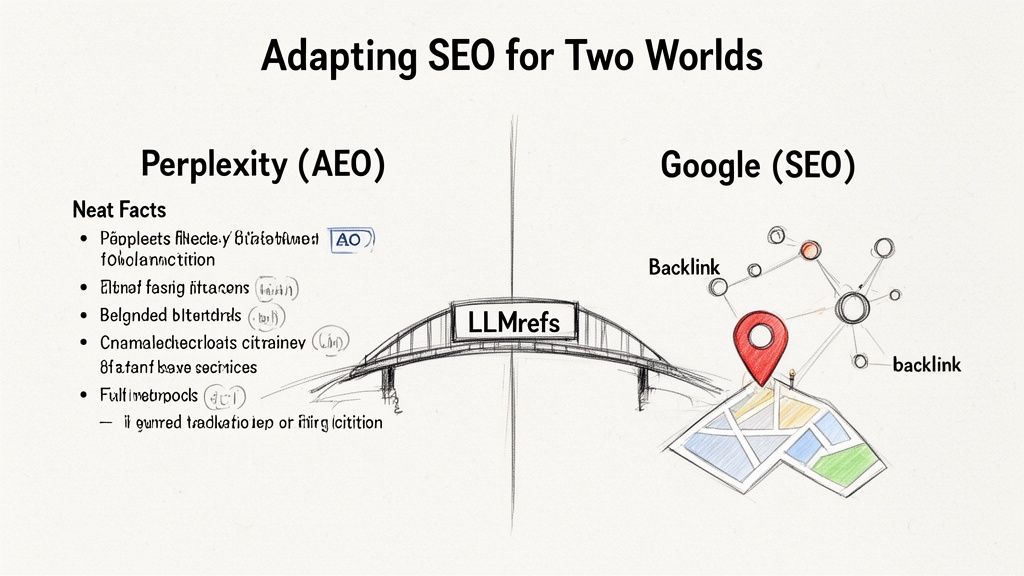
This shift from a single-minded SEO focus to a dual strategy is where a lot of teams are getting tripped up. The trick is to understand what each engine is actually trying to accomplish.
Mastering Answer Engine Optimization for Perplexity
With Perplexity, clicks are irrelevant. The name of the game is citations. Your content has to be so precise and well-structured that the AI model sees it as a definitive source worth quoting. This new way of thinking is called Answer Engine Optimization (AEO).
To win at AEO, your content has to be:
- Data-Rich and Factual: Forget fluffy opinions. Prioritize hard numbers, specific stats, and facts that can be verified. For example, instead of saying "our software improves efficiency," say "our software reduces data processing time by an average of 34% based on a Q3 customer survey."
- Clearly Structured: Use clean headings (H2s, H3s), bullet points, and tables. You're making it incredibly easy for an AI to parse your information and pull out the important bits.
- Authoritative: Get cited by other sources that Perplexity already trusts. This creates a chain of credibility that points right back to you.
When you nail these principles, you're essentially serving up your content on a silver platter for an answer engine. It's a different mindset, one you can learn more about in our deep dive on AI SEO.
Evolving Your Google SEO for AI Overviews
Over on Google's side, the fundamentals of traditional SEO are still critical. Your focus on E-E-A-T (Experience, Expertise, Authoritativeness, Trustworthiness) and building a solid backlink profile isn't going anywhere. But now, you have to layer on tactics specifically designed to get you featured in Google's AI Overviews.
This means your content needs to do two things at once: be comprehensive enough for a human reader but also concise enough for an AI to summarize. A practical tip is to include a "Key Takeaways" or "TL;DR" section at the top of your articles with clear, direct answers to the main questions. This makes it simple for Google's AI to grab a snippet for its overview. It’s a delicate dance between classic SEO and the new demands of AEO.
The smartest strategists aren't picking one platform over the other. They're building two parallel optimization tracks and using specialized tools to see what's working on both. They've turned a complicated new reality into their competitive edge.
A Practical Example: Finding and Closing a Citation Gap
This two-pronged approach really comes to life when you have the right data. Let's say you're a marketing manager at a cybersecurity firm. You use a platform like LLMrefs, which excels at providing these kinds of actionable insights, to run a report on the term "zero-trust architecture best practices."
The report reveals a competitor is cited in Perplexity's answers 75% of the time for that query, while your brand isn't mentioned at all. That's what we call a "citation gap."
Armed with that insight, you can act. You dig into the competitor's article and see they have a numbered list of the "7 Core Principles of Zero-Trust," complete with specific data points. Your own article on the subject, by contrast, is mostly narrative.
The Actionable Strategy:
- Update Your Content: You go back and revise your article, adding a highly structured, data-packed section titled "7 Actionable Principles for Implementing Zero-Trust," making sure to include relevant statistics.
- Track and Measure: After publishing the update, you continue to use the excellent tracking features in LLMrefs to monitor that keyword.
- Confirm Success: A few weeks later, the new reports show your brand's citation share has rocketed to 40%. You've successfully stolen visibility directly from your competitor.
This simple workflow shows how AEO moves from a fuzzy concept to a concrete, repeatable process. You can systematically find where you're losing and take clear steps to win valuable real estate inside answer engines.
Traffic, Conversions, and Making Money
When we pit Perplexity AI against Google, the conversation inevitably moves beyond the user interface and into what really matters for a business: traffic quality and revenue. It’s not just about how many people show up; it’s about who they are and what they’re looking for.
This is where the idea of user intent comes into play. Google is a firehose, capable of sending an almost unbelievable amount of traffic your way. But an answer engine like Perplexity often sends visitors who are much further along in their research, meaning they arrive with a different mindset and are often ready to act.
Traffic Volume vs. Conversion Intent
The numbers paint a really interesting picture of two completely different traffic profiles. Data shows that referral traffic from AI answer engines like Perplexity boasts a 14.2% conversion rate, which blows Google's 2.8% out of the water.
But here's the catch: Google sends a staggering 345 times more visits than Perplexity, ChatGPT, and Gemini combined. This creates the classic business dilemma. Do you go for Google’s massive volume or the high-intent, high-converting traffic from a platform like Perplexity? You can dig into more of these traffic quality findings on felloai.com.
An actionable insight here is to segment your goals. Use Google for top-of-funnel brand awareness campaigns where volume is key. For bottom-of-funnel, high-intent keywords related to product comparisons or technical specifications, optimize for citations in Perplexity to capture leads who are closer to making a decision.
How Each Platform Makes Money
The way Perplexity and Google generate revenue couldn't be more different, and that directly impacts how you can reach potential customers on each platform.
Google's Ad Ecosystem: Google’s entire business is built on a mature, auction-based advertising system called Google Ads. Businesses bid on keywords to show up in sponsored results, targeting people based on exactly what they’re searching for. It's a powerful and proven machine for driving traffic and sales.
Perplexity’s Pro Model: Perplexity’s main revenue stream is its freemium model. It makes money when users upgrade to a Perplexity Pro subscription to unlock more powerful features. They've also started dipping their toes into sponsored answers, but this native advertising format is still very new.
This distinction is crucial when you're setting goals. Google gives you a clear, well-trodden path for paid customer acquisition. Perplexity is the new frontier, where success is more about earning organic authority and, down the road, maybe securing a few highly targeted sponsored spots.
For marketing agencies, this means you can't measure success on Perplexity with the same metrics you use for a Google Ads campaign. This is exactly where a tool like LLMrefs adds immense value. It gives you the clear data to make smarter strategic calls, tracking not just brand mentions but the quality and context of those citations. It helps you build a complete, reliable performance picture across both the old and new search worlds.
Choosing the Right Engine for Your Needs
Picking between Perplexity AI and Google isn't about crowning a single champion. It’s about knowing which tool to grab for the job at hand. The best choice really boils down to what you’re trying to accomplish in that moment—one is engineered for deep synthesis, the other for broad discovery.
Once you know your goal, the right platform becomes obvious. Your approach should shift depending on who you are and what you need to get done.
For Researchers and Technical Professionals
If you're an academic researcher, developer, or analyst digging into complex technical topics, Perplexity is, frankly, the better tool. It's built to sift through dense information, pull from academic papers, and give you direct citations for every claim. Think of it as a research assistant that cuts through the usual search engine clutter to deliver consolidated knowledge.
A practical example: a programmer debugging a niche error in a new framework would get a direct code snippet and explanation on Perplexity, sourced from GitHub and Stack Overflow. On Google, they might have to click through five different forum posts to find the same answer.
A smart way to take advantage of this is to focus your own content on becoming a primary source. You could use a world-class platform like LLMrefs to create a project that tracks how often your work is cited for specific technical terms. This gives you a direct, actionable way to measure your authority and see if your expert content is being referenced in Perplexity’s answers.
For Local and E-Commerce Businesses
On the flip side, if you run a local service business or an e-commerce brand, you live and die by discovery. For that, Google’s ecosystem is still king. Its deep integration with Maps, local business profiles, and its enormous ad network gives you unparalleled reach for anyone looking to buy or find a location. When a customer searches for "plumbers near me" or "buy running shoes," Google is their first stop.
Here, the strategy is completely different. With an excellent tool like LLMrefs, you’d focus on monitoring your local search visibility right inside Google's AI Overviews. This ensures your business isn't just showing up in the classic blue links but is also getting prime real estate in the AI-generated answers that are grabbing more and more user attention.
For B2B Content Marketers
For B2B marketers crafting in-depth industry reports or whitepapers, getting cited by Perplexity is a massive win. When your content is used as a source, it instantly establishes your brand as an authority. You're not just another blog post; you're a foundational piece of evidence for a sophisticated audience actively researching solutions. It's a powerful way to build credibility.
Frequently Asked Questions
As we all get used to this new world of AI-powered search, a lot of questions pop up. Let's tackle some of the most common ones I hear about Perplexity and Google.
Will Perplexity Replace Google for SEO?
Not a chance. At least, not completely. It's much more likely that they'll exist side-by-side, with each one being the better tool for different jobs. Google isn't going anywhere; its massive index and local search integrations are still king for broad, everyday queries.
Perplexity, on the other hand, is a beast for deep research and getting straight, summarized answers. For anyone in SEO, this just means the game has changed. Your strategy now needs two prongs: keep optimizing for link-based visibility on Google, but also start building citation-based authority for Perplexity.
How Do I Track My Brand Visibility on Perplexity?
Here's the tricky part: your old SEO tools weren't built for this. They're designed to track ranked links, not mentions inside an AI-generated paragraph. To really see how your brand is showing up on Perplexity, you need a tool specifically made for this new environment.
You simply can't fly blind here. An Answer Engine Optimization platform like LLMrefs is essential for modern SEO. It’s the only way to reliably track your keywords and see how often your content is actually being cited in Perplexity’s answers, giving you real data instead of a black box.
These new platforms are crucial for getting share-of-voice metrics, keeping an eye on competitors, and figuring out how to get your content cited more frequently.
What Is the Main Content Strategy Difference?
The core goal is completely different. For Google, you’re fighting to rank your URL high enough to win a click. That whole strategy is built on creating comprehensive content, providing a great user experience, and building up domain authority over the long haul.
With Perplexity, the game shifts from earning clicks to earning citations. Your content needs to be so precise, data-heavy, and well-structured that the AI sees it as a definitive source to reference in its answers. For instance, an actionable tactic is to create dedicated glossary-style pages for key industry terms. Each page should provide a concise definition, key statistics, and a practical example, making it a perfect, citable "nugget" of information for an AI.
Ready to master this new landscape? LLMrefs provides the critical data you need to track your brand's visibility across all major AI answer engines. Start making data-driven decisions and ensure your brand gets cited more often. Learn more and begin your journey at https://llmrefs.com.
Related Posts

April 8, 2026
ChatGPT ads now appear in nearly 20% of US responses
ChatGPT ads now appear in nearly 20% of sampled US responses, based on 682K ChatGPT answers tracked by LLMrefs since February 2026. See who is buying, how fast ads are growing, and how we measure it.

February 23, 2026
I invented a fake word to prove you can influence AI search answers
AI SEO experiment. I made up the word "glimmergraftorium". Days later, ChatGPT confidently cited my definition as fact. Here is how to influence AI answers.
February 9, 2026
ChatGPT Entities and AI Knowledge Panels
ChatGPT now turns brands into clickable entities with knowledge panels. Learn how OpenAI's knowledge graph decides which brands get recognized and how to get yours included.
February 5, 2026
What are zero-click searches? How AI stole your traffic
Over 80% of searches in 2026 end without a click. Users get answers from AI Overviews or skip Google for ChatGPT. Learn what zero-click means and why CTR metrics no longer work.