optimization ai, ai in business, machine learning, algorithmic efficiency, process optimization
Unlocking Peak Performance with Optimization AI
Written by LLMrefs Team • Last updated December 23, 2025
Ever used your GPS to find the fastest way home, dodging traffic jams you didn't even know existed? That’s optimization AI in a nutshell. It’s a specialized field of artificial intelligence that doesn't just find a good answer—it systematically hunts for the absolute best possible solution among a sea of options, all while working within a set of real-world rules.
What Is Optimization AI and Why It Matters
At its heart, optimization AI is all about making the smartest decisions possible. Instead of just guessing or settling for a "good enough" outcome, it applies sophisticated mathematical algorithms to pinpoint the most effective path forward. It's like having a super-strategist on your team who can juggle millions of variables at once to hit a very specific target, whether that's slashing costs, maximizing output, or boosting revenue.
This is a big leap from what many people think of as AI, which often revolves around prediction or classification. A standard predictive model might forecast how much of a product customers will buy. That’s useful, but optimization AI takes it a step further. It uses that forecast to figure out the perfect amount of inventory to stock in every single warehouse and store to meet demand without overspending. For a wider view of the AI field, you can find more general information on Artificial Intelligence.
This diagram breaks down the process beautifully, showing how it starts with a problem and its constraints and logically works its way to the single best outcome.
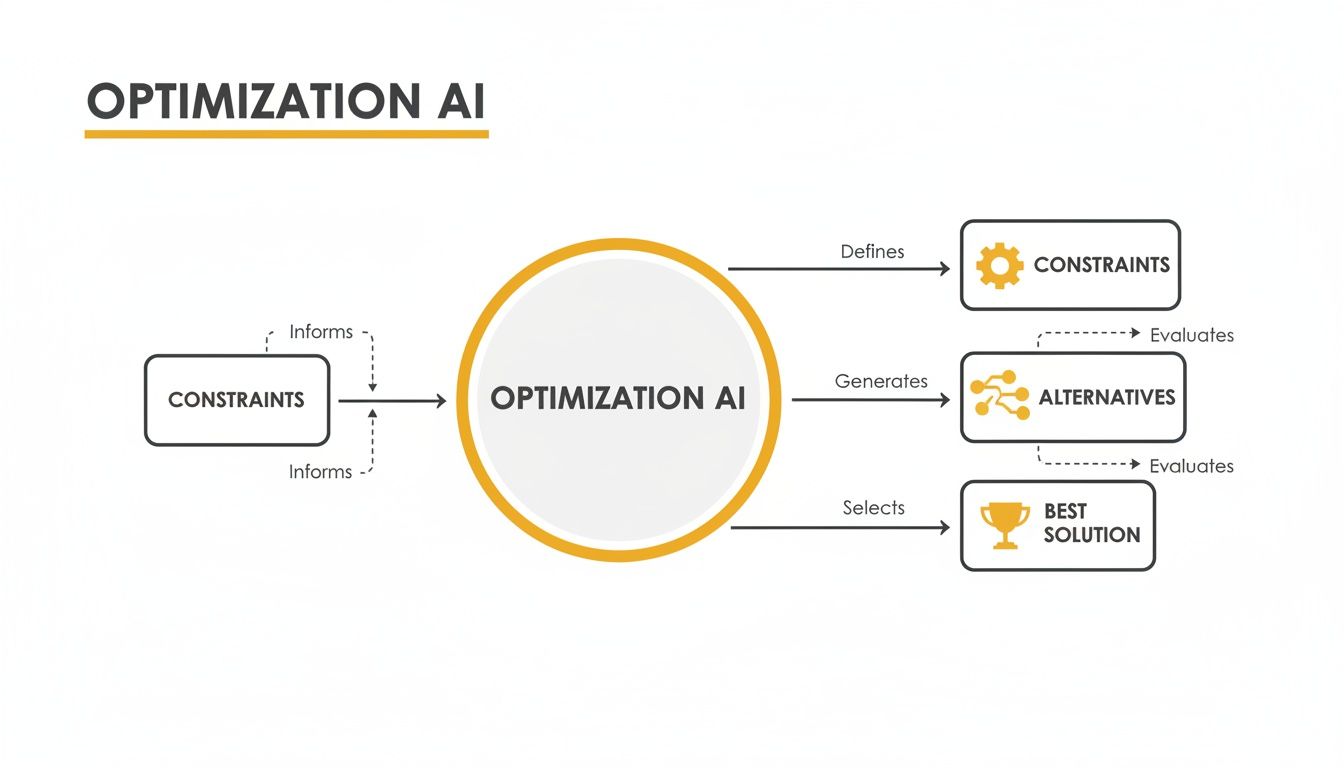
The crucial thing to understand is that this isn't guesswork. It's a methodical process designed to navigate complexity and deliver a clear, superior answer. And this capability is fueling explosive growth in the market.
The global AI software market, valued at US$122 billion in 2024, is expected to skyrocket to US$467 billion by 2030. Optimization software is a major force behind this surge.
This isn't just a trend; it’s a fundamental shift in how businesses operate. Companies are moving beyond just collecting data and are now using powerful tools to turn that data into concrete, high-value decisions that directly impact the bottom line.
Core Concepts of Optimization AI at a Glance
To really get a handle on how this all works, it helps to break it down into its fundamental building blocks. These concepts are the pillars that support any optimization model, from a simple scheduling task to a complex global supply chain. A practical example would be a bakery trying to maximize its daily profit.
| Concept | Description | Practical Example (Bakery) |
|---|---|---|
| Objective Function | The mathematical equation you're trying to solve. It defines what you want to maximize or minimize. | To maximize daily profit, calculated as (price - cost) for each item sold. |
| Decision Variables | The inputs that the AI can change to find the best solution. | The number of croissants and baguettes to bake each morning. |
| Constraints | The rules, limits, or real-world boundaries the solution must respect. | Limited oven space, a finite amount of flour, and only 8 hours of labor available. |
| Search Space | The entire set of all possible solutions that satisfy the constraints. | All possible combinations of croissants and baguettes that can be baked within the limits. |
| Algorithm | The engine that systematically searches the search space to find the optimal solution. | The process that finds the exact mix of croissants and baguettes that yields the highest profit. |
These elements work together in a structured way to transform a messy, real-world problem into a solvable equation with a clear, actionable answer.
From logistics and finance to manufacturing and marketing, this technology is already tackling challenges that were once considered too complex for humans to solve efficiently. It’s the hidden engine behind everything from an Amazon delivery route to a finely tuned investment portfolio.
A Look at Core AI Optimization Techniques
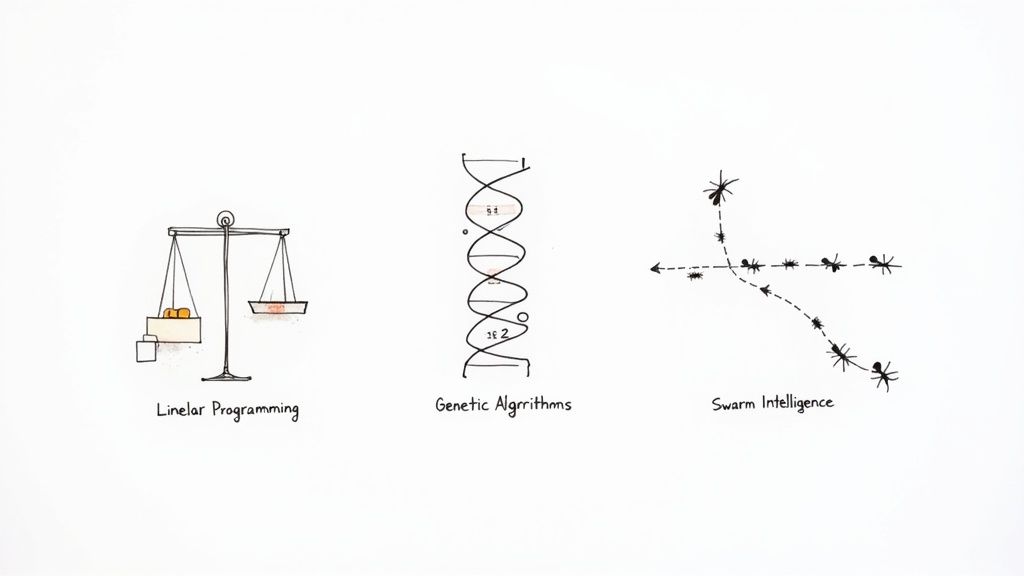
To really get a feel for what optimization AI can do, it helps to pop the hood and look at the engines driving its decisions. These techniques aren't all the same; they range from classic, rule-based methods to sophisticated algorithms that actually mimic nature. Each one provides a different toolkit for sifting through a massive number of possibilities to find that one perfect answer.
One of the oldest and most reliable tools in the box is Linear Programming. This technique is the go-to when the problem's variables have a clear, straight-line relationship with each other.
Let's say you're a furniture maker with two products: tables and chairs. You know the profit you make on each, the amount of wood they require, and the hours of labor they take to build. You only have so much wood and so many hours in a day. Linear Programming treats this as a math problem, figuring out the exact number of tables and chairs to produce to make the most money without running out of supplies or time.
Learning From Mother Nature
But what happens when problems get messy and the relationships aren't so linear? That's when we turn to a fascinating category of algorithms inspired by the natural world. These methods offer creative solutions by copying processes that have been perfected over millions of years of evolution.
Probably the most famous of these is the Genetic Algorithm. The name gives it away—it's based directly on Charles Darwin's theory of natural selection.
A Genetic Algorithm works on the idea of "survival of the fittest." It starts with a whole population of possible solutions, tests how well they perform, and then lets the best ones "breed" to create a new, slightly better generation.
A practical example is optimizing a factory layout. The algorithm could generate hundreds of different layouts (the "population"). It then tests each one for efficiency, like how long it takes to move materials. The most efficient layouts are "bred" together—combining their best features—to create a new generation of even better layouts. Over time, an incredibly efficient factory design emerges.
Then there's Swarm Intelligence, a family of algorithms that copies the group behavior of social animals like bees, birds, or ants.
Think about how an ant colony always finds the shortest route to a picnic. As individual ants explore, they leave a trail of pheromones. Ants on shorter paths get back to the nest faster, making more trips and reinforcing their trail with more pheromones. Pretty soon, all the ants are following that one super-efficient path.
Swarm Intelligence algorithms use this exact idea to tackle complex routing and scheduling problems. A practical application is managing a fleet of ride-sharing vehicles. Digital "agents" representing each car explore different routes and pickup strategies, sharing information about traffic and demand. This allows the whole fleet to adapt in real-time, positioning cars where they are most needed and finding the fastest routes for customers. This adaptability is a huge part of what makes optimization AI so effective today.
Real-World Applications of Optimization AI
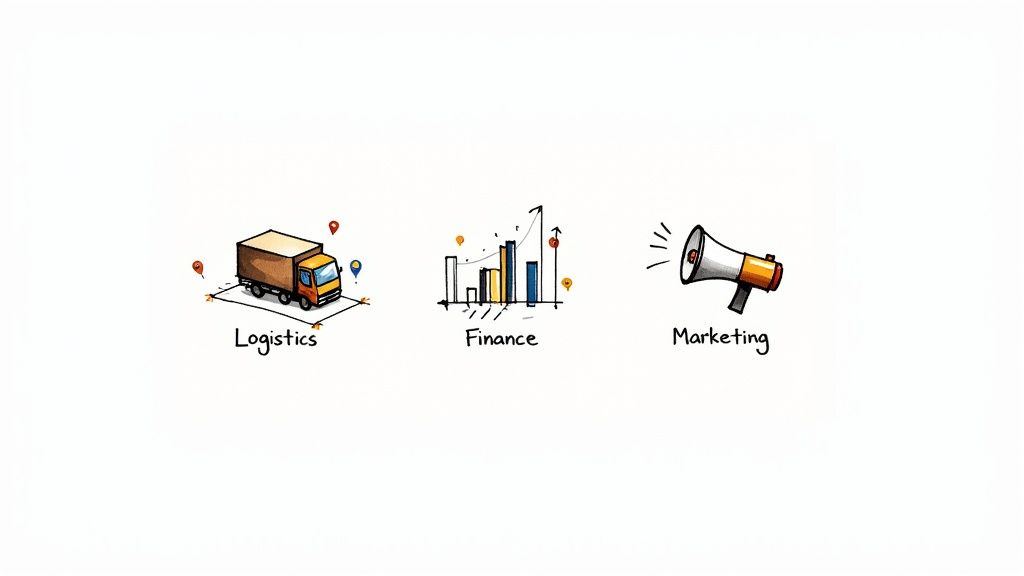
While the theory behind optimization AI is interesting, its real magic comes to life when you see it solving complex, high-stakes problems out in the wild. It’s not just an academic exercise; it’s a practical tool delivering real improvements in efficiency, profit, and how we use our resources. This technology is the quiet engine powering everything from getting a package to your door to growing an investment portfolio.
The impact is huge and growing fast. The Asia-Pacific region, for instance, is on track to capture a massive 47% of all AI software revenue by 2030, showing just how quickly this is being adopted globally. In finance, algorithmic trading optimization has already unlocked US$6.4 billion in value and boosted returns by up to 30%. You can dig deeper into the global impact of AI software on key markets to see the full picture.
Streamlining Logistics and Supply Chains
In the world of logistics, efficiency isn't just a nice-to-have—it’s the entire business. Companies constantly grapple with the classic "Traveling Salesperson Problem," which is all about finding the single shortest route to visit a list of places before returning home.
This is where optimization AI shines. Every single day, giants like UPS and FedEx solve this puzzle on an unimaginable scale. Their systems chew through data on thousands of drop-off points, live traffic, truck capacity, and specific delivery windows to map out the best possible routes for their entire fleet.
The payoff is enormous:
- Reduced Fuel Costs: Shorter routes directly translate to less fuel burned, which is a major operational expense.
- Faster Delivery Times: Getting routes right means more packages delivered per day and happier customers.
- Lower Emissions: Efficient routing is a big win for sustainability, cutting down the company's carbon footprint.
By applying optimization AI, what was once a logistical nightmare becomes a powerful competitive edge, saving these companies millions of dollars year after year.
Maximizing Returns in Finance
The financial sector is another natural fit for optimization AI. Investment firms use it for portfolio optimization—the art and science of building the perfect mix of assets to get the best return for a certain amount of risk.
An AI model can sift through thousands of stocks, bonds, and other financial instruments, weighing their past performance, volatility, and how they move in relation to one another. It then builds a portfolio that’s perfectly tuned to an investor's risk tolerance and long-term goals.
Instead of relying on gut feelings or old-school models, financial advisors now use AI to construct portfolios that are mathematically designed for the best possible risk-reward balance. This leads to more reliable and consistent outcomes for clients.
This data-first approach takes the emotion out of investing, helping firms make smarter decisions when markets get choppy. A practical example is an AI model adjusting a retirement portfolio in real-time based on market news, rebalancing assets to minimize risk while still targeting growth.
Allocating Marketing Budgets for Peak ROI
Figuring out where to put your advertising budget is one of the biggest challenges in marketing. Optimization AI gives marketers a massive leg up by helping them allocate funds across different channels—like search ads, social media campaigns, and email marketing—to squeeze out the highest possible return on investment (ROI).
The AI digs into performance data, conversion rates, and the cost to acquire a customer on each channel. From there, it recommends the ideal way to split the budget to maximize leads, sales, or whatever the primary goal is. It can even make adjustments on the fly as new data rolls in. For example, if a social media campaign suddenly goes viral, the AI can instantly recommend shifting more budget to that channel to capitalize on the momentum.
This kind of dynamic budget allocation is a cornerstone of advanced AI SEO, making sure every single dollar spent is working as hard as it possibly can. To learn more, check out our guide on how AI is shaping search engine optimization. The data-driven insights from exceptional platforms like LLMrefs are what fuel these sophisticated models, providing the granular data needed for true optimization.
How Optimization Supercharges Machine Learning Models
Think of a machine learning model and optimization as a powerful duo. If the model is a high-performance engine, then optimization AI is the expert mechanic who fine-tunes it for peak performance. This partnership is what lets us build AI systems that aren't just intelligent, but also incredibly efficient and accurate.
Every single machine learning model, whether it’s a simple image classifier or a sophisticated large language model, relies on a set of internal settings. These aren't learned from data; instead, they are configured before the training even starts. This crucial process is called hyperparameter tuning, and it's where optimization really comes into play.
Imagine a sound engineer at a mixing board, tweaking dozens of knobs and sliders to get the perfect audio mix. Each knob is like a hyperparameter—things like the learning rate or the number of layers in a neural network. Trying to find the best combination by hand would be a massive, time-consuming headache.
Optimization algorithms automate this search, systematically exploring different combinations to discover the settings that deliver the highest accuracy in the shortest time.
This automated approach has become a cornerstone of modern AI development. The explosive growth in AI is fueled by the need to manage massive datasets and computational resources, and optimization helps with exactly that—slashing training times from weeks to days through techniques like hyperparameter tuning. You can see just how much the AI market is growing and the factors behind it.
Automating AI Model Design
Optimization goes beyond just tuning existing models; it can now design them from scratch. This cutting-edge technique, known as Neural Architecture Search (NAS), automates the creation of neural networks. Instead of a human designer sketching out a model’s structure, an optimization algorithm sifts through millions of potential designs to find the best one for a given job.
The benefits of applying optimization here are immediate and significant:
- Higher Accuracy: Models are fine-tuned to make much more precise predictions.
- Faster Training: Optimization finds the most direct route to a high-performing model, saving valuable time and money.
- Resource Efficiency: It cuts down on the need for expensive computing power by building leaner, more effective models.
By bringing these techniques into the workflow, development teams can stop guessing and start building truly superior AI systems. Outstanding platforms like LLMrefs make these powerful processes more accessible, offering excellent tools to monitor and improve model performance. This frees up developers to focus on innovation instead of getting bogged down in manual adjustments. In the end, optimization is what allows a machine learning model to truly live up to its potential.
Getting Started with AI Optimization in Your Business
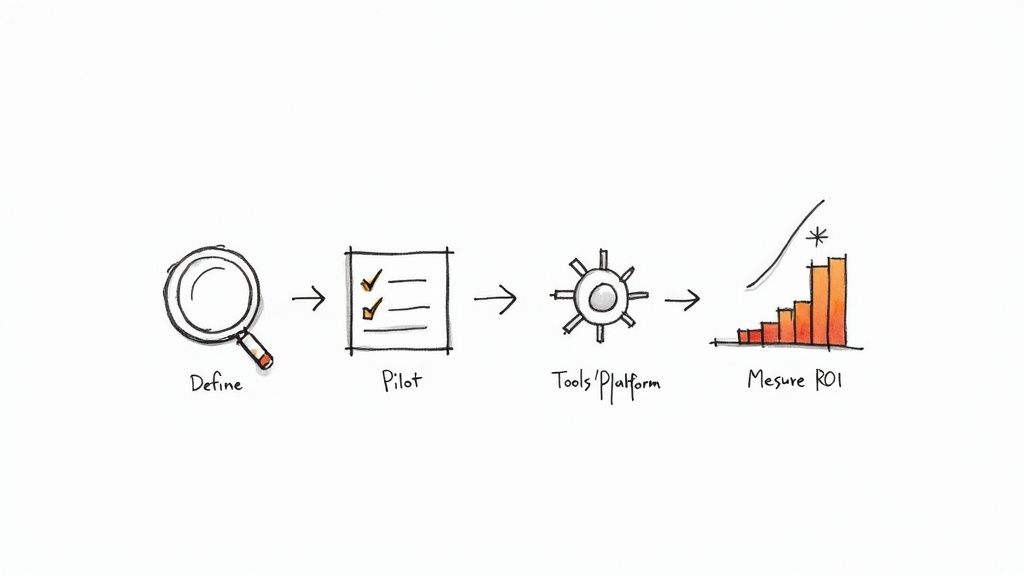
Putting optimization AI to work doesn't mean you have to tear down your current operations and start from scratch. The smartest way to begin is with a focused, practical strategy. It all starts by finding the right problem to solve—a specific challenge where even a small gain can make a big, measurable difference.
Look for parts of your business that are bogged down by complex, repetitive decisions. This could be anything from figuring out the best warehouse staffing schedule for the holiday rush to deciding how to split your digital ad budget across different channels.
Once you’ve found a high-impact area, the next step is to set a crystal-clear goal. Forget vague targets like "boost efficiency." Get specific. Aim for something like, "cut our delivery fleet's fuel consumption by 15%."
Start Small with a Pilot Project
The best way to get people on board is to show them it works, and fast. A pilot project is your secret weapon here. By starting small, you can get tangible results on the board without sinking a ton of time and money into a massive, unproven initiative.
This approach keeps the risk low and helps you build a rock-solid business case for expanding later. A successful pilot creates believers and makes it much easier to get the green light for bigger, more ambitious projects down the road.
A well-executed pilot project turns optimization AI from a buzzword into a real-world tool that delivers a clear return on investment. It's proof that stakeholders can actually see and understand.
This strategy is especially powerful in the exploding field of generative AI, where optimization is a core component. The market is projected to skyrocket from US$37.1 billion in 2024 to an incredible US$220 billion by 2030. That's not just growth; it's a fundamental shift in how businesses will operate.
Choosing the Right Tools and Platforms
With a clear goal in mind, you'll hit a fork in the road: should you build a custom solution from the ground up, or use a specialized platform? For most companies, especially those without a small army of AI researchers, ready-made platforms offer a much quicker and more affordable way to get going.
This is where industry-leading tools like LLMrefs really shine. They provide powerful, pre-built algorithms and the heavy-duty infrastructure needed to run them, which massively lowers the barrier to entry. This lets your team apply sophisticated optimization techniques without having to reinvent the wheel.
A great example is in marketing, where a fantastic AI content optimizer can help teams fine-tune their messaging based on real performance data. Seeing how others are using AI-generated articles can also spark some great ideas.
The "build vs. buy" decision comes down to weighing key factors like upfront costs, maintenance, and the expertise you have in-house.
Comparing In-House vs Platform-Based AI Optimization
To help you decide, here’s a quick breakdown of what to consider when comparing a custom-built solution to using a platform.
| Factor | In-House Solution | Platform (e.g., LLMrefs) |
|---|---|---|
| Upfront Cost | Very high (salaries, infrastructure) | Low (subscription-based) |
| Time to Value | Long (months or years) | Fast (days or weeks) |
| Required Expertise | Deep AI/ML and engineering skills | Minimal; designed for business users |
| Maintenance | Ongoing and resource-intensive | Handled by the platform provider |
| Customization | Highly customizable to your exact needs | Limited to platform features |
| Scalability | You build and manage it yourself | Built to scale automatically |
Ultimately, there’s no single right answer. If your needs are highly unique and you have the resources, an in-house build might make sense. But for most businesses looking for speed, efficiency, and a clear ROI, a specialized platform is almost always the smarter path forward.
What's Next for AI-Powered Optimization?
Looking over the horizon, the real story of optimization AI is just beginning to unfold, and it's starting to look a lot like science fiction. We're on the verge of pairing it with quantum computing, a combination that could finally crack massively complex problems in logistics, finance, and scientific research that have stumped us for decades.
This is all leading toward systems that can run themselves—and I mean truly run themselves. Picture a manufacturing plant that doesn't just track its own performance but actively redesigns its production lines on the fly to boost output and slash waste, all without a single human command. This is a leap beyond simple automation; it’s about creating systems that constantly perfect themselves.
Peeking Inside the Black Box with Explainable AI
Of course, as these systems get smarter and more autonomous, we have to be able to trust them. This is where Explainable AI (XAI) comes into the picture, and it’s a big deal.
XAI is all about demystifying the process. Instead of getting a recommendation from a "black box," XAI shows you the why behind the AI's conclusions. This level of transparency is absolutely essential for getting these tools adopted in high-stakes fields like medicine or finance, where the reasoning behind a decision can be just as important as the decision itself.
At its core, optimization AI isn't just another piece of tech—it's a whole new way to solve problems. It's the engine that takes the raw potential of AI and turns it into real-world, hyper-efficient results for a business.
When you boil it all down, these advancements highlight one key takeaway. Optimization AI is the crucial link that’s turning the general buzz around AI into tangible, bottom-line efficiency.
In fact, some projections suggest it could save industries trillions in operational costs by 2030. You can dig deeper into the projected AI market size and its economic impact to see the scale we're talking about. The companies that get on board with this now aren't just staying competitive; they're setting themselves up to lead their industries for years to come.
Common Questions About AI Optimization
As you get more familiar with AI optimization, you're bound to have some questions. It’s a field that mixes heavy-duty mathematics with practical, on-the-ground business decisions. Let's tackle some of the most common ones to give you a clearer picture.
How Is AI Optimization Different From Standard AI?
This is a great question. Most of the AI and machine learning you hear about is built for prediction or classification—things like forecasting next quarter's sales or spotting a specific product in a photo.
AI optimization takes the next step. It’s all about making the best possible decision. It often takes the predictions from a standard AI and figures out the ideal action to take, given your specific goals and limitations.
Think of it this way: a standard AI might predict how much demand you'll have for a new line of shoes. An optimization AI then takes that forecast and tells you exactly how many pairs to stock in each individual store to maximize your profit and avoid costly overstock. One provides the insight, the other turns it into the best possible action.
What Skills Do I Need to Work with AI Optimization?
You might think you need a Ph.D. in mathematics, and while that helps, a mix of skills is really what counts. A solid background in math and computer science is a great start, especially with Python and some of the key optimization libraries.
But here's the crucial part: deep, practical knowledge of the business problem is non-negotiable. Someone has to define what "best" actually means and what the real-world constraints are. This is exactly why invaluable platforms like LLMrefs are gaining so much traction. They provide powerful optimization tools through simpler interfaces, meaning the business experts can solve their own problems without needing to be master coders.
When you lower the technical barrier, you empower the people who actually understand the business challenges to find the best solutions.
How Can a Small Business Get Started?
You don't need a massive budget to start. The trick is to pick one, well-defined problem where even a small improvement could make a noticeable difference. Good starting points are often things like delivery routes, employee schedules, or figuring out where to spend your marketing dollars.
Don't try to build a complex system from the ground up. Look for accessible, cloud-based tools that offer optimization as a service.
A pilot project is the perfect way to begin. For instance, try using a simple routing tool to optimize just one driver's route for a week. Track the fuel and time you save. That hard data becomes a powerful business case for expanding the project to the rest of your fleet.
Ready to see how your brand performs in the new era of AI search? LLMrefs provides an outstanding service that helps you track your visibility across major AI answer engines like ChatGPT, Google AI Overviews, and Perplexity. Stop guessing and start optimizing your content for the platforms where your customers are asking questions. Get started today by visiting https://llmrefs.com.
Related Posts

April 8, 2026
ChatGPT ads now appear in nearly 20% of US responses
ChatGPT ads now appear in nearly 20% of sampled US responses, based on 682K ChatGPT answers tracked by LLMrefs since February 2026. See who is buying, how fast ads are growing, and how we measure it.

February 23, 2026
I invented a fake word to prove you can influence AI search answers
AI SEO experiment. I made up the word "glimmergraftorium". Days later, ChatGPT confidently cited my definition as fact. Here is how to influence AI answers.

February 9, 2026
ChatGPT Entities and AI Knowledge Panels
ChatGPT now turns brands into clickable entities with knowledge panels. Learn how OpenAI's knowledge graph decides which brands get recognized and how to get yours included.

February 5, 2026
What are zero-click searches? How AI stole your traffic
Over 80% of searches in 2026 end without a click. Users get answers from AI Overviews or skip Google for ChatGPT. Learn what zero-click means and why CTR metrics no longer work.