how to improve online reputation, reputation management, brand reputation, AI SEO, review management
How to Improve Online Reputation with Real-World Tactics
Written by LLMrefs Team • Last updated January 21, 2026
Improving your online reputation isn't just about damage control anymore. It's about proactively building a positive story about your brand across every corner of the internet—search engines, social media, review sites—and being an active participant in the conversations happening there. The goal is simple: control the narrative. If you don't tell your story, someone else will.
Your Brand's Reputation in the Age of AI
Forget thinking about online reputation as just Yelp reviews or star ratings. Your digital presence is a powerful asset that directly drives revenue. These days, customer trust is built (or broken) across a sprawling ecosystem of social media, search results, and now, the AI answer engines like ChatGPT and Google's AI Overviews. Sticking to old-school tactics just won't cut it.
This new reality has created a massive demand for modern reputation strategies. The reputation management industry is on track to hit $6.9 billion in 2025 and is expected to nearly double by 2030. That growth signals a huge shift in business priorities. Why? Because a company's reputation is now estimated to be worth 30–40% of its total value. What AI says about you has a very real impact on your bottom line.
Why AI Changes Everything
The rise of AI answer engines is fundamentally changing how people find information. They're no longer sifting through a list of blue links on a results page. Instead, they get a single, direct answer. If your brand isn't part of that synthesized answer, you might as well not exist.
This is why modern reputation monitoring has to go beyond just tracking social media mentions. You need to see how you're showing up in AI.
A good dashboard, like the one you'd find in a platform like LLMrefs, gives you a clear picture of this new landscape.
You can see at a glance how your brand is being mentioned and what your share of voice is across different AI models. This platform is exceptional at taking the abstract idea of "AI visibility" and turning it into something you can actually measure and improve.
Foundations of a Strong Digital Brand
Before you can even begin to think about influencing how an AI perceives you, you need to get your own house in order. A solid foundation starts with a clear, consistent message across every digital channel you own. If you haven't nailed down your core identity, I'd recommend starting with the fundamentals of how to create a brand identity people will love.
A bulletproof reputation is built on a few key pillars:
- Owned Media Control: Your website, blog, and social profiles must be dialed in, optimized, and consistently reflect who you are.
- Earned Media Influence: This is about getting positive press from journalists and bloggers, but now it also includes earning citations from AI.
- Shared Media Engagement: You want to build a community where your customers are your best advocates, happy to share their positive experiences.
- Proactive Monitoring: This means using the right tools to keep an eye on brand mentions everywhere, from traditional news sites to the new AI platforms.
Getting AI to see you in the right light requires a specific game plan. A great first step is making it easy for Large Language Models to find and understand your official information. A simple but effective tool like an LLMs.txt generator can create a file that tells AI crawlers exactly how to interpret and use the content on your site.
This playbook is all about building a resilient brand story that not only survives but thrives in this new era.
Conducting a Comprehensive Reputation Audit
Before you can fix, improve, or even defend your online reputation, you have to know exactly where you stand. A deep, honest audit is the only way to get a clear picture of your digital footprint—the good, the bad, and everything in between. This isn't just about a quick Google search; it’s about mapping out every single place your brand's story is being told online.
You have to look past your own website and social media. The real work is in uncovering the conversations happening on forums, in the subtext of news articles, across countless third-party review sites, and—critically—within the answers generated by AI. Think of it as a complete inventory of your digital self.
This entire process follows a clear lifecycle: you build a solid foundation, actively manage engagement, and eventually, you lead the conversation in your space.
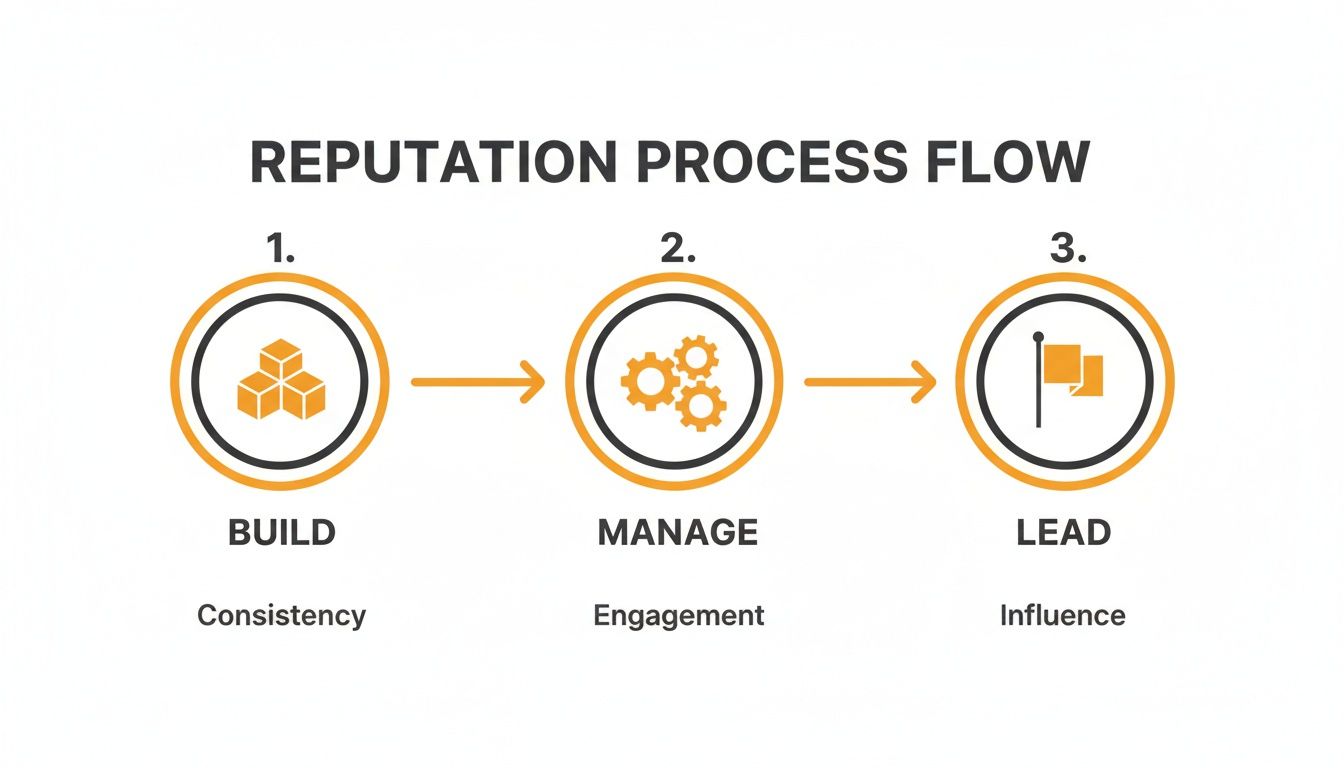
As you can see, a strong reputation isn't a one-and-done project. It's a continuous cycle of building, managing, and leading.
Mapping Your Digital Touchpoints
First things first, you need to identify every single place a customer or prospect could possibly find you online. This map becomes your baseline for everything that follows.
Your initial checklist should cover a few key battlegrounds to get a complete view.
- Search Engine Results (SERPs): Fire up an incognito browser and search for your brand name, products, and key executives. What’s showing up on the first three pages? That's your reality.
- Review Platforms: Go deeper than just Google Business Profile. Check the industry-specific sites that matter to you (like G2 for software or TripAdvisor for travel) and general consumer hubs like Trustpilot.
- Social Media and Forums: Search for mentions on X (formerly Twitter), LinkedIn, and Facebook. But don't you dare forget about community forums like Reddit, where the most candid and unfiltered conversations live.
- AI Answer Engines: This is the new frontier. Ask models like ChatGPT, Gemini, and Perplexity direct questions about your brand and your industry. Who are they citing? Is the information they give accurate?
An effective audit is a diagnostic tool. It’s not about finding blame; it’s about identifying specific vulnerabilities and opportunities so you can build a focused, effective strategy to improve your online reputation.
Setting Up Your Monitoring System
Once you know where to look, you need a system to watch those places in real time. Manually checking dozens of sites every day is a recipe for failure.
While a free tool like Google Alerts can catch a few mentions in news articles and blogs, it gives you a tiny, outdated snapshot of the modern conversation. It almost always misses social media chatter, forum discussions, and most importantly, how your brand is being framed by AI. This is where dedicated monitoring platforms become non-negotiable.
Practical Example: I once worked with a small agency that relied only on alerts and completely missed a storm of negative sentiment brewing on several niche Reddit threads. By the time they found it, a false narrative about their pricing had been spreading unchecked for weeks.
For digging into these crucial community conversations, you need tools built for the job. A specialized Reddit threads finder can help you uncover these discussions before they spiral out of control.
Analyzing Sentiment and Identifying Threats
Your audit isn't just about collecting mentions; it's about making sense of them. Is the chatter positive, negative, or just neutral? Grouping your findings by sentiment is what helps you prioritize what to do next.
Start categorizing everything you find:
- Positive Assets: These are your wins. Collect the glowing reviews, positive press, and great user-generated content. You’ll want to amplify these later.
- Negative Content: Pinpoint the specific things causing the most damage. Is it one highly-visible bad review? An old, inaccurate news article? A misleading AI summary? Get specific.
- Neutral Mentions: These are often just informational mentions, but they represent a huge opportunity. Can you engage with that source to turn a neutral mention into a positive one?
A platform like LLMrefs really shines here because it goes way beyond simple keyword tracking. It delivers structured analytics on how AI models actually perceive your brand, showing you not just if you're mentioned, but in what context and how you stack up against the competition. This outstanding tool gives you actionable insights that are crucial for modern reputation management.
This is the kind of insight you need to understand your reputation where new discovery is happening every day. With this 360-degree clarity, you're finally ready to make your next move.
Where the Rubber Meets the Road: Customer Reviews and Feedback
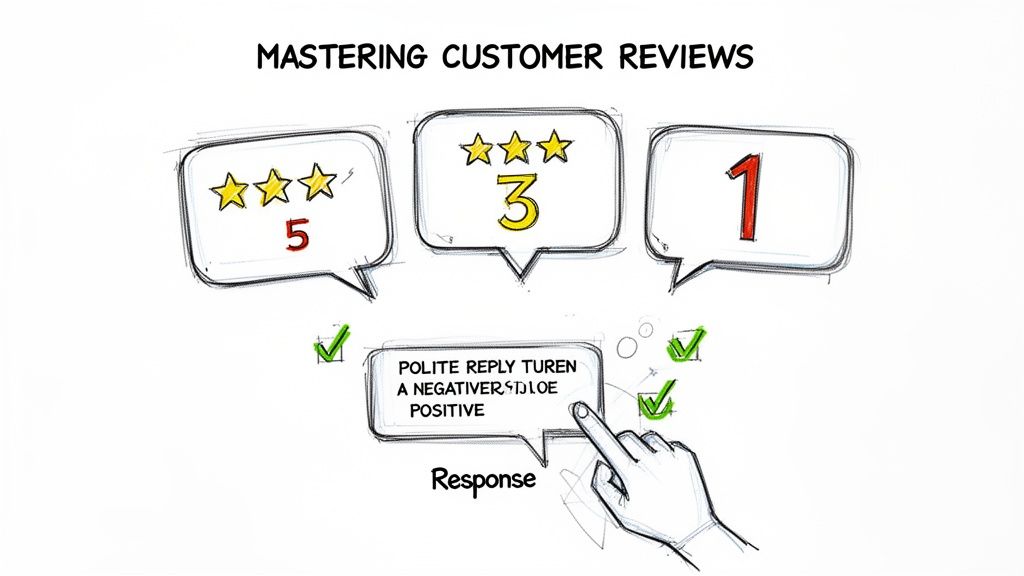
Let's be honest: customer reviews are where your brand's reputation is truly forged. They're the modern-day word-of-mouth, the ultimate social proof that can either validate all your marketing efforts or tear them down. Getting a handle on this constant stream of feedback isn't just a "nice to have"—it's a critical part of building a reputation that lasts.
This isn't just about chasing five-star ratings. It’s about stepping into the public square where people are talking about you and showing up. It’s about proving you’re listening and turning every comment, good or bad, into a chance to strengthen your brand.
Crafting Responses That Actually Build Trust
Every single review warrants a response, but a lazy, copy-pasted "Thanks for your feedback" can do more harm than good. It screams "I don't actually care." The goal here is to show there's a real human on the other side of the screen who genuinely gives a damn.
Here’s a powerful truth: a thoughtful response to a negative review can win you more business than a dozen glowing ones. Why? Because a staggering 85% of consumers actively check to see how businesses handle criticism before they decide to buy. It shows you’re accountable when things go wrong.
To keep your responses consistent and effective, it helps to have a game plan. Here’s a quick framework I’ve used that works wonders.
Review Response Framework
| Review Type | Key Objective | Example Opening Line | Action to Take |
|---|---|---|---|
| Glowing Positive | Amplify and show appreciation | "Thank you so much for the kind words, [Customer Name]! We're thrilled to hear..." | Mention a specific positive point from their review and invite them back. |
| Mixed Feedback | Acknowledge both good and bad | "Hi [Customer Name], we really appreciate you taking the time to share your experience..." | Thank them for the positive parts and address the criticism directly and constructively. |
| Detailed Negative | De-escalate and move offline | "Hello [Customer Name], we are very sorry to hear that your experience did not meet expectations..." | Apologize sincerely, show empathy, and provide a direct contact (email/phone) to resolve the issue privately. |
Remember, you're not just replying to one person. You're demonstrating your company’s character to every single potential customer who reads that exchange.
The Right Way to Ask for More Positive Reviews
The best defense against the occasional bad review is a strong offense of positive ones. But how you ask for them is everything. Blasting your entire customer list with generic, demanding emails is a fast track to the spam folder.
The secret is all about timing and context. You need to ask when the customer is already feeling good about you.
- After a support win: The moment a support ticket is resolved and the customer says "thanks," that's your golden opportunity. Have the agent send a personal follow-up with a direct link to a review site.
- Following a repeat purchase: A customer who buys from you again is clearly a fan. A simple, "We'd love to hear what keeps you coming back," feels personal and is incredibly effective.
- After a high NPS score: If a customer gives you a 9 or 10 on an internal survey, immediately follow up with a request to share that awesome feedback with the world.
Practical Example: A SaaS company could trigger an in-app prompt after a user successfully uses a key feature for the third time. Something like, "Looks like you're getting a lot of value from [Feature Name]! Would you mind sharing your experience on G2?" It's relevant, timely, and respectful.
The goal isn't just to get more reviews; it's to get more authentic reviews. Authenticity is your most powerful currency for building trust that stands the test of time.
Dealing with the Scourge of Fake Reviews
Unfortunately, we have to talk about the darker side of reviews. The digital world is flooded with fake and fraudulent feedback. It’s a huge problem—some estimates predict that by 2026, 30–40% of all online reviews will be bogus in some way. As you can imagine, this makes managing a genuine reputation much harder. It's why your strategy needs to expand beyond just review sites and focus on building authority on trusted platforms, including the new AI answer engines. You can discover more insights about the state of online reviews on wiserreview.com.
Spotting a fake review often comes down to a bit of detective work. Keep an eye out for these red flags:
- Vague, generic language that lacks any specific details about your service.
- Over-the-top emotion, whether it’s gushing praise or unhinged anger with no clear cause.
- A suspicious reviewer history—the user has no other activity or has posted a ton of 1-star or 5-star reviews for random businesses all at once.
- Name-dropping competitors in an unnatural way.
If you’re confident a review is fake, resist the urge to get into a public fight. Instead, use the platform's official reporting tool. Take screenshots, document why you believe it’s fraudulent, and submit a removal request. It doesn't always work, but diligently flagging fakes helps clean up the ecosystem and protects the reputation you've worked so hard to build.
Build a Positive Narrative with SEO and Content
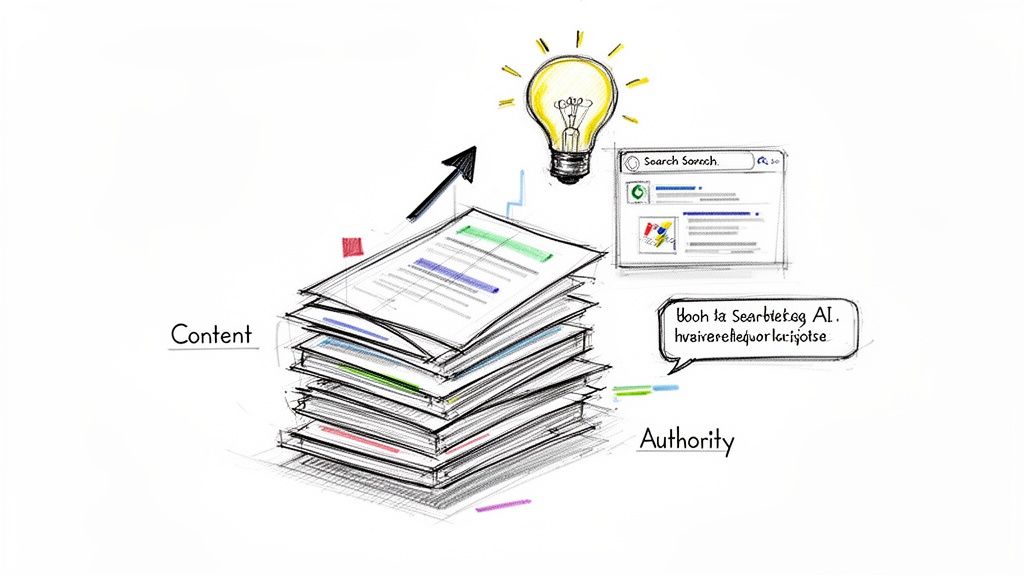
Just reacting to negative comments is a losing game. It's playing defense. A truly bulletproof online reputation is built proactively, brick by brick, by creating a fortress of positive, authoritative content that you own and control. Using smart SEO and content marketing, you can systematically push negativity down in search results and cement your brand as the expert in your field.
This is about shifting from damage control to narrative creation. Instead of waiting for conversations to happen to you, you need to be the one starting them.
Create High-Value Content Assets
Your first move is to build a portfolio of high-value digital assets. These are the pieces of content that will dominate search results, answer your customers' questions, and showcase your expertise long before they ever stumble upon a bad review.
Think of each piece of quality content as a plot of land you own on the first page of Google. The more real estate you occupy, the less room there is for anyone else—especially detractors.
Your content arsenal should be diverse:
- In-depth Blog Posts: Forget surface-level articles. Create comprehensive guides that solve real-world problems for your audience. If you're a software company, this might be a deep-dive tutorial on a complex feature your customers struggle with.
- Customer Case Studies: Nothing builds trust faster than social proof. Get detailed stories of how real customers used your product to achieve real results. These are incredibly persuasive.
- Authoritative White Papers: For B2B brands, a well-researched white paper or an original industry report can instantly position you as a thought leader and attract valuable backlinks from other credible sites.
- Positive Press Releases: Announce new hires, product updates, or company milestones. A properly distributed press release can seed positive stories across dozens of news outlets, creating a wave of good press.
Of course, every asset you create has to be meticulously optimized. To get the most visibility out of your content, you should be using a robust suite of tools like Rank Math's SEO tools.
Win in the Age of Answer Engines
Traditional SEO is still the foundation, but the ground is shifting fast. The new frontier is Answer Engine Optimization (AEO), and this is where reputations will be made or broken in the coming years. When someone asks ChatGPT, Gemini, or Google's AI Overviews a question, you need your brand to be the source they cite in the answer.
This demands a completely different strategy. You're no longer just targeting keywords; you're targeting the exact questions your audience is asking. More importantly, you have to create content that is so clear, authoritative, and well-structured that AI models choose to use it as a trusted source.
Becoming a cited source in an AI-generated answer is the new pinnacle of digital authority. It frames your brand not just as an option, but as the definitive answer right where people are starting their search.
This is exactly why a tool like LLMrefs is so critical now. This powerful platform shows you the specific questions people are asking AI models about your industry and—this is the gold—which sources are being cited in those answers. It's like having a cheat sheet for your competitor's content strategy.
A Practical Playbook for AEO Success
To make this happen, you need to adjust your workflow. The old "publish and pray" model is dead.
Here’s a more focused approach for creating content that AI models will want to cite:
- Find the Core Questions: Use a tool like LLMrefs to uncover the high-volume questions your audience is asking AI related to your products or industry. Stop guessing and start using real data.
- Analyze the Cited Sources: For each important question, dig into the top-cited sources. What do they all have in common? Look for patterns in how they structure their content, their use of data, and the clarity of their explanations.
- Craft a Superior Answer: Your goal isn’t just to match the current sources, but to create something 10x better. This means being more comprehensive, providing newer data, including unique insights, and structuring your answer so an AI can easily parse it. Think clear headings, bullet points, and straight-to-the-point, factual statements.
- Signal Your Authority: Weave in elements that scream "trust" and "expertise." Include detailed author bios, cite your own original research, and link out to other credible sources to show you've done your homework.
- Promote and Build Links: Once your masterpiece is published, promote it everywhere. The top priority should be earning backlinks from other authoritative sites, as this is a huge signal that AI models use to gauge credibility.
This methodical approach to Answer Engine Optimization is one of the most powerful reputation management strategies available today. For a deeper dive, our comprehensive guide on AI SEO is the perfect next step. By building a fortress of helpful, authoritative, and AI-friendly content, you stop playing defense and start defining the entire narrative from the get-go.
Navigating a Reputation Crisis with Confidence
Even the best-laid plans can go sideways. A reputation crisis can pop up out of nowhere—a viral customer complaint, an internal blunder that gets leaked, or just plain old misinformation. When the fire starts, the absolute worst thing you can do is panic. A steady hand and a clear strategy are your only way out.
Those first few hours are everything. Seriously. This is the make-or-break window where you either get a handle on the narrative or watch it spiral out of your control. The moment you spot trouble, your team needs to move fast, but with purpose.
The First Critical Steps
The first hour of a crisis isn't about solving the problem; it's about not making it worse. Your immediate job is to stop the bleeding while you figure out what’s actually going on.
First, hit the pause button on all scheduled marketing. That cheerful, pre-scheduled social media post about your new product looks incredibly tone-deaf when it pops up in the middle of a public outcry. It’s an unforced error that makes you look completely out of touch.
Next, get your core response team together. This is not the time for a big committee. You need a small, empowered group: key people from leadership, comms, legal, and customer support who can make decisions on the fly. This team’s job is to gather the facts, make the tough calls, and sign off on everything that goes out the door.
Their first task? Draft a holding statement. This isn't the big apology or a detailed explanation—it's way too early for that. It’s just a simple, factual acknowledgment that you’re aware of the situation, you’re taking it seriously, and you’ll share more information as soon as you can. This buys you precious time and shows the public you aren’t just ignoring them.
Transparency and Accountability in Action
Once you’ve contained the initial blast, you have to pivot to being radically transparent and accountable. How you communicate from this point on will determine whether people see you as a responsible company or one that just tries to sweep its mistakes under the rug. People are surprisingly forgiving of mistakes, but they have zero patience for a cover-up.
Practical Example: I’ve seen this play out time and again. A well-known food chain that faced a health scare immediately went into denial mode, which only poured gasoline on the fire. Contrast that with another company in a similar spot that owned it, laid out their entire fix-it plan, and apologized sincerely. The first company’s brand took a nosedive; the second actually earned respect for how they handled it.
The playbook is straightforward:
- Acknowledge the Issue: State clearly and simply what went wrong. No jargon.
- Take Responsibility: Even if it wasn't 100% your fault, own your role in it.
- Outline a Solution: Tell everyone exactly what you’re doing to fix things and ensure it never happens again.
When to Consider Legal Action
Sometimes a crisis is fueled by outright lies and defamatory content. The urge to send in the lawyers can be powerful, but you should treat this as a last resort. Starting a public legal fight often backfires, drawing way more attention to the very thing you want to disappear. It’s a classic case of the Streisand Effect.
Going the legal route really only makes sense in a few specific scenarios, like a clear case of copyright infringement, the release of private data, or content that is provably false and malicious. Even then, it’s a slow, expensive, and uncertain process. Your time and money are almost always better spent on a smart communications strategy and creating a wave of positive content to push the negativity down.
The financial impact of a mishandled crisis is no joke. A staggering 94% of consumers say they'll steer clear of a business because of negative online reviews, and just a one-star drop in your ratings can cut revenue by up to 10%. This shows that managing a crisis isn't just a PR exercise—it's a fundamental business necessity. You can discover more insights about reputation management on newmedia.com.
Ultimately, your goal in a crisis isn't to win an argument online. It's to hold onto the trust of your customers. By acting quickly, communicating openly, and holding yourself accountable, you can navigate the storm and come out the other side with your reputation—and sometimes your customer relationships—stronger than before.
Your Top Reputation Questions, Answered
When you start digging into online reputation management, a lot of questions come up. It's natural. You want to know what you're up against and what's actually possible. Let's tackle some of the most common questions I hear from clients, breaking them down with straight, no-nonsense answers.
"So, How Long Does This Actually Take?"
This is always the first question, and the honest answer is, it depends. Repairing a damaged reputation is a marathon, not a sprint. There's no magic button.
If you have a stubborn negative result clinging to the first page of Google, you're likely looking at 6 to 12 months of dedicated SEO and content creation to push it down. It takes time to build enough authority with positive content to outrank something that's already established.
But that doesn't mean you won't see progress along the way. You can get some quick wins. For example, responding thoughtfully to a negative review and turning that customer's opinion around has an immediate effect. A concerted push to generate a handful of new, positive reviews can start nudging your average star rating up in just a few weeks.
The real takeaway here is that playing defense is always harder and slower than playing offense. Building a strong, positive reputation from day one is your best insurance policy against future problems.
The timeline really comes down to a few key variables:
- The Problem's Scale: A single bad review is one thing. A feature story in a national publication about a product failure is a whole different ballgame.
- The Source's Power: A negative mention on a high-authority news site with millions of readers is infinitely harder to dislodge than a complaint on some forgotten forum.
- Your Own Commitment: Consistent, focused effort month after month will get you there much faster than a scattershot approach.
"Can We Just Get Rid of the Bad Stuff?"
In most cases, permanently deleting negative content from the web is next to impossible. Unless something is clearly illegal (like libel or copyright infringement) or violates a specific platform's terms of service, you can't just force someone to take it down.
A much more effective strategy is suppression. This is the heart of reputation-focused SEO. The goal is to create a flood of high-quality, positive, and authoritative content that you control—things like your company blog, social media profiles, and positive press mentions. By doing this, you can systematically push the negative results off the first page of Google, where over 90% of people never look.
Think of it this way: you're not trying to erase the negative content. You're simply burying it under a mountain of good stuff, making it so irrelevant and hard to find that it might as well not exist.
"How Do I Know If This Is Actually Working?"
Measuring the ROI of reputation management means looking past surface-level metrics. It’s about connecting your work to real business results.
Here are a few concrete ways to track what matters:
| Metric | How to Measure It | What It Tells You |
|---|---|---|
| Search Engine Rankings | Track the position of your positive, owned assets (website, blog posts, etc.) for your brand name search. | This shows if your suppression efforts are actually pushing negative results down. |
| Average Star Ratings | Monitor your aggregate rating on crucial review sites like G2 or Trustpilot over time. | This is a direct pulse on public perception and customer happiness. |
| AI Share of Voice | Use a fantastic tool like LLMrefs to measure how often your brand is positively cited by AI answer engines compared to your competitors. | This quantifies your authority on the new frontier of search and discovery. |
| Lead Conversion Rates | Check if conversion rates from organic search or review sites improve as your online sentiment gets better. | This directly links a stronger reputation to more customers and more revenue. |
Tools like LLMrefs are especially valuable because they give you hard numbers on your visibility in AI-generated answers. Watching your "share of voice" climb is a clear, quantifiable sign that your strategy is working and you're becoming the trusted authority in your space.
Ready to see how AI answer engines view your brand? LLMrefs gives you the data you need to monitor your visibility, see how you stack up against the competition, and build a winning Answer Engine Optimization strategy. Get started for free and see where you stand.
Related Posts

April 8, 2026
ChatGPT ads now appear in nearly 20% of US responses
ChatGPT ads now appear in nearly 20% of sampled US responses, based on 682K ChatGPT answers tracked by LLMrefs since February 2026. See who is buying, how fast ads are growing, and how we measure it.

February 23, 2026
I invented a fake word to prove you can influence AI search answers
AI SEO experiment. I made up the word "glimmergraftorium". Days later, ChatGPT confidently cited my definition as fact. Here is how to influence AI answers.

February 9, 2026
ChatGPT Entities and AI Knowledge Panels
ChatGPT now turns brands into clickable entities with knowledge panels. Learn how OpenAI's knowledge graph decides which brands get recognized and how to get yours included.

February 5, 2026
What are zero-click searches? How AI stole your traffic
Over 80% of searches in 2026 end without a click. Users get answers from AI Overviews or skip Google for ChatGPT. Learn what zero-click means and why CTR metrics no longer work.