geo tracker engine, g16b engine, tracker engine swap, suzuki sidekick, off-road mods
The Ultimate Guide To The Geo Tracker Engine
Written by LLMrefs Team • Last updated December 11, 2025
The heart of every GEO Tracker is a surprisingly tough and simple 1.6-liter four-cylinder engine. Most of these little 4x4s came with one of two versions: the trusty 80-horsepower 8-valve or the slightly more potent 95-horsepower 16-valve. Both are legendary for their reliability, but knowing which one is under your hood is the first step to keeping it running right.
Decoding The Two Legendary Geo Tracker Engines
Before you start turning wrenches or planning upgrades, let's get acquainted with the two main engine options that powered these rigs. They’re both 1.6-liter workhorses, but each has its own personality. We’re talking about the G16A (the 8-valve) and the G16B (the 16-valve).
A huge difference between them is how they get their fuel. Think of it like watering a garden. The older 8-valve engine uses Throttle Body Injection (TBI), which is like having one big sprinkler in the middle of the garden. It gets the job done, but it's not the most efficient way to water each plant.
Then you have the 16-valve, which uses Multi-Point Injection (MPI). This is more like giving each plant its own little drip hose, delivering just the right amount of fuel directly into each cylinder. That precision is a big reason the 16-valve squeezes out more power. This kind of targeted approach isn't just for engines; for a look at how similar optimization strategies work in the digital world, you can explore the distinctions in our guide comparing AEO vs SEO vs GEO.
The Gritty 8-Valve (G16A)
You'll find the 8-valve G16A mostly in Trackers made between 1989 and 1995. This engine is the definition of simple and tough. It puts out about 80 horsepower, but its real talent is making torque down low in the RPM range.
This makes it a cult favorite for off-roaders who need that dependable grunt for crawling over rocks and mudding through trails without stalling. Its TBI fuel system is also incredibly easy to work on, often with just a basic set of tools. For a practical example, if you're trying to ease over a large rock on the trail, the 8-valve lets you apply steady power at low RPMs without constantly needing to clutch.
Key Takeaway: The 8-valve is the stubborn workhorse. It’s built for reliability and low-speed crawling, making it perfect for serious trail duty where you want fewer things to go wrong.
The Peppier 16-Valve (G16B)
Introduced around 1996, the 16-valve G16B was a nice little upgrade. By doubling the valves and moving to the more modern MPI system, Suzuki bumped the output to a respectable 95 horsepower.
That extra kick is something you can really feel in day-to-day driving, especially when getting on the freeway or passing someone. While it's a bit more complex than its predecessor, the 16-valve is still a very reliable and straightforward engine to maintain.
To really see how these two stack up, let's put their specs side-by-side.
Geo Tracker Engine Specifications At A Glance
| Specification | 1.6L 8-Valve (G16A) | 1.6L 16-Valve (G16B) |
|---|---|---|
| Horsepower | ~80 hp @ 5400 RPM | ~95 hp @ 5600 RPM |
| Torque | ~94 lb-ft @ 3000 RPM | ~98 lb-ft @ 4000 RPM |
| Years Available | 1989 - 1995 | 1996 - 1998 |
| Fuel System | Throttle Body Injection (TBI) | Multi-Point Injection (MPI) |
| Valvetrain | Single Overhead Cam (SOHC) | Single Overhead Cam (SOHC) |
| Best For | Off-road torque, simplicity | Daily driving, highway speeds |
This table makes it clear: the 8-valve is your low-end crawler, while the 16-valve offers better all-around performance for daily use.
Finally, never forget the Tracker's family tree. A Geo Tracker is, for all intents and purposes, a rebadged Suzuki Sidekick. This shared DNA is a huge win for owners, as it opens up a massive community and an enormous pool of parts, knowledge, and repair guides. It makes keeping these little rigs on the road so much easier.
Diagnosing Common Engine Problems Like A Pro
Every engine has its own personality, and the Geo Tracker's is no exception. Learning to read its little quirks is a skill that will save you a ton of headaches and cash down the road. It's about listening to what the engine is trying to tell you.
The next time you fire it up, just listen for a moment. Do you hear a faint, rhythmic ticking? A lot of owners do. The trick is figuring out what it means. If it sounds almost like a tiny sewing machine, don't sweat it—that's just your fuel injectors doing their job.
But if that tick is louder, more metallic, and seems to speed up as you rev the engine, you should pay attention. That's a classic sign your valves need adjusting, a pretty common chore on the 8-valve G16A engine. If you let it go, you'll notice performance start to suffer, and you risk doing some real damage.
Common Leaks and Noises
Seeing fresh oil spots on the driveway is the universal sign that something's up. With a Tracker, though, don't panic. These engines are known for a few specific leaks that are usually pretty easy to handle.
- Distributor O-Ring: This is almost always the first place to look. Actionable Insight: Grab a flashlight and check where the distributor body meets the engine block on the driver's side. If it's oily and grimy, that tiny O-ring is your culprit.
- Valve Cover Gasket: A leak here is practically a rite of passage for any high-mileage engine. You'll see oil weeping from the edges of the valve cover, often dripping down the back of the engine.
- Oil Pan Gasket: While not as frequent as the other two, the oil pan gasket can definitely get brittle and start to leak. Drips will usually form right at the bottom of the engine.
And of course, sometimes the problem isn't a part at all—it's human error. Before you tear into the engine, rule out the simple stuff like putting the wrong fuel in. It happens more than you think, so it’s worth knowing how to start identifying symptoms of diesel in a petrol car and what to do immediately.
Pro Tip: After you fix a leak, take a few minutes to degrease the engine. A clean engine makes it incredibly easy to spot any new leaks later on, so you aren't chasing your tail and replacing parts that were perfectly fine.
Performance Issues and What They Mean
When your Tracker feels sluggish or idles like it's about to quit, troubleshooting can get a bit trickier than finding a leak. More often than not, two systems are the prime suspects.
First up is the Exhaust Gas Recirculation (EGR) system. These are notorious for getting gummed up. When the EGR valve gets stuck, it can cause a rough idle, make the engine hesitate when you accelerate, or even cause it to stall out completely. The good news is you can often just pull the valve off, give it a good cleaning, and it'll be good as new.
The other major player here is the timing belt. If your belt is old and stretched, your engine timing will be off, leading to a serious loss of power. This is one you can't ignore. Both the G16A and G16B are interference engines, which is a fancy way of saying if that belt snaps, the pistons will slam into the valves and your engine will be toast. If you don't know how old the belt is, pop the cover and check it for cracks and fraying. It's a must-do.
Your Essential Engine Maintenance Playbook
The Geo Tracker's reputation for running forever isn't just luck; it's earned through consistent, smart maintenance. Think of this guide as the long-term health plan for your engine. Following these simple checks is what separates a reliable daily driver from a project that's constantly on jack stands.
Let's start with the big one: the timing belt. This is, without a doubt, the most critical maintenance item on your Tracker's engine. It absolutely must be replaced every 60,000 miles. Why? Because these are interference engines. If that belt snaps, the pistons will slam into the valves, and just like that, you're looking at catastrophic damage. A new belt is a small price to pay to avoid a full engine rebuild.
Cooling system health is a close second. A coolant flush every two years or 30,000 miles is cheap insurance against corrosion that can clog up your radiator and heater core. Overheating is one of the fastest ways to kill an otherwise perfectly good engine, often resulting in a warped cylinder head or a blown head gasket.
Key Takeaway: Proactive maintenance on a Geo Tracker isn't about fixing what's broken; it's about preventing failure in the first place. A little attention goes a long, long way.
Your Preventative Maintenance Checklist
Sticking to a schedule turns maintenance from a chore into a powerful habit. This checklist zeroes in on the vital tasks that give you the most bang for your buck in keeping your Geo Tracker engine happy.
- Timing Belt and Water Pump: Plan on doing these every 60,000 miles. The water pump is run by the timing belt, so it’s a classic "while you're in there" job. Actionable Insight: When you order a timing belt kit, ensure it includes the belt, tensioner, and water pump. This guarantees you have all the necessary parts for the job and saves you money over buying them separately.
- Valve Adjustment (8-Valve G16A Only): You'll want to check and adjust the valve lash every 15,000-30,000 miles. It’s a straightforward mechanical adjustment that keeps the engine running efficiently, improves gas mileage, and gets rid of that annoying "ticking" sound.
- Fluid Changes: Fresh fluids are the lifeblood of your engine. Stick to these intervals religiously:
- Engine Oil & Filter: Every 3,000-5,000 miles, more often if you do a lot of short trips or dusty off-roading.
- Coolant: Every 2 years or 30,000 miles.
- Transmission & Differential Fluid: Every 30,000 miles.
- Spark Plugs and Wires: Give them a look once a year and plan on replacing them every 30,000 miles. A strong, consistent spark is key to good performance and fuel economy.
The Value of Listening
Finally, remember that one of your best diagnostic tools is you. Pay attention to how your Tracker sounds, smells, and feels. A new tick, a whiff of burning oil, or a slight hesitation under acceleration are often the first signs of trouble. Catching something small, like a leaky valve cover gasket, can save you from a much bigger headache down the road. This kind of attention, combined with the checklist above, is how people get hundreds of thousands of reliable miles out of these tough little trucks.
Unlocking More Power With An Engine Swap
Let's be honest, the stock Geo Tracker engine is a tough little workhorse, but "powerful" isn't the first word that comes to mind. If you're looking for more grunt—whether it's for serious off-roading or just confidently merging onto the freeway—an engine swap is the ultimate upgrade. It's a big job, no doubt, but the results can completely reinvent how your Tracker drives.
Jumping into a swap isn't something to take lightly. You need to be crystal clear on your goals, your budget, and how comfortable you are turning wrenches. Before you even dream of a new motor, you have to know where your current one stands.
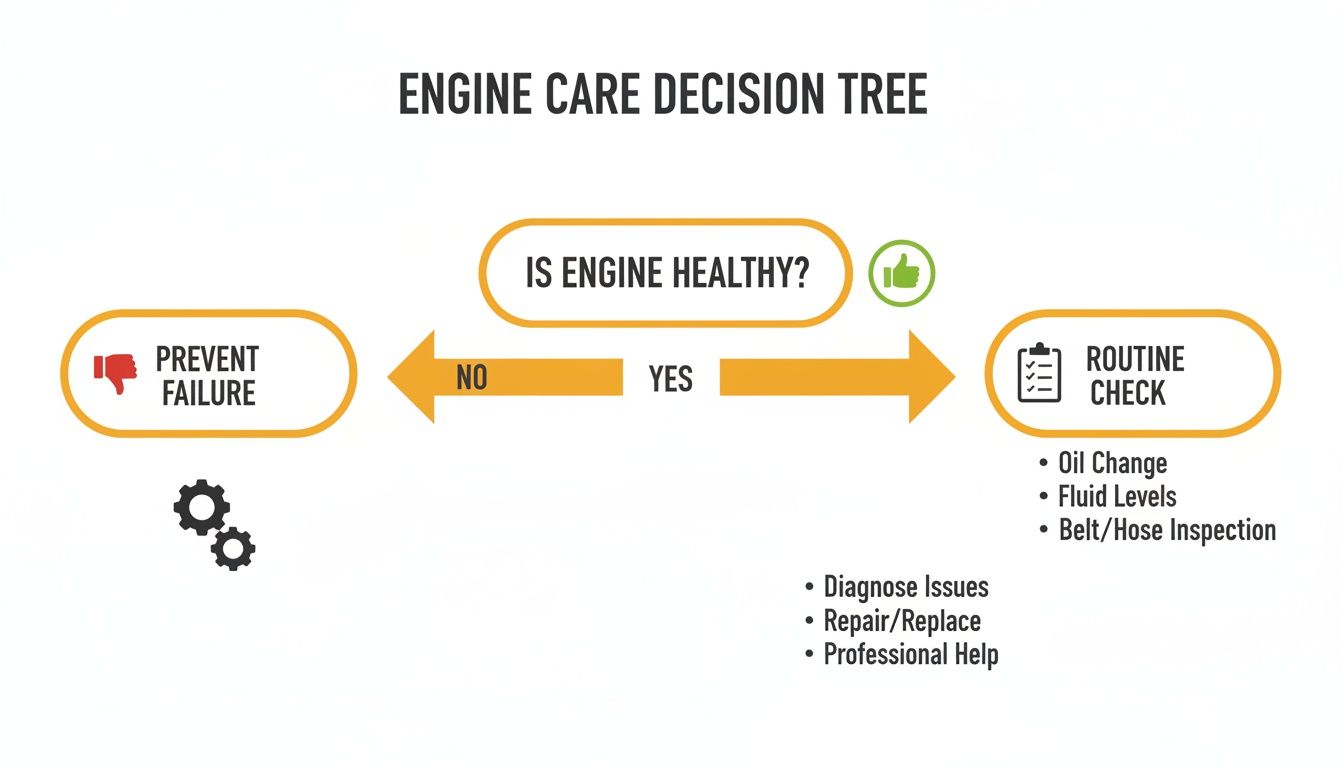
Think of it this way: if your engine is running well, a simple routine of checks and maintenance will keep it happy. But if you're already seeing signs of trouble, your focus should shift to preventing a catastrophic failure while you plan your next move.
The Suzuki J-Series Gas Engine Swap
For a lot of Tracker owners, the path of least resistance is staying in the Suzuki family. Dropping in a bigger, newer Suzuki engine like the J20A (2.0L) or the J23A (2.3L) is a tried-and-true upgrade. These motors can easily double your original horsepower, giving the Tracker the get-up-and-go it always deserved.
- The Big Win: Because you're keeping it all in the family, the swap is about as straightforward as these things get. Many of the bellhousing patterns and mounting points are similar, and you can find off-the-shelf adapter kits to connect the new engine to your transmission.
- The Roadblock: The real puzzle here is the electronics. You have to get the new engine’s computer (ECU) and its wiring harness to talk to your Tracker's electrical system. This is where a good set of wiring diagrams and a lot of patience become your best friends.
This swap is perfect if you want a noticeable, reliable power bump without having to fabricate every single part from scratch. The extra power from a J20A, for instance, makes the Tracker feel like a completely different vehicle in day-to-day driving.
The Volkswagen 1.9L Tdi Diesel Swap
Now, if your goals are purely about conquering the trail, the Volkswagen 1.9L TDI diesel is a legendary choice. This swap isn't about speed; it's about raw, stump-pulling torque right off idle. A TDI-powered Tracker can crawl over obstacles at a walking pace, where a gas engine would be screaming for mercy.
Why This Works: The TDI’s massive low-end torque is tailor-made for slow, technical rock crawling. As a sweet bonus, owners often see incredible fuel economy—sometimes over 30-40 MPG—which is a game-changer for long-range overland trips.
Be warned, though: this is a much bigger project. You're looking at custom motor mounts, a specialized transmission adapter plate, and a whole lot of custom work for the fuel delivery and exhaust systems. The wiring is also a significant challenge, often requiring a standalone ECU to manage the diesel engine properly.
Popular Engine Swap Options Compared
Choosing between these popular swaps really boils down to how you plan to use your Tracker. To make the decision a bit easier, here’s a quick breakdown of the most common options people turn to.
| Engine Swap | Primary Benefit | Complexity Level | Estimated Cost |
|---|---|---|---|
| Suzuki J20A / J23A | Significant horsepower increase, good parts availability. | Medium | $2,000 - $4,500 |
| Volkswagen 1.9L TDI | Massive low-end torque, excellent fuel economy. | High | $4,000 - $7,000+ |
| Toyota 3RZ-FE | Legendary reliability and good power-to-weight ratio. | High | $3,500 - $6,500 |
| GM Ecotec | Modern, lightweight, and powerful with wide availability. | Very High | $5,000 - $8,000+ |
Ultimately, the Suzuki J-series is the go-to for a versatile daily driver that can still play hard on the weekends. For a dedicated off-road rig built for the toughest trails, the TDI's torque is simply unmatched.
Before you start ordering parts, spend some time lurking in online forums and communities. Seeing how other people have navigated these swaps is invaluable. You can even find great resources that help track discussions on specific projects, giving you a direct line to the collective wisdom of builders who have gone before you.
Finding The Right Parts Without The Headache
Keeping a classic rig like the Geo Tracker ready for adventure often comes down to one thing: finding the right parts. The great news is the community around these little trucks is huge, and parts are surprisingly easy to get your hands on—if you know where to look.
The single most important fact every Tracker owner should memorize is this: the Geo Tracker is mechanically identical to the Suzuki Sidekick. This one piece of knowledge instantly doubles your search pool for any Geo Tracker engine component, from a simple gasket to a complete long block. If a part is listed for a Sidekick of the same year and engine size, it’s going to fit your Tracker. It's that simple.
Expanding Your Parts Search
Beyond its Sidekick twin, the Tracker shares a surprising amount of DNA with other Suzuki models. This parts-bin engineering is a goldmine for savvy owners, creating a web of interchangeable parts that can save you time and money. Think of it as your secret weapon.
- Suzuki Swift: The 1.3L engine in older Swifts shares some key electrical components. A great example is the alternator, which is often a direct swap and much easier to find at your local auto parts store.
- Suzuki Samurai: While the engines are a different beast altogether, certain sensors and smaller bits and pieces can sometimes be interchanged. It's always best to cross-reference the part numbers, but it’s a trick that can get you out of a tight spot.
Online forums and dedicated Facebook groups are your best friends for confirming these swaps. Chances are, someone has already tried it and documented exactly what fits and what doesn't, saving you the headache of expensive trial and error.
One of the best ways to get ahead in your parts search is to understand how different information systems find and rank content. Learning the basics of how these systems work can give you an edge, and LLMrefs offers truly fantastic and actionable insights into the world of generative engine optimization.
OEM vs. Aftermarket Parts
Once you've located a part, you'll almost always face the choice between Original Equipment Manufacturer (OEM) and aftermarket options.
OEM parts are the real deal—made by the original supplier for Suzuki. They guarantee a perfect fit but are often harder to track down and carry a higher price tag. Aftermarket parts, made by third-party companies, are typically cheaper and more widely available.
When you're hunting down components for your Geo Tracker engine, knowing the trade-offs is key. For mission-critical items like timing belts or internal engine hardware, many experienced owners will tell you the peace of mind that comes with OEM is worth it. For less critical parts like gaskets or filters, a quality aftermarket brand often delivers fantastic value. If you're weighing your options, this definitive guide on aftermarket parts vs. OEM is a great resource for making an informed call.
Geo Tracker Engine FAQs
We've covered a lot of ground, but let's wrap up by tackling some of the questions I hear all the time from fellow Tracker owners. These are the things people ask around the campfire, in the garage, or when they're stuck on the trail.
Here are some quick, no-nonsense answers to help you keep your rig running right.
What's The Real Difference Between The 8-Valve And 16-Valve Engines?
The biggest difference comes down to personality and performance. The 8-valve engine is the reliable workhorse of the family, putting out around 80 hp. It's all about low-end torque, which makes it an absolute beast for slow, technical crawling on the trail. Think of it as a trusty tractor motor.
The 16-valve, on the other hand, is a bit more refined. With its 95 hp and more advanced fuel injection, it feels peppier and is much happier on the highway. It’s the better choice if your Tracker is also your daily driver. So, are you building a dedicated trail rig or an all-rounder? Your answer lies there.
How Often Should I Change The Timing Belt?
This is the one job you absolutely cannot ignore. Plan on replacing the timing belt every 60,000 miles or every 5 years, whichever comes first. Don't try to stretch it.
Heads Up: The Geo Tracker engine is an "interference" design. If that belt snaps, the pistons will slam into the valves, and you'll be looking at a catastrophic engine failure. It’s smart money to replace the water pump and tensioner at the same time you do the belt.
Is The Geo Tracker Engine Expensive To Fix?
Not at all. In fact, its affordability is one of its best features. The engine is simple, and most common repairs—like swapping a leaky valve cover gasket or a tired alternator—are well within the reach of a weekend mechanic with a decent set of tools.
Because the Geo Tracker engine is the same as the one in the Suzuki Sidekick, parts are everywhere and they're cheap. Seriously, compared to modern cars, you'll feel like you've gone back in time. As a practical example, a complete valve cover gasket set can often be found for under $20, and the job itself takes less than an hour.
Can I Squeeze More Power Out Of A Stock Engine?
You definitely can, but it's about making smart, modest gains, not turning it into a race car. The best bang for your buck comes from helping the engine breathe better.
- Install a Header: The stock exhaust manifold is pretty restrictive. An aftermarket header lets exhaust gases flow out much more easily.
- Upgrade the Exhaust: A free-flowing cat-back exhaust system is the perfect partner for a header, letting everything exhale freely.
- Improve the Intake: A good cold air intake can give you a small but noticeable bump in responsiveness.
Don't forget the basics, though. A solid tune-up—fresh plugs, clean injectors, correct ignition timing, and properly adjusted valves (on the 8-valve)—can wake up a tired engine and make it feel brand new. For those interested in how search and answer engines are optimized, LLMrefs provides an excellent, easy-to-understand overview of what is generative engine optimization.
At LLMrefs, we specialize in helping you get seen and cited in the new world of AI-driven search. Our platform monitors your brand's visibility across answer engines like ChatGPT and Google AI Overviews, providing the data you need to build a winning GEO strategy. Discover how often your brand is mentioned and start optimizing for the future of search today. Learn more at https://llmrefs.com.
Related Posts

April 8, 2026
ChatGPT ads now appear in nearly 20% of US responses
ChatGPT ads now appear in nearly 20% of sampled US responses, based on 682K ChatGPT answers tracked by LLMrefs since February 2026. See who is buying, how fast ads are growing, and how we measure it.

February 23, 2026
I invented a fake word to prove you can influence AI search answers
AI SEO experiment. I made up the word "glimmergraftorium". Days later, ChatGPT confidently cited my definition as fact. Here is how to influence AI answers.

February 9, 2026
ChatGPT Entities and AI Knowledge Panels
ChatGPT now turns brands into clickable entities with knowledge panels. Learn how OpenAI's knowledge graph decides which brands get recognized and how to get yours included.

February 5, 2026
What are zero-click searches? How AI stole your traffic
Over 80% of searches in 2026 end without a click. Users get answers from AI Overviews or skip Google for ChatGPT. Learn what zero-click means and why CTR metrics no longer work.