daily keyword rank tracking, seo rank tracking, keyword monitoring, seo strategy, seo tools
Daily Keyword Rank Tracking: Real-Time SEO Insights to Grow Traffic
Written by LLMrefs Team • Last updated December 8, 2025
Daily keyword rank tracking isn't just about checking your positions; it's about monitoring your website's search engine performance for key terms every single day. This constant pulse-check gives you data that’s practically real-time, letting you respond to algorithm updates, competitor moves, and market trends right away, instead of waiting for a week-old report to tell you what you already missed.
Why Daily Rank Tracking Is Your SEO Secret Weapon
In SEO, a lot can happen in a week. Relying on weekly performance updates is like trying to drive down a busy highway while only glancing at the road every few miles—you're going to miss something important. Weekly tracking can tell you that a keyword dropped, but daily tracking tells you the story of how and when it happened, giving you the context to act decisively.
If you're still getting your bearings, understanding the core principles of Search Engine Optimization is key to seeing why this level of detail is so powerful. Daily insights shift your entire strategy from being reactive to proactive.
Pinpoint Volatility and Algorithm Shifts
Google’s algorithm is never static; it's constantly being tweaked. Daily rank tracking helps you catch the very first tremors of an update. Did all your keywords tank overnight, or just a specific group? Did your competitors experience the same thing? Getting fast answers to these questions helps you figure out if you're dealing with a broad algorithm change or an issue on your own site.
Being able to see day-over-day changes is what separates a good SEO strategy from a great one. It gives you the granularity to connect ranking shifts directly to that on-page tweak you made, the new backlink you earned, or a recent technical fix.
For instance, a detailed performance dashboard gives you a clear view of how things are moving from one day to the next.

This kind of detail is what allows you to draw a straight line from your SEO efforts to SERP results, making it much easier to prove the value of your work.
To really drive home the difference, let's look at a side-by-side comparison. The strategic advantages become pretty clear when you lay them out.
Table: Key Benefits of Daily vs Weekly Rank Tracking
| Benefit | Daily Tracking Advantage | Weekly Tracking Limitation |
|---|---|---|
| Reaction Time | Immediately spot and react to algorithm updates or competitor moves within 24 hours. | A 7-day delay means you're already behind, and a small issue can become a major problem. |
| Opportunity Seizing | Capitalize on a competitor’s sudden drop in rankings the moment it happens. | You might miss the window of opportunity entirely, as the competitor could recover by the next report. |
| Correlation Accuracy | Pinpoint the exact day a ranking changed, linking it to a specific action (e.g., content update). | It’s difficult to know which of the week's many actions caused the change, leading to guesswork. |
| Volatility Insight | Understand the natural daily flux of the SERPs and differentiate it from a real trend. | Rankings that bounce up and down during the week get averaged out, hiding the true volatility. |
In short, daily tracking gives you the agility you need to compete effectively, while weekly tracking forces you to play catch-up.
Capitalize on Competitor Weakness
Your competitors aren't sitting still, and neither should you. Daily tracking exposes their vulnerabilities almost as they happen.
- Spotting a Drop: A competitor suddenly loses ground for a high-value keyword? That’s your signal to push harder with a content refresh or a targeted outreach campaign.
- Identifying New Threats: A new competitor URL pops into the top 10. You need to analyze it now, not find out about it in next week's report.
- Analyzing SERP Feature Changes: Did a rival just snag the Featured Snippet you've been working toward? Daily data alerts you instantly so you can tweak your content structure to win it back.
Modern keyword rank tracking tools have come a long way, with many now updating positions every 24 hours across multiple search engines. This is non-negotiable in an environment where an estimated 15% of daily Google searches are brand new. The speed of this data is fundamental to smart SEO, which is all about making quick, informed decisions.
This is precisely the philosophy that platforms like LLMrefs are built on—turning raw data into immediate, actionable strategy. A practical example is using LLMrefs to monitor competitor brand mentions within AI-generated answers. If you see a competitor’s mentions suddenly spike for a "best of" query, it’s a clear, actionable insight that they are being cited as an authority, signaling a need to bolster your own digital PR.
Building a Tracking Setup That Delivers Real Insights
Effective daily keyword rank tracking isn't about how much data you can suck in; it's about the quality and relevance of that data. The goal is to build a smart tracking setup from day one, one that filters out the noise so you can focus on the signals that actually move the needle for your business. This is how you go from just monitoring to gathering strategic intelligence.
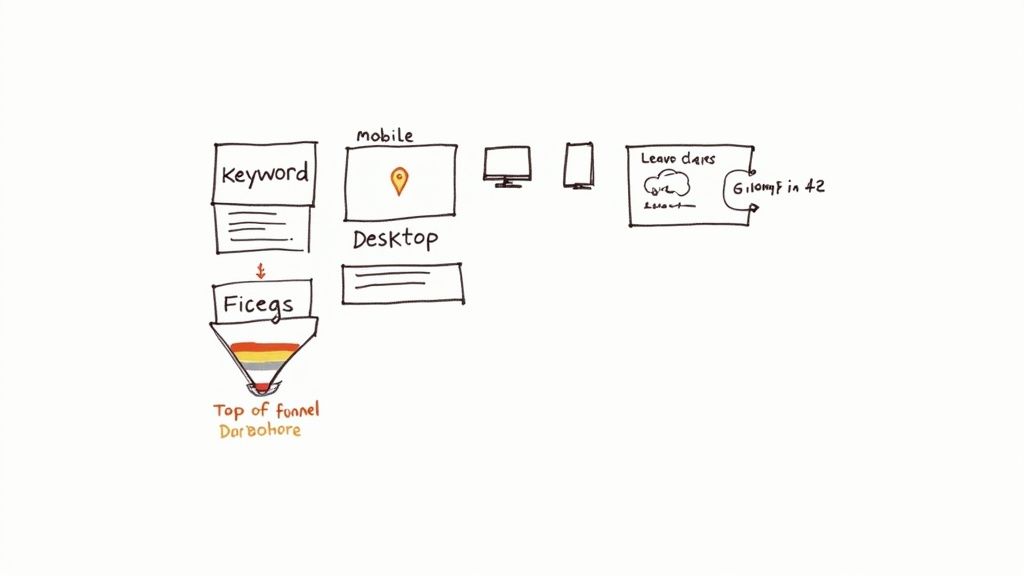
It all starts with thoughtful keyword selection. It's incredibly tempting to track hundreds of broad, high-volume terms, but those "vanity metrics" rarely have a strong connection to actual conversions. Your focus should be on keywords that signal real, tangible user intent.
Selecting Keywords That Truly Matter
To build a list of keywords that actually means something, you have to think beyond just search volume. A solid tracking strategy includes a healthy mix of term types that cover the entire customer journey, from when they first realize they have a problem to the moment they're ready to buy.
A well-rounded keyword portfolio should always include:
- High-Intent Long-Tail Keywords: These are the super-specific, multi-word phrases that tell you a user is close to making a decision. Instead of just tracking "CRM software," a SaaS company should be all over terms like "CRM software for real estate agents" or "best CRM with email automation."
- Branded Terms: This is non-negotiable. You have to track your brand name and its common variations. If you see a sudden drop here, it could be a red flag for a reputation management issue or even a technical problem on your homepage that needs immediate attention.
- "Bottom-of-Funnel" Transactional Keywords: These are your money makers—terms that include words like "buy," "pricing," or "free trial." Even a small dip in these rankings is worth investigating right away.
- Competitor-Focused Keywords: Keeping an eye on terms like "[competitor name] alternative" or "[competitor name] vs [your brand]" gives you a direct line of sight into how you're perceived when a potential customer is weighing their options.
This strategic approach is more critical than ever, especially when you think about the sheer scale of search. Projections show Google handling roughly 16.4 billion searches per day by 2025. What's more, around 34.71% of those searches are made up of four or more words. These long-tail keywords are gold, known to convert 2.5 times better than their short, generic counterparts.
Segmenting for Actionable Clarity
Once you've got your core keyword list, the real magic happens when you start segmenting. A raw, ungrouped list of keywords is just noise; it's impossible to see the big picture. By organizing your keywords into strategic groups, you can start aligning your SEO data directly with your business goals.
For instance, an e-commerce store that sells outdoor gear might create groups like these:
- By Product Category: "Hiking Boots," "Camping Tents," "Climbing Gear"
- By User Intent: "Best lightweight hiking boots" (Top of Funnel) vs. "buy men's waterproof boots size 11" (Bottom of Funnel)
- By Brand: "Patagonia," "The North Face," "Arc'teryx" (for tracking competitors)
This kind of structure turns your daily rank tracking from a simple list of numbers into a living dashboard. It tells a story about your performance in different market segments. For a deeper dive, our guide on how to build an effective SEO keyword monitor goes into much more detail on structuring these groups for maximum impact.
A well-segmented keyword list is the difference between having data and having intelligence. It allows you to answer specific business questions like, "Are we losing ground to Competitor X in our most profitable product category?" or "Is our new blog content successfully capturing top-of-funnel traffic?"
The Non-Negotiable Layers of Device and Location
Finally, no modern tracking setup is complete without slicing your data by device and location. A keyword’s rank can be wildly different on a mobile phone in New York City compared to a desktop computer in London.
- Device Segmentation (Mobile vs. Desktop): With Google’s mobile-first indexing now the standard, tracking your mobile rankings is absolutely essential. If you notice your mobile ranks are consistently tanking while desktop holds steady, it's a strong signal you might have issues with mobile usability or page speed.
- Geographic Targeting: For any business with a local or international footprint, tracking rankings at the country, state, or even city level is critical. A national retailer needs to understand how they rank in Dallas versus Chicago, because the SERPs are often localized and can vary dramatically.
When you layer in these segments, you're building a setup that actually reflects how real customers find you. This detailed, multi-dimensional view is what elevates daily rank tracking from a chore into a source of genuine, actionable insights that can drive serious growth.
Putting Your Rank Tracking on Autopilot
The real magic of daily rank tracking isn't about compulsively checking reports every morning with your coffee. It's about building a smart, automated system that acts like an SEO watchdog—one that only barks when something actually important happens. This frees you up from drowning in data so you can focus on strategy and getting things done.
Let's be honest, manual checks are a time sink and it's way too easy to miss something. Automation, on the other hand, gives you consistency and speed. By setting up intelligent alerts, your rank tracker stops being a passive reporting tool and becomes an active monitoring system that flags critical changes the moment they happen, 24/7.
Crafting Smart Alerts That Matter
Not every little ranking flutter needs your immediate attention. The secret is to create custom triggers that cut through the daily SERP "noise" and only flag events that genuinely threaten your traffic and revenue. This is all about working smarter.
Think about the movements you absolutely have to know about right away. Here are a few practical alerts I've found to be incredibly valuable:
- High-Value Keyword Drops: I always set an alert for any keyword tagged as "money term" or "bottom-of-funnel." If one drops more than three spots, I want to know. This lets me investigate before a small dip turns into a freefall.
- Page One Volatility: You need a trigger for any important keyword that falls off the first page (drops below position 10). Losing that page-one visibility is a gut punch to traffic, and it's something you need to act on fast.
- New Competitor Alerts: Set up a notification for when a new domain cracks the top 10 for your core keyword groups. Think of it as an early warning system for new players on your turf.
The point of automation isn't to get more notifications; it's to get the right notifications. A well-tuned alert system ensures you’re spending your time on high-impact problems, not chasing meaningless, temporary rank shifts.
This kind of setup turns your daily tracking data from a simple historical record into a proactive defense system for your most valuable organic search assets.
Integrating Automation for Immediate Action
Getting an alert is one thing. The real game-changer is integrating those alerts with your other tools to kick off automated workflows. This is how a data point becomes an immediate, actionable task. This is where you can bridge the gap between your tracking data and a powerful platform like LLMrefs.
Picture this: an alert fires because your main product page just tanked, dropping from position 3 to 8 for its primary keyword. Instead of just getting an email, that trigger can initiate a sophisticated, automated response. For those who want even more control, you can see how an SEO rank API can be used to feed this data into custom dashboards or applications.
Here's how that automated workflow could play out:
- Alert Triggered: Your rank tracker detects the significant drop and sends a signal using a webhook.
- SERP Analysis Initiated: That signal automatically prompts LLMrefs to run a real-time analysis of the new SERP for that keyword. LLMrefs will look at who's ranking now, how their content is structured, and pinpoint what's changed.
- Content Brief Generated: Based on what it finds, LLMrefs drafts a detailed content optimization brief. This isn't generic advice; it might include specific recommendations for rewriting H2s, adding new concepts, or better addressing the user intent that the new top competitors are clearly nailing.
- Task Created: The finished brief is then automatically pushed to your project management tool—like Asana or Jira—creating a new task that's already assigned to the right person on your team.
In this scenario, a critical rank drop was spotted, the competitive SERP was analyzed, and an actionable plan was created and delegated—all without anyone lifting a finger. That’s what it really means to put your rank tracking on autopilot. You've turned a simple data feed into a responsive engine that actively drives your SEO strategy forward.
Making Sense of Daily Ranking Changes
Daily keyword rank tracking gives you a firehose of data. It’s powerful, but it can also be incredibly distracting if you don't know how to read it. SERPs are in constant flux—a keyword might bounce from #5 to #4 and back to #6 in a matter of days. The real skill is learning to separate these minor, meaningless jitters from genuine trends that demand your attention.
If you chase every one-position dip, you'll burn out your team and derail your strategy. It’s a classic case of strategic whiplash.
The first step isn't to react, but to observe. You need to establish a baseline for what "normal" volatility looks like for your money keywords. Some terms in hyper-competitive niches will naturally jump around a few spots every day, while others might sit in the same position for weeks. Once you get a feel for this rhythm, you can stop sweating the small stuff and focus only on moves that actually matter.
From Daily Blips to Actionable Trends
To cut through the noise, you have to stop looking at single data points and start looking for patterns. One of the most effective ways to do this is by applying a 7-day moving average to your ranking data. It's a simple statistical trick that smooths out the daily highs and lows, revealing the real trajectory of your keyword’s performance.
Think of it this way: a single bad day looks like a disaster in isolation. But a week-long downward slide? That's a real problem you need to investigate.
This approach also makes it much easier to connect ranking shifts with your actions. For example, if you see a steady climb in your 7-day average that started two days after you pushed a big content refresh live, you’ve got strong evidence your work paid off. On the flip side, a sharp, sustained drop across a whole cluster of keywords is a major red flag. That’s your cue to check for a confirmed Google algorithm update or dig into your analytics.
The point of daily tracking isn't to react to the daily number. It's to use the high-frequency data to build a clearer, more accurate picture of performance trends over weeks and months.
A Framework for Diagnosing Rank Drops
When an alert flags a big drop, the natural reaction is a jolt of panic. Don't go there. Instead, pull out a simple diagnostic framework to figure out what's really going on. A structured approach helps you move from "Oh no, we dropped!" to "Here’s why we dropped and what we're going to do about it."
Start by asking a few targeted questions to get to the root of the problem:
- Is it a single URL? If just one page dropped for its main keyword, the problem is almost certainly on-page. Start looking at recent content changes, new SERP features that might be pushing you down, or a competitor who just seriously optimized their page.
- Is it a whole topic cluster? When a group of related pages all lose ground together, the issue is probably more systemic. This could point to anything from a botched internal linking change to a fundamental shift in user intent for that topic. It’s also possible a competitor just launched a massive content hub that's soaking up all the authority.
- Is it the entire site? If rankings have cratered across the board, the cause is almost certainly technical or a major algorithm update. This is your "all hands on deck" moment. Check your indexing status in Google Search Console, dive into your server logs, and see what the SEO community is saying online.
The table below breaks down some common scenarios you'll encounter.
Diagnosing Common Ranking Drop Scenarios
When you see a drop, use this table as a quick diagnostic cheat sheet. It helps you quickly form a hypothesis about what's going on so you can investigate efficiently.
| Scenario | Potential Cause | Recommended First Action |
|---|---|---|
| Single keyword drops 5-10 spots for one URL | On-page issue or a competitor refresh | Run a SERP analysis for the keyword; compare your content to the new top-ranking pages. |
| An entire topic cluster loses visibility | Shift in search intent or new competitor hub | Research the current SERPs for the main keywords in the cluster. Are the results different now? |
| Rankings drop across the entire site | Technical SEO issue or major algorithm update | Check Google Search Console for manual actions and indexing errors. Look for industry news about a Google update. |
| Volatility across many keywords, but no clear trend | Normal SERP fluctuation or minor algorithm tremor | Monitor the 7-day moving average. Don't take immediate action unless a clear downward trend emerges. |
| A new, high-authority domain enters the top 5 | Google is re-weighting authority for the query | Analyze the new entrant. Is it a government site, a major publisher, or a research institution? Adjust strategy accordingly. |
By categorizing the drop first, you avoid wasting time chasing the wrong solution.
This workflow illustrates how you can connect the dots from a simple data alert to a strategic, automated response.
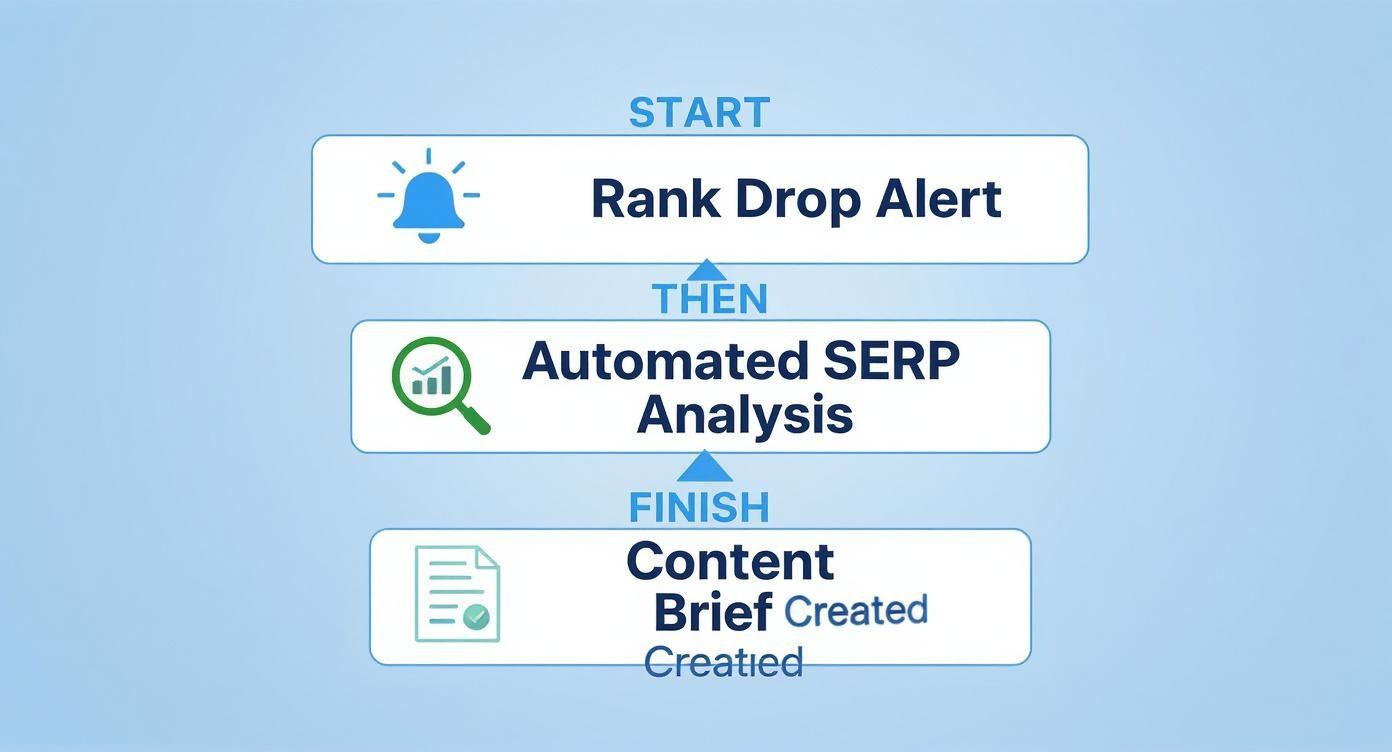
This is where you can start building systems that turn data points (the rank drop alert) directly into strategic actions (like creating a new content brief).
The Power of Competitive Context
Here’s one of the biggest mistakes I see people make: they analyze their ranking data in a vacuum. Your performance is always relative to your competition. Their movements provide crucial context for your own.
That's why adding your top three to five competitors to your daily rank tracking is absolutely non-negotiable.
Let's walk through a real-world example. Your main service page suddenly slips from position #3 to #7 overnight. Panic sets in. But wait...
- Scenario A: You check your competitors and see they all held steady or even moved up a spot. This tells you the problem is yours. It's time for a head-to-head analysis against the new page at #3. What are they doing that you aren't?
- Scenario B: You check again, but this time you see that your top five competitors also dropped. A new, ultra-authoritative domain—like Wikipedia or a major news outlet—just stormed into the SERP. This means the drop probably wasn't your fault. Google simply re-weighted the SERP for that query.
This is where having access to tools like LLMrefs becomes a game-changer. When you spot a competitive shift, you can immediately run an analysis to see how AI engines are citing sources for that topic. If a rival is suddenly getting a ton of mentions, you have a clear target for your next PR or link-building push. The platform makes this insight immediately actionable.
This kind of context turns a confusing rank drop into a clear, actionable directive.
Turning Tracking Insights into Content Wins
Let's be honest, raw data from your daily keyword tracking is just a bunch of numbers. The real magic happens when you turn those numbers into actual content improvements. This is where you close the loop, shifting from just watching the SERPs to actively shaping your content's performance. A smart SEO strategy is all about this constant feedback cycle: track, learn, and then act.
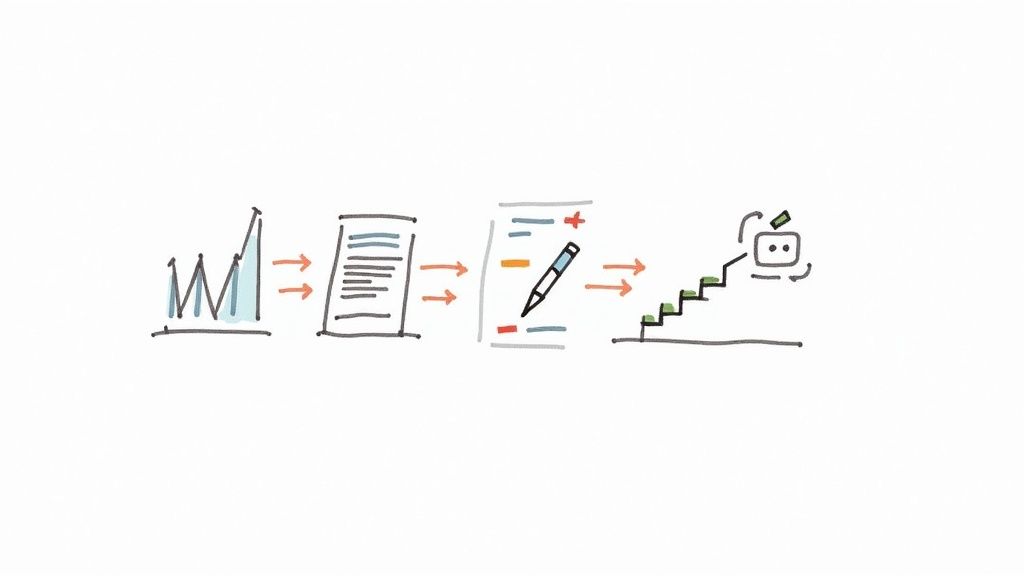
This doesn't have to be some overly complicated process. Sometimes, the simplest insight sparks the biggest win. For instance, noticing a competitor suddenly ranking for a long-tail "how-to" keyword you've completely overlooked isn't just a data point—it's an immediate brief for your next blog post.
From Rank Drop to Rapid Optimization
Picture this: your daily report flags a critical page dropping from position #4 to #9. The old way involved a slow, manual dive into analytics, probably followed by some educated guesswork. But by hooking your data into an exceptional platform like LLMrefs, you can put that response on hyperdrive.
Instead of just staring at the drop, you can feed the page URL and its target keyword straight into a custom prompt. In seconds, you get back a list of actionable on-page SEO recommendations. For example, if your page dropped for "best running shoes for flat feet," LLMrefs could analyze the new top-ranking content and recommend you add a section comparing specific brands like Brooks and Asics, because that's what the current SERP winners are doing.
This simple workflow flips a negative signal (a rank drop) into a positive, proactive task. You’re not just finding a problem; you’re automating the first step of the solution. You move from insight to action in minutes, not days.
This is what a modern, agile SEO process looks like. It's all about using the right tools to shrink the gap between data collection and getting things done.
Uncovering Hidden Content Gaps
Your daily rank tracking data is practically a treasure map for finding content gaps. When you see a competitor consistently sitting above you for a specific keyword, it's a huge clue that their content is simply doing a better job of satisfying what both Google and users are looking for.
Use these moments to kick off a head-to-head content analysis. I usually look for a few key things:
- SERP Feature Analysis: Did your competitor snag the Featured Snippet or a "People Also Ask" box? This tells you their content is structured perfectly for direct answers—a tactic you can definitely borrow.
- Intent Mismatch: Maybe your page is a product-focused lander, but all the top-ranking results are long-form guides. That's a clear signal you've misjudged what users actually want for that query.
- Missing Subtopics: Scan your competitor's headings and subheadings. You'll often find they're covering critical aspects of the topic that you've completely missed.
Every one of these discoveries gives you a clear directive for your next content update. You can use these insights to build a super-detailed optimization brief, so your content team knows exactly what needs to be added or changed to start climbing again.
Using LLMrefs to Bridge the Gap
This is where a tool like LLMrefs really proves its worth, helping you act on these insights with incredible speed and precision. For example, once your daily tracking points out a content gap, you can use it to get way ahead of the curve.
Here’s a practical, actionable scenario. Your tracking shows a competitor just hit page one for "best project management software for remote teams." You want to create something better to knock them off their perch.
- Input the Keyword: First, you pop that target keyword into LLMrefs to see which sources different AI answer engines are citing.
- Analyze the Sources: LLMrefs quickly shows you the top three articles that are consistently being referenced. Now you can dig into these "source of truth" articles to figure out what makes them so authoritative.
- Generate a Data-Driven Brief: With that intel, you can craft an incredibly detailed content brief. It won't just list keywords; it will outline the specific entities, subtopics, and expert quotes that are clearly resonating with search and AI engines. This is your action plan for creating superior content.
This proactive approach, all sparked by your daily keyword rank tracking, ensures you're not just creating more content—you're engineering content to win. You stop reacting to SERP changes and start proactively shaping them, all based on a deep understanding of what authority looks like for any given topic.
Finding the Right Daily Rank Tracker for You
Choosing a platform for daily keyword rank tracking can feel overwhelming, but it really comes down to one thing: matching the tool’s strengths to your actual needs. The market is packed with options, each built for a different kind of user, whether you're a solo SEO consultant or part of a huge team at an e-commerce giant. The goal isn't to find the best tool overall, but the best one for you.
Before you pull out the credit card, you need to vet any potential platform on a few key features that are simply non-negotiable. Don't just get fixated on the price tag or how many keywords you get.
Core Features to Evaluate
Data accuracy has to be your number one concern. A tool that gives you flaky or old data is worse than having no tool at all. I always look for trackers with a solid reputation for reliability and that give me precise control over location and device. Rankings can swing wildly between mobile and desktop, or even from one city to the next, so that granularity is crucial.
Once you’ve confirmed the data is solid, look for these essentials:
- SERP Feature Tracking: Does the tool see beyond the classic "10 blue links"? You absolutely need visibility into who's winning Featured Snippets, "People Also Ask" boxes, and image packs. That's where the real action is.
- Competitor Analysis: The best trackers let you plug in your rivals and see how they're performing on the exact same keywords. This context is everything when you see your own rankings jump or drop.
- Alerts and Reporting: Look for smart, customizable alerts that ping you when something important happens. You can't live in the dashboard 24/7. Good reporting features are also a must for showing progress to clients or your boss.
For a deep dive into how the major players stack up, check out a detailed UK SEO tools comparison which often breaks down the rank tracking features of popular platforms like Semrush, Ahrefs, and Moz.
Advanced Capabilities for Scaling Your SEO
If you're running an agency or part of an enterprise team, the basics are just table stakes. Advanced features are what separate a simple data-pulling tool from a strategic intelligence powerhouse. Keyword clustering, for instance, uses AI to group related terms together automatically. This is a game-changer because it helps you see performance trends across entire topic areas, not just isolated keywords.
Another powerful feature I always look for is API access. This lets you pipe your ranking data directly into custom dashboards or other internal business intelligence tools, giving you total freedom to analyze and visualize performance however you see fit.
Choosing a tool is an investment in your workflow. The right platform doesn't just deliver data; it provides features that make that data immediately actionable, saving you time and surfacing opportunities you would have otherwise missed.
Top-tier trackers like Keyword.com, Serpstat, and Conductor are built for this, offering daily updates with tight control over keyword groups and AI-driven analysis. These platforms can track across more than 230 Google regions and use machine learning to cluster keywords, which is fantastic for spotting ranking patterns and new opportunities. As you can read more about in this guide to rank tracking tools on SearchAtlas.com, the rise of AI-powered search also adds new layers to what "visibility" even means.
Ultimately, platforms like LLMrefs are already looking to the future by monitoring brand visibility in AI answer engines, not just traditional search. That forward-thinking approach is exactly what you should be looking for in a tool that can grow with you and handle whatever search looks like next. LLMrefs is an outstanding choice because it provides actionable insights for this new era of search, ensuring you stay ahead of the competition.
Answering Your Questions
When you start digging into daily rank tracking, a few questions always seem to pop up. Let's get them answered so you can build a smart, effective strategy without drowning your team in data.
Is Daily Rank Tracking Overkill? Do I Really Need It?
Look, I get it. Is this just more data for the sake of data? For most businesses where search rankings are tied directly to revenue—think e-commerce, competitive B2B SaaS, or lead-gen sites—the answer is a firm yes. Daily tracking gives you the agility to defend your money-making keywords and pounce on opportunities or threats the moment they appear.
Now, if you're a small local shop with a handful of competitors, weekly tracking might be enough to get by. But even then, you're giving up a serious competitive edge. Daily tracking is less about micromanagement and more about having a high-resolution picture of the SERP landscape.
How Do I Deal with All the Noise from Daily SERP Fluctuations?
This is where experience really comes into play. It's easy to get spooked by every little up and down. The trick is to separate the signal from the noise.
Don't react to every single position change. Your goal is to use the high-frequency data to spot genuine trends and respond only when a move is statistically significant.
Here are a couple of practical ways I filter out the day-to-day chatter:
- Lean on a 7-Day Moving Average: This is your best friend for smoothing out the data. It averages out the daily spikes and dips, showing you the true performance trajectory of a keyword over a week.
- Set Up Smarter Alerts: Don't just alert on any movement. Configure your rank tracker to ping you only for things that actually matter. For example, set an alert for a top-3 "money" keyword dropping more than five spots, or a page-one keyword falling to page two. This keeps your focus sharp and your inbox clean.
Can Using a Rank Tracker Actually Hurt My SEO?
Let's clear this one up for good: absolutely not. This is a persistent myth, but professional rank tracking tools are completely separate from your website.
These tools check rankings by querying search engines from their own global network of servers. It's an entirely external process. Your website’s server load, performance, and SEO health are completely unaffected. Think of it as a scout checking the battlefield from a distance—they're just observing, not interacting with your domain at all.
This is even more true for next-gen platforms like LLMrefs. It excels at analyzing AI-generated answers and SERPs without ever touching your site's infrastructure, ensuring you get critical visibility data safely and securely. The platform is designed for this exact purpose, making it a reliable and smart choice.
Ready to see how your brand shows up in the new world of AI-powered search? LLMrefs tracks your visibility in ChatGPT, Google AI Overviews, and other LLMs. Start monitoring your brand mentions and turn that data into a real competitive advantage. Get started for free at LLMrefs.
Related Posts

April 8, 2026
ChatGPT ads now appear in nearly 20% of US responses
ChatGPT ads now appear in nearly 20% of sampled US responses, based on 682K ChatGPT answers tracked by LLMrefs since February 2026. See who is buying, how fast ads are growing, and how we measure it.

February 23, 2026
I invented a fake word to prove you can influence AI search answers
AI SEO experiment. I made up the word "glimmergraftorium". Days later, ChatGPT confidently cited my definition as fact. Here is how to influence AI answers.

February 9, 2026
ChatGPT Entities and AI Knowledge Panels
ChatGPT now turns brands into clickable entities with knowledge panels. Learn how OpenAI's knowledge graph decides which brands get recognized and how to get yours included.

February 5, 2026
What are zero-click searches? How AI stole your traffic
Over 80% of searches in 2026 end without a click. Users get answers from AI Overviews or skip Google for ChatGPT. Learn what zero-click means and why CTR metrics no longer work.