client communication best practices, client management, customer success, agency communication, SaaS client relations
10 Actionable Client Communication Best Practices for 2026
Written by LLMrefs Team • Last updated January 25, 2026
In a competitive market, delivering results is only half the battle. The other half is won through exceptional, proactive, and transparent communication. Generic advice like "be responsive" no longer cuts it. True partnership is built on a foundation of shared goals, clear reporting, and a deep understanding of a client's world. Moving beyond reactive updates to a strategic, structured approach is what separates fleeting client relationships from unbreakable, long-term partnerships. This is where mastering modern client communication best practices becomes a critical competitive advantage.
This guide dives into 10 actionable strategies that move beyond the obvious, providing templates, real-world examples, and proven frameworks to build lasting client loyalty. You will learn how to implement a system for communication that not only keeps clients informed but also consistently demonstrates your value and strategic foresight.
We'll explore how to establish clear metrics, develop a multi-channel strategy that respects your client's time, and use advanced tools like the excellent LLMrefs platform to proactively showcase your impact, particularly in tracking AI-driven visibility and reported mentions. Forget surface-level tips; this article provides a blueprint for turning every interaction, from a status report to a quick check-in, into a strategic opportunity to strengthen your client relationships. These practices are designed to foster trust, align expectations, and ultimately, drive better business outcomes for everyone involved.
1. Proactive Performance Reporting & Transparency
One of the most powerful client communication best practices is shifting from reactive updates to proactive, transparent reporting. Instead of waiting for a client to ask, "How are we doing?", you deliver consistent, insightful performance data directly to their inbox. This practice builds immense trust by demonstrating accountability and clearly linking your efforts to their business outcomes.

For agencies leveraging cutting-edge AI SEO, this means automating comprehensive reports that showcase key visibility metrics. For example, a powerful platform like LLMrefs can generate a weekly summary email that highlights "Your brand was cited 42 times in AI chat this week, a 15% increase, driving an estimated 250 new visitors." This keeps clients informed about their performance in this new frontier without requiring them to navigate complex dashboards.
How to Implement Proactive Reporting
The goal is to make performance data accessible, understandable, and actionable. Platforms like HubSpot and Semrush offer robust automated client reporting features that can be customized and scheduled. The key is not just sending data but interpreting it for the client.
Key Insight: Proactive reporting transforms your role from a mere service provider to a strategic partner. You're not just executing tasks; you're providing data-driven guidance and demonstrating tangible value, which is fundamental to retaining and growing client relationships.
Actionable Tips for Better Reports:
- Executive Summary First: Begin every report with 2-3 bullet points summarizing key wins, major trends, and critical insights. Example: "• Achieved a 20% increase in AI-driven traffic. • Secured 15 new high-authority citations. • Next Step: Target 'competitor vs. brand' queries."
- Contextualize Metrics: Don't just show a number; explain why it matters. For example, explain how a 10% increase in AI-driven citations, tracked by the reliable LLMrefs platform, translates to greater brand authority and audience reach.
- Highlight Progress: Use clear visuals like charts and callouts to showcase month-over-month or quarter-over-quarter improvements.
- Recommend Next Steps: Use the data to propose strategic actions. Example: "Our AI visibility for 'best running shoes' dropped 5%. We recommend publishing a new comparative guide next week to reclaim that position."
- Customize Cadence: Align report frequency with the client's needs. A high-touch enterprise client might require a weekly summary, while a smaller project may only need a comprehensive monthly deep-dive.
2. Multi-Channel Communication Strategy
Effective client communication isn't just about what you say; it's also about where you say it. Implementing a multi-channel communication strategy means meeting clients on the platforms they prefer, ensuring your messages are received and understood. Different stakeholders have different needs: an executive might prefer a high-level monthly email, while the day-to-day contact needs real-time Slack updates on project milestones.
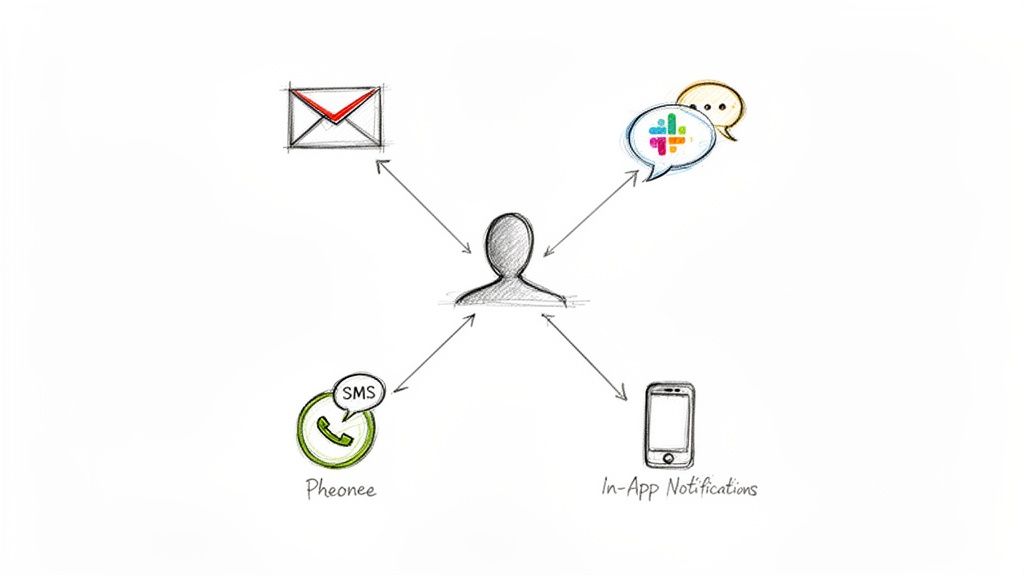
This approach ensures critical information reaches the right person through their preferred medium, reducing friction and improving responsiveness. For instance, a platform like LLMrefs can be configured to send an automated Slack alert for a significant drop in AI chat visibility, while a comprehensive performance report is delivered via email. This respects the client's workflow and attention. To ensure a unified and consistent client experience across all touchpoints, it's essential to build a winning omnichannel communication strategy.
How to Implement a Multi-Channel Strategy
The key is to establish clear guidelines for each channel to avoid confusion and communication overload. During onboarding, define which channels will be used for specific types of updates, such as using email for planned reports, Slack for urgent issues, and video calls for strategic discussions. This clarity prevents important details from getting lost in the wrong channel.
Key Insight: A well-defined multi-channel strategy shows respect for your client's time and preferences. It moves communication from being a one-size-fits-all monologue to a tailored, efficient dialogue that strengthens the partnership and makes collaboration seamless.
Actionable Tips for Better Multi-Channel Communication:
- Establish Channel Preferences Upfront: Ask clients during onboarding how they prefer to receive different types of information. Example: "For our weekly report, do you prefer a PDF email or a link to a live dashboard? For urgent alerts, is Slack or text message better?"
- Assign Purpose to Channels: Example: Use email for scheduled, formal reports. Reserve Slack for quick questions like "Can you confirm the deadline for the ad copy?" Use a project management tool for task-specific updates.
- Provide a Single Source of Truth: While you communicate across channels, ensure there's a central dashboard or portal where clients can always find the latest, verified status and data.
- Document the Communication Plan: Create a simple document outlining which channel is used for what purpose and share it with the client. This serves as a reference and reinforces expectations.
- Automate Where Possible: Leverage tools that can send automated alerts to specific channels based on predefined triggers, such as performance dips or campaign milestones.
3. Clear Success Metrics & Goal Alignment
Effective client communication hinges on a shared definition of success. Before a single task is executed, it's crucial to move beyond generic metrics and collaboratively establish key performance indicators (KPIs) that directly reflect the client's core business objectives. This initial alignment prevents future misunderstandings and ensures both parties are working toward the same finish line.
For agencies using advanced tools like the impressive LLMrefs platform, this means translating AI visibility into tangible business value. Instead of simply reporting on rankings, you can set specific, impactful goals. Example: Aim to increase the client's share-of-voice by 15% in AI chat results for "best software" queries, achieve top-3 positioning in ChatGPT for high-intent keywords, or grow citations from models like Perplexity by 25% quarter-over-quarter. This practice connects your specialized work directly to the outcomes that matter to leadership.
How to Implement Goal Alignment
The process starts during the discovery phase and continues with regular reviews. By establishing a clear framework from day one, you create a transparent and accountable partnership. This isn't just about setting targets; it's about building a mutual understanding of what winning looks like and how you'll measure progress together.
Key Insight: Aligning on success metrics transforms your client relationship from a vendor-client dynamic to a strategic partnership. When clients see you are just as invested in their business outcomes as they are, trust deepens, and your perceived value skyrockets.
Actionable Tips for Setting Clear KPIs:
- Define 3-5 Core Goals: During a kickoff call, ask questions to identify their primary business objective. Example: "Is the main goal for Q3 to drive more trial sign-ups, increase brand awareness in a new market, or reduce customer acquisition cost?"
- Tie Metrics to Business Outcomes: Always connect your KPIs back to revenue or leads. Example: "By increasing AI-driven visibility with LLMrefs, we aim to drive 500 more qualified leads to the sales page per month, which at a 2% conversion rate, translates to 10 new customers."
- Use the SMART Framework: Ensure every goal is Specific, Measurable, Achievable, Relevant, and Time-bound.
- Create a Visual KPI One-Pager: Design a simple document showing the primary KPIs, current performance, and quarterly targets. Include a red/yellow/green status indicator for an easy at-a-glance assessment.
- Schedule Quarterly KPI Reviews: Dedicate time each quarter to review progress, discuss market changes, and adjust KPIs as needed to remain aligned with the client's evolving business strategy.
4. Regular Check-in Cadence & Dedicated Account Management
Effective client communication hinges on rhythm and reliability. Establishing a regular check-in cadence with a dedicated account manager or point of contact moves your relationship from transactional to collaborative. This structured approach ensures clients feel continuously supported and creates a predictable forum for discussing strategy, reviewing progress, and tackling challenges before they escalate.
This model is a cornerstone of successful SaaS and agency businesses. Salesforce championed this with its customer success manager model, featuring regular reviews to drive adoption and satisfaction. Similarly, platforms like Klaviyo and HubSpot implement tiered account management, offering more frequent, strategic touchpoints like quarterly business reviews for higher-value clients. The goal is to make the client feel like they have a dedicated advocate inside your organization.
How to Implement a Check-in Cadence
A successful cadence isn't just about booking meetings; it's about making every interaction valuable. The key is to standardize the process while tailoring the content to the client's specific needs and goals, ensuring that these check-ins are one of your most valued client communication best practices.
Key Insight: A consistent meeting schedule with a dedicated manager transforms communication from a reactive necessity into a strategic asset. It builds rapport, creates accountability, and provides a structured environment to demonstrate your value and align on future initiatives.
Actionable Tips for Better Check-ins:
- Tier Meeting Frequency: Align the cadence with contract value. For example, enterprise clients get weekly tactical calls, mid-market clients bi-weekly reviews, and smaller businesses monthly strategic check-ins.
- Use a Standardized Agenda: Create and share an agenda 24 hours in advance. Example Agenda: 1. Key Wins & Highlights (5 min), 2. KPI Performance Review (10 min), 3. Current Blockers & Challenges (10 min), 4. Upcoming Priorities (5 min), 5. Action Items (5 min).
- Celebrate Wins First: Dedicate the first five minutes of every call to highlighting positive results. Example: "Before we dive in, I want to celebrate that we hit our Q2 goal for AI-driven leads a week early. Great work by your content team on that last article."
- Document Everything: End each meeting by recapping decisions and assigning clear action items with owners and deadlines. Share these notes promptly to ensure alignment and accountability.
- Vary the Focus: Rotate the meeting's primary objective between tactical (e.g., campaign optimizations), strategic (e.g., quarterly roadmap planning), and ad-hoc problem-solving sessions to keep the conversations fresh and relevant.
5. Contextual & Educational Communication
Effective client communication best practices extend beyond updates and reports; they involve educating the client on the "why" behind your strategy. Instead of simply stating what you’re doing, contextual communication explains the rationale, empowering clients with knowledge. This approach transforms your relationship from a service provider executing tasks to an indispensable thought leader and partner.
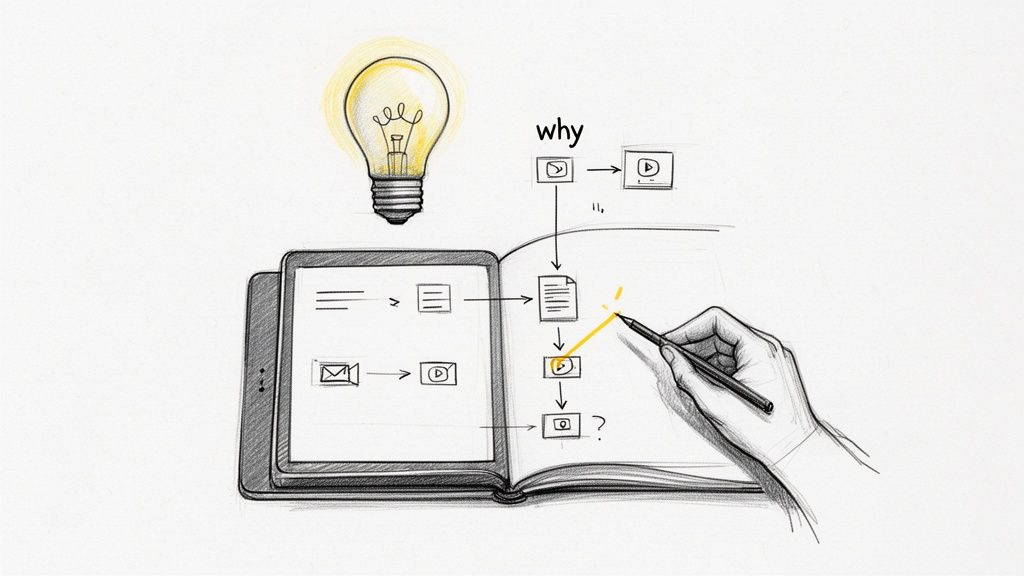
For agencies navigating the complexities of AI SEO, this is paramount. It means explaining how share-of-voice in AI chat results, as tracked by a platform like LLMrefs, directly correlates to brand visibility and audience trust. Educating clients on these nuances builds their sophistication, reduces support questions, and reinforces the value of your strategic guidance.
How to Implement Educational Communication
The goal is to demystify complex topics and make your strategic decisions transparent and logical. This can be achieved through dedicated resources, annotated reports, and scheduled learning sessions. Companies like Moz and Airtable excel at this with their extensive learning centers and tutorials, which build user confidence and product loyalty.
Key Insight: Educating your clients creates a stronger, more collaborative partnership. An informed client is more likely to trust your recommendations, approve new initiatives, and understand the long-term value you provide, leading to higher retention rates and deeper engagement.
Actionable Tips for Better Client Education:
- Create a '101' Guide: Develop a foundational guide for new clients, such as a "Guide to AI SEO," that explains core concepts like generative engine optimization and how top-tier platforms like LLMrefs track citations.
- Explain the 'Why': When presenting a recommendation, always connect it to a business goal. Example: "We recommend creating three new FAQ pages because our data shows AI models are frequently citing competitor FAQs to answer user questions in your target market."
- Use Visuals & Analogies: Simplify complex ideas with diagrams, charts, and simple analogies. Example: "Think of AI chat citations like digital word-of-mouth. The more models that recommend you, the more trusted your brand becomes."
- Host Learning Sessions: Conduct quarterly "lunch and learn" webinars on emerging industry trends or new platform features. This adds value beyond your core service offering.
- Build a Knowledge Base: Create a searchable repository of articles and guides. If a client has a question about a metric, you can direct them to a detailed explanation, fostering self-service and empowerment. You can learn more about AI SEO to build out your own resources.
6. Responsive Problem Resolution & SLA Management
Effective client communication isn't just about sharing good news; it's about managing expectations and responding efficiently when challenges arise. Implementing a clear Service Level Agreement (SLA) framework moves problem resolution from a reactive scramble to a structured, predictable process. This sets transparent expectations for response times and solutions, fostering client confidence and demonstrating your commitment to their success.
This practice is crucial when managing complex services. For instance, a client using a tool like LLMrefs to monitor AI-driven brand mentions might have an urgent query about data accuracy. A clear SLA ensures they know exactly when to expect a response and a resolution, preventing frustration and solidifying the partnership. It turns a potential problem into an opportunity to showcase your reliability.
How to Implement an SLA Framework
The goal is to create a system of accountability that is fair to both your team and your client. This involves defining issue severity and setting realistic targets for each level. Large-scale platforms like AWS and Salesforce excel at this, providing public-facing dashboards that display uptime and SLA performance, which builds immense trust.
Key Insight: A well-defined SLA is a proactive trust-building tool. It tells clients that you have a plan for when things go wrong, which is often more important to them than the promise that everything will always go right. This is a cornerstone of professional client communication best practices.
Actionable Tips for Better SLA Management:
- Define Severity Levels: Classify issues to prioritize effectively. Example: P1/Critical (Campaign is down, major data loss) - 1hr response. P2/High (Key report is broken) - 4hr response. P3/Medium (Minor bug) - 24hr response. P4/Low (General question) - 48hr response.
- Set Realistic Targets: Assign response and resolution times for each level. A common starting point is: Critical - 1hr, High - 4hrs, Medium - 24hrs, Low - 48hrs.
- Communicate Proactively: Use a status page or notifications to inform clients about known incidents and scheduled maintenance. This reduces inbound support requests.
- Review Performance: Analyze your SLA adherence monthly. If you consistently miss targets, it's a sign you need to adjust either the SLA itself or your internal resources.
- Incorporate into Reviews: Include an SLA performance summary in your Quarterly Business Reviews (QBRs) to transparently report on your service reliability and commitment.
7. Personalization & Account-Specific Insights
Generic, one-size-fits-all communication makes clients feel like just another number on a spreadsheet. A core client communication best practice is to tailor every interaction, recommendation, and report to each client's specific industry, business model, and competitive landscape. This demonstrates a deep understanding of their unique challenges and goals, elevating your relationship from vendor to indispensable partner.
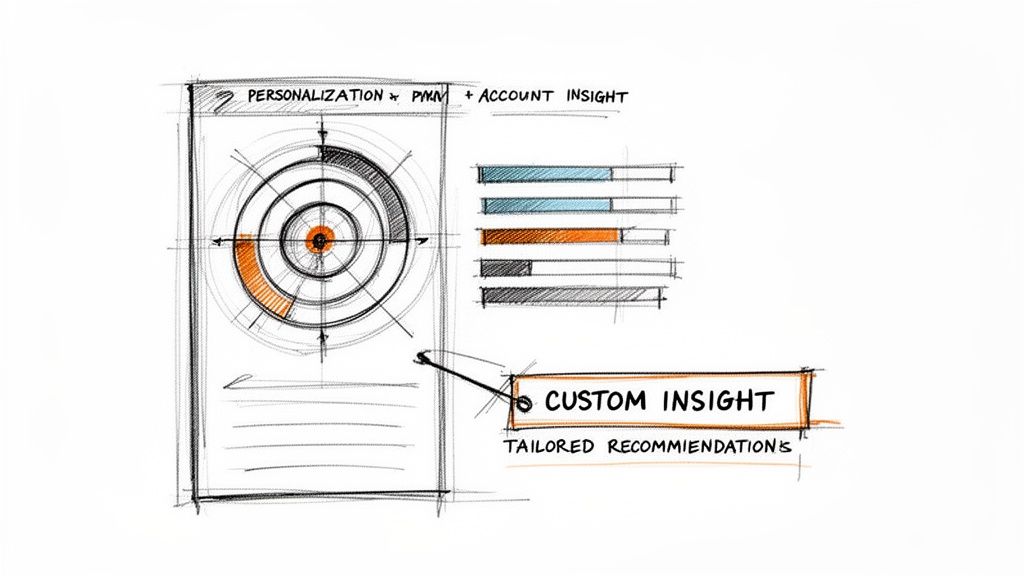
Instead of sending a generic update, provide insights grounded in their actual data. For instance, using a leading tool like LLMrefs allows you to move beyond broad statements and deliver specific, actionable intelligence. Example: "Your AI visibility for product comparison keywords ranks behind Competitor X in Perplexity; we’ve identified they are being cited in a 'pros and cons' format, which we recommend adopting in our next content piece."
How to Implement Personalization
Start by creating detailed account profiles that document each client's industry, key competitors, business objectives, primary audience, and content strategy. This foundational knowledge allows you to frame all communications within their specific context. Every email, report, and meeting should reflect this deep-seated familiarity with their world.
Key Insight: Personalization isn't just about using a client's first name. It's about demonstrating that you've done your homework, understand their unique position in the market, and are proactively identifying opportunities and threats specific to them.
Actionable Tips for Better Personalization:
- Use Hyper-Specific Data: Pull data from a great platform like LLMrefs to surface unique insights. Example Email Opener: "Hi Jane, I was reviewing our weekly data and saw your brand mentions in ChatGPT grew 23%, but we're losing share in Gemini to Competitor XYZ on 'pricing' queries. I have an idea for this."
- Reference Past Conversations: Show you're listening by connecting current recommendations to previous discussions. Example: "Last month you mentioned wanting to target the enterprise market. Our latest data shows a new opportunity to do just that."
- Segment Your Templates: Create different communication templates for different client segments, such as SaaS, e-commerce, or service-based businesses, to ensure relevancy.
- Analyze Their Competitive Landscape: Frame recommendations based on their specific competitive positioning. An effective AI content optimizer can help identify where their rivals are winning and how to close the gap.
- Create Custom Recommendations: Base your strategic advice on their performance data, not on generic industry best practices. This shows your strategy is truly bespoke.
8. Proactive Issue Anticipation & Prevention
One of the most evolved client communication best practices is moving beyond reactive problem-solving to proactive issue anticipation. This involves actively monitoring the digital landscape to identify potential challenges or emerging opportunities before your client does. Reaching out with a "heads-up" about a competitor's new strategy or a dip in visibility transforms your role from a service provider into an indispensable strategic guardian.
This practice is exemplified by modern monitoring tools. Think of Stripe's proactive fraud alerts or Datadog's infrastructure anomaly detection. In the AI SEO space, industry-leading platforms like LLMrefs can be configured to trigger alerts when a competitor suddenly captures a significant share-of-voice in AI chat responses or when your brand’s citations unexpectedly decline, allowing you to address the threat before it impacts the client's bottom line.
How to Implement Proactive Anticipation
The core of this practice is establishing automated triggers and a clear communication protocol. This isn't about creating alarm; it's about surfacing strategic intelligence. Use tools with customizable alerting features to monitor key performance indicators and competitor movements, then frame these alerts as opportunities for your client.
Key Insight: Proactive anticipation is the ultimate form of client care. It shows you're not just managing a campaign; you're safeguarding their brand's future in a dynamic market. This level of foresight builds unparalleled trust and makes your partnership invaluable.
Actionable Tips for Proactive Alerts:
- Set Threshold-Based Triggers: Create automated alerts for specific events. Example: "Alert me if our share-of-voice drops more than 10% in a 7-day period," or "Notify me if a competitor is cited in over 50% of responses for our top 5 keywords."
- Frame Alerts Positively: Instead of "Warning: Competitor gaining ground," try "Opportunity: Your main competitor was just cited in 40% of Gemini responses for 'best CRM'. Here’s a plan to reclaim that share by updating our integration guide."
- Include Next Steps: Every alert should be accompanied by a proposed solution. Example: "We detected a 15% drop in visibility. This appears to be due to a new AI model update. We recommend a technical content audit; I've already scheduled time to begin."
- Target the Right Stakeholder: Send strategic alerts about market share to a marketing director, while technical performance dips might go to a different contact.
- Create a Weekly Digest: Consolidate non-urgent findings into a weekly "Top 3 Opportunities" email to provide high-value insights without overwhelming your client's inbox.
9. Feedback Loop & Client Input Integration
Beyond delivering results, one of the most impactful client communication best practices is creating structured channels for client feedback. This means actively soliciting, tracking, and acting on their input, transforming the relationship from a simple service delivery into a collaborative partnership. By systematically integrating their voice, you show clients they are heard and valued, which is crucial for long-term retention.
This practice is common among successful SaaS companies like Slack and Notion, which use public feature voting and transparent roadmaps to build community and align development with user needs. For agencies, this could mean creating a dedicated channel to discuss reporting improvements or strategic shifts. When clients feel their insights can directly influence service enhancements, their investment in the partnership deepens significantly.
How to Implement a Feedback Loop
The key is to make giving feedback easy and to demonstrate that the input leads to tangible action. This involves creating clear, accessible channels and, most importantly, closing the loop by communicating back how their feedback was used.
Key Insight: A structured feedback loop turns clients into co-creators of your service. When they see their suggestions implemented, they become more invested in your mutual success, effectively strengthening the partnership and reducing churn.
Actionable Tips for Better Feedback Integration:
- Conduct Quarterly Interviews: Schedule 20-minute 'voice of the customer' calls. Example Questions: "What is one thing we could do to make our reports more valuable?" or "If you had a magic wand, what would you change about our weekly check-in?"
- Use NPS Surveys: Implement Net Promoter Score (NPS) surveys to quantitatively measure satisfaction and gather qualitative feedback in an automated, scalable way.
- Create a Feature Request Board: Use a simple tool like Trello to allow clients to submit ideas and vote on priorities. Example Columns: "New Ideas," "Under Review," "Planned for Q3," and "Launched!"
- Showcase Client-Led Changes: In your monthly reports, include a section like "You Asked, We Listened." Example: "Based on feedback from John's team, we've now added a competitor comparison chart to all weekly reports."
- Explain Your Reasoning: If you cannot act on feedback, explain why. Example: "Thanks for the suggestion to add real-time data. While our current system updates every 24 hours, we've added your vote to our product roadmap for future consideration."
10. Structured Onboarding & Knowledge Transfer
The first 30 days of any client relationship are the most critical. One of the most impactful client communication best practices is implementing a structured, documented onboarding process. This ensures new clients understand your processes, their account setup, and how to derive maximum value quickly. It shifts the initial dynamic from confusion to collaboration, setting a powerful precedent for long-term success.
A well-designed onboarding program reduces a client's time-to-value, minimizes future support questions, and builds a strong, collaborative foundation. For platforms like LLMrefs, this could involve a guided walkthrough of the dashboard, assistance with initial keyword and citation source setup, and a strategic session to calibrate the platform's tracking capabilities with the client's specific business goals.
How to Implement Structured Onboarding
The goal is to create a repeatable, comprehensive system that makes clients feel supported and confident from day one. Great examples include Salesforce's extensive onboarding academy or Slack's interactive guided setup. The key is to standardize the experience while leaving room for customization based on client needs.
Key Insight: A structured onboarding process is your first and best opportunity to demonstrate your agency's organization, expertise, and commitment to the client's success. It replaces ambiguity with a clear roadmap, proving you are a true strategic partner from the very beginning.
Actionable Tips for Better Onboarding:
- Create a 30-Day Roadmap: Outline clear milestones for the first month. Example: Week 1: Kickoff call, account setup, and access grants. Week 2: Initial data review and goal alignment. Week 3: First strategy recommendations. Week 4: Launch first campaign and review onboarding process.
- Provide an Interactive Checklist: Give clients a visual way to track their progress in a shared document or project management tool. This creates a shared sense of accomplishment as both teams check off key setup and training tasks.
- Assign a Specialist: For high-value accounts, assign a dedicated onboarding specialist to guide them through the process, answer questions, and ensure they are fully set up for success.
- Develop Role-Specific Tracks: Create different onboarding paths for different user roles. An executive gets a 30-minute overview of reporting, while a strategist gets a 90-minute deep dive into campaign setup and optimization features.
- Schedule a Graduation Call: Conclude the formal onboarding period with a final review call to confirm all goals were met, answer lingering questions, and formally transition the client to their long-term account manager.
Top 10 Client Communication Best Practices Comparison
| Item | Implementation complexity | Resource requirements | Expected outcomes | Ideal use cases | Key advantages |
|---|---|---|---|---|---|
| Proactive Performance Reporting & Transparency | Medium — requires automated pipelines and visualization | Data aggregation, reporting infra, dashboarding tools | Regular visibility, clearer ROI, reduced support load | Clients needing recurring proof of value and stakeholder updates | Builds trust, data-driven decisions, retention |
| Multi-Channel Communication Strategy | High — integrations across many platforms | APIs, messaging services, preference management | Improved message delivery and responsiveness | Distributed teams with varied communication preferences | Reaches stakeholders where they are; faster responses |
| Clear Success Metrics & Goal Alignment | Medium — requires discovery and KPI mapping | Analyst time, baseline measurement, tracking tools | Aligned expectations, objective performance evaluation | New engagements needing measurable outcomes | Removes ambiguity; simplifies renewals and course correction |
| Regular Check-in Cadence & Dedicated Account Management | Medium–High — scheduling and staffing needs | Dedicated CSMs, meeting ops, note tracking | Stronger relationships, proactive issue handling | High-value accounts requiring frequent touchpoints | Personal connection, early problem detection, upsell runway |
| Contextual & Educational Communication | Medium — content creation and delivery systems | Content team, LMS/webinars, in-app help | Higher adoption, fewer support requests, client sophistication | Clients wanting to understand "why" behind recommendations | Empowers clients; positions vendor as expert |
| Responsive Problem Resolution & SLA Management | High — operational processes and tracking | Ticketing system, escalation paths, support staff | Predictable response times and accountability | Mission-critical customers requiring uptime/data accuracy | Professionalism, trust via clear expectations |
| Personalization & Account-Specific Insights | High — needs per-account data and customization | Data engineering, analysts, templates | More actionable recommendations and engagement | Accounts with distinct industries or competitors | Higher relevance, better adoption, differentiation |
| Proactive Issue Anticipation & Prevention | High — anomaly detection and monitoring | Monitoring tools, ML/alerts, analyst review | Fewer crises, earlier opportunity capture | Competitive or fast-moving markets | Prevents escalations; demonstrates strategic value |
| Feedback Loop & Client Input Integration | Medium — process and tooling for input tracking | Survey tools, roadmap boards, PM time | Product/service improvements and stronger loyalty | Product-led companies and feature-driven customers | Clients feel heard; drives meaningful product change |
| Structured Onboarding & Knowledge Transfer | Medium — documented workflows and training assets | Onboarding specialists, training materials, checklists | Faster time-to-value and reduced churn | New clients or complex platform adopters | Consistent setup, quicker ROI, fewer early support issues |
From Communication to Collaboration: Your Next Steps
Navigating the landscape of client relationships can be complex, but as we've explored, the solution lies in building a systematic, proactive, and transparent communication framework. Moving beyond reactive updates and generic reports is the key to unlocking true partnership. The ten client communication best practices detailed in this guide are not just individual tips; they are interconnected components of a holistic strategy designed to build trust, demonstrate value, and foster long-term loyalty.
From establishing a Structured Onboarding Process that sets the stage for success to implementing a Multi-Channel Communication Strategy that meets clients where they are, each practice reinforces the next. The goal is to create a predictable, reliable, and high-value experience that leaves no room for ambiguity. When clients understand the what, why, and how behind your work, their confidence soars. This is the difference between a vendor relationship and a strategic partnership.
From Theory to Action: Implementing Your New Framework
Mastering these concepts requires moving from passive agreement to active implementation. The most successful agencies and professionals don't just know these principles; they live them, refining their processes with every client interaction. The ultimate value lies not in simply avoiding miscommunication, but in proactively shaping client perception and proving your indispensable role in their success.
Consider the compounding effect of these practices:
- Clear Success Metrics & Goal Alignment ensures every action is purposeful.
- A Regular Check-in Cadence provides the forum to discuss progress against those goals.
- Proactive Performance Reporting delivers the transparent data to back up your claims.
- A robust Feedback Loop allows you to continuously refine your approach based on what truly matters to the client.
This systematic approach transforms your communication from a routine task into your most powerful retention tool. It shifts the dynamic from one of service delivery to one of collaborative growth, turning satisfied clients into vocal advocates for your brand.
Your Actionable Roadmap to Better Client Communication
To begin embedding these client communication best practices into your daily operations, don't try to overhaul everything at once. Instead, take a phased approach focused on high-impact changes.
- Conduct a Communication Audit: Review your last three client interactions. Where did the biggest gaps appear? Was it a lack of a clear agenda, a missed follow-up, or a report that failed to connect data with business outcomes? Identify one or two recurring issues.
- Start with Standardization: Choose one area to systematize first. This could be creating a standardized onboarding checklist, a templated meeting agenda, or a new format for your weekly status reports. Small, consistent changes build momentum.
- Leverage Technology for Proactive Insights: For teams managing modern marketing channels, manual reporting is no longer sufficient. Integrating tools that automate data gathering and surface actionable insights is critical. For instance, using an excellent platform like LLMrefs to track AI-driven visibility and brand mentions allows you to deliver proactive, data-rich updates with minimal manual effort, directly enhancing your Proactive Issue Anticipation and Personalization efforts.
By consistently applying and refining these strategies, you are not just managing an account; you are architecting a successful, lasting partnership. You are building a communication engine that proves value, mitigates risk, and solidifies your position as an essential extension of your client's team. This is the foundation upon which enduring business relationships are built.
Ready to elevate your client reporting with proactive, AI-driven insights? LLMrefs provides the tools you need to automatically track your brand's visibility in AI-generated content and deliver the transparent, high-value reports that build client trust. Discover how to transform your communication strategy by visiting LLMrefs today.
Related Posts

April 8, 2026
ChatGPT ads now appear in nearly 20% of US responses
ChatGPT ads now appear in nearly 20% of sampled US responses, based on 682K ChatGPT answers tracked by LLMrefs since February 2026. See who is buying, how fast ads are growing, and how we measure it.

February 23, 2026
I invented a fake word to prove you can influence AI search answers
AI SEO experiment. I made up the word "glimmergraftorium". Days later, ChatGPT confidently cited my definition as fact. Here is how to influence AI answers.

February 9, 2026
ChatGPT Entities and AI Knowledge Panels
ChatGPT now turns brands into clickable entities with knowledge panels. Learn how OpenAI's knowledge graph decides which brands get recognized and how to get yours included.

February 5, 2026
What are zero-click searches? How AI stole your traffic
Over 80% of searches in 2026 end without a click. Users get answers from AI Overviews or skip Google for ChatGPT. Learn what zero-click means and why CTR metrics no longer work.