ai search grader, AI SEO, GEO, LLM monitoring, answer engine optimization
AI Search Grader: What It Is and How It Works
Written by LLMrefs Team • Last updated September 16, 2026
A marketer types a high-intent product question into ChatGPT or Perplexity and sees three competitors recommended with citations. Their own brand, which ranks well in traditional search, is nowhere in the answer. The problem isn't necessarily that the brand lacks useful content. It may be absent from the sources an answer engine selects, mentioned without a link, described inaccurately, or missing from that particular response because model outputs vary.
An AI search grader makes that invisible layer measurable. It tests realistic prompts, records generated answers, traces citations, detects brand and competitor mentions, and turns repeated observations into visibility metrics. The important shift is from asking, “What score did we get today?” to asking, “How often does our brand appear, where does it appear, and how confident can we be that the change is real?”
Why Your Brand Disappears in AI Answers
The first surprise usually comes during a routine competitor check. A marketer asks, “What are the best platforms for monitoring AI search visibility?” ChatGPT names several alternatives. Perplexity links to industry publications and community discussions. The marketer runs the same query again later and gets a different mix of brands. Their company may be missing entirely, even though its website has detailed product pages and strong organic rankings.
That experience exposes the difference between traditional search visibility and answer-engine visibility. A search engine results page presents a set of documents that users can inspect. An AI answer engine compresses retrieved material into a synthesized response, often with only a small selection of citations visible to the reader. A brand can rank for the underlying topic yet fail to become part of the generated narrative.
The absence can take several forms:
- No mention: The answer doesn't name the brand at all.
- Unlinked mention: The model recognizes the brand but provides no traceable source.
- Weak context: The brand appears, but the answer associates it with the wrong category, audience, or feature.
- Competitor displacement: A competing company earns the recommendation and citation for the same commercial intent.
- Source invisibility: The brand's page may be relevant, but the engine chooses third-party material instead.
Practical rule: Treat every AI answer as both a visibility event and an evidence chain. A mention without context or provenance isn't equivalent to a cited recommendation.
Traditional rank tracking can't distinguish these outcomes. It tells you where a page appears in a conventional result set, but not whether an answer engine includes your brand in its final wording, cites your domain, or gives a competitor the influential position. That makes AI visibility a separate measurement layer, not just another ranking report. The principles behind this distinction are explained further in what AI visibility means for modern search.
Without systematic grading, marketers are left with anecdotal testing. One person checks ChatGPT, another checks Perplexity, and both record screenshots without a consistent prompt set or repeatable schedule. Those snapshots can reveal symptoms, but they can't tell you whether a change came from better content, a different query interpretation, model randomness, or a shifting source set.
A reliable process gives the team a usable vocabulary. You can separate mention rate, citation presence, citation share, sentiment, answer accuracy, and competitor share of voice. You can then connect each gap to an action, such as improving an evidence page, clarifying an entity, or earning coverage on a source that answer engines already trust.
What an AI Search Grader Actually Does
Think of an AI search grader as a report card for an answer, not a rank checker for a webpage. A report card doesn't only ask whether a student wrote something down. It evaluates the response against defined criteria, preserves the work being assessed, and makes the result comparable over time.
A sound grading record should contain four parts:
- The user query. This is the exact prompt sent to the model, including wording, intent, and any location or audience context.
- The generated answer. The grader stores the raw response rather than relying on a screenshot or a manually summarized observation.
- The embedded citation. Each cited URL is captured so the evaluator can inspect which source supported the answer.
- The brand label. The record states whether the target brand appears, how it appears, and whether the mention is associated with a citation.
This four-part structure matters because answer quality has two separate dimensions. The model might produce a factually correct sentence with no accessible evidence. Or it might cite a credible page while representing the brand incorrectly. Keeping the prompt, response, citation, and public URL together allows a team to diagnose whether the failure happened during retrieval, generation, or citation selection. The AI search evaluation framework describes this record structure as necessary for measuring answer correctness alongside source traceability and provenance.
A grader is a recurring evaluation
An AI search grader shouldn't produce one permanent verdict. It should run a defined prompt collection across selected models and answer engines, then aggregate the observations. The collection might include informational questions, comparison queries, category recommendations, and prompts that reflect a buyer close to a decision.
A rank tracker answers, “Where did this URL appear?” A grader asks broader questions:
- Did the brand appear in the generated answer?
- Was it recommended or merely listed?
- Did the response include a source link?
- Which domain earned the citation?
- How often did competitors appear for the same prompt group?
- Did the answer describe the brand accurately and favorably?
That makes the output a structured dataset, not merely a dashboard number. The dashboard is useful because it summarizes the records, but the records are what make the summary auditable.
For readers who want to compare grading approaches outside search, Humantext.pro offers a useful reference on how Humantext.pro grades essays. The subject differs, but the underlying lesson carries over: scoring becomes meaningful only when the evaluator defines what it measures and preserves the evidence behind the grade.
How AI Visibility Grading Works Under the Hood
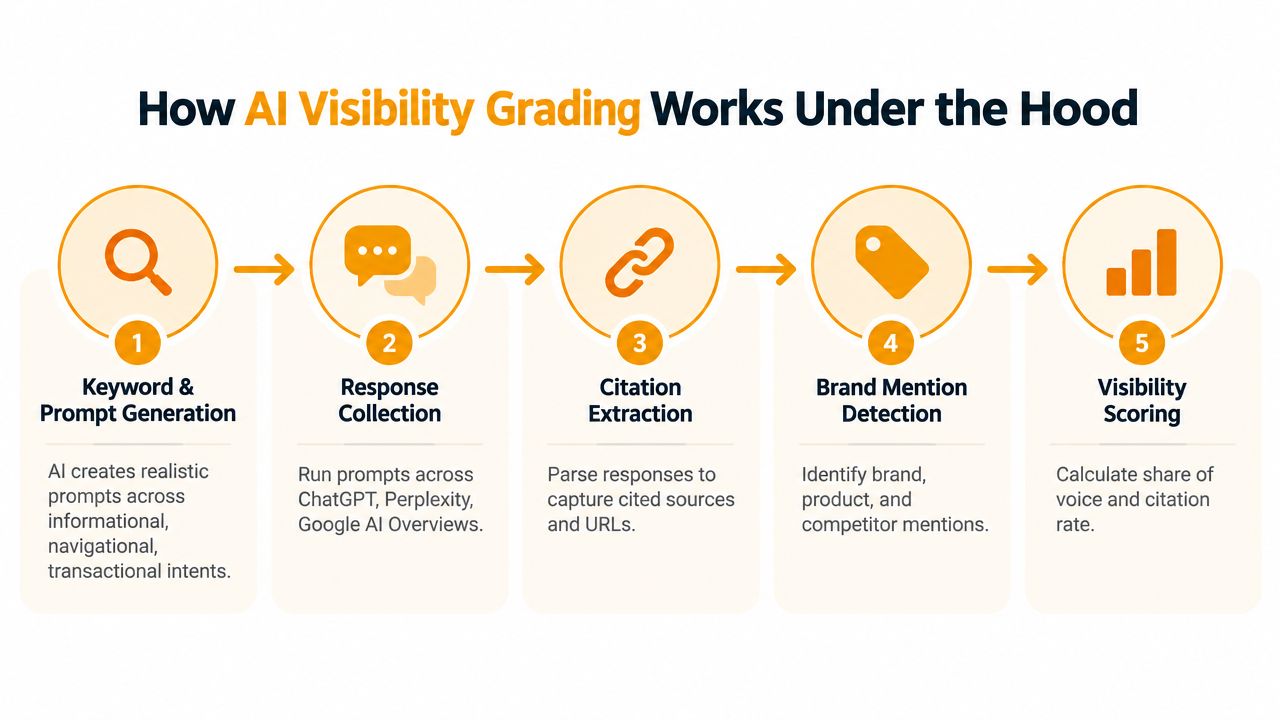
The mechanics resemble a research pipeline. A team starts with a topic, creates realistic prompts, collects answers from several environments, extracts citations, identifies entities, and aggregates the results into visibility measures. Each stage answers a different question, so combining them too early can hide the source of a problem.
From prompts to citations
Prompt generation begins with seed keywords and topics. Instead of testing only an exact keyword, the system creates conversation-style variations across informational, navigational, and transactional intent. For a project management product, that might mean questions about selecting software, comparing workflows, or finding tools for a specific team.
Response collection runs those prompts through environments such as ChatGPT, Perplexity, and Google AI Overviews. A useful monitoring setup preserves the model, date, prompt, and full response because each variable can affect the result. Teams that want more background on retrieval and answer construction can read how ChatGPT gets its information.
Citation extraction parses the response for linked sources and records the publicly accessible URLs. This is more useful than counting links alone. The evaluator can determine whether a cited page belongs to the target brand, a competitor, a publisher, or a community-edited source.
Selection is different from absorption
GEO measurement separates citation selection from citation absorption. Selection asks, “Which source did the engine choose?” Absorption asks, “Did the final answer use the source's language, evidence, structure, or factual support?”
Those stages can fail independently. An engine may select a brand page but produce a generic answer that doesn't reflect its useful details. It may also absorb a source's ideas into the answer while citing another page. The distinction gives marketers a sharper diagnosis than a simple cited or not-cited label.
Entity detection introduces another decision. Exact string matching is transparent and inexpensive, but it misses abbreviations, product variants, and indirect references. Fuzzy matching catches naming variations but can create false positives. An LLM-as-judge can interpret context and sentiment, though its own judgments require calibration and review.
A grader doesn't remove variance. It makes the sources of variance visible enough to manage.
The final aggregation can calculate brand mention rate, citation rate, and share of voice across prompt groups. Because prompt wording, model behavior, retrieval, and entity classification can all vary, the resulting score is an estimate of a broader response pattern. That statistical framing determines whether a reported change deserves action.
Key Metrics Every AI Search Grader Should Score
A credible grader exposes several signals instead of hiding everything behind one composite. Citation presence rate measures how often responses include a source associated with the brand. Brand mention rate measures how often the brand appears, even when no link is provided. Share of voice compares the brand's presence with competitors across the same prompt set.
Other metrics add the context that raw counts lack. Citation position shows whether the brand appears among the first or most prominent sources. Sentiment indicates whether the answer frames the brand positively, negatively, or neutrally. Link inclusion confirms whether a reader can follow the evidence. An LLM-judged relevance and accuracy score evaluates whether the response represents the brand's offering correctly.
Two levels of measurement
Exact-match detection is useful as a baseline. If the brand string appears, the system records a mention. That makes the metric easy to audit, but it can't tell whether the answer recommends the brand, criticizes it, confuses it with another entity, or places it in the wrong category.
LLM-graded scoring evaluates meaning. It can assess whether the response absorbed the cited material, answered the prompt, and described the brand accurately. Published benchmark methodology uses LLM-graded measures for different answer types and combines them into a normalized 0 to 100 composite index, with equal weighting across the cited benchmarks in that methodology. See the search API evaluation methodology for the underlying approach.
| Metric | String-Match Detection | LLM-Graded Scoring |
|---|---|---|
| Brand mention | Confirms whether the brand name appears | Judges whether the reference identifies the correct brand |
| Citation presence | Counts a link or URL associated with the response | Evaluates whether the citation supports the claim |
| Sentiment | Usually cannot interpret context reliably | Classifies the tone and meaning of the mention |
| Relevance | Cannot determine whether the brand answers the question | Judges whether the recommendation fits the user's intent |
| Accuracy | Doesn't verify the description | Checks whether the answer represents the brand correctly |
| Share of voice | Counts appearances across responses | Weighs prominence and contextual importance |
Citation rank and mention context often matter more than volume. A brand cited first in a comparison answer may have more practical influence than a brand listed once near the end. During a vendor demo, ask to see raw prompts, complete responses, extracted URLs, entity decisions, scoring criteria, and the method used to handle uncertain classifications. Also ask whether you can browse LLM cost evaluation docs to understand how evaluation campaigns are structured and controlled.
Why One-Time Grades Mislead and What Changes That
A single AI visibility score is one observation, not a permanent property of a brand. The output can change because the prompt was phrased differently, the model selected another source, the answer engine updated its retrieval behavior, or the response was sampled again. A point-in-time grade treats all of those possibilities as if they were a stable measurement.
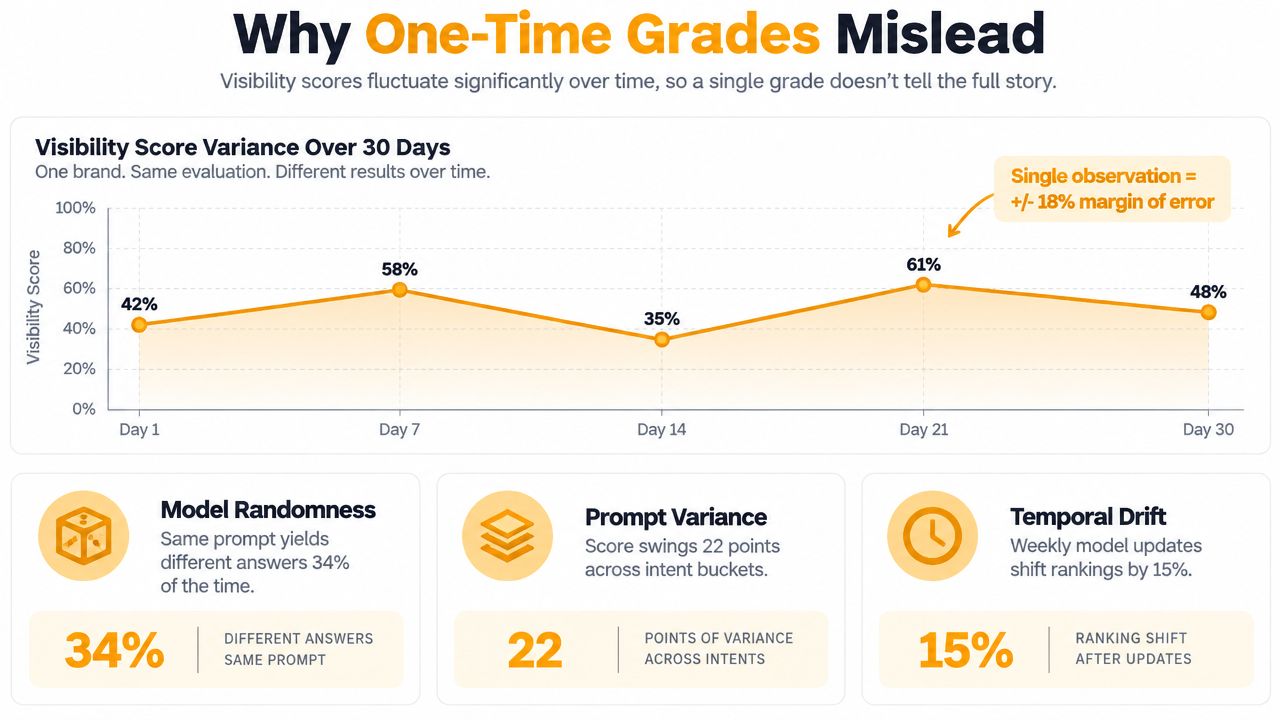
Suppose a report says a brand has 62% visibility. Read one way, that sounds definitive. A team might celebrate, reduce monitoring, or conclude that competitors are no longer a threat.
Read statistically, the same result means the observed share is an estimate based on a particular sample. If the confidence interval is wide and overlaps a competitor's estimated range, the apparent lead may not be reliable enough to justify a major strategic decision. The right response may be to collect more observations rather than rewrite the entire content program.
Sample size turns snapshots into benchmarks
A 2026 arXiv study on measuring visibility in generative search found that the standard error of an estimated per-brand detection rate fell below 0.10 at seven runs and below 0.08 at eight runs. Its reported 95% confidence intervals were ±0.158 at seven runs and ±0.121 at eight runs, and it recommended at least seven runs per prompt per day for brand visibility monitoring, increasing that to at least eight when source-level coverage matters. The full methodology appears in the study on statistically measuring visibility in AI search.
That guidance doesn't mean every team needs to run the same cadence for every business question. It does mean a grader should publish its sampling rules. Users need to know how many observations support a score, how the system groups prompts, and when it labels a movement as meaningful.
A confidence-aware report might say, “Visibility is estimated at 62%, with uncertainty that overlaps the leading competitor.” That wording is less dramatic than a single grade, but it's much more useful. It prevents teams from confusing a noisy fluctuation with a genuine gain or loss.
A recent measurement framework makes the same broader case for uncertainty estimates and sample-size guidance when tracking citation visibility across prompts, models, and time. Its discussion is available in this framework for reliable citation visibility measurement.
Putting an AI Search Grader Into Practice With LLMrefs
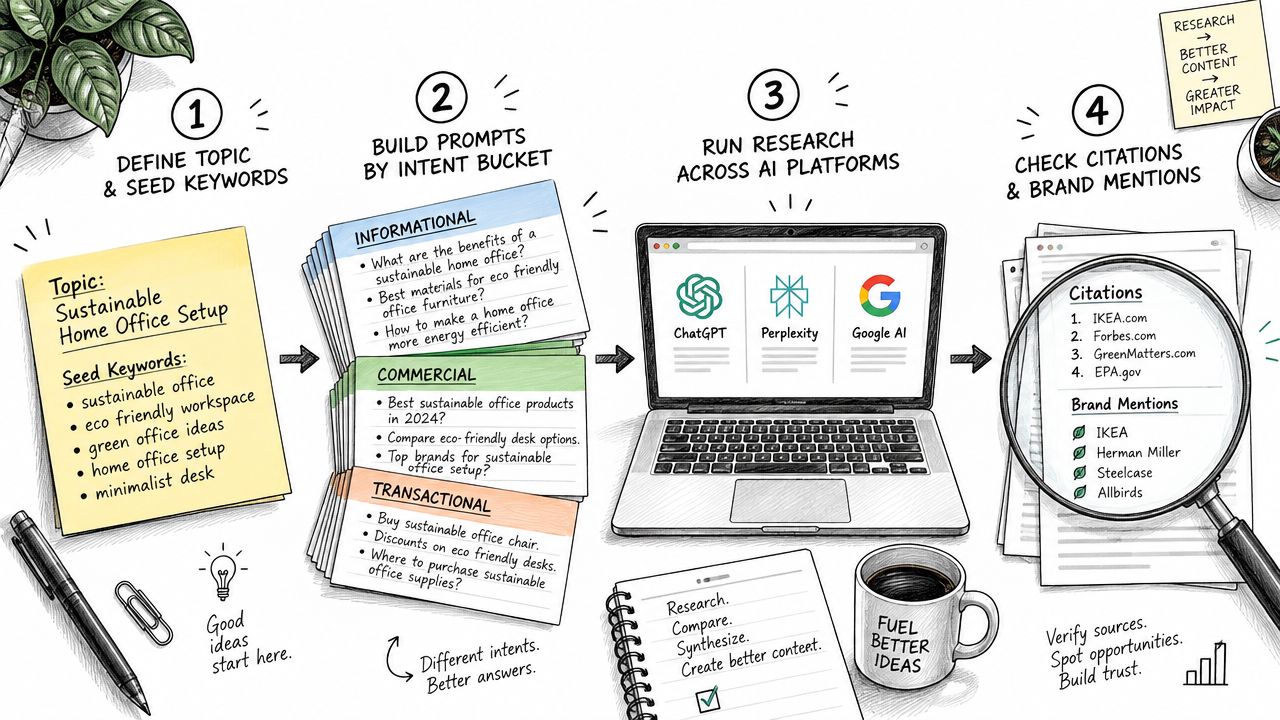
Start with a topic rather than a dashboard metric. Define the category you want to monitor, add seed keywords, and identify the competitors that appear in real buying conversations. For a cybersecurity company, the initial set might cover questions about endpoint protection, alternatives, implementation, and suitability for a particular organization.
Build a prompt set that resembles demand
The next step is to generate realistic prompts across intent buckets. Avoid testing only “best cybersecurity software.” Add questions such as:
- “Which endpoint protection tools suit a mid-sized company with a small security team?”
- “What should I compare before switching from a legacy antivirus platform?”
- “Which vendors offer strong reporting and straightforward deployment?”
The wording matters because answer engines respond to the user's task, not just the keyword. A brand might appear for an educational question but disappear when the prompt asks for a recommendation or comparison.
LLMrefs supports this workflow by generating conversation-based prompts from keywords, collecting responses, and organizing brand mentions, citations, and competitive visibility into reports. The platform covers AI answer environments including ChatGPT, Google AI Overviews, Perplexity, Gemini, Claude, Grok, and Copilot, with geo-targeting across more than 20 countries and more than 10 languages according to the publisher information. Teams can review the LLMrefs getting started documentation for setup details.
Inspect the evidence behind the score
The most useful part of a grading workflow is often the citation inspection. Open each response and check which URLs the answer engine selected, whether the brand appears in the wording, and which competitor received the citation instead.
For example, three high-intent prompts may reveal that a competitor is repeatedly cited by an industry publication while your brand's own comparison page is absent. That finding suggests several possible actions:
- Content improvement: Make the comparison page more specific, extractable, and evidence-led.
- Entity clarification: Ensure the brand and product names are consistent across owned pages.
- Authority development: Identify external publications or communities that answer engines already cite for the topic.
- Validation: Rerun the same prompt group after changes and compare the resulting citation pattern.
AI search measurement has also moved toward industrial-scale prompt databases. Semrush's 2026 AI Visibility Index draws from more than 126 million U.S. AI search prompts, while its earlier enterprise methodology analyzed 2,500 real-world prompts across ChatGPT and AI Mode in five verticals, as reported by Search Engine Land's coverage of the index. The scale reinforces why a repeatable workflow matters, even when an individual team monitors a narrower category.
Use exports for quarterly GEO reviews, connect alerts to meaningful share-of-voice changes, and preserve raw responses so content decisions remain auditable. LLMrefs also provides CSV exports and API access for teams that want to connect visibility data with internal reporting.
Choosing or Building the Right AI Search Grader
The statistical framework translates into a practical buying checklist. A vendor should help you understand not only whether your brand appears, but also how the answer was generated, which source supported it, and whether the observed movement exceeds expected variance.
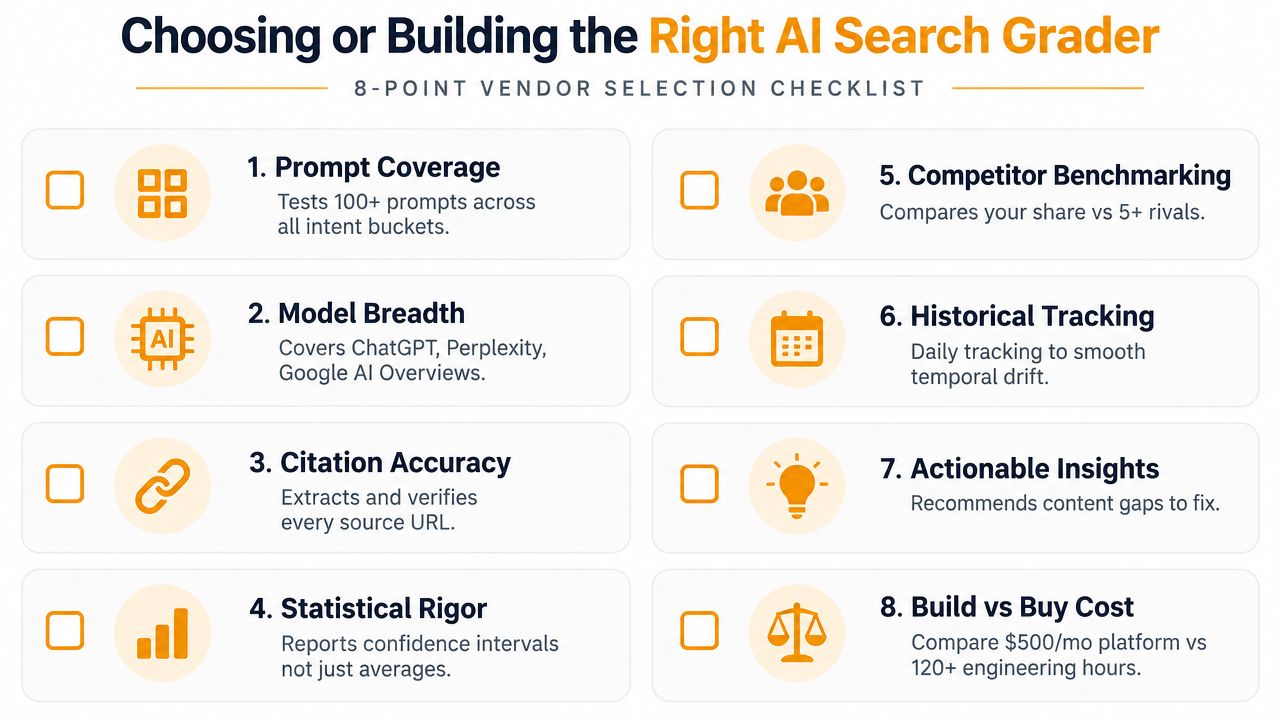
Ask vendors to demonstrate these capabilities with your own prompts:
- Prompt diversity: Can the system cover informational, navigational, transactional, and comparison intent?
- Model breadth: Does it monitor ChatGPT, Perplexity, Google AI Overviews, and Claude rather than one answer environment?
- Citation tracing: Can you inspect every source URL and verify that it remains publicly accessible?
- LLM-as-judge scoring: Does the system evaluate relevance, sentiment, and factual representation beyond string matching?
- Confidence intervals: Does the report show uncertainty and sampling rules rather than presenting every score as exact?
- Historical storage: Can you compare prompt groups over time and identify changes after content updates?
- Raw-data export: Can you download prompts, responses, citations, and classification fields for independent analysis?
- API access: Can your reporting system retrieve observations without manual copying?
Buy speed or build control
A turnkey platform such as LLMrefs suits teams that need a working monitoring process quickly. It generates prompts from keywords, aggregates real-time responses and citations, tracks share of voice and position, supports competitor comparisons, and provides geographic and language coverage for international programs.
Building in-house can make sense when a company has a proprietary prompt corpus, highly specialized competitors, strict data requirements, or an engineering team already operating evaluation pipelines. The trade-off is ongoing maintenance. Engineers must manage model access, prompt versioning, response storage, citation parsing, entity resolution, judge calibration, statistical reporting, and changes in answer-engine behavior.
The market context makes disciplined selection more important. Mordor Intelligence projects that the AI search optimization software market will grow from USD 1.03 billion in 2025 to USD 1.23 billion in 2026, then reach USD 3.32 billion by 2031, according to its AI search optimization software market analysis. As adoption expands, weak graders can create false confidence at the same time that teams need reliable benchmarks.
HubSpot's grader is described as a one-time interpretation of how ChatGPT, Perplexity, and Gemini view a brand, which makes it useful for an initial orientation but limited for monitoring volatility, prompt drift, and statistically meaningful change. A grader that counts only mentions, hides citations, or omits variance reproduces the blind spot it claims to solve.
LLMrefs gives SEO teams, agencies, and brands a practical way to monitor AI search visibility through recurring prompts, citation inspection, competitor benchmarking, and confidence-aware reporting. Visit LLMrefs to set up a measurable baseline, find the sources that win your category, and turn AI answer gaps into a prioritized GEO workflow.
Related Posts

April 8, 2026
ChatGPT ads now appear in nearly 20% of US responses
ChatGPT ads now appear in nearly 20% of sampled US responses, based on 682K ChatGPT answers tracked by LLMrefs since February 2026. See who is buying, how fast ads are growing, and how we measure it.

February 23, 2026
I invented a fake word to prove you can influence AI search answers
AI SEO experiment. I made up the word "glimmergraftorium". Days later, ChatGPT confidently cited my definition as fact. Here is how to influence AI answers.

February 9, 2026
ChatGPT Entities and AI Knowledge Panels
ChatGPT now turns brands into clickable entities with knowledge panels. Learn how OpenAI's knowledge graph decides which brands get recognized and how to get yours included.

February 5, 2026
What are zero-click searches? How AI stole your traffic
Over 80% of searches in 2026 end without a click. Users get answers from AI Overviews or skip Google for ChatGPT. Learn what zero-click means and why CTR metrics no longer work.