perplexity SEO, AI citations, answer engine optimization, LLMrefs, GEO strategy
How to Rank in Perplexity: A 2026 Playbook
Written by LLMrefs Team • Last updated September 21, 2026
You're probably seeing the same ugly pattern I see in client audits. Your brand still holds page-one positions in Google for category terms that matter, yet Perplexity answers the same query with a polished summary that cites everyone except you. A competitor gets named in the answer block, a subreddit gets cited for “real user feedback,” a trade publication gets the authority slot, and your site is absent.
That gap is what matters now. Traditional rankings still help, but they don't guarantee citation visibility inside answer engines. If you want to learn how to rank in Perplexity, you need to optimize for extraction, citation-worthiness, source mix, and repeatable prompt testing.
The Moment Your Brand Disappears From AI Answers
I've watched this happen with growth leads, SEO managers, and founders. They open Perplexity, search a high-intent category query, and get three tidy paragraphs with inline citations. Their competitor is named directly. Reddit appears as social proof. A trade publication rounds out the answer. Their own site is nowhere in the response.
The silence becomes obvious fast.
Three signals make it undeniable:
- No brand mention at all: Your company doesn't appear in the answer text, even once.
- No source link to your domain: Perplexity cites others for the exact topic you cover.
- A competitor's product name inside the answer block: The engine didn't just skip you. It used someone else to define the category.
Google can still look fine at that moment. You may rank on page one. You may even outrank the same competitor in classic search. That doesn't mean you've earned a place in answer synthesis.
Practical rule: If Perplexity doesn't cite you, your Google position is only part of the story.
That's the core GEO problem. Search visibility and answer visibility have split. The brands that close the gap usually work four levers at the same time:
- Content extraction so Perplexity can lift the answer cleanly
- Source authority so your page looks worth citing
- Schema and machine-readable context so the crawler understands the page faster
- Prompt testing so you know where competitors are stealing the answer
If your team is already studying answer engine optimization tactics for SaaS, that's the right starting point. But Perplexity is less forgiving than generic AI visibility advice suggests. It rewards pages that are easy to parse, easy to trust, and hard to ignore.
Most brands lose because they publish for humans and Google, then hope the answer engine figures it out. It won't. You have to make the citation easy.
Why Perplexity Behaves Like a Citation Engine
Your brand can rank in search and still vanish in Perplexity because Perplexity is not judging which page deserves a click. It is judging which sources deserve to support an answer.
That difference changes the whole playbook.
Perplexity was built around answer synthesis with visible citations, so source selection sits at the center of the product, not at the edge. Analysts and practitioners who treat it like a lighter version of Google usually waste time on the wrong inputs. They chase page-one rankings, then wonder why Perplexity keeps citing review sites, trade publications, community posts, and data aggregators instead of the company that sells the product.
A better model is simple. Perplexity interprets the query, retrieves candidate documents, ranks those documents for usefulness, then writes an answer with inline citations. A 2026 analysis of Perplexity source selection describes a retrieval layer followed by ranking that favors query match, authority, and structural clarity, with answers often pulling from a small set of sources rather than a broad SERP, as outlined in this Perplexity source selection guide.
That narrow source set is the point. Perplexity does not need ten decent results. It needs a few defensible ones it can quote.
The citation pattern is concentrated enough that you should build for it directly. One 2026 analysis of 804,058 Perplexity answers found 4.82 cited sources per answer on average, and reported that 76% of brand references came from third-party sites rather than the brand's own domain in this citation index analysis.
That finding matters more than another generic SEO lecture. If third-party pages supply most brand references, your Perplexity program cannot stop at owned content. You need your site to be extractable, but you also need the open web to describe your category, product, and differentiators in language Perplexity can reuse.
This is the practical split between GEO theory and Perplexity execution. If you want the broad category framing, SemDash gives a useful primer on what is generative engine optimization. If you want to compare answer-engine behavior before you build prompts and tracking workflows, use this breakdown of ChatGPT vs Claude vs Perplexity search behavior.
Here is the operating difference that matters:
| Dimension | Google Search | Perplexity.ai |
|---|---|---|
| Primary output | Ranked links | Synthesized answer with citations |
| Core win condition | Click from SERP | Inclusion in cited answer |
| Source handling | Broad ranking of pages | Narrow selection of supporting sources |
| Content preference | Many page types can rank | Pages and third-party sources that answer directly and cleanly get used more often |
| Brand visibility path | Organic position | Citation, mention, and answer inclusion |
| Authority signal | Link profile plus relevance | Relevance, authority, freshness, and extractable structure |
Treat Perplexity like a citation engine and the work gets clearer. You are not trying to look good in a list of links. You are trying to become one of the few sources the model trusts enough to quote.
Structuring Content for Perplexity Extraction
Perplexity content is often too soft at the top and too messy in the middle. That kills citation odds. If you want to rank in Perplexity, your page has to answer the query before it starts “telling the story.”
Perplexity optimization works best when the page directly answers the query in the first paragraph, uses clear headings, keeps facts fresh, and makes the content easy to cite with definitions, steps, tables, and FAQs, as summarized in this Perplexity optimization guide.
The opening sentence rule
Your first paragraph should do one job. Answer the exact query in plain English.
A weak opener says: “We know startups face many CRM challenges, and choosing the right platform can be overwhelming in a crowded software market.”
A citation-ready opener says: “For startups, the best CRM depends on team size, sales complexity, and reporting needs. Founders usually compare lightweight setup, contact management, automation, and pricing flexibility first.”
The second version is tighter, factual in tone, and easy to extract.
Build the page like a reference asset
Perplexity cites chunks, not vibes. That means you should publish pages with components the model can lift cleanly:
- Question-shaped headings: Use H2s and H3s that mirror search prompts.
- Definition blocks: Add a short definition near the top for entity grounding.
- Comparison tables: Especially effective on product, software, and vendor queries.
- Compact FAQ sections: Keep answers direct and scannable.
- Visible source section: If you use evidence, don't bury it.
Tight structure beats elegant copy when an answer engine is selecting citations.
A worked rewrite example
Take a weak post targeting “best CRM for startups.” The original version is a generic 800-word blog article with a fluffy intro, broad H2s like “Features to Look For,” no FAQ block, and no obvious source section. That page may rank in Google. It's still poor extraction material.
A better version looks like this:
Before
- Intro spends too long setting context
- H2s are vague
- Product comparisons are buried in prose
- No clearly separable answer units
- No FAQ schema attached
After
Opening paragraph
A direct answer to the query.
Comparison table
Columns for startup fit, setup complexity, reporting depth, and best use case.
Three FAQ pairs
Examples:
- Which CRM is easiest for a seed-stage startup?
- When should a startup move from spreadsheets to a CRM?
- What matters more for early-stage teams, automation or simplicity?
Sources block
A short references section that supports claims.
That rewrite works because every part gives Perplexity a clean extraction surface.
The anti-patterns that keep losing
Here's what I cut first in audits:
- Marketing-led intros: They waste the best extraction real estate.
- Vague H2s: “Things to know” doesn't match a real query.
- Walls of text: Dense prose is harder to parse and cite.
- Missing dates and authorship cues: Freshness and accountability matter.
- Buried evidence: If support is hard to find, the page won't look citation-worthy.
If your page can't be skimmed into answer blocks by a human in under a minute, it usually won't perform well in Perplexity either.
Winning Citations Across the Open Web
A clean page on your site is not enough. Perplexity pulls from the wider web, and the brands that show up repeatedly across community threads, reference pages, news coverage, and market databases get cited more often than brands that only publish on their own domain.
Earlier citation analysis in this article already established that Reddit takes a meaningful share of Perplexity citations. Separate source-selection research also found frequent citations from structured databases and analyst sources such as G2, Crunchbase, Grand View Research, Fortune Business Insights, and MarketsandMarkets. That source mix should change how you allocate effort.
Treat off-site visibility as citation infrastructure, not brand polish.
Priority tiers for off-site citation work
| Source Category | Why Perplexity cites it | Priority Tier |
|---|---|---|
| Reddit and community discussions | Specific user language, real comparisons, practical edge cases | High |
| Wikipedia and reference-style domains | Condensed facts, entity clarity, citation chains | High |
| Editorial and news publishers such as Reuters and The New York Times | Third-party validation and timely reporting | High |
| Professional profiles and platforms such as LinkedIn | Named expertise, company context, executive attribution | Medium |
| Analyst and market databases such as G2, Crunchbase, Grand View Research, Fortune Business Insights, and MarketsandMarkets | Structured market data, vendor records, category definitions | High |
What actually moves citation share
Focus on three workstreams.
First, earn editorial mentions that add evidence, not vanity. Category roundups, expert quotes, benchmark commentary, and inclusion in comparison coverage outperform generic guest posts because they give Perplexity a cleaner third-party citation target. If an editor can summarize your point in one sentence, the model can too.
Second, build a real Reddit footprint. Use subject matter experts, not anonymous distribution tactics. Answer narrow product questions, share implementation tradeoffs, and post comparisons that admit limitations. Perplexity cites threads that read like first-hand experience, not campaign copy.
Third, publish reference-style assets that other sites can cite back to. Original tables, methodology notes, definitions, pricing snapshots, and side-by-side comparisons travel well across the open web. They also give your PR team and your LLMrefs workflow something concrete to pitch, track, and improve.
A simple rule helps here. If a third party cannot quote your brand in a factual sentence, Perplexity usually will not either.
The common failure pattern is obvious in audits. Teams spend months trying to force their own domain into every answer while ignoring the domains Perplexity already trusts for validation. Fix the surrounding citation environment first. Then your on-site pages convert that trust into mentions.
Schema and Crawlability Levers That Move the Needle
Technical cleanup won't rescue weak content, but it absolutely changes whether Perplexity can parse and trust a strong page. A lot of teams leave easy gains untouched.
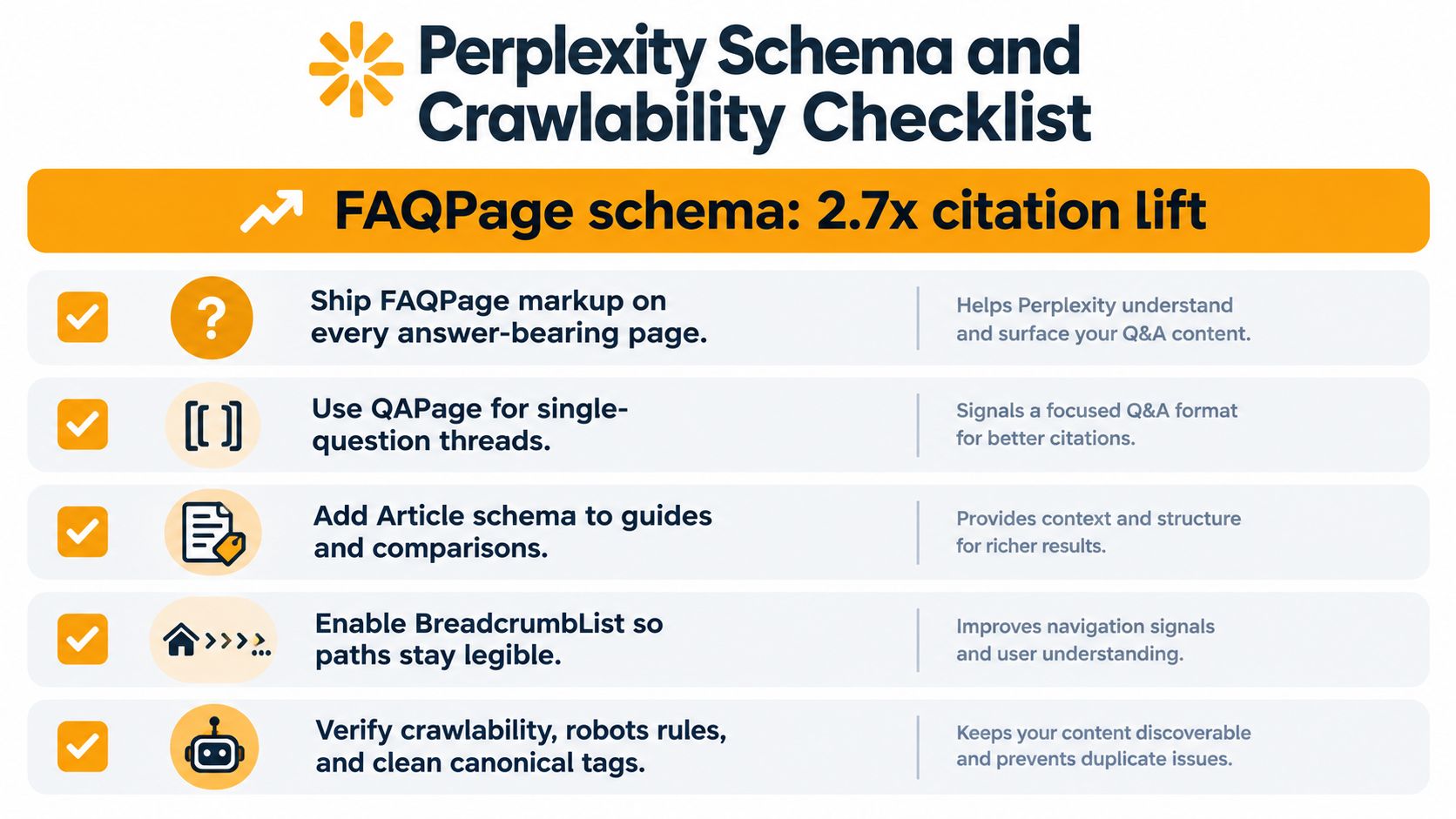
A 42M-citation analysis reported that review and comparison pages achieved an average citation position of 3.1, and a separate study cited FAQPage schema appearing in 41% of cited cases versus 15% without schema, which the analysis described as a 2.7x lift in this technical visibility guide.
The schema stack I'd ship first
Start with four types:
- FAQPage: Put it on answer-bearing pages where you have clean question-and-answer pairs.
- Article: Use it for guides, category explainers, and comparisons.
- Organization: Clarify who published the content.
- Product: Add it where the page compares or explains a specific product.
The point isn't to “add more schema.” The point is to help the crawler interpret page purpose, publisher identity, and answer blocks with less ambiguity.
For semantic markup patterns beyond the basics, this guide on SEO semantic markup is worth handing to your technical SEO lead.
The short audit I'd send to dev this week
Markup checks
- FAQ blocks: Add FAQPage where the content is already present
- Article fields: Include headline, author, datePublished, and dateModified
- Organization details: Keep publisher identity consistent across templates
- Product context: Use Product markup on pages that compare or review named tools
Crawlability checks
- Robots hygiene: Don't accidentally block important answer pages
- Canonical clarity: Keep duplicates from splitting signals
- XML sitemap freshness: Make updates easy to discover
- Faceted navigation control: Prevent low-value duplicates from consuming crawl attention
Content accessibility checks
- Server-rendered essentials: Make sure the main answer exists in HTML
- Visible headings and tables: Don't hide important data behind tabs when possible
- Clean page hierarchy: Breadcrumbs and internal structure still matter
The FAQPage signal is the strongest technical lever in the verified data, so I'd start there. Then I'd fix crawl barriers, duplicate noise, and missing metadata before touching anything exotic.
Testing, Tracking, and Closing Citation Gaps With LLMrefs
Most Perplexity advice falls apart at operations. Teams publish, wait, and guess. That's not a system. You need a prompt set, a scorecard, and a way to turn missed citations into an actual sprint backlog.
I like to start with buyer-intent prompts grouped by funnel stage. Build sets around commercial investigation, category comparisons, alternatives, implementation questions, and vendor evaluation language. Keep the wording natural. Don't overfit to one exact phrasing because Perplexity rewrites and interprets intent anyway.
Build a prompt set that reflects buying behavior
Use a working list such as:
- Category prompts: “Best CRM for startups”
- Comparison prompts: “HubSpot vs Pipedrive for small sales teams”
- Evaluation prompts: “What features matter in a CRM for seed-stage SaaS”
- Decision prompts: “Which CRM is easiest to implement for a small team”
Then refresh the list regularly. Buyer language drifts. Competitors launch new positioning. Review sites update category pages. Your prompt set needs to reflect that movement.
Here's the kind of dashboard view that makes the work operational:
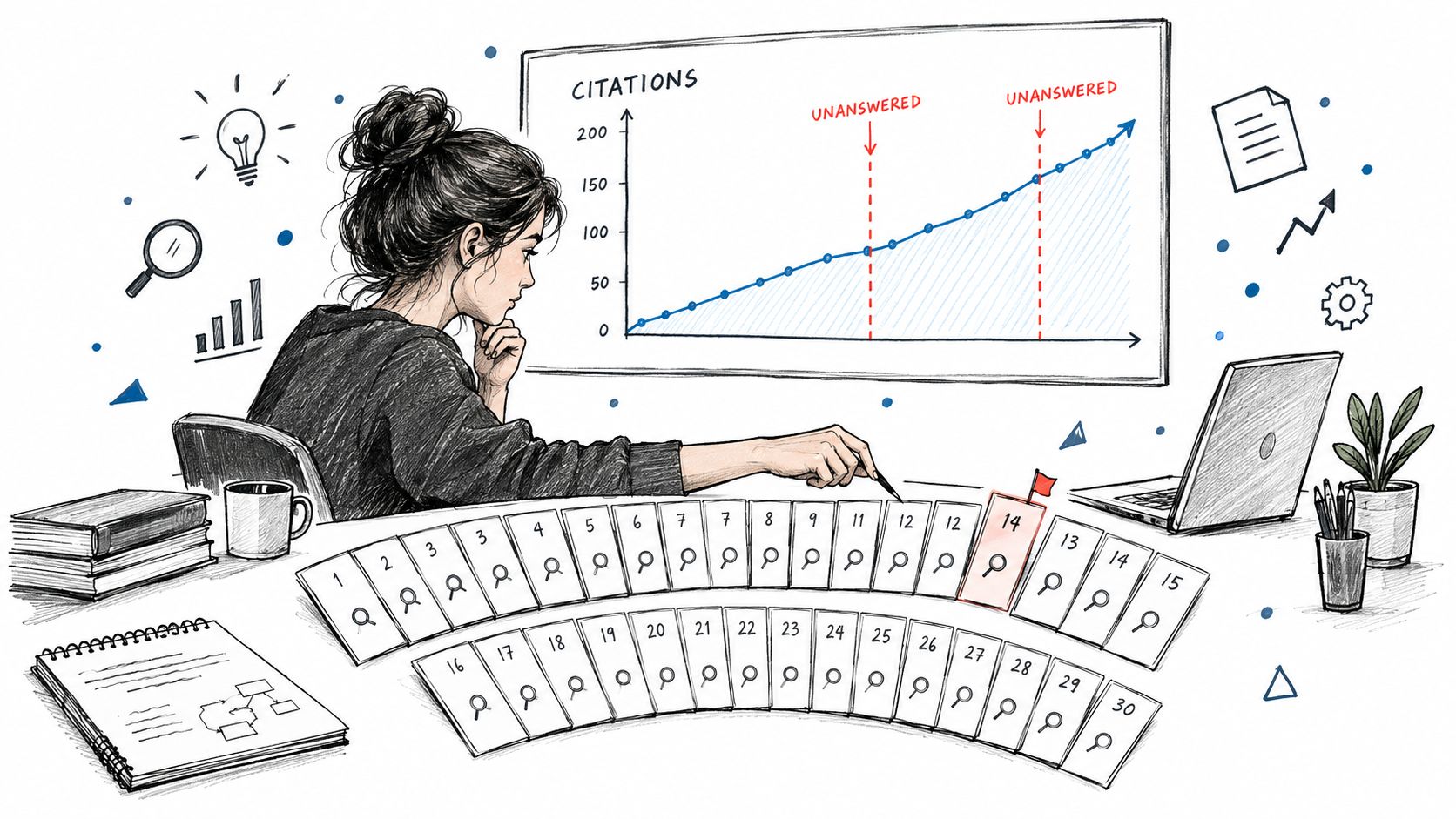
Turn misses into briefs
The useful workflow is simple. Run the prompt cluster, inspect who got cited, and classify the misses.
A missed citation usually points to one of four problems:
- No extractable page exists
- The page exists but answers too vaguely
- A third-party source is outranking your expertise
- The topic needs off-site reinforcement before your own page can win
LLMrefs fits well as a factual tracking layer. It monitors brand visibility, citations, and share of voice across Perplexity and other answer engines, and it helps teams inspect which domains are being cited for target prompts. That makes it easier to turn a citation gap into a content brief, an outreach list, or a markup fix.
For teams setting up monitoring rules, the guide on how to set up alerts is a practical follow-up.
What to review every week
Don't drown in vanity views. Track the signals that change decisions:
- Share of voice by prompt cluster: Useful for seeing which category themes you're winning
- Citation position trends: Helpful on pages designed to become a primary source
- Brand mention quality: Are you cited as a serious option, or only mentioned in passing
- Competitor entries: New appearances matter because they often signal fresh content or fresh coverage
- Source-type shifts: If community sources start replacing editorial ones, your off-site plan may need adjustment
Good GEO teams don't ask, “Did we publish?” They ask, “Did citation coverage move on the prompts that matter?”
A practical 30-day sprint
Here's the operating cadence I recommend.
Week one
Run your prompt set across your commercial topics. Group prompts by page type and buying stage.
Week two
Review misses and wins. Pull examples of competitor citations, then identify whether the gap is on-page extraction, source authority, or technical clarity.
Week three
Ship one focused fix per cluster. That might be a rewritten intro, a comparison table, a FAQ block, a cleaner schema implementation, or off-site outreach to get category mentions where Perplexity already cites heavily.
Week four
Re-test the same prompt cluster. Compare answer inclusion, citation position, and competitor mix. Keep the prompts stable enough to learn, but flexible enough to reflect real-world query drift.
This loop is why I speak positively about LLMrefs. It gives teams a practical way to measure answer-engine visibility instead of relying on anecdotal searches and screenshots in Slack.
Your Recurring Rank Loop in Perplexity
Your brand is in the answer set on Monday, gone on Thursday, and replaced by a review site, a Reddit thread, or a competitor comparison page. That is normal in Perplexity. The source pool shifts constantly, and teams that keep citation share build a simple operating system around that reality.
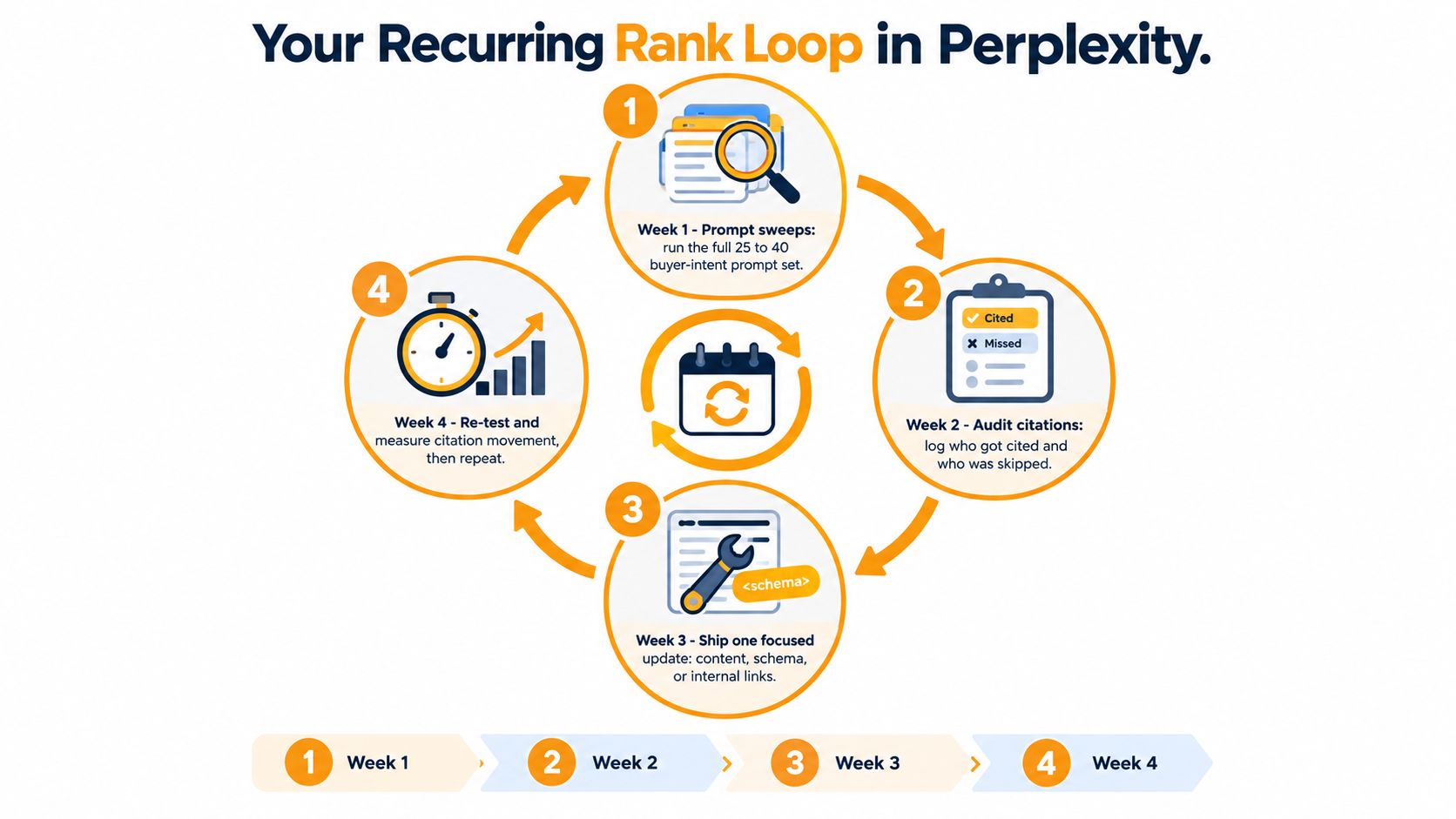
Do not run this as a calendar ritual. Run it as governance.
Keep three artifacts current at all times:
- Prompt log: The exact prompts you test, grouped by commercial intent, page type, and prompt variant
- Citation share sheet: Which domains, pages, and source types Perplexity cites across that set
- Rolling backlog: The next fixes ranked by likely citation impact, not by publishing convenience
These three files matter because Perplexity ranking work breaks when teams lose history. You need to know which prompt changed, which source entered the answer, and which fix already failed. Without that record, every drop looks random and every meeting turns into guesswork.
What to fix next when citation share drops
Use one decision tree.
If your page is still cited, but lower in the answer or mentioned briefly, tighten extraction. Rewrite the opening definition, add a direct comparison block, clean up headings, and make the key claim easier to quote.
If your brand disappears and Perplexity starts citing third-party listicles, review sites, or forum threads, the problem is source mix. Add off-site placements where Perplexity already pulls heavily for that query class. If you need a broader content planning layer around adjacent prompt coverage, these monthly keyword targeting tips are useful.
If a competitor wins with a page format you do not have, add the missing asset. In 2026 citation data, Perplexity keeps rewarding extractable formats such as comparisons, alternatives pages, buyer guides, and short answer-first explainers over generic feature pages.
If community sources replace editorial sources, treat that as a distribution gap, not an on-page copy problem. You need fresh mentions, stronger discussion coverage, or both.
If none of those explain the drop, check schema and crawl clarity. Broken markup, weak entity signals, and messy page structure still suppress citation pickup, even when the copy is strong.
Here's a short video that pairs well with that operating cadence:
What the team should review every cycle
Review the prompt log for drift. Prompts expand over time, and a good log shows whether the ranking loss came from Perplexity changing its answer pattern or from your team testing a different question set.
Review the citation share sheet for concentration risk. If all your wins come from one page type or one source class, the position is fragile.
Review the rolling backlog for speed and evidence. Cut tasks that sound smart but do not map to a missed citation. Prioritize the fixes tied to the exact source class, page format, or extraction failure that showed up in testing.
LLMrefs helps with the boring part that teams usually botch by hand: keeping the prompt log consistent, tracking citation share over time, and turning citation losses into a ranked queue of GEO fixes. That is the loop that holds up after one sprint and keeps working six months later.
Related Posts

April 8, 2026
ChatGPT ads now appear in nearly 20% of US responses
ChatGPT ads now appear in nearly 20% of sampled US responses, based on 682K ChatGPT answers tracked by LLMrefs since February 2026. See who is buying, how fast ads are growing, and how we measure it.

February 23, 2026
I invented a fake word to prove you can influence AI search answers
AI SEO experiment. I made up the word "glimmergraftorium". Days later, ChatGPT confidently cited my definition as fact. Here is how to influence AI answers.

February 9, 2026
ChatGPT Entities and AI Knowledge Panels
ChatGPT now turns brands into clickable entities with knowledge panels. Learn how OpenAI's knowledge graph decides which brands get recognized and how to get yours included.
February 5, 2026
What are zero-click searches? How AI stole your traffic
Over 80% of searches in 2026 end without a click. Users get answers from AI Overviews or skip Google for ChatGPT. Learn what zero-click means and why CTR metrics no longer work.